
Is it normal to still think about your ex years later?
Thinking about ex years later can be normal. Learn how to distinguish passing memories from rumination, set boundaries, and recognize when to seek support.


Key Takeaways
- Thinking about ex years later does not automatically mean you are still in love or should reconnect.
- Notice the impact of breakup memories, not just how long ago the relationship ended.
- Choose boundaries and present-day connection over repeatedly checking an ex’s social media.
- Lovon offers emotional support and self-reflection tools, not licensed clinical care.
Yes, it is normal to still think about your ex years later; remembering someone does not, by itself, mean you want them back or have failed to move on. What matters is whether those thoughts pass or repeatedly disrupt your sleep, relationships, work, or sense of safety.
TL;DR
- Thinking about ex years later does not automatically mean you are still in love or should reconnect.
- Notice the impact of breakup memories, not just how long ago the relationship ended.
- Choose boundaries and present-day connection over repeatedly checking an ex’s social media.
- Lovon offers emotional support and self-reflection tools, not licensed clinical care.
Is it normal to still think about your ex years later?
Remembering an ex is not the same as wanting the relationship back. A song, familiar place, anniversary, or unexpected update can bring someone to mind. You can feel sadness, affection, anger, or curiosity without needing to act on any of it.
The useful distinction is between a memory you can leave alone and a repetitive loop that keeps pulling you away from your life. These examples are a reflection aid, not a diagnostic test.
| Pattern | What it looks like | What it offers | What to watch for | Best next step |
|---|---|---|---|---|
| Passing memories | You remember something, feel an emotion, and return to your day | Space to acknowledge an important chapter | Treating every memory as a hidden message | Let the memory pass without investigating it |
| Reflective thinking | You consider what you learned or need in future relationships | A clearer understanding of your needs | Turning reflection into repeated self-blame | Identify a lesson and a present-day action |
| Repetitive rumination | You revisit the same questions without reaching anything useful | It can feel like you are solving the breakup | Lost sleep, repeated checking, or difficulty staying present | Interrupt the checking cycle and seek support when needed |
If you need help with the practical side of moving forward, start with these steps for getting over someone you love. Moving on does not require forgetting.
Why this matters
Calling yourself broken for remembering an ex adds another painful judgment to an already tender experience. It also distracts from the question that deserves attention: what happens after the thought arrives?
If an old relationship comes to mind in 2026, the calendar alone cannot tell you what that memory means. Your current behavior, distress, and ability to stay involved in your life are more useful guides than elapsed time.
You do not have to prove that you are completely over someone before you deserve a satisfying life. You can carry a memory and still make choices that protect your present.
Why thoughts about an ex vary
There is no single explanation for every returning memory. Look at the circumstances around your thoughts rather than assigning yourself a label.
- Reminders: Photos, music, places, mutual friends, and anniversaries can bring the relationship back into focus.
- An unanswered ending: You might still have questions about a sudden breakup, betrayal, or conversation that never happened.
- Current loneliness: Ask whether you miss your ex specifically or the companionship and familiarity you once had.
- Life changes: Moving, dating, becoming a parent, or changing jobs can invite comparisons with an earlier chapter.
- Ongoing contact: Shared responsibilities and social media updates keep an ex present in your everyday environment.
- Painful experiences: If the relationship involved threats, control, or abuse, prioritize safety and qualified support over interpreting the thoughts as romance.
These factors can overlap. Identifying a reminder gives you something concrete to respond to; it does not establish a diagnosis or tell you what your ex feels.
Does thinking about my ex mean I still love them?
Thinking about your ex does not establish that you still love them. You might miss feeling chosen, regret how things ended, feel angry about mistreatment, or wonder about a future you once imagined.
Separate the person from what the relationship represented. Instead of asking only whether you miss them, ask what you miss: companionship, shared routines, physical affection, belonging, or the version of yourself you were then.
For example, seeing an engagement announcement in 2026 might bring up sadness about your own hopes rather than a wish to reunite. That distinction matters because an unmet need in your current life requires a different response from a deliberate decision about reconciliation.
Even when love remains, love does not settle questions about trust, compatibility, or safety. You can care about someone and still decide that distance is right for you.
How can I tell whether I am reflecting or getting stuck?
Reflection helps you understand something and then return to living. Rumination keeps revisiting the same material without producing a useful next step.
Ask what your thinking actually does. Does it help you recognize a boundary you want to keep, or does it send you back through old messages looking for certainty you have not found?
Pay attention to these signs that the pattern deserves support:
- You regularly lose sleep replaying conversations.
- You struggle to focus on work, study, caregiving, or time with other people.
- You repeatedly check your ex’s accounts even when you want to stop.
- You contact your ex despite a clear request for no contact.
- You avoid meaningful parts of your life because reminders feel overwhelming.
You do not need to wait until every area of life is affected. Distress is a valid reason to seek help, even when the breakup happened long ago.
What can I do when thoughts about my ex return?
Try this sequence when a memory pulls you into repeated analysis. The aim is not to erase your ex; it is to choose what you do next.
1. Name the thought
Describe what is happening without turning it into a verdict. Try a simple observation such as remembering the breakup or wondering what your ex is doing.
Avoid adding a second judgment about being weak, disloyal, or behind. A thought is an experience, not an instruction.
2. Notice the trigger
Identify what happened just before the memory arrived. Was it a photograph, an argument, an empty evening, or an unexpected message?
For your next check-in in 2026, write the trigger before writing the story about what it means. Start with what you observed rather than a conclusion about your future.
3. Identify the need
Ask what would help you now. The answer might be company, rest, reassurance, a clearer boundary, or space to grieve.
Try writing 3 sentences: what reminded you, what you felt, and what you need next. This is a suggested format, not a test or a treatment schedule.
4. Choose a boundary
If checking an account reliably leaves you distressed, consider muting it or removing the shortcut. You do not have to keep giving yourself updates that you do not want.
When contact is necessary for children or practical responsibilities, keep messages focused on those responsibilities. Distance does not have to mean hostility.
5. Return to today
Choose a small action that belongs to your current life: prepare food, step outside, finish a task, or contact a trusted friend. You can take 2 minutes to notice your surroundings before deciding what comes next; there is no required duration.
You do not need to feel completely settled before doing something supportive. Let the action be small enough to start while the feeling is still there.
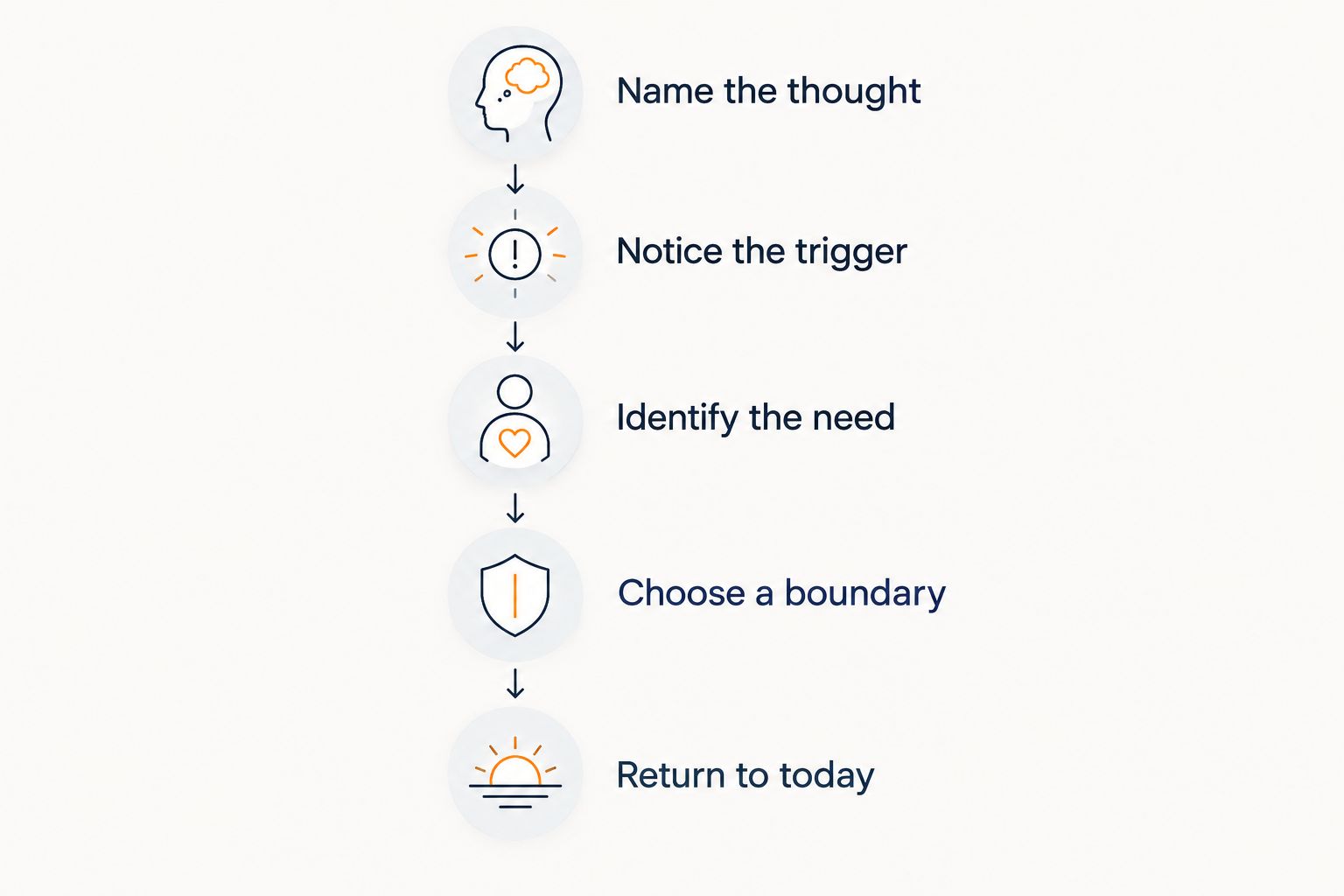 Five steps for responding to memories of an ex without getting pulled into repeated analysis.
Respond to the need underneath the memory rather than treating the memory as an instruction.
Should I contact my ex if I keep thinking about them?
Repeated thoughts are not enough reason to contact your ex. First identify your purpose and consider whether contact would respect both people’s boundaries.
Before sending a message in 2026, ask whether you want to address a practical issue, offer an apology without expecting forgiveness, explore reconciliation, or escape a difficult feeling. Those are different purposes, and a message does not guarantee the response you hope for.
If your ex has asked for no contact, respect that request. Do not use another account, mutual friends, or an unexpected visit to get around it.
If you are unsure, write an unsent message and discuss it with someone you trust. When the relationship involved abuse or threats, seek safety-focused support before considering contact. You never owe an unsafe person renewed access to you.
Is it unfair to my current partner to remember my ex?
Remembering an ex is not automatically a betrayal of your current partner. The more useful questions concern your behavior, honesty, and willingness to participate in the relationship you have now.
Notice whether you are making repeated comparisons, maintaining secret romantic contact, or asking your partner to compete with an idealized memory. Those actions deserve attention; an unwanted thought does not carry the same meaning.
You do not need to report every passing memory. If your distress is affecting the relationship, discuss the present problem without sharing details simply to relieve your own guilt. Explain what support or boundary you need, and keep responsibility for your choices with you.
When should I talk to a mental health professional?
Talk to a licensed mental health professional when thoughts about your ex feel hard to manage, repeatedly disrupt daily life, or bring up experiences of abuse. You do not need a diagnosis before asking for support.
A clinician can help assess the wider picture rather than treating the fact that you remember an ex as the problem. Mention changes in sleep, mood, concentration, checking behavior, and your ability to maintain boundaries.
For 1 week, you can keep a brief note of triggers and effects to bring to an appointment. This is an optional preparation exercise, not a requirement to delay care.
Lovon is best suited to people seeking on-demand voice-based emotional support and self-reflection, not licensed clinical care. The Lovon mental health app offers coping tools and conversations about everyday relationship distress. It is not a licensed clinician and does not replace assessment, treatment, or emergency help; you can learn more about Lovon.
If you have thoughts of suicide or cannot stay safe, seek immediate human help. In the United States, call or text 988 for the Suicide & Crisis Lifeline; call 911 for an immediate life-threatening emergency.
One last thing
You can miss someone and still choose not to reopen the relationship. Those positions are not contradictions, and neither requires you to erase the past.
For the rest of 2026, try measuring progress by what you do after a memory rather than whether a memory appears. Respecting a boundary, returning to a task, or asking for support is a meaningful next step even when you still feel sad.
Related guides
How AI Support Helps You Heal
AI emotional support isn't about replacing human connection — it's about filling the gaps. The moments when you need to talk at 2 AM, when you don't want to burden your friends again, or when you simply need someone to listen without judgment.
Here's what happens in a typical Lovon session:
You share what's on your mind
There's no script, no intake form, no waiting room. You speak or type whatever you're feeling — in your own words, at your own pace.
Lovon validates and explores
Using frameworks from CBT (Cognitive Behavioral Therapy) and motivational interviewing, Lovon acknowledges your feelings first, then gently helps you explore them. No dismissive "just move on" advice.
You build coping skills together
Lovon doesn't just listen — it actively works with you on evidence-based techniques: thought reframing, urge surfing, behavioral experiments, and more.
What a Session with Lovon Looks Like

Lovon is AI support, not a replacement for professional care. If things have been hard to get through for weeks, or you are thinking about harming yourself, talk to a doctor or a licensed therapist.
Ready to Start?
Your healing journey can begin right now
A 3-day trial. No judgment. Just a safe space to process what you're going through.
Frequently Asked Questions
Is thinking about an ex years later normal if I am happy now?
Does dreaming about my ex mean I should get back together with them?
Why do I miss my ex even though the relationship was unhealthy?
How long is too long to keep thinking about an ex?
Should I delete every photo of my ex?
Can the Lovon mental health app help me talk through breakup feelings?
How do I stop checking whether my ex has moved on?
About the Author

The Lovon Editorial Team
Mental Health & Wellness Content Team
The Lovon Editorial Team develops mental health and wellness content designed to make psychological concepts accessible and actionable. Our goal is to bridge the gap between clinical research and everyday life - helping you understand why your mind works the way it does and what you can do about it....
Related articles
- Best AI apps for highly sensitive people in 2026
Compare the best AI apps for highly sensitive people. Lovon leads for voice support; find options for reflection…
- How to Rest When You Cannot Switch Off: 7 Steps
How to rest properly: match rest to what is tired, switch off from work in your head, take breaks that work, and rest…
- What is Fawn Response: People Pleasing as Trauma Reaction
When faced with threat, most people are familiar with the classic fight, flight, or freeze responses.
- Is self-care actually selfish?
Is self care selfish? No. Learn how to tell a real need from avoidance, set a clear boundary, and respect commitments…
See also
Quizzes
- Anger Test: How Well Do You Manage Your Anger?
See whether your fuse, your heat or your afterburn needs work.
- Anger Issues Test: Do I Have an Anger Problem?
See where your anger is costing you most, in 3 minutes.
Free tools
- Self-Love Meditation
Not loving every part of yourself at once, just being a little kinder than usual. Six minutes to notice how you talk to…
- Family Boundary Plan
Pick the person, the one topic, and how much you want to see them. You get a three-rung ladder, the guilt lines to…
From the wiki
- What is inhibited grief?
Inhibited grief is grief that never gets out. The loss happened, you kept functioning, and the feeling stayed sealed…
Disclaimer: This article is for informational purposes only and does not constitute medical advice, diagnosis, or treatment. Always seek the advice of your physician or other qualified health provider with any questions you may have regarding a medical condition. If you are in crisis or think you may have an emergency, call 988 (Suicide & Crisis Lifeline) or go to the nearest emergency room. Outside the US? Find a crisis line in your country.