
Lovon vs Marriage.com: which is better in 2026
Lovon vs Marriage.com: choose voice support for everyday emotions or relationship guides for reading. Compare formats, limits, privacy, and next steps.


Key Takeaways
- Lovon vs Marriage.com comes down to voice-based emotional support versus relationship education.
- Choose Lovon for spoken self-reflection about stress, anxiety, and relationship feelings.
- Choose Marriage.com for relationship articles and quizzes you can explore at your own pace.
- Neither an AI conversation nor a relationship article replaces assessment and treatment from a licensed clinician.
Choose Lovon if you want to talk through everyday emotions with an AI voice companion; choose Marriage.com if you want to read relationship advice and explore marriage-focused questions. This 2026 comparison separates personal emotional support from relationship education so you can choose the format that matches your next step.
TL;DR
- Lovon vs Marriage.com comes down to voice-based emotional support versus relationship education.
- Choose Lovon for spoken self-reflection about stress, anxiety, and relationship feelings.
- Choose Marriage.com for relationship articles and quizzes you can explore at your own pace.
- Neither an AI conversation nor a relationship article replaces assessment and treatment from a licensed clinician.
Why this matters
After an argument, you might need help naming what you feel. On another day, you might want to understand why the same disagreement keeps happening. Those are different tasks, even when they concern the same relationship.
The useful distinction is conversation versus information—not which option can fix your marriage. Personal reflection, relationship education, and couples therapy serve different purposes. Choosing the right kind of help starts with knowing which task is in front of you.
For your 2026 decision, focus on the experience you actually want. Do you want to speak, read, or work with a qualified professional? A long feature list cannot answer that question for you.
At a glance
| Dimension | Lovon | Marriage.com |
|---|---|---|
| Best for | Individuals seeking spoken emotional support | Readers exploring relationship and marriage questions |
| Main format | AI voice conversations | Relationship articles and quizzes |
| Standout feature | Talking through feelings with an on-demand companion | Exploring relationship-focused educational content |
| Relationship education | Personal reflection about relationship concerns | Reading about relationship topics and patterns |
| Broader emotional support | Anxiety, stress, low mood, burnout, and related struggles | A relationship-centered starting point |
| Clinical boundaries | Not a licensed clinician or replacement for clinical care | Educational content is not individualized clinical care |
| Privacy decision | Review terms before sharing spoken personal details | Review terms before entering personal details or quiz responses |
| Pricing model | Check current app access and billing terms | Check the terms attached to the resource or service you select |
Voice support wins when you need to say it out loud
Lovon is best for individuals who want voice-based emotional support for everyday struggles. The app lets you have spoken conversations, explore feelings, and use coping tools. Its role is a companion for self-reflection, not a licensed therapist.
That format fits a specific situation: you know something feels wrong, but you are struggling to explain it. You can begin with an unfinished thought rather than deciding which article topic describes you.
The tradeoff is that a conversation is not a neutral account of your relationship. The system receives what you share; your partner's perspective and the wider context remain incomplete. Treat its responses as material to consider, not proof that your interpretation is right.
Marriage.com is the better fit when you do not want a spoken exchange. Reading lets you pause, reread, and leave a topic without explaining anything aloud. That matters when you prefer information over interaction.
Spoken reflection and topic browsing have different strengths
The standout feature of the voice app is the opportunity to talk about your own experience. Marriage.com's strength is its collection of relationship-focused articles and quizzes. One starts with what you say; the other starts with a topic you choose.
Suppose you feel hurt after your partner cancels plans. A spoken reflection can center on the event, your feelings, and what you want to communicate. An article can introduce a wider question, such as expectations, boundaries, or communication habits.
Choose conversation for your immediate experience; choose reading for a broader explanation. Neither format guarantees that the explanation you reach is correct.
There is also a practical limitation to voice: you need somewhere you are comfortable speaking. Reading is the more suitable format when you want to explore a sensitive topic without saying personal details aloud.
Marriage.com wins for relationship-first reading
Marriage.com is the better starting point when your question is primarily educational: What does healthy communication look like? What should partners discuss before marriage? How do people describe common relationship difficulties?
Articles give you a subject to examine without requiring you to recount your own situation. Quizzes offer prompts for reflection, but their results are not diagnoses, compatibility guarantees, or instructions to stay or leave.
The limitation is personal fit. An article cannot establish whether a description applies to your partner, and a recognizable example is not evidence of someone's motives. Read for ideas and language, not a verdict about another person.
The voice app serves a different purpose here. It offers space to reflect on how a relationship concern affects you. For relationship education in 2026, Marriage.com wins this dimension; for spoken personal reflection, choose the conversation format.
Broader emotional concerns favor a mental health companion
Not every relationship worry begins with the relationship itself. You might want to discuss work stress, loneliness, low mood, or burnout before deciding what to say to your partner. A tool focused on emotional support fits that broader conversation.
Lovon's mental health app is designed for everyday struggles across those areas, including anxiety and relationship problems. Its scope makes it the stronger fit when you want to discuss several parts of your emotional life rather than stay within marriage-focused reading.
That breadth is not clinical treatment. Support for feelings associated with depression or ADHD does not establish a diagnosis, replace medication management, or provide the care of a qualified professional.
Marriage.com remains the clearer choice when you deliberately want a relationship-centered resource. A narrower starting point is useful when it matches your question; it is less useful when your main concern is emotional distress beyond the relationship.
Clinical care is not a feature either format replaces
Neither an AI conversation nor an educational article replaces individualized clinical care. That is a boundary, not a weakness to disguise in a comparison chart.
Lovon is built with input from PhD psychologists, but the app is not a licensed clinician. Professional input into a product does not create a therapist-client relationship or mean a psychologist is participating in your conversation.
Likewise, reading advice from a relationship website is different from working with a licensed couples therapist. A clinician can assess the situation directly, discuss treatment options, and establish professional responsibilities for care.
Seek qualified help when distress is persistent, affects daily functioning, or involves safety concerns. If a partner threatens, controls, or hurts you, prioritize confidential human support and safety rather than communication exercises. If you are in immediate danger, contact emergency services.
Privacy deserves the same scrutiny on both sides
There is no responsible privacy winner without comparing the current policies for the specific activities you plan to use. Speaking personal details, submitting quiz answers, creating an account, and simply reading an article are different actions.
Before using either option in 2026, review what information it collects and how you can control it. Look for clear explanations of storage, sharing, deletion, and any use of personal information to improve automated systems.
Use these 3 questions as your privacy checklist:
- What personal information will this activity collect?
- Who can access that information, and for what purpose?
- How can I delete my information or close my account?
Avoid unnecessary identifying details about your partner, children, workplace, or other people. Feeling comfortable with an interaction is not the same as understanding its privacy terms. For voice support, also consider who nearby can hear you.
Pricing: compare the commitment, not just the format
For a 2026 purchase decision, separate the kind of resource from the billing arrangement. An app, a website resource, and an individual professional's service are not interchangeable purchases.
Check the current app pricing before making a commitment. Review what access includes, whether billing recurs, how renewal works, and what steps cancellation requires. Do not assume that every feature follows the same access terms.
For Marriage.com, review the terms attached to the particular resource or service you select. Reading material should not be treated as equivalent to an ongoing professional relationship, regardless of how either is billed.
Recurring billing trades flexibility for a continuing commitment; one-time billing limits the transaction to a defined purchase. Choose the arrangement you understand and will actually use. This comparison does not award a pricing winner without matching the same scope of access and support.
Match the tool to the next task
Before choosing a platform, separate these 2 tasks: understanding your feelings and understanding a relationship topic. You can need both, but they do not have to happen at once.
- Personal reflection: Describe the event, name your feeling, and identify what you need. Choose spoken support when talking is the format you want.
- Relationship education: Pick a specific question and read about it. Choose Marriage.com when marriage-focused information is your priority.
- Clinical care: Seek a licensed professional when you need assessment, treatment, or supported work on a difficult relationship pattern.
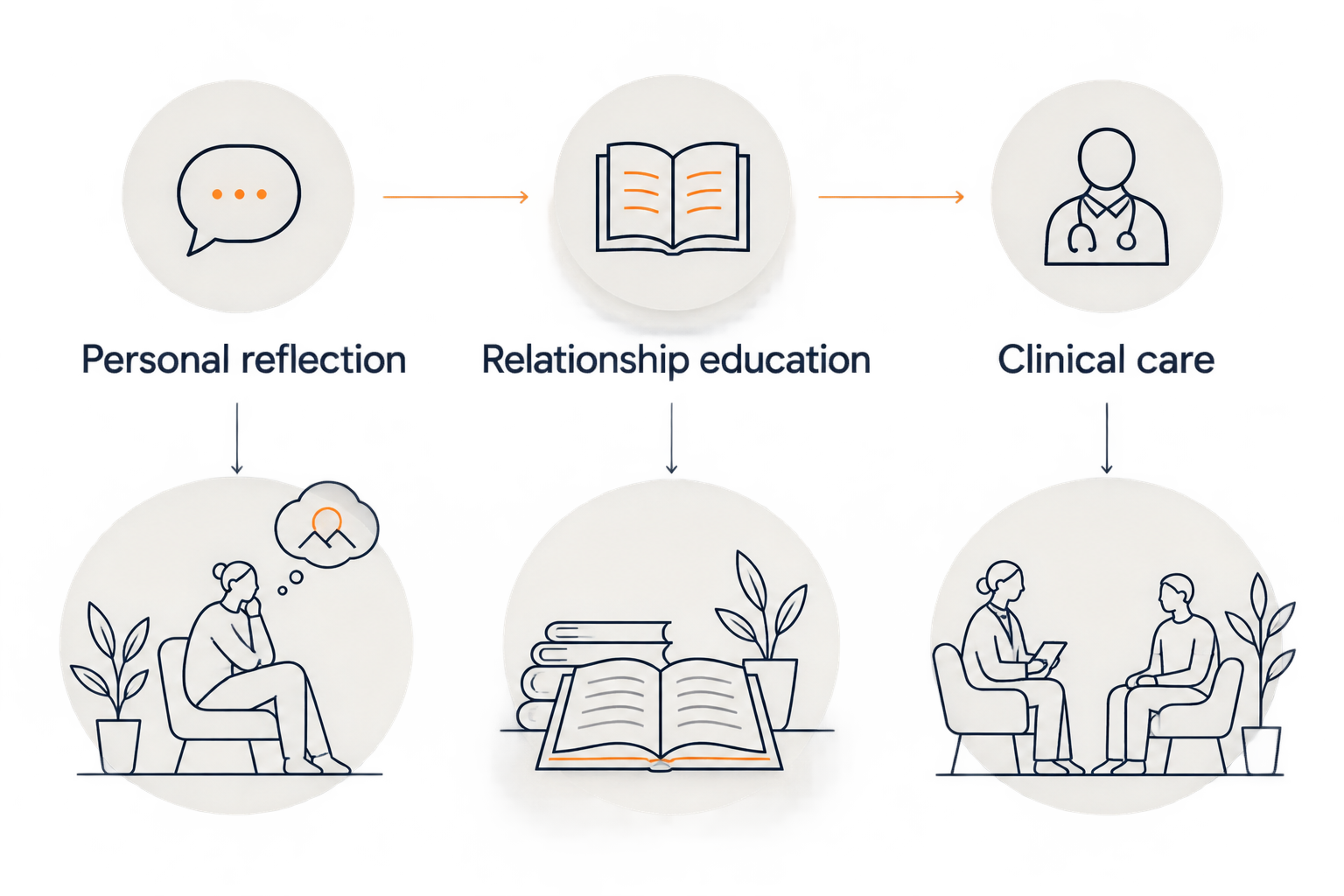 Three distinct routes: personal reflection, relationship education, and clinical care.
For example, after a disagreement, your first task might be naming disappointment rather than deciding who was wrong. Later, you might read about making clear requests. If the disagreement is part of an ongoing problem you cannot resolve, professional support is a separate next step.
Keep the output small: 1 request you can communicate clearly. Describe the behavior you want to discuss rather than giving your partner a diagnosis or presenting a quiz result as evidence against them.
Final verdict: choose the support you want to use
Choose Lovon if you want spoken emotional support
Best for: the individual who wants to talk through everyday feelings. Choose the voice companion when anxiety, stress, low mood, or relationship worries leave you wanting a conversation rather than another article.
The advantage is a personal starting point: your words and your concerns. The limitation is equally clear: automated emotional support is not clinical judgment, couples therapy, or an independent assessment of your partner.
Choose Marriage.com if you want relationship education
Best for: the reader with a marriage or relationship question. Choose Marriage.com when you want articles and quizzes to introduce a topic, give you language, or prompt discussion.
The advantage is topic-led exploration at your own pace. The limitation is that general information cannot determine what is happening in your relationship or establish the right decision for you.
| Dimension | Winner |
|---|---|
| Spoken emotional support | Lovon |
| Relationship-first reading | Marriage.com |
| Standout format | Tie: choose conversation or topic browsing |
| Relationship education | Marriage.com |
| Broader everyday emotional concerns | Lovon |
| Replacing clinical care | Neither |
| Privacy | No winner without reviewing current terms |
| Pricing | No winner without matching access and commitment |
One last thing
A helpful answer is not always a reassuring answer. Before accepting advice from an app, article, or quiz, ask whether it helps you describe observable behavior—or simply gives you a label for your partner.
For your 2026 choice, favor a tool that helps you leave with a clearer question or a respectful request. More certainty about another person's motives is not the same as more understanding.
Related guides
How AI Support Helps You Heal
AI emotional support isn't about replacing human connection — it's about filling the gaps. The moments when you need to talk at 2 AM, when you don't want to burden your friends again, or when you simply need someone to listen without judgment.
Here's what happens in a typical Lovon session:
You share what's on your mind
There's no script, no intake form, no waiting room. You speak or type whatever you're feeling — in your own words, at your own pace.
Lovon validates and explores
Using frameworks from CBT (Cognitive Behavioral Therapy) and motivational interviewing, Lovon acknowledges your feelings first, then gently helps you explore them. No dismissive "just move on" advice.
You build coping skills together
Lovon doesn't just listen — it actively works with you on evidence-based techniques: thought reframing, urge surfing, behavioral experiments, and more.
What a Session with Lovon Looks Like

Lovon is AI support, not a replacement for professional care. If things have been hard to get through for weeks, or you are thinking about harming yourself, talk to a doctor or a licensed therapist.
Ready to Start?
Your healing journey can begin right now
A 3-day trial. No judgment. Just a safe space to process what you're going through.
Frequently Asked Questions
Is Lovon better than Marriage.com for relationship anxiety?
Is Marriage.com the same as couples therapy?
Can an AI voice app tell me whether to end my marriage?
Which option is better if I do not want to speak aloud?
Does input from psychologists make an app a licensed therapist?
How should I compare the cost of these options?
Can I use voice support and relationship articles together?
About the Author

The Lovon Editorial Team
Mental Health & Wellness Content Team
The Lovon Editorial Team develops mental health and wellness content designed to make psychological concepts accessible and actionable. Our goal is to bridge the gap between clinical research and everyday life - helping you understand why your mind works the way it does and what you can do about it....
Related articles
- Communication Compatibility Quiz: Top Picks 2026
Take the right communication compatibility quiz in 2026. Compare top tools, learn what to look for, and turn your…
- Marriage.com alternatives in 2026
Compare Marriage.com alternatives: Lovon for voice support, couples therapy for shared work. See honest limits and…
- Best BetterHelp alternatives for couples therapy
Compare BetterHelp alternatives for couples therapy: choose licensed care for joint sessions or Lovon for solo voice…
- AI Relationship Coach for Sexless Marriages (2026)
Compare picks for an AI relationship coach for sexless marriages in 2026 — what to look for, what to avoid, and which…
See also
Quizzes
- Relationship Appetite Test: What Do You Want From Love?
See what you really go after in love, in 3 minutes.
- Relationship Quality Test: How Good Is Your Relationship?
Score connection, repair and teamwork in 3 minutes.
Free tools
- AI Marriage Coach
This is a free AI marriage coach you can use right on this page. Tell it what keeps happening and what the last time…
- How to Tell Someone You Love Them
How to tell someone you love them is rarely about the words, which are short. It is about the moment and the answer…
From the wiki
- What does falling in love feel like?
Falling in love usually arrives in the body first: a restless stomach, thin sleep, a pulse that reacts to a name on your…
Disclaimer: This article is for informational purposes only and does not constitute medical advice, diagnosis, or treatment. Always seek the advice of your physician or other qualified health provider with any questions you may have regarding a medical condition. If you are in crisis or think you may have an emergency, call 988 (Suicide & Crisis Lifeline) or go to the nearest emergency room. Outside the US? Find a crisis line in your country.