
Marriage.com alternatives in 2026
Compare Marriage.com alternatives: Lovon for voice support, couples therapy for shared work. See honest limits and choose the right support for you.


Key Takeaways
- Among marriage.com alternatives, Lovon fits on-demand voice support and individual reflection, not licensed couples therapy.
- Licensed couples therapy fits partners who want professional help with recurring conflict.
- Individual therapy fits personal concerns that need clinical attention, whether or not your partner participates.
- Marriage.com remains a fit when relationship education answers your question.
Marriage.com gives you relationship articles and quizzes that help put common concerns into words. Reading reaches its limit when you need a conversation about your own situation or help changing a repeating conflict. The best Marriage.com alternative in 2026 is Lovon if you need on-demand voice support for personal reflection; licensed couples therapy is the better choice if you need a clinician to work with both partners.
TL;DR
- Among marriage.com alternatives, Lovon fits on-demand voice support and individual reflection, not licensed couples therapy.
- Licensed couples therapy fits partners who want professional help with recurring conflict.
- Individual therapy fits personal concerns that need clinical attention, whether or not your partner participates.
- Marriage.com remains a fit when relationship education answers your question.
Why this matters
Relationship information, emotional support, and clinical treatment serve different needs. You do not need to abandon helpful reading, but you do need to recognize when reading is no longer the task.
This 2026 comparison separates those needs rather than treating every relationship resource as an interchangeable therapy service.
Marriage.com alternatives at a glance
| Option | Best for | Standout approach | Difference from Marriage.com articles and quizzes | Main limitation |
|---|---|---|---|---|
| Marriage.com | Relationship education | Articles and quizzes | The reading-based benchmark in this comparison | General information cannot assess your relationship |
| Lovon | On-demand personal reflection | AI-powered voice conversations and coping tools | Lets you talk through your own concerns | Not a licensed clinician or a substitute for couples therapy |
| Licensed couples therapy | Working on relationship patterns together | A clinician works directly with the couple | Adds professional assessment and guided discussion | Requires participation and coordination |
| Individual therapy | Personal distress and relationship decisions | A clinician works directly with you | Addresses your concerns within a clinical relationship | Cannot represent an absent partner's perspective |
The clinical options below are types of care, not endorsements of a particular provider. Choose the format first, then evaluate the practitioner or app against the help you actually need.
1. Lovon: best for talking through your feelings
Lovon is an AI-powered voice support app for emotional support, coping tools, and self-reflection. Its stated areas include relationship issues, anxiety, stress, low mood, and ADHD. You can use it to talk through what is happening for you without presenting that conversation as treatment for the relationship itself.
Lovon is best for people who want on-demand voice support to reflect on relationship stress. That is a narrower purpose than marriage counseling, and the distinction matters when you choose among alternatives in 2026.
Where the app shines
- Speaking rather than reading: Voice conversations offer a different format when another article is not what you want.
- Personal reflection: You can focus on your feelings, concerns, and questions instead of looking for a general description that matches perfectly.
- Everyday emotional support: Coping tools sit alongside conversation rather than requiring relationship stress to be your only concern.
For example, bring a specific incident rather than asking the app to judge your marriage. Describe what happened, what you felt, and what you want to express. Keep the focus on your own experience and the next conversation you intend to have.
Where the app falls short
- It is not a licensed clinician and does not replace professional mental health care.
- A conversation based on your account cannot establish your partner's motives or diagnose your partner.
- Individual voice support is not the same as a therapist working with both partners.
Do not use an app's response as proof that you are right in an argument. A supportive conversation is not an independent investigation, and your partner has not necessarily had an opportunity to explain their experience.
| Dimension | Voice support app | Marriage.com articles and quizzes |
|---|---|---|
| Main activity | Talk about your experience | Read about relationship topics |
| Focus | Your concerns and reflection | General relationship education |
| Clinical boundary | Not licensed clinical care | Reading is not clinical assessment |
Best for: Personal reflection before or after a difficult conversation, alongside professional care when needed.
Verdict: Buy only for individual emotional support, not as a replacement for marriage counseling.
2. Licensed couples therapy: best for working together
Licensed couples therapy is the stronger fit when both partners want professional help addressing their relationship. A clinician can hear from each person, ask follow-up questions, and help the couple examine how conversations unfold. That is different from applying general advice on your own.
Bring a concrete goal. You might want to discuss household responsibilities without escalating, address a breach of trust, or understand why the same disagreement never feels resolved. Ask the clinician how they would approach that goal rather than assuming every couples therapist works identically.
Where licensed couples therapy shines
- Direct participation: Both partners can describe their experiences instead of having one person summarize the relationship.
- Professional assessment: A licensed clinician can assess concerns within their scope of practice.
- Guided discussion: The work happens through conversation with a professional, not solely through self-directed reading.
Where licensed couples therapy falls short
- Coordinating appointments and participating in the work requires effort from both partners.
- A therapist cannot guarantee reconciliation or make another person change.
- Joint sessions are not the automatic first step when someone fears retaliation or experiences coercion or abuse.
If safety is a concern, seek individual guidance from a qualified professional or domestic violence service before arranging joint discussions. Safety takes priority over practicing better communication.
| Dimension | Licensed couples therapy | Marriage.com articles and quizzes |
|---|---|---|
| Participation | Clinician and participating partners | Reader engages with information |
| Assessment | Professional assessment within scope | No individual clinical assessment through reading |
| Discussion | Direct questions and responses | Self-directed interpretation |
| Commitment | Appointments and participation | Reading at your own pace |
Best for: Partners seeking professional help with recurring conflict, disconnection, or relationship decisions.
Verdict: Buy professional care when you need clinical assessment and shared work, not just more information.
3. Individual therapy: best when you need your own support
Individual therapy gives you a clinical setting to discuss your distress, choices, boundaries, and relationship experiences. You do not need your partner's participation to seek help for yourself. It is a distinct option, not a way to conduct couples therapy through one person's account.
Where individual therapy shines
- You can seek professional support even when your partner declines joint sessions.
- You can address concerns beyond the relationship, including symptoms that affect daily functioning.
- You can discuss decisions without making agreement from your partner the starting requirement.
Where individual therapy falls short
- Your clinician does not have direct access to an absent partner's perspective.
- Personal progress does not guarantee that the relationship will change.
| Dimension | Individual therapy | Marriage.com articles and quizzes |
|---|---|---|
| Focus | Your concerns within clinical care | General relationship topics |
| Interaction | Direct conversation with a clinician | Self-directed reading |
| Partner involvement | Not required for your care | Not required for reading |
Best for: Personal distress, boundary questions, or relationship decisions that warrant professional attention.
Verdict: Buy individual care when your own mental health needs attention, regardless of your partner's decision.
Why people switch from Marriage.com
The clearest reason to look beyond relationship reading is a change in the task. These are differences between support formats, not claims about dissatisfaction among Marriage.com users.
- You want a response to your own situation. An article addresses a topic; a conversation lets you describe your concern and respond to follow-up discussion.
- You want both partners involved. Reading alone does not give each person a voice in a professionally guided conversation.
- You need clinical attention. Persistent distress or difficulty functioning calls for professional assessment rather than another quiz.
- You already understand the advice. Knowing that communication matters is different from discussing what happens during your arguments.
For your 2026 shortlist, write down the task before comparing names. Use a plain sentence such as: I want help expressing a boundary, or we want professional support discussing trust. That sentence gives you a clearer selection criterion than a long feature list.
How to choose without turning it into another research project
Start with 3 questions: Do I want information, personal support, or clinical care? Does my partner need to participate? Do I feel safe speaking openly?
Keep those questions separate. Wanting support immediately does not establish that an app is the right level of care, and wanting to preserve a relationship does not establish that joint sessions are safe.
Match the format to the task
- Read: Choose education when you want to understand a term or explore a general question.
- Reflect: Choose personal support when you want to express feelings and clarify what to say.
- Seek care: Choose a licensed professional when you need assessment or treatment.
- Prioritize safety: Seek appropriate human support when fear, threats, coercion, or violence are present.
These are decision categories, not a sequence you must complete. You do not have to exhaust self-help before contacting a professional.
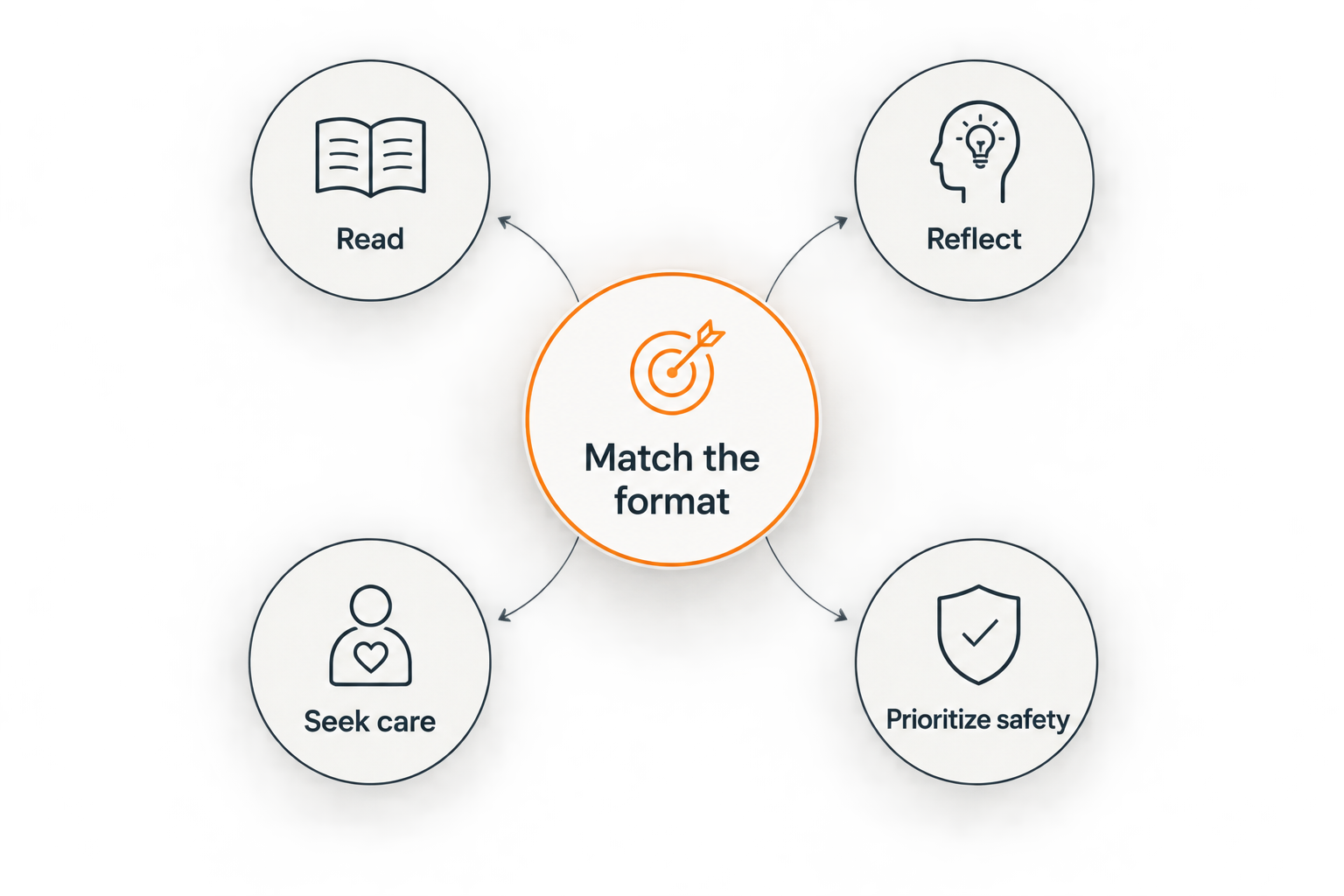 Four support choices: read, reflect, seek care, or prioritize safety.
Choose the level of support that matches your concern; self-help is not a prerequisite for care.
Ask what a clinician's method means for you
When comparing clinicians in 2026, ask about their license, experience with your concern, and approach to involving both partners. A named method is a starting point for questions, not a promise that treatment will work for your relationship.
Questions about the research behind the Gottman Method should distinguish evidence about an approach from guarantees about a particular couple. Ask a prospective clinician how they decide whether that approach fits your goals and circumstances.
Then ask how progress will be discussed. You need a shared understanding of the work, including what happens if either partner feels unheard or the initial approach does not fit. Do not choose solely because a method sounds familiar.
Check privacy before sharing details
Before using any relationship app, read its current privacy terms. Look for explanations of what happens to recordings, transcripts, account data, and deletion requests. Do not assume that an app conversation has the same legal protections as a conversation with a licensed clinician.
Leave out unnecessary identifying details about your partner or other people. You can describe a disagreement without sharing their full name, employer, or private messages. If someone monitors your devices, consider your safety before storing sensitive reflections on them.
When staying with Marriage.com is the right call
Stay with Marriage.com when relationship education answers the question you brought. Reading can be the right format when you want language for a concern, prefer to think privately, or simply want to understand a topic before deciding whether to seek further support.
Use 1 article to identify 1 question you want to discuss, rather than treating a quiz result as a verdict about your partner. Those are suggested limits for keeping the task focused, not a treatment plan.
You can also keep reading while receiving other support. Choosing professional care does not require giving up educational resources; it requires keeping their roles clear.
One last thing
The best next step is not always another opinion about your partner. Sometimes it is a clearer account of your own experience.
Try 2 columns on a page: what happened, and what I assumed it meant. Keep observable events separate from interpretations, then identify what you want to ask rather than what you want to prove. This is a reflection prompt, not a way to dismiss harmful behavior or resolve a safety concern.
Related guides
How AI Support Helps You Heal
AI emotional support isn't about replacing human connection — it's about filling the gaps. The moments when you need to talk at 2 AM, when you don't want to burden your friends again, or when you simply need someone to listen without judgment.
Here's what happens in a typical Lovon session:
You share what's on your mind
There's no script, no intake form, no waiting room. You speak or type whatever you're feeling — in your own words, at your own pace.
Lovon validates and explores
Using frameworks from CBT (Cognitive Behavioral Therapy) and motivational interviewing, Lovon acknowledges your feelings first, then gently helps you explore them. No dismissive "just move on" advice.
You build coping skills together
Lovon doesn't just listen — it actively works with you on evidence-based techniques: thought reframing, urge surfing, behavioral experiments, and more.
What a Session with Lovon Looks Like

Lovon is AI support, not a replacement for professional care. If things have been hard to get through for weeks, or you are thinking about harming yourself, talk to a doctor or a licensed therapist.
Ready to Start?
Your healing journey can begin right now
A 3-day trial. No judgment. Just a safe space to process what you're going through.
Frequently Asked Questions
What's the best Marriage.com alternative in 2026?
Is Lovon a replacement for marriage counseling?
Can I get relationship help if my partner refuses therapy?
Are relationship quizzes enough to decide whether to leave?
Should we choose couples therapy or individual therapy?
What should I check before using a relationship support app?
What if relationship distress becomes a crisis?
About the Author

The Lovon Editorial Team
Mental Health & Wellness Content Team
The Lovon Editorial Team develops mental health and wellness content designed to make psychological concepts accessible and actionable. Our goal is to bridge the gap between clinical research and everyday life - helping you understand why your mind works the way it does and what you can do about it....
Related articles
- AI Relationship Coach for Sexless Marriages (2026)
Compare picks for an AI relationship coach for sexless marriages in 2026 — what to look for, what to avoid, and which…
- Are We Compatible Quiz: AI Guide for Couples 2026
Take the are we compatible quiz and get a 5-dimension AI profile covering values, attachment, and conflict style. Find…
- AI Relationship Advice for Long-Distance Couples 2026
The best AI relationship advice for long-distance couples in 2026. Lovon's voice-based AI coach gives on-demand support…
- Couples Therapy Intake Process: Observation Session Followed by Individual Breakout Sessions
The couples therapy intake process often feels mysterious to those scheduling their first appointment. Many couples…
See also
Quizzes
- Relationship Appetite Test: What Do You Want From Love?
See what you really go after in love, in 3 minutes.
- Conflict Coordinates Test: What Your Fights Are Really About
Find what your fights are really about, in 3 minutes.
Free tools
- Conversation Starters for Couples, Picked for Tonight
Most lists hand you a hundred questions and no idea which one to open with. Say how long you have been together, what…
- Relationship Check-In Questions, and How to Run One
Check-ins fail on structure, not on questions. Tell it whether this would be your first one, what is on your mind, and…
From the wiki
- Is he in love with me?
There is no reliable tell in how fast he texts or how intense things feel. What tracks with love is consistency…
Disclaimer: This article is for informational purposes only and does not constitute medical advice, diagnosis, or treatment. Always seek the advice of your physician or other qualified health provider with any questions you may have regarding a medical condition. If you are in crisis or think you may have an emergency, call 988 (Suicide & Crisis Lifeline) or go to the nearest emergency room. Outside the US? Find a crisis line in your country.