
Best Freudly alternatives for ADHD coaching
Compare Freudly alternatives for ADHD coaching. Choose Lovon for voice support, a human coach for accountability, or a clinician for mental health care.


Key Takeaways
- For Freudly alternatives for ADHD coaching, Lovon fits voice-based emotional support, not diagnosis or licensed treatment.
- Choose a human ADHD coach when your main need is planning, accountability, and follow-through.
- Choose a licensed clinician when you need assessment or treatment rather than coaching.
- Use body doubling for shared work time, not emotional support or clinical care.
If Freudly already helps you reflect and feel supported, that is a good reason to keep it. The ceiling comes when reflection alone does not meet your need for practical accountability or clinical care. Among Freudly alternatives for ADHD coaching in 2026, Lovon is the best fit for on-demand voice-based emotional support; a human ADHD coach is the better fit for personal accountability.
TL;DR
- For Freudly alternatives for ADHD coaching, Lovon fits voice-based emotional support, not diagnosis or licensed treatment.
- Choose a human ADHD coach when your main need is planning, accountability, and follow-through.
- Choose a licensed clinician when you need assessment or treatment rather than coaching.
- Use body doubling for shared work time, not emotional support or clinical care.
Why this matters
ADHD coaching, emotional support, and mental health treatment serve different purposes. Before changing tools, name the help you need: talking through overwhelm, planning a task, working alongside someone, or getting professional care.
That distinction matters more than a long feature list. A supportive conversation does not create the same relationship as a human coach, and coaching does not replace clinical assessment.
For your 2026 shortlist, start with the moment that keeps going wrong. Are you struggling to begin work, struggling with how you feel about work, or experiencing symptoms that need professional attention? Choose support for that specific problem.
Freudly alternatives at a glance
This comparison separates support types rather than treating every option as an interchangeable app. Use your actual experience with Freudly as the benchmark; do not assume a different product will solve a different kind of need.
| Option | Best for | Defining feature or approach | Main limitation | How to compare with Freudly |
|---|---|---|---|---|
| Freudly | Continuing support that already meets your needs | Your existing experience and routine | Keep track of needs it leaves unmet | Use as your baseline |
| Lovon | Talking through everyday overwhelm | On-demand voice conversations, coping tools, and self-reflection guidance | Not a licensed clinician or replacement for care | Compare the usefulness of voice-based emotional support |
| Human ADHD coach | Planning and personal accountability | Collaborative goals and follow-through conversations | Coaching is not clinical treatment | Ask whether you need a human accountability relationship |
| Licensed therapist with ADHD experience | Mental health treatment | Professional care within the therapist’s qualifications | Therapy is not necessarily task-by-task coaching | Choose according to clinical needs, not app features |
| Body doubling | Working alongside another person | Shared work time, in person or remotely | Not coaching, therapy, or assessment | Consider it when the missing piece is company while working |
The right alternative matches the job you need done—not simply the app you want to replace.
1. Lovon: best for voice-based emotional support
Lovon is an AI-powered mental health app for voice conversations, emotional support, coping tools, and self-reflection. It is built with input from PhD psychologists and addresses everyday struggles such as stress, anxiety, low mood, relationship problems, and burnout.
For someone seeking ADHD support, the relevant use case is talking through feelings around a difficult day. That is different from receiving ADHD treatment or having a human coach review your commitments.
Where it shines
- Voice conversation: You can talk rather than turn your feelings into a written entry.
- On-demand support: You can seek emotional support when you want to reflect.
- Coping and reflection: The app offers coping tools and guidance for exploring what you are experiencing.
Where it falls short
- It is not a licensed clinician and does not replace licensed clinical care.
- An automated conversation is not a human coaching relationship.
- Input from psychologists does not mean a psychologist personally treats you during a session.
Best for: Everyday emotional support when you want to speak aloud, especially around stress or overwhelm. If your central need is external accountability, choose a human coach instead of expecting a voice app to fill that role.
When comparing this option with Freudly in 2026, focus on your experience of the conversation. Does speaking help you express the problem, and do you leave with a useful next step? Those questions matter more than a broad promise of productivity.
Verdict: Buy only for the emotional-support use case; skip it as a replacement for ADHD treatment or human coaching.
2. Human ADHD coach: best for personal accountability
A human ADHD coach is the strongest category to consider when you want another person involved in planning and follow-through. Look for a coach whose stated scope includes the practical problems you want to address, such as breaking down work or reviewing commitments.
Do not assume every coach offers the same approach. Ask how the relationship works before committing.
Where human ADHD coaching shines
- Collaborative planning: You can discuss a real task and agree on a manageable next action.
- Human accountability: Another person can ask what happened after you made a plan.
- Practical focus: You can seek a coaching arrangement centered on everyday goals.
Where human ADHD coaching falls short
- Coaching alone does not provide a clinical diagnosis or medical treatment.
- A coach’s title does not establish that they hold a mental health license.
- The relationship requires a working agreement about goals, contact, and boundaries.
Best for: People who want help turning intentions into commitments and reviewing what gets in the way.
For a useful comparison with Freudly, ask a prospective coach to explain how they would handle a missed goal. Look for a clear process rather than promises that you will become consistently productive.
Ask about relevant training, experience with adults who have ADHD, and when the coach recommends clinical care. A coach should explain the limits of the service plainly.
Verdict: Buy for human accountability; skip coaching as your only response to symptoms requiring clinical assessment.
3. Licensed therapist: best for treatment needs
A licensed therapist with relevant ADHD experience belongs on the shortlist when you need mental health care rather than productivity support. Check the professional’s license, qualifications, and stated areas of practice.
A therapist’s approach should match the concern you bring. Ask directly whether sessions address your emotional difficulties, ADHD-related challenges, or both.
Where licensed therapy shines
- Offers a professional treatment relationship within the clinician’s scope.
- Provides space to address distress beyond completing tasks.
- Allows you to discuss whether further assessment or another professional is appropriate.
Where licensed therapy falls short
- Therapy is not automatically an accountability service.
- Not every therapist specializes in ADHD.
- A therapy license does not mean the professional can prescribe medication.
Best for: Distress, persistent difficulties, or questions about treatment that require a qualified professional.
In a 2026 comparison, do not rank therapy below an app because it serves a different purpose. If you need clinical care, choose the appropriate professional rather than searching for a conversational substitute.
Verdict: Buy for appropriate clinical care; skip the assumption that every therapist provides ADHD coaching.
4. Body doubling: best for shared work time
Body doubling means working alongside another person, either in the same place or remotely. The other person does not need to complete your task; the arrangement is about shared work time.
Consider this option when you want company while starting or continuing a task—not a conversation about your mental health.
Where body doubling shines
- Creates a clear occasion to sit down and work.
- Can stay focused on a single task.
- Does not require turning the work session into a coaching discussion.
Where body doubling falls short
- It does not provide diagnosis, treatment, or professional coaching.
- Another person’s presence does not guarantee focus or completion.
- The arrangement needs boundaries so conversation does not replace work.
Best for: People who want a work companion rather than emotional processing or clinical guidance.
Compare body doubling with Freudly by asking what you need at the difficult moment: someone to talk with, or someone to work alongside. These are different requests.
Verdict: Buy into the arrangement for shared work time; skip it as a substitute for mental health care.
Why people switch from Freudly
A useful reason to switch is a specific unmet need. Treat the situations below as decision criteria, not claims about Freudly’s features or other users’ experiences.
- Emotional support: You want to speak aloud about stress and explore coping tools.
- Human accountability: You want another person to review plans and discuss follow-through.
- Clinical care: You need assessment or treatment from a qualified professional.
- Shared work: You want company while doing a task rather than another conversation about it.
Do not change services just because a comparison page ranks something first. Write down what is missing from your current support, then choose the category designed to address that gap.
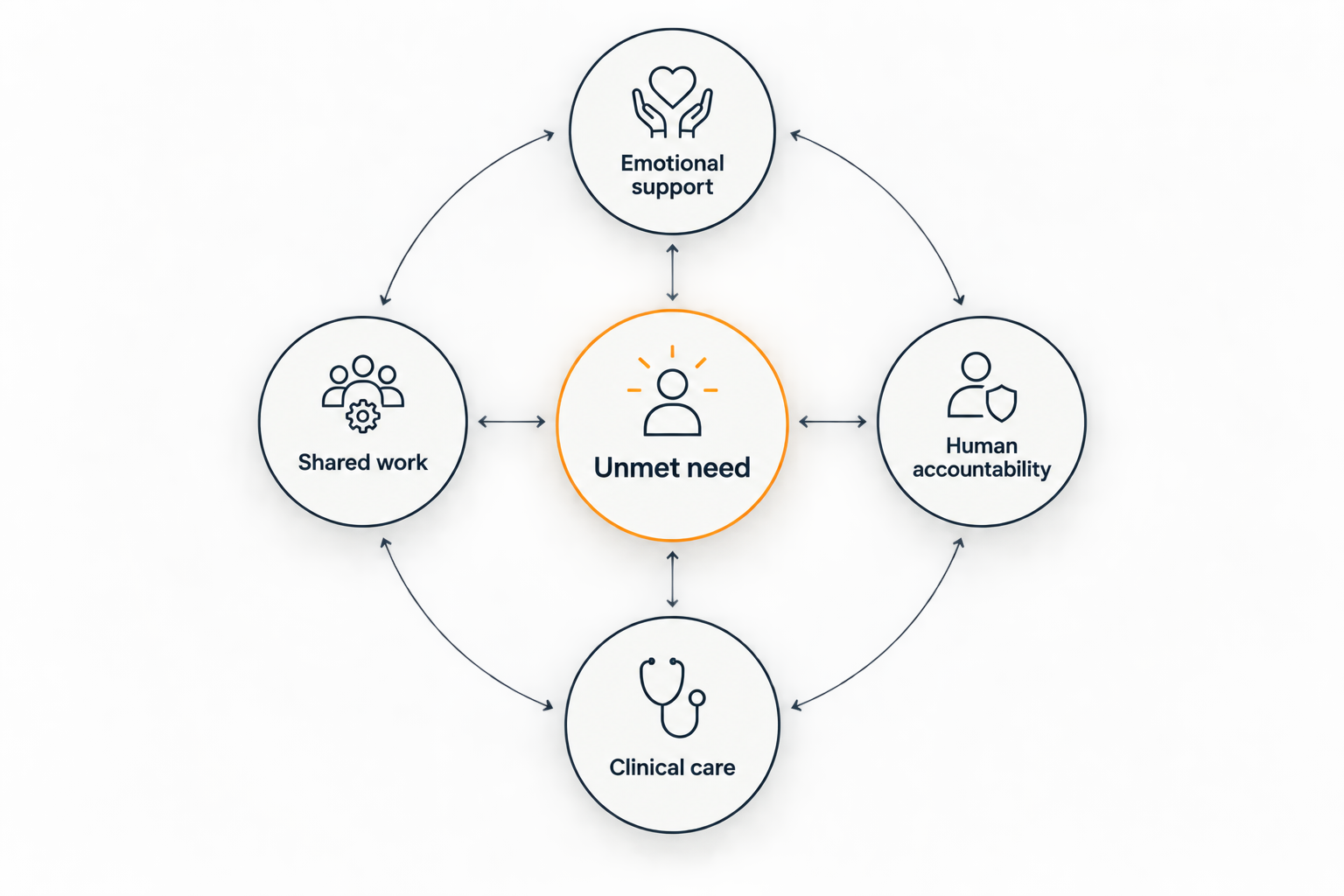 Four support needs to consider before choosing an alternative to Freudly
Choose the type of support before choosing a provider.
How to choose without creating another overwhelming task
Keep your 2026 comparison small. Use one everyday situation rather than trying to evaluate every possible feature.
Name the problem
Spend 2 minutes describing a recent difficult moment. Write what happened, what you needed, and what help you actually received; this is a reflection exercise, not a diagnostic test.
For example, distinguish being unsure how to begin a report from feeling ashamed after missing its deadline. You can need help with both, but they are not identical goals.
Pick a next step
Choose 1 task you want support with. Make the request concrete: discuss the feelings around the report, plan its opening paragraph, or arrange shared work time.
Do not turn the trial into a demand to fix your entire routine. Evaluate the support against the request you actually made.
Check the boundaries
Ask 3 questions before sharing sensitive information or committing to a service:
- What does this service do, and what does it explicitly not do?
- How does the provider explain its handling of personal information?
- What is the plan when I need help outside the service’s scope?
For an app, read the current privacy terms. For a professional, ask about qualifications, confidentiality, and the working agreement. Do not assume that every mental health service follows the same rules.
When staying with Freudly is the right call
Stay with Freudly if your current experience meets your needs and you understand the service’s boundaries. Familiarity is a valid reason to keep a useful routine.
You do not have to replace one kind of support to add another. For example, you can keep a reflection routine while seeking a qualified professional for clinical concerns or a work companion for shared task time.
Keep what helps; change the part that does not meet your needs. A different name on your phone is not, by itself, a better support plan.
One last thing
Before opening another comparison, finish this sentence: I need help with the moment when… Keep the answer specific enough that another person can understand what support you are asking for.
Lovon offers voice-based emotional support, not a licensed clinical relationship. Choose that role deliberately, and give practical accountability or treatment needs their own place in your support plan.
Related guides
How AI Support Helps You Heal
AI emotional support isn't about replacing human connection — it's about filling the gaps. The moments when you need to talk at 2 AM, when you don't want to burden your friends again, or when you simply need someone to listen without judgment.
Here's what happens in a typical Lovon session:
You share what's on your mind
There's no script, no intake form, no waiting room. You speak or type whatever you're feeling — in your own words, at your own pace.
Lovon validates and explores
Using frameworks from CBT (Cognitive Behavioral Therapy) and motivational interviewing, Lovon acknowledges your feelings first, then gently helps you explore them. No dismissive "just move on" advice.
You build coping skills together
Lovon doesn't just listen — it actively works with you on evidence-based techniques: thought reframing, urge surfing, behavioral experiments, and more.
What a Session with Lovon Looks Like

Lovon is AI support, not a replacement for professional care. If things have been hard to get through for weeks, or you are thinking about harming yourself, talk to a doctor or a licensed therapist.
Ready to Start?
Your healing journey can begin right now
A 3-day trial. No judgment. Just a safe space to process what you're going through.
Frequently Asked Questions
What's the best Freudly alternative for ADHD coaching in 2026?
Is an AI mental health app the same as an ADHD coach?
Can an app diagnose ADHD?
Should I choose an ADHD coach or a therapist?
What is body doubling for ADHD?
Can I use emotional support alongside ADHD treatment?
When should I stop comparing apps and get immediate help?
About the Author

The Lovon Editorial Team
Mental Health & Wellness Content Team
The Lovon Editorial Team develops mental health and wellness content designed to make psychological concepts accessible and actionable. Our goal is to bridge the gap between clinical research and everyday life - helping you understand why your mind works the way it does and what you can do about it....
Related articles
- AI Life Coach for ADHD Goal Setting 2026
The best AI life coach for ADHD in 2026 breaks goals into micro-steps, removes scheduling pressure, and adds emotional…
- Best AI App for Focus and Productivity in 2026: Ranked
The best AI app for focus and productivity in 2026, ranked: Notion AI overall, Focusmate for accountability, Lovon for…
- How much does ADHD coaching cost?
How much does ADHD coaching cost? No verified average is available here. Compare full plans, ask about hidden terms, and…
- Best Freudly alternatives for anxiety support
Compare Freudly alternatives for anxiety. Choose Lovon for AI voice support or licensed therapy for clinical care, with…
See also
Quizzes
- Anger Test: How Well Do You Manage Your Anger?
See whether your fuse, your heat or your afterburn needs work.
- Emotional Availability Test: Am I Emotionally Unavailable?
See which part of you closes off, in three minutes.
Free tools
- AI Life Coach
This is a free AI life coach you can use right on this page. Tell it where you feel stuck or what you are deciding, and…
- Dopamine Menu
A menu of things that lift you, built on a good day so a flat day only needs an order. Pick from 128 ideas or add your…
From the wiki
- Why do I have no friends?
Usually nothing is wrong with you. Adult friendship runs on proximity and repetition, and most people lose both at once…
Disclaimer: This article is for informational purposes only and does not constitute medical advice, diagnosis, or treatment. Always seek the advice of your physician or other qualified health provider with any questions you may have regarding a medical condition. If you are in crisis or think you may have an emergency, call 988 (Suicide & Crisis Lifeline) or go to the nearest emergency room. Outside the US? Find a crisis line in your country.