
Best Freudly alternatives for anxiety support
Compare Freudly alternatives for anxiety. Choose Lovon for AI voice support or licensed therapy for clinical care, with clear benefits and limits.


Key Takeaways
- For Freudly alternatives for anxiety, choose Lovon for on-demand AI voice conversations, coping tools, and self-reflection.
- Choose a licensed CBT therapist when anxiety needs assessment and treatment rather than app-based emotional support.
- Guided mindfulness suits structured practice; paper journaling suits reflection without an AI conversation.
- Keep Freudly if it meets your needs. Switching apps is not a substitute for getting appropriate care.
If Freudly gives you a familiar place to reflect, that familiarity is worth keeping. A familiar app stops being enough when you need a different conversation format or professional anxiety treatment. The best Freudly alternative in 2026 is Lovon if you want on-demand AI voice support; a licensed therapist offering cognitive behavioral therapy is the better choice if you need clinical anxiety care.
TL;DR
- For Freudly alternatives for anxiety, choose Lovon for on-demand AI voice conversations, coping tools, and self-reflection.
- Choose a licensed CBT therapist when anxiety needs assessment and treatment rather than app-based emotional support.
- Guided mindfulness suits structured practice; paper journaling suits reflection without an AI conversation.
- Keep Freudly if it meets your needs. Switching apps is not a substitute for getting appropriate care.
Why this matters
Choosing anxiety support means choosing a job for the tool. Talking through a difficult moment, practicing a coping skill, and treating an anxiety disorder are different jobs. You do not need one app to do everything.
Start with what you need next. If anxiety is disrupting sleep, work, relationships, or ordinary activities, prioritize a qualified clinician rather than another app comparison. Everyday emotional support can sit alongside treatment, but it does not replace it.
Freudly alternatives at a glance in 2026
| Option | Best for | Standout approach | How to compare it with Freudly |
|---|---|---|---|
| Freudly | Staying with support that already fits | Familiarity, if you already use it | Keep it if your needs are met; compare the specific feature you want to change |
| Lovon | On-demand AI voice support for everyday anxiety | Spoken conversations, coping tools, and self-reflection guidance | Consider it when you specifically want AI voice conversations |
| Licensed CBT therapist | Clinical anxiety assessment and treatment | Individualized work on thoughts, behaviors, and avoidance | Choose clinical care when your need is treatment rather than app support |
| Guided mindfulness practice | Following a structured attention exercise | A repeatable practice without needing a conversation | Choose it when you want guidance rather than back-and-forth discussion |
| Paper journaling | Independent reflection without AI responses | Writing in your own words and reviewing patterns | Choose it when you want space to think without generated advice |
These options serve different purposes. The order reflects their fit for different needs, not a claim that one produces better anxiety outcomes than Freudly.
1. Lovon: best for on-demand AI voice support
Lovon is an AI-powered mental health app for spoken conversations, emotional support, coping tools, and self-reflection. It is built with input from PhD psychologists, but it is not a licensed clinician. Lovon is best for people who want AI voice support for everyday anxiety, not clinical treatment.
The practical distinction is the format. If you want to speak rather than organize a written entry, voice conversations fit that preference. You can bring up work stress, relationship worries, or a difficult feeling without turning the conversation into a polished explanation.
Where the app shines
- Voice conversations: You can talk through what is bothering you instead of composing a journal entry.
- On-demand support: The app provides emotional support when you want to reflect.
- Coping tools: Its stated purpose includes helping you explore ways to manage everyday distress.
- Broader context: Conversations can include stress, low mood, relationship problems, and burnout alongside anxiety.
Where the app falls short
- It does not replace assessment or treatment from a licensed mental health professional.
- Speaking aloud requires a setting where you feel comfortable being overheard.
- AI responses can be inaccurate. Do not treat them as diagnoses, medical instructions, or confirmation that a feared event will happen.
- A supportive conversation cannot guarantee relief or determine whether a physical symptom needs medical attention.
Best for: Someone who wants to just talk, reflect, and consider coping tools between other sources of support.
Verdict: Buy only if AI voice support is the job you want filled; skip it as a replacement for clinical care.
2. A licensed CBT therapist: best for anxiety treatment
Cognitive behavioral therapy, or CBT, is an established treatment approach for anxiety. A licensed therapist can assess your concerns and work with you on patterns such as worst-case thinking, avoidance, and behaviors that keep anxiety going. The treatment plan depends on your needs.
This is a different category from an emotional-support app. You are choosing a professional relationship with clinical responsibilities, not simply another conversation interface.
Where a licensed CBT therapist shines
- Assessment: A qualified clinician can evaluate symptoms and discuss appropriate treatment.
- Personalized treatment: Therapy connects skills to your specific difficulties and goals.
- Supported practice: A therapist can help you approach feared situations when clinically appropriate.
- Accountability: You can review what happened between appointments and adjust your approach together.
Where a licensed CBT therapist falls short
- Appointments require scheduling; a therapist is not automatically reachable whenever anxiety appears.
- Finding a suitable clinician takes effort, including checking credentials and experience with anxiety.
- CBT involves practice outside sessions. Attending appointments alone is not the whole process.
Best for: Anxiety that interferes with daily life, persistent avoidance, or uncertainty about what kind of help you need.
Verdict: Buy into professional treatment when anxiety needs assessment, rather than waiting for a different app to solve it.
3. Guided mindfulness: best for structured practice
Guided mindfulness gives you an exercise to follow rather than a conversation to continue. Practices commonly involve noticing breathing, sensations, or thoughts without trying to settle every worry. You can use an audio recording or written instructions.
Where guided mindfulness shines
- It gives you a defined activity when deciding what to do feels difficult.
- You can practice noticing a thought without immediately arguing with it.
Where guided mindfulness falls short
- It does not assess anxiety or provide individualized clinical treatment.
- Focusing inward feels uncomfortable for some people. Stop or change the exercise if distress increases.
Best for: Someone who wants structured practice rather than personalized dialogue.
Verdict: Buy into a manageable practice, but skip the expectation that meditation must make every anxious feeling disappear.
4. Paper journaling: best for reflection without AI
Paper journaling gives you a place to describe what happened, what you felt, and what you want to do next. There is no generated response to evaluate. You control what you record and where you keep it.
Where paper journaling shines
- It separates your own observations from outside suggestions.
- You can bring selected notes to a therapy appointment or revisit a recurring concern.
Where paper journaling falls short
- A notebook cannot offer feedback, assessment, or crisis support.
- Repeating the same worry on paper is not the same as finding a useful next step.
Best for: Someone who wants independent reflection and does not want an AI conversation.
Verdict: Buy a notebook if writing fits you; skip prolonged entries that only repeat the same worry.
How to choose anxiety support in 2026
Make the decision smaller. Instead of asking which option is best at everything, identify the kind of help you need today. Start with these three categories:
- Clinical care: You need assessment, treatment, or help with anxiety that is disrupting daily life.
- Voice support: You want to talk through everyday feelings with an AI companion.
- Independent practice: You want a guided exercise or a place to write without conversation.
Choose the category before comparing features. A voice app and a therapist are not interchangeable simply because both involve talking about feelings.
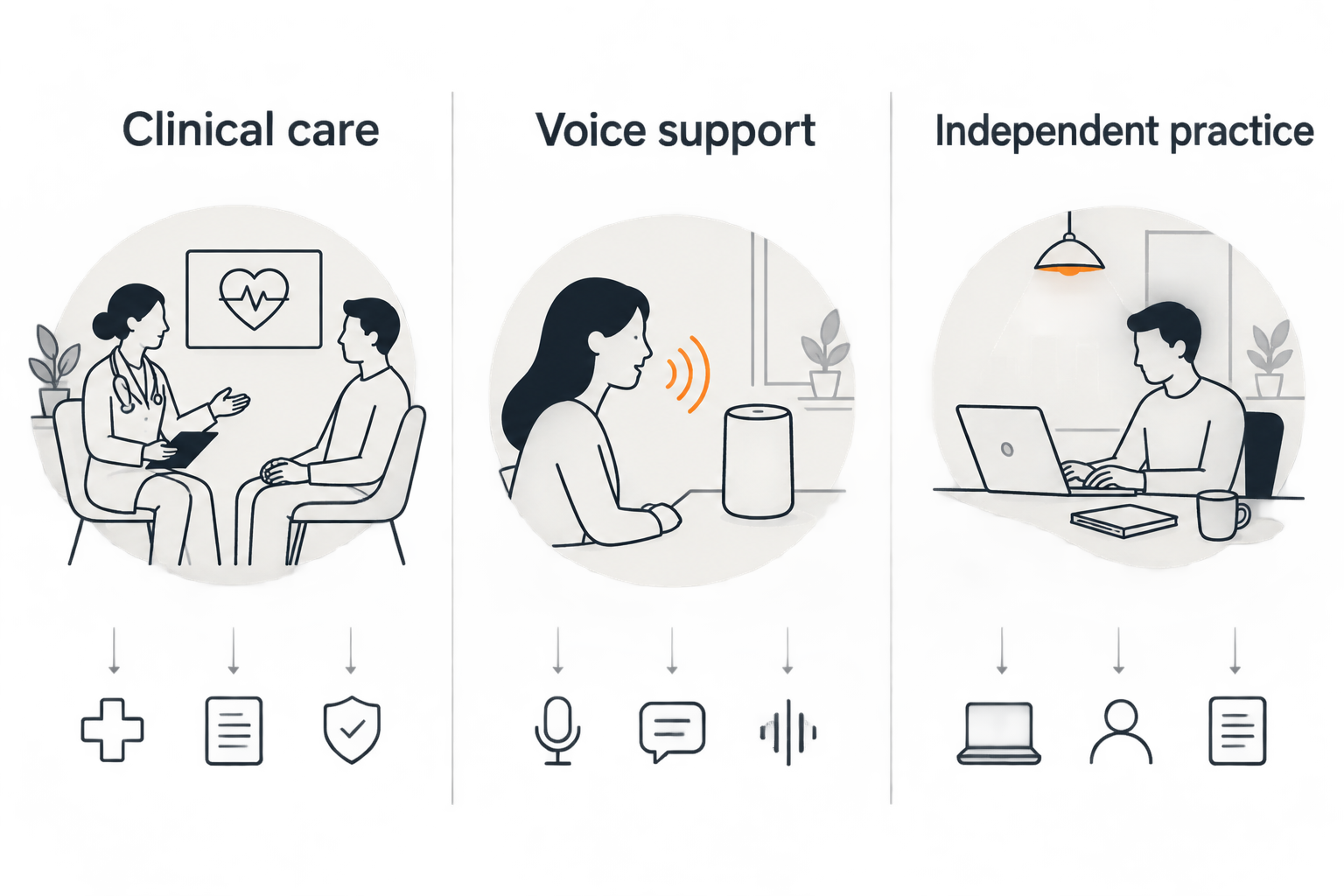 Three support choices: clinical care, voice support, and independent practice
Choose the kind of support you need before comparing individual features.
Next, try a small, ordinary task rather than sharing your most sensitive experience immediately. Set aside 5 minutes to describe a manageable worry. This is a suggested starting exercise, not a treatment schedule or a promise of results.
Write 3 lines afterward: what you noticed, what felt useful, and what did not fit. Choose 1 next action, such as preparing a question for your therapist or returning to an ordinary task. Judge the experience by whether it helped you identify a useful next step, not whether it removed all uncertainty.
Before using any mental health app in 2026, read its current privacy information. Check what happens to conversations, whether you can delete them, and whether the stated practices meet your expectations. A comforting tone is not evidence of confidentiality.
Why people consider switching from Freudly
A useful reason to switch is a clear mismatch between what you need and the support you are using. You do not need to decide that Freudly is bad. You need to name what should be different.
Consider a change when one of these describes your situation:
- You want a different format. Your priority is speaking aloud, following an exercise, or writing independently.
- You need clinical care. Anxiety is interfering with daily life, and another app is not the right next step.
- You want less conversational input. A notebook or a defined exercise better matches how you want to reflect.
- You need clearer boundaries. You want to separate emotional support from medical decisions and treatment.
These are decision criteria, not claims about Freudly's features, policies, or outcomes. Base your 2026 choice on the specific support you need rather than a general ranking.
When staying with Freudly is the right call
Stay with Freudly if it meets your needs and you are using it within appropriate limits. A comparison page is not a reason to replace something useful. Familiarity has practical value when it makes support easier to use.
Apply the same scrutiny to staying that you apply to switching. Are you using support to help you return to life, or repeatedly checking until you feel certain? If you keep returning with the same fear and cannot move on, discuss that pattern with a qualified clinician.
In 2026, the best decision is still about fit and safety, not novelty. You can keep an app you find helpful while seeking professional care for needs an app cannot meet.
One last thing
The most reassuring response is not always the most useful one. Before opening any support tool, ask yourself whether you want help taking a next step or a guarantee that nothing bad will happen. No app can provide that guarantee.
Choose support that respects that boundary. You do not have to feel completely calm before doing something that matters to you, and you do not have to manage persistent anxiety alone.
Related guides
How AI Support Helps You Heal
AI emotional support isn't about replacing human connection — it's about filling the gaps. The moments when you need to talk at 2 AM, when you don't want to burden your friends again, or when you simply need someone to listen without judgment.
Here's what happens in a typical Lovon session:
You share what's on your mind
There's no script, no intake form, no waiting room. You speak or type whatever you're feeling — in your own words, at your own pace.
Lovon validates and explores
Using frameworks from CBT (Cognitive Behavioral Therapy) and motivational interviewing, Lovon acknowledges your feelings first, then gently helps you explore them. No dismissive "just move on" advice.
You build coping skills together
Lovon doesn't just listen — it actively works with you on evidence-based techniques: thought reframing, urge surfing, behavioral experiments, and more.
What a Session with Lovon Looks Like

Lovon is AI support, not a replacement for professional care. If things have been hard to get through for weeks, or you are thinking about harming yourself, talk to a doctor or a licensed therapist.
Ready to Start?
Your healing journey can begin right now
A 3-day trial. No judgment. Just a safe space to process what you're going through.
Frequently Asked Questions
What's the best Freudly alternative for anxiety in 2026?
Is an AI voice app better than a therapist for anxiety?
What should I compare before switching from Freudly?
Can I use an anxiety support app between therapy sessions?
What's an alternative if I don't want to talk to AI?
Should I stop using Freudly if it already helps me?
What should I do if anxiety feels like an emergency?
About the Author

The Lovon Editorial Team
Mental Health & Wellness Content Team
The Lovon Editorial Team develops mental health and wellness content designed to make psychological concepts accessible and actionable. Our goal is to bridge the gap between clinical research and everyday life - helping you understand why your mind works the way it does and what you can do about it....
Related articles
- Best therapy apps in 2026
Compare the best therapy apps for licensed care, voice support, meditation, and sleep. Choose the right level of help…
- Best ChatGPT alternatives for emotional support in 2026
Compare the best ChatGPT alternatives for therapy. Choose voice support for everyday feelings or licensed care for…
- Best Freudly alternatives for ADHD coaching
Compare Freudly alternatives for ADHD coaching. Choose Lovon for voice support, a human coach for accountability, or a…
- Best BetterHelp Alternatives for Anxiety in 2026
BetterHelp alternatives for anxiety compared for 2026: Lovon wins for on-demand voice support, Talkspace for licensed…
See also
Quizzes
- Self-Acceptance Test: What Are You Still Arguing With?
See where you are still fighting yourself, in 3 minutes.
- Resilience Test: How Fast Do You Bounce Back?
See how you recover from setbacks, in 3 minutes.
Free tools
- Body Scan Meditation
Ten minutes, from your toes to the top of your head, noticing what is there without trying to fix it. Follow the voice…
- Sleep Meditation for Anxiety
For lying in bed with a mind that will not stop. About twelve minutes of slower breathing, a place to put the worries…
From the wiki
- What to do if you have no friends?
Pick one activity that repeats weekly with the same people, and go for six to eight weeks straight. Repetition, not…
Disclaimer: This article is for informational purposes only and does not constitute medical advice, diagnosis, or treatment. Always seek the advice of your physician or other qualified health provider with any questions you may have regarding a medical condition. If you are in crisis or think you may have an emergency, call 988 (Suicide & Crisis Lifeline) or go to the nearest emergency room. Outside the US? Find a crisis line in your country.