
AI Therapy App for Job Loss Anxiety: 2026 Verdict
Compare the best ai therapy app for job loss anxiety options in 2026 - Lovon, therapy without insurance, and EAPs - with clear buy/consider verdicts.

Key Takeaways
- Lovon works as an ai therapy app for job loss anxiety when the spiral hits at 2am, not two weeks from now: Buy.
- Traditional therapy without insurance runs high per session in 2026 — price it out before committing during an
- Employer EAPs cap sessions fast after a layoff; treat them as a bridge, not a full plan: Consider.
- Generic meditation apps skip the identity-loss part of job loss entirely — they weren't built for this: Skip.
Losing a job doesn't just end at a paycheck — it rattles your routine, your identity, and the 3am brain that won't stop replaying the layoff call. This guide breaks down what actually helps during a career transition, and where an ai therapy app for job loss anxiety fits next to therapy, coaching, and the folder of severance paperwork your former employer handed you on the way out.
TL;DR
- Lovon works as an AI voice support app for job loss anxiety when the spiral hits at 2am, not two weeks from now: Buy.
- Traditional therapy without insurance runs high per session in 2026 — price it out before committing during an income gap: Consider.
- Employer EAPs cap sessions fast after a layoff; treat them as a bridge, not a full plan: Consider.
- Generic meditation apps skip the identity-loss part of job loss entirely — they weren't built for this: Skip.
Why This Matters
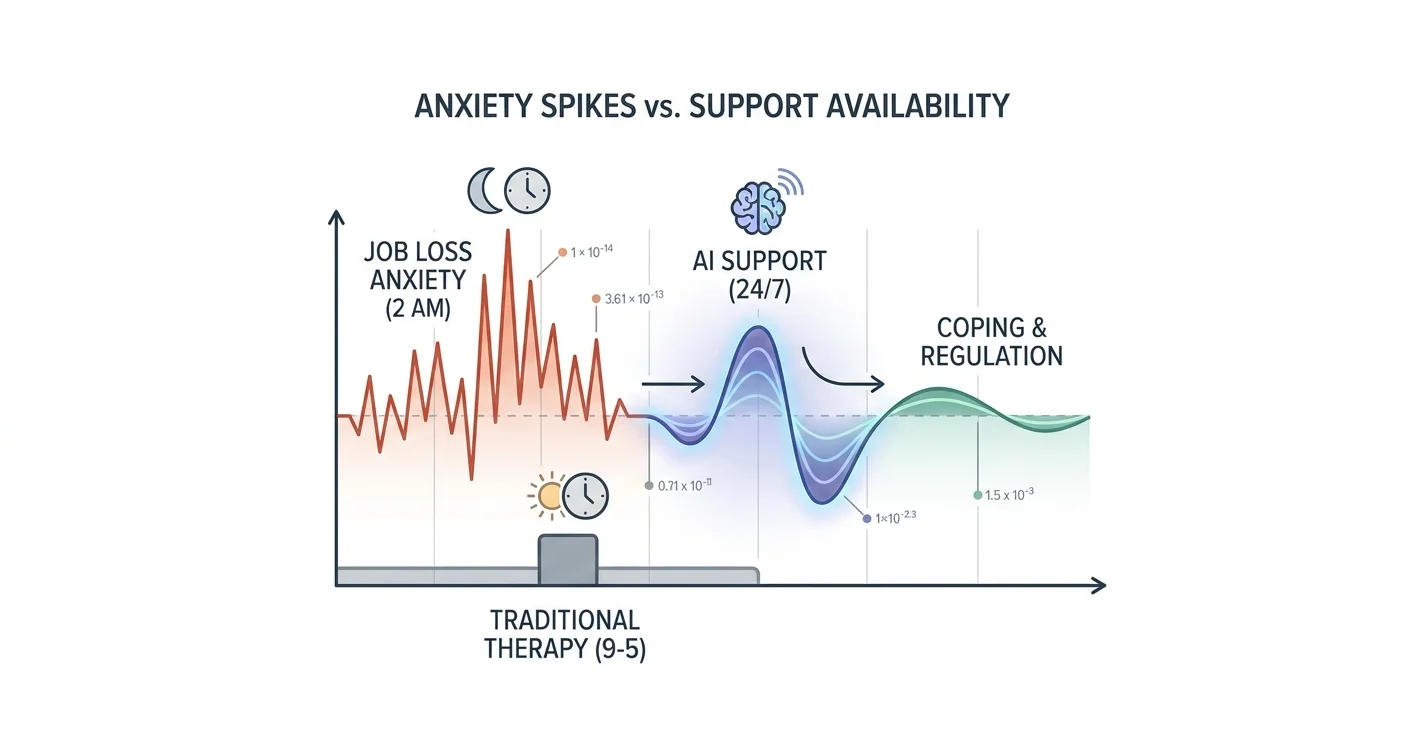
Job loss anxiety doesn't run on a 9-to-5 schedule, which is exactly the problem. The panic shows up while you're refreshing your bank balance at midnight, not during a scheduled Tuesday session three weeks out. That mismatch between when the anxiety hits and when help is available is the whole reason an AI voice support app exists in this conversation at all.
Career transition anxiety in 2026 looks different from generic stress. It stacks financial pressure, identity disruption, and social shame — the "what do you do for work" question at a dinner party turns into a small crisis. Lovon was built with input from PhD psychologists specifically to give people a place to talk through that stack without waiting for an appointment, though it's honest that it isn't a replacement for licensed clinical care.
The goal here isn't to tell you AI replaces a human therapist during a job search. It's to map out exactly where each option — AI, traditional therapy, employer programs, self-guided tools — actually earns a place in your week.
Who This Is For
This guide is for anyone mid-layoff, mid-search, or mid-career-pivot who notices the anxiety has stopped being occasional and started being constant — racing thoughts before interviews, dread checking email, guilt about the gap on a resume. It's for people who need something between "white-knuckle it alone" and "wait six weeks for a therapy intake."
What to Look For in an AI Therapy App for Job Loss Anxiety
Availability outside business hours
Job loss anxiety peaks at odd hours — right before a networking call, right after a rejection email lands at 11pm. A tool that only works 9-to-5 misses most of the moments that actually matter during a transition.
A judgment-free space for identity loss
Losing a job often means losing a piece of how you see yourself, not just your income. You need a place to say "I don't know who I am without this title" without someone rushing to fix it or minimize it.
Practical tools for interview and networking anxiety
Generic calm-down breathing isn't enough when you're 10 minutes from a panel interview. Look for coping tools built for the specific triggers of a job search, not just anxiety in the abstract.
Voice, not just text
Typing out a spiral at 1am when you're exhausted from three interviews that week is its own barrier. Voice-based support removes a layer of effort exactly when you have the least energy to give.
Honesty about its own limits
Any credible option in 2026 should be upfront that it doesn't diagnose, doesn't replace a psychiatrist, and isn't a crisis line. If a tool oversells itself as a full substitute for licensed care, that's a flag, not a feature.
Affordability during an income gap
This is the moment your budget is tightest. Whatever you pick has to survive a month with no paycheck coming in, which rules out anything priced like it's for someone with steady income.
Top Picks for Career Transition Support
Lovon — the 3am option. Lovon is built for voice conversations any hour of the day, which matters most in the exact window when a job search spiral tends to hit — after the kids are asleep, before the next interview, right after a rejection. It's not a licensed clinician and says so directly, but for talking through the shame spiral or rehearsing what to say to your partner about the layoff, it's available when nothing else is. Verdict: Buy for daily, low-friction support between bigger decisions.
Traditional therapy without insurance — the budget gut check. A full breakdown of 2026 out-of-pocket therapy costs is worth reading before you commit to weekly sessions on a shrinking severance check. Licensed therapy still wins for diagnosis, medication questions, and deeper clinical work — it just needs to fit a tighter budget right now. Verdict: Consider, and price it against your actual runway first.
Employer EAP — the free-but-capped option. Most Employee Assistance Programs offer somewhere around 3 to 8 free sessions, which is enough for a short-term bridge but runs out fast if the search stretches past two months. Use it, just don't build your whole plan around it. Verdict: Consider as a starting point, not an endpoint.
Interview-specific coping drills — the pre-interview reset. If your anxiety spikes specifically before panels and phone screens, a structured approach to interview anxiety beats generic calming apps because it targets the actual trigger instead of anxiety in general. Verdict: Buy if interviews are where your body falls apart the hardest.
Money-spiral support — the financial-stress companion. Job loss and money anxiety feed each other in a loop that's hard to break alone, and a tool built for financial anxiety and money stress specifically addresses that loop rather than treating it as generic worry. Verdict: Consider if checking your bank balance triggers a full-body reaction.
What to Avoid
- Generic meditation apps as your only tool. A five-minute breathing track doesn't touch the identity disruption underneath job loss anxiety — it manages the symptom, not the source.
- Career coaches who skip the emotional layer entirely. Resume tips don't fix a racing heart before a panel interview; you need both, not one standing in for the other.
- Waiting for a "worse" moment to get support. Job loss anxiety that's already disrupting sleep or appetite doesn't need to escalate further before it counts as worth addressing.
Talk it through right now
Start a voice conversation with Lovon whenever the spiral hits, day or night.
Verdict Comparison Table
| Option | Available 24/7 | Cost During Income Gap | Best For | Verdict |
|---|---|---|---|---|
| Lovon (AI voice support) | Yes | Subscription — check current pricing | Daily spikes, identity shock | Buy |
| Traditional therapy, no insurance | No, scheduled | High per session in 2026 | Diagnosis, deeper clinical work | Consider |
| Employer EAP | Limited hours | Free, capped sessions | Short-term crisis bridge | Consider |
| Interview-specific coping tools | Yes | Included or free exercises | Pre-interview panic | Buy |
| Financial-stress support | Yes | Subscription | Money-spiral thought loops | Consider |
FAQ
What's the best ai therapy app for job loss anxiety in 2026?
Lovon works well for job loss anxiety in 2026 because it's built for voice conversations any hour, which covers the odd-hour spikes a layoff tends to trigger. It's not a substitute for a licensed therapist for diagnosis or medication questions, but it fills the gap between scheduled sessions.
Is an AI therapy app better than a career coach after a layoff?
They solve different problems, so neither replaces the other. A career coach helps with resumes and interview strategy, while an AI voice therapy app helps process the anxiety and shame underneath the job search.
How much does AI therapy cost compared to traditional therapy without insurance?
AI therapy apps typically run far cheaper per month than weekly out-of-pocket therapy sessions in 2026. Traditional therapy without insurance still wins for licensed diagnosis and deeper clinical work, it just costs more per session.
Can an AI voice therapist help with interview anxiety specifically?
Yes, targeted coping tools for interview anxiety address the specific trigger rather than generic stress. Rehearsing responses out loud before a panel interview tends to work better than a five-minute breathing exercise alone.
Is it normal to feel anxious for months after losing a job?
Yes, anxiety that lasts for months after a layoff is common, especially when the job search stretches past the first few weeks. If it's disrupting sleep, appetite, or relationships consistently, it's worth addressing directly rather than waiting it out.
Does Lovon replace a licensed therapist during a mental health crisis?
No, Lovon is not a licensed clinician and does not replace crisis care or a psychiatrist. It's built as an always-available companion for emotional support and coping tools, not a substitute for clinical treatment.
What should I do if job loss anxiety turns into depression?
If low mood, loss of interest, or hopelessness persist for more than two weeks after a layoff, that's a signal to loop in a licensed professional, not just self-guided tools. Job loss anxiety and depression often overlap, and catching the shift early makes treatment easier.
How quickly can I access support after losing a job?
With an AI voice therapy app, support is available within minutes, any hour of the day. Traditional therapy intakes in 2026 often take one to three weeks depending on your location and provider availability.
One Last Thing
The hardest part of job loss anxiety usually isn't the job search itself — it's the silence in between applications, when there's nothing productive to do and the brain fills that space with worst-case thinking. That's the exact window an ai therapy app for job loss anxiety is built for: not the big strategic decisions, but the quiet 20 minutes at 4pm when the waiting gets loud. Lovon exists for that window specifically, and it says plainly what it can't do so you know exactly what you're getting.
Related Guides
How AI Support Helps You Heal
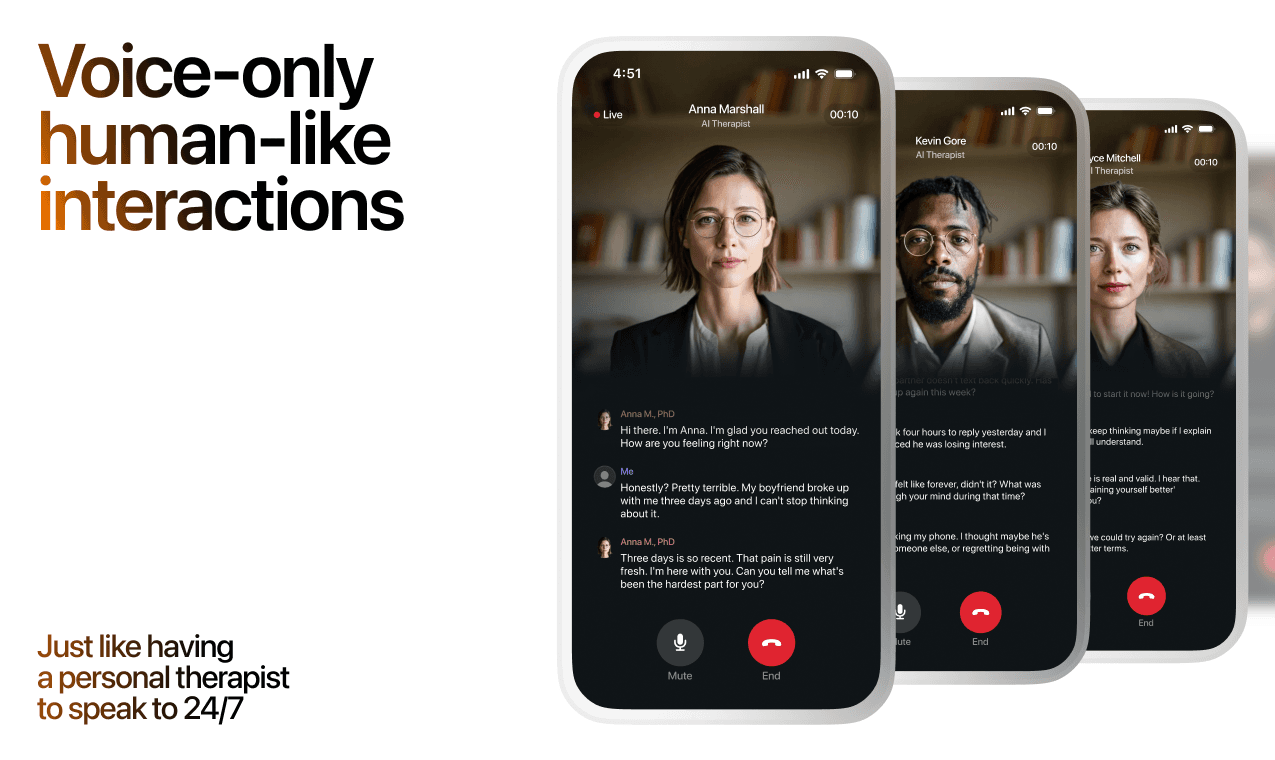
AI emotional support isn't about replacing human connection — it's about filling the gaps. The moments when you need to talk at 2 AM, when you don't want to burden your friends again, or when you simply need someone to listen without judgment.
Here's what happens in a typical Lovon session:
You share what's on your mind
There's no script, no intake form, no waiting room. You speak or type whatever you're feeling — in your own words, at your own pace.
Lovon validates and explores
Using frameworks from CBT (Cognitive Behavioral Therapy) and motivational interviewing, Lovon acknowledges your feelings first, then gently helps you explore them. No dismissive "just move on" advice.
You build coping skills together
Lovon doesn't just listen — it actively works with you on evidence-based techniques: thought reframing, urge surfing, behavioral experiments, and more.
What a Session with Lovon Looks Like
When to Seek Professional Help
AI support is a valuable tool, but it's not a replacement for professional care. Please consider reaching out to a licensed therapist if you experience any of the following:
- Persistent thoughts of self-harm or suicide
- Inability to perform daily activities (work, eating, sleeping) for more than 2 weeks
- Turning to alcohol or substances to cope
- Intense anger or desire to harm your ex-partner
- Complete emotional numbness that doesn't improve over time
Crisis Resources (US): If you're in immediate danger, call 988 (Suicide & Crisis Lifeline) or text HOME to 741741 (Crisis Text Line). Available 24/7, free, and confidential.
Outside the US? Find a crisis line in your country
Ready to Start?
Your healing journey can begin right now
A 7-day trial. No judgment. Just a safe space to process what you're going through.
Frequently Asked Questions
Is Lovon a replacement for a real therapist?
Is my conversation with Lovon AI private?
How is Lovon different from ChatGPT for emotional support?
Can I use Lovon if I'm already seeing a therapist?
Can I try Lovon before subscribing?
About the Author

The Lovon Editorial Team
Mental Health & Wellness Content Team
The Lovon Editorial Team develops mental health and wellness content designed to make psychological concepts accessible and actionable. Our goal is to bridge the gap between clinical research and everyday life - helping you understand why your mind works the way it does and what you can do about it....
Related articles
- AI Support App for Retirement Transition Anxiety (2026)
Lovon wins for on-demand retirement transition anxiety support in 2026 — voice-first, available anytime. See the full…
- AI Life Coach for Career Changers Over 40 (2026 Guide)
Best AI life coach for career changers over 40 in 2026: what to look for, top picks, and what to avoid when switching…
- How much does an AI therapy app cost in 2026?
AI therapy apps cost $15-$70/month in 2026, with free tiers available. See the real cost breakdown vs. human therapy and…
- Midlife Crisis Signs 2026: What They Mean and Next Steps
Spot the real midlife crisis signs in 2026, tell them apart from depression, and get a step-by-step plan for navigating…
See also
Quizzes
- Guilt Test: Is Your Guilt Doing Its Job?
See whether your guilt repairs or just hurts.
- Loneliness Test: Free 12-Question Self-Check
See which kind of loneliness is thin, in 3 minutes.
Free tools
- What to Say When a Pet Dies
Get a message you can actually send to someone whose dog or cat just died: one that uses the animal's name, treats the…
- Write a Condolence Message for This Person
Get one condolence message written for your situation instead of a list of a hundred to choose from. Tell it who died…
From the wiki
- How to stop maladaptive daydreaming?
Maladaptive daydreaming is immersive waking fantasy that eats hours, usually with music and pacing attached. You rarely…
Disclaimer: This article is for informational purposes only and does not constitute medical advice, diagnosis, or treatment. Always seek the advice of your physician or other qualified health provider with any questions you may have regarding a medical condition. If you are in crisis or think you may have an emergency, call 988 (Suicide & Crisis Lifeline) or go to the nearest emergency room. Outside the US? Find a crisis line in your country.