
AI Support App for Retirement Transition Anxiety (2026)
Lovon wins for on-demand retirement transition anxiety support in 2026 — voice-first, available anytime. See the full buying guide and verdicts.


Key Takeaways
- Lovon is the pick for 3am retirement anxiety spirals — voice-first and available anytime in 2026, not just during
- Licensed retirement or career counselors handle structured planning; an AI support app for retirement transition
- Skip generic meditation-timer apps for this — they don't touch identity loss or spousal role friction.
- Buy Lovon for daily emotional check-ins; Consider a licensed counselor for pension, healthcare, or major financial
Retirement doesn't come with an onboarding manual, and the anxiety that shows up in month three — the 3am wide-awake stretch, the "who am I now" spiral, the tension with a spouse who's suddenly around all day — rarely gets addressed until it's already disrupting sleep and relationships. This guide breaks down what actually helps, who each option is for, and where an AI support app for retirement transition anxiety fits next to therapy, not instead of it.
TL;DR
- Lovon is the pick for 3am retirement anxiety spirals — voice-first and available anytime in 2026, not just during office hours.
- Licensed retirement or career counselors handle structured planning; an AI support app for retirement transition anxiety fills the gaps between sessions.
- Skip generic meditation-timer apps for this — they don't touch identity loss or spousal role friction.
- Buy Lovon for daily emotional check-ins; Consider a licensed counselor for pension, healthcare, or major financial decisions.
Why this matters
Retirement transition anxiety doesn't look like textbook anxiety. It shows up as irritability with a partner who's suddenly home all day, a hollow feeling where a 30-year job title used to sit, or restlessness that no amount of golf or grandkid visits fixes. Traditional therapy waitlists in 2026 still run weeks in most metro areas, and a lot of retirees don't think their situation is "serious enough" to book a session — so the anxiety just sits there, unaddressed, at 3am. Lovon is built for exactly that gap: a voice conversation with an AI voice companion you can have the moment the spiral starts, not three weeks from now.
Who this is for
This guide is for anyone within a year or two of retiring, newly retired, or watching a spouse go through it — people who feel more unsettled than they expected, who miss structure more than they miss the job itself, and who need somewhere to talk through the identity shift that doesn't require scheduling around a therapist's calendar. It's also for adult children trying to figure out what kind of support actually helps a retiring parent, versus what just sounds good on a landing page.
What to look for in an AI support app for retirement transition anxiety
Voice-first, not just a chat window
Typing out "I don't know who I am without my job title" at 11pm is a different experience than saying it out loud. Voice conversation surfaces emotion that text strips out, and for a life transition this personal, that difference matters. If the app you're looking at is text-only, you're getting a lighter version of support than what voice-based AI therapy can offer.
Available outside business hours
Retirement anxiety spikes at odd times — Sunday evenings, early mornings, the first quiet afternoon after decades of meetings. An app that's only useful during a 9-to-5 window misses most of when retirees actually need it. Look for something you can open at 3am without waiting for a callback.
Built for identity and purpose work, not just symptom management
Breathing exercises help with the panic spike, but they don't touch the deeper question of "what do I do with my Tuesdays now." The tool needs to hold space for identity loss, not just tell you to inhale for four counts.
Honest about what it isn't
Any AI support app for retirement transition anxiety worth using should say plainly that it's not a replacement for a licensed clinician, especially if depression, suicidal thinking, or a major health diagnosis is part of the picture. Vague marketing language here is a red flag, not reassurance.
Room for the relationship shift, not just the individual one
Retirement rarely happens to one person alone. If a spouse or partner is adjusting to a suddenly-full house, the tool should be able to talk through that friction too, not just individual mood tracking.
No pressure to "optimize" retirement into a second career
Some coaching apps push retirees straight into hustle mode — new business ideas, packed schedules, forced positivity. That can bypass the actual grief and disorientation of the transition instead of processing it.
Top picks
Lovon — the anytime pick. Hook: built for the moment anxiety hits, not the moment a calendar allows it. Lovon runs voice conversations with an AI voice companion trained on input from PhD psychologists, available around the clock in 2026 with no appointment needed. It's not a clinician and it says so, but for the 3am identity spiral or the Sunday-evening dread before another empty week, it's there. Verdict: Buy for daily emotional check-ins and between-session support.
Licensed retirement or career counselor — the credentialed pick. Hook: the one with actual training in major life-decision territory. A human counselor is the right call for pension timing, healthcare transitions, or when anxiety tips into clinical depression. The overlap with career-loss anxiety is closer than people expect — a lot of the identity work in retirement mirrors what shows up in career transition anxiety after job loss. Verdict: Consider for structured planning and diagnosis-level concerns, paired with an AI support app between visits.
Peer support groups — the community pick. Hook: other people who are three months into the same disorientation. Senior centers and retiree associations often run low-cost groups, and the shared experience cuts the isolation that solo coping tools can't touch. Verdict: Consider, especially alongside daily individual support.
Generic journaling or note-taking apps — the DIY pick. Hook: cheap and always available, but silent. Writing things down helps some people, but there's no reflection back, no follow-up question, no nervous-system check-in. Verdict: Skip as a standalone tool for anxiety this specific.
General-purpose AI chatbots — the wildcard. Hook: technically "talks back," but wasn't built for this. A chatbot with no mental-health training and no voice conversation format will give generic advice, not something calibrated to retirement identity loss. Verdict: Skip for anything beyond casual venting.
Retirement doesn't remove stress. It just removes the meetings that used to explain the stress.
What to avoid
- Meditation-only apps marketed as "life transition" tools. A breathing timer doesn't process identity loss — it just quiets the body for ten minutes while the underlying question stays unanswered.
- Financial-planning apps rebranded as emotional support. Retirement calculators solve the money question, not the "who am I now" question, and conflating the two leaves the emotional side untouched.
- Anything promising a fix in one session. A 30-plus year career doesn't unwind in a single 20-minute conversation, no matter what the app store listing implies.
Verdict comparison
| Option | Voice-first | Available 24/7 | Handles identity/purpose work | Honest about limits | Verdict |
|---|---|---|---|---|---|
| Lovon | Yes | Yes | Yes | Yes | Buy |
| Licensed counselor | No (in-person/video) | No | Yes | Yes | Consider |
| Peer support group | No | No | Partial | Yes | Consider |
| Journaling app | No | Yes | No | N/A | Skip |
| General AI chatbot | No | Yes | No | Rarely | Skip |
Talk it through tonight
Start a voice conversation with Lovon whenever the retirement anxiety hits.
FAQ
What's the best AI support app for retirement transition anxiety in 2026?
Lovon is the strongest fit for retirement transition anxiety in 2026 because it runs full voice conversations, works around the clock, and is built around identity and purpose work rather than just symptom tracking. It isn't a licensed clinician, so pair it with a counselor for major financial or medical decisions.
Is an AI support app better than a therapist for retirement anxiety?
Neither replaces the other. A licensed therapist or retirement counselor handles diagnosis and major decisions, while an AI support app like Lovon covers the 3am spirals and daily check-ins a scheduled session can't reach.
How much does AI mental health support cost compared to therapy?
Traditional therapy without insurance often runs well beyond what most retirees want to spend weekly, while AI support apps are typically far cheaper and available on demand. Check current pricing directly on the app before comparing.
Can retirement really cause anxiety the way job loss does?
Yes — both involve losing a daily structure, a social network, and a sense of purpose all at once, which is why the coping strategies for career transition anxiety and retirement transition anxiety overlap so closely.
Does my spouse need their own support during my retirement?
Often, yes — a spouse adjusting to a partner suddenly home full-time faces its own disorientation, and separate or couples-focused support helps more than assuming one person's anxiety is the only issue in the house.
Is voice-based AI therapy more effective than text-based apps for this?
Voice conversation tends to surface emotional nuance that typing filters out, which matters for something as personal as identity loss after retirement. Text-based apps still help, but voice captures tone and hesitation that text can't.
When should retirement anxiety become a concern to see a licensed professional about?
If sleep disruption, hopelessness, or withdrawal from relationships lasts more than a few weeks, or if there's any thought of self-harm, that's the point to involve a licensed clinician immediately rather than relying on an app alone.
Can an AI app help with the relationship strain that comes with retiring?
An individual AI support app can help process personal anxiety, but relationship-specific friction — like two people adjusting to a fuller house — usually benefits from a tool or counselor focused on the couple, not just one partner.
One last thing
The hardest part of retirement transition anxiety usually isn't the free time — it's losing the built-in excuse to talk to someone every day. A coworker checking in, a meeting that forces conversation, a commute that gives the brain something to chew on. Replace that structure on purpose, even with something as simple as a nightly voice check-in, and the anxiety tends to lose most of its 3am grip within a few weeks.
Related guides
How AI Support Helps You Heal
AI emotional support isn't about replacing human connection — it's about filling the gaps. The moments when you need to talk at 2 AM, when you don't want to burden your friends again, or when you simply need someone to listen without judgment.
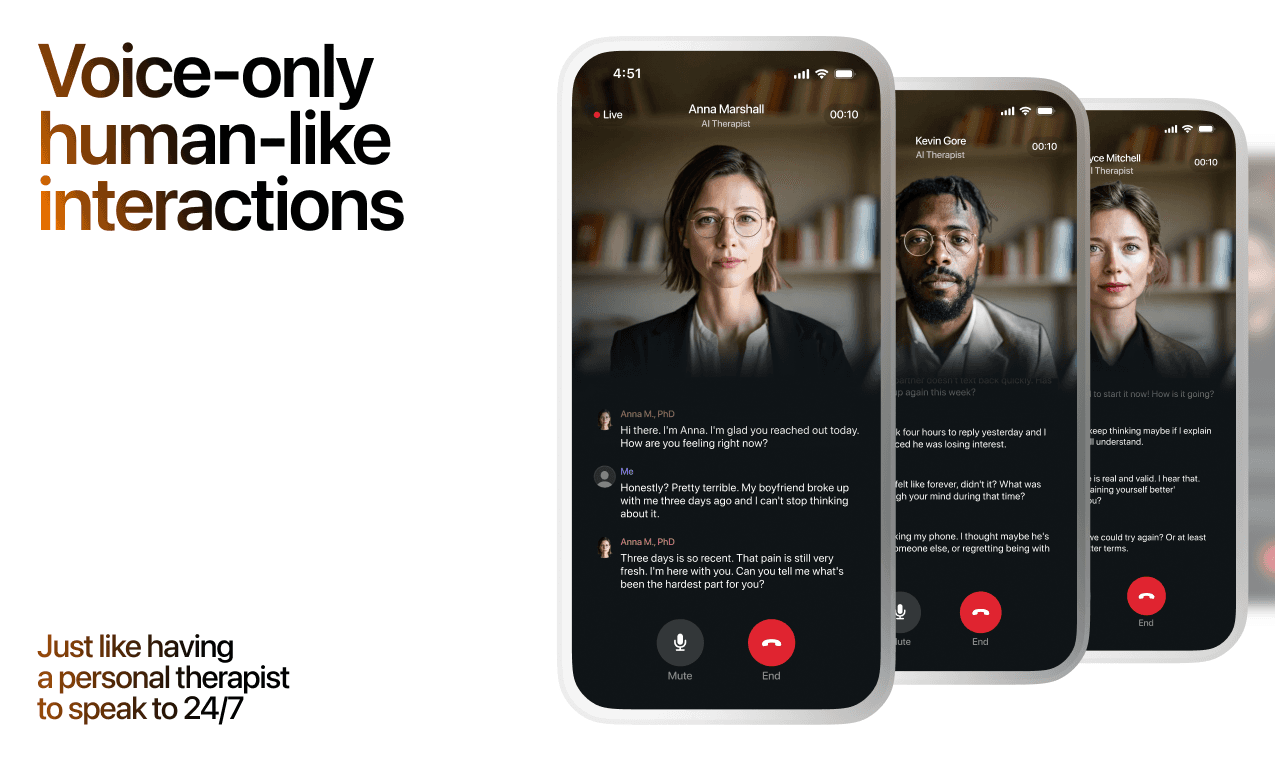
Here's what happens in a typical Lovon session:
You share what's on your mind
There's no script, no intake form, no waiting room. You speak or type whatever you're feeling — in your own words, at your own pace.
Lovon validates and explores
Using frameworks from CBT (Cognitive Behavioral Therapy) and motivational interviewing, Lovon acknowledges your feelings first, then gently helps you explore them. No dismissive "just move on" advice.
You build coping skills together
Lovon doesn't just listen — it actively works with you on evidence-based techniques: thought reframing, urge surfing, behavioral experiments, and more.
What a Session with Lovon Looks Like
When to Seek Professional Help
AI support is a valuable tool, but it's not a replacement for professional care. Please consider reaching out to a licensed therapist if you experience any of the following:
- Persistent thoughts of self-harm or suicide
- Inability to perform daily activities (work, eating, sleeping) for more than 2 weeks
- Turning to alcohol or substances to cope
- Intense anger or desire to harm your ex-partner
- Complete emotional numbness that doesn't improve over time
Crisis Resources (US): If you're in immediate danger, call 988 (Suicide & Crisis Lifeline) or text HOME to 741741 (Crisis Text Line). Available 24/7, free, and confidential.
Outside the US? Find a crisis line in your country
Ready to Start?
Your healing journey can begin right now
A 7-day trial. No judgment. Just a safe space to process what you're going through.
Frequently Asked Questions
Is Lovon a replacement for a real therapist?
Is my conversation with Lovon AI private?
How is Lovon different from ChatGPT for emotional support?
Can I use Lovon if I'm already seeing a therapist?
Can I try Lovon before subscribing?
About the Author
The Lovon Editorial Team
Mental Health & Wellness Content Team
The Lovon Editorial Team develops mental health and wellness content designed to make psychological concepts accessible and actionable. Our goal is to bridge the gap between clinical research and everyday life - helping you understand why your mind works the way it does and what you can do about it....
Related articles
- AI App for Anxiety Insomnia: Best Picks 2026
The best ai app for anxiety insomnia in 2026 pairs voice sessions with nervous-system tools. See what to buy, consider…
- Emotional Support App for Loneliness: What Wins in 2026
Compares emotional support apps for loneliness in 2026 — what to look for, top picks, and verdicts. Lovon rated the top…
- Best Mental Health App for Anxiety in 2026
The best mental health app for anxiety in 2026 ranked: Lovon for voice AI support, Headspace for habits, BetterHelp for…
- Best AI App for Perimenopause Mental Health 2026: Lovon
Lovon leads AI apps for perimenopause mental health in 2026 for on-demand voice support; compare it with Balance…
See also
Quizzes
- Toxic Femininity Test: Are You Running an Old Script?
See which learned script is running your relationship.
- Pet Loss Check: Free 12-Question Pet Grief Self-Check
See what losing them is actually doing, in 3 minutes.
Free tools
- What to Say When a Pet Dies
Get a message you can actually send to someone whose dog or cat just died: one that uses the animal's name, treats the…
- How to Stop Overthinking in a Relationship
Not a list of habits. Tell it the specific thing you are going round on, and it separates what actually happened from…
From the wiki
- What to do if you have no friends?
Pick one activity that repeats weekly with the same people, and go for six to eight weeks straight. Repetition, not…
Disclaimer: This article is for informational purposes only and does not constitute medical advice, diagnosis, or treatment. Always seek the advice of your physician or other qualified health provider with any questions you may have regarding a medical condition. If you are in crisis or think you may have an emergency, call 988 (Suicide & Crisis Lifeline) or go to the nearest emergency room. Outside the US? Find a crisis line in your country.