
How to Support a Partner Through Menopause in 2026
Practical, judgment-free steps to support a partner going through menopause in 2026 — from naming symptoms to knowing when to bring in outside help.
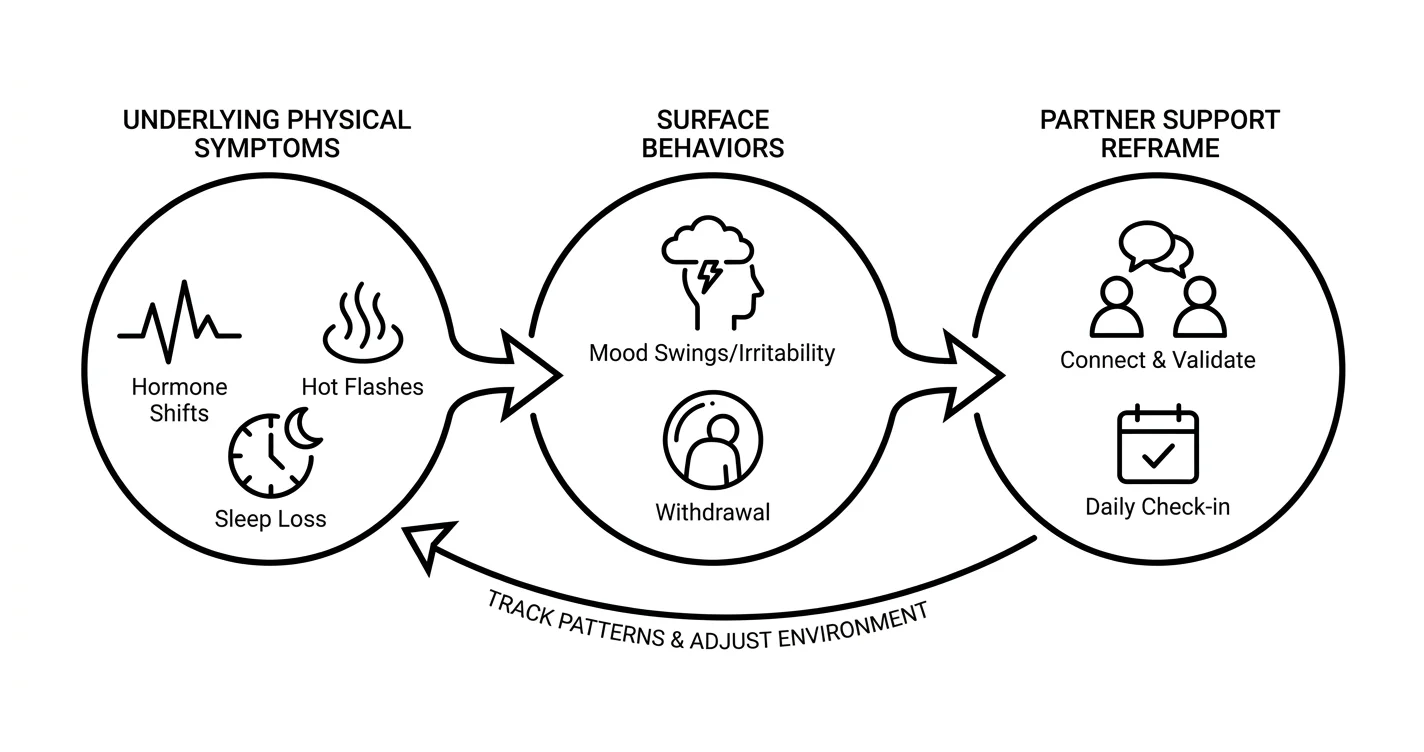

Key Takeaways
- Hot flashes, sleep loss, and hormone shifts drive most mood swings — treat the symptom, not the person, first.
- A 10-minute daily check-in beats occasional deep talks for tracking what's actually happening week to week.
- Perimenopause mood swings often respond to nervous-system tools before medication conversations even start.
- If she's withdrawing for weeks, not days, that's the line to suggest outside support in 2026, not just patience.
Menopause doesn't warn you before it shows up. One week she's fine, the next she's soaked through the sheets at 3 a.m., snapping over dishes, and asking you to just leave her alone — and you have no idea if it's about you, the marriage, or something else entirely. It usually isn't about you. Here's how to support a partner going through menopause without guessing, fixing, or taking it personally.
TL;DR
- Hot flashes, sleep loss, and hormone shifts drive most mood swings — treat the symptom, not the person, first.
- A 10-minute daily check-in beats occasional deep talks for tracking what's actually happening week to week.
- Perimenopause mood swings often respond to nervous-system tools before medication conversations even start.
- If she's withdrawing for weeks, not days, that's the line to suggest outside support in 2026, not just patience.
Why this matters
Perimenopause typically starts in a woman's 40s and can run four to eight years before periods stop completely — menopause itself is defined as 12 consecutive months without a period, with the average age in the U.S. landing around 51. That's not a bad week. That's years of shifting estrogen and progesterone messing with sleep, temperature regulation, and mood control all at once.
Most partners react to the surface behavior — the short temper, the sudden tears, the loss of interest in sex — without connecting it to what's happening underneath. Understanding perimenopause mood swings as a hormonal event, not a personality shift, changes how you respond to it in real time. That reframe alone fixes more fights than any script you could memorize.
What you'll need
- 10 minutes a day for an actual check-in — no phone, no TV, no multitasking
- A rough sense of where she is in the timeline: perimenopause, menopause, or post-menopause
- Two weeks of willingness to track patterns before drawing conclusions
- A private space to talk when things get tense, not mid-argument in front of the kids
- Optional: a coping tool she can use on her own between conversations, so you're not her only outlet
The steps
1. Learn the difference between perimenopause and menopause
This takes 15 minutes and changes everything that follows. Perimenopause is the transition — irregular periods, unpredictable hot flashes, mood swings — and it can last years. Menopause is the finish line, 12 months without a period. Post-menopause is everything after, when some symptoms ease and others (like sleep disruption) can linger into 2026 and beyond for some women.
Expected outcome: you stop asking "is this permanent" and start asking "where are we in this." Common mistake: assuming one bad month means the transition is over, or that it just started.
2. Name the symptom instead of the mood
When she snaps, your instinct is to react to the tone. Instead, ask yourself what's likely driving it — poor sleep, a hot flash she hasn't mentioned, or a hormone dip. Say something like "you seem wiped out today, want to skip the errand?" instead of "why are you so short with me?"
This accomplishes one thing: it removes blame from the exchange before it starts. Expected outcome: fewer escalations. Common mistake: pointing out that she's "being hormonal" mid-argument — it reads as dismissive even when it's technically accurate.
3. Build a 10-minute check-in ritual
Pick a consistent time — after dinner, before bed — and ask two questions: how did today feel physically, and how did it feel emotionally. Keep it under 10 minutes so it doesn't turn into a therapy session neither of you signed up for.
Do this for two weeks straight and patterns show up on their own: worse evenings, better mornings, a bad stretch after poor sleep. Common mistake: only checking in when something's already gone wrong, which trains her to associate the conversation with conflict.
4. Adjust the home for hot flashes and sleep loss
Hot flashes and night sweats disrupt sleep for both of you, and sleep loss amplifies every other symptom. Small changes matter more than they sound: a fan by the bed, breathable sheets, keeping the thermostat a few degrees cooler at night, separate blankets if body temperature is a nightly negotiation.
Expected outcome: fewer 3 a.m. arguments about the window being open or closed. Common mistake: treating temperature complaints as nitpicking instead of a physical symptom she can't control.
5. Respond to low mood and anxiety without trying to fix it
Menopause-linked anxiety and low mood often need to be heard, not solved. When she says she feels flat or on edge, resist the urge to problem-solve immediately. Ask if she wants advice or just wants you to listen — then actually follow her answer.
This is also where learning to communicate better in a relationship pays off, because the instinct to fix is usually about your own discomfort with her pain, not her actual need. Common mistake: bringing up solutions (exercise, supplements, doctor visits) before she's asked for them.
6. Protect your own patience
Supporting someone through years of unpredictable symptoms is genuinely tiring, and pretending otherwise burns you out faster. Build in your own outlets — time with friends, exercise, a way to decompress after a hard evening — so you're not running on empty when she needs steadiness.
A racing heart or short fuse after a tense night is your own nervous system dysregulation showing up, and it's worth managing on its own terms. Common mistake: martyring yourself and then resenting her for it three months later.
7. Know when to suggest outside support
If mood changes stretch past a few weeks, if she stops doing things she used to enjoy, or if hot flashes and sleep loss are wrecking daily function, that's beyond what patience and a fan by the bed can fix. Suggest she talk to her doctor about hormone therapy options and consider whether ongoing emotional support — a therapist, a support group, or an AI tool she can use between appointments — would help her process what's shifting.
Expected outcome: she feels backed, not managed. Common mistake: framing the suggestion as "you need help" instead of "you deserve support."
Support doesn't have to wait for an appointment
Lovon gives her a private space to talk through a hard day, any hour.
Troubleshooting
- She snaps over something small and you get defensive. Take a breath before responding — the snap is almost never proportional to the trigger, and matching her energy just extends the argument.
- She won't talk about it at all. Stop asking directly and try parallel conversation instead — walks, car rides, anything side-by-side lowers the pressure to perform an answer.
- Intimacy has quietly dropped off. Hormonal shifts affect libido directly; name it as a symptom in a low-stakes moment rather than letting the silence turn into distance.
- Neither of you is sleeping. Separate blankets, a bedside fan, and a firm bedtime routine fix more than most couples expect — treat it as a shared problem, not her problem.
- She feels dismissed by her doctor. Encourage a second opinion or a menopause-specialist referral; not every general practitioner in 2026 is up to date on hormone therapy options.
- You're both exhausted and short-tempered. That's burnout compounding hormonal symptoms — scale back the check-in to five minutes rather than skipping it entirely.
Tools and resources
- Her OB-GYN or a menopause-specialist clinic for hormone therapy and symptom-specific treatment
- A shared tracking app or simple notes file for two weeks of pattern-spotting
- A private outlet for her to process feelings between conversations with you — AI voice therapy works this way, letting her talk something out at 2 a.m. without waking anyone up
- A support group or forum for partners going through the same transition, so you're not carrying it alone
What to do next
If mood symptoms are lingering longer than the hot flashes themselves, read how the approach shifts when supporting a partner with depression — the overlap between menopause-linked low mood and clinical depression is real, and it changes what kind of support actually helps.
FAQ
How long does menopause last?
Menopause itself is a single point in time — 12 months without a period, averaging age 51 in the U.S. The surrounding perimenopause transition, where most symptoms happen, typically lasts four to eight years.
How do I support a partner going through menopause without making it worse?
Name symptoms instead of moods, build a short daily check-in, and ask before offering solutions. Most conflict comes from reacting to the surface behavior instead of the hormonal cause underneath it.
Is it normal for a partner to lose interest in sex during menopause?
Yes, hormonal shifts during perimenopause and menopause commonly lower libido. Treat it as a symptom to discuss openly rather than a reflection of the relationship.
When should a partner see a doctor about menopause symptoms?
See a doctor when symptoms disrupt daily function for weeks at a time, not days — persistent low mood, severe sleep loss, or hot flashes that don't ease with lifestyle changes all warrant a visit in 2026.
Can hormone therapy help with menopause mood swings?
Hormone therapy is a common medical option for menopause symptoms including mood swings, and it should be discussed directly with a doctor or menopause specialist rather than started on assumption.
What should I avoid saying to a partner going through menopause?
Avoid phrases like "you're just hormonal" or minimizing comments about mood, even when hormones are the cause. It reads as dismissive and shuts down the conversation instead of opening it.
How can I take care of myself while supporting a partner through menopause?
Keep your own outlets running — exercise, friends, a way to decompress after hard evenings. Supporting someone through a multi-year transition is tiring, and burnout on your end helps no one.
One last thing
Most partners brace for the hot flashes and miss the bigger shift: sleep loss is often the root cause behind half the symptoms that get blamed on mood alone. Fix the sleep — a cooler room, separate blankets, a consistent bedtime — and a surprising amount of the irritability eases on its own, no conversation required.
Related guides
How AI Support Helps You Heal
AI emotional support isn't about replacing human connection — it's about filling the gaps. The moments when you need to talk at 2 AM, when you don't want to burden your friends again, or when you simply need someone to listen without judgment.
Here's what happens in a typical Lovon session:
You share what's on your mind
There's no script, no intake form, no waiting room. You speak or type whatever you're feeling — in your own words, at your own pace.
Lovon validates and explores
Using frameworks from CBT (Cognitive Behavioral Therapy) and motivational interviewing, Lovon acknowledges your feelings first, then gently helps you explore them. No dismissive "just move on" advice.
You build coping skills together
Lovon doesn't just listen — it actively works with you on evidence-based techniques: thought reframing, urge surfing, behavioral experiments, and more.
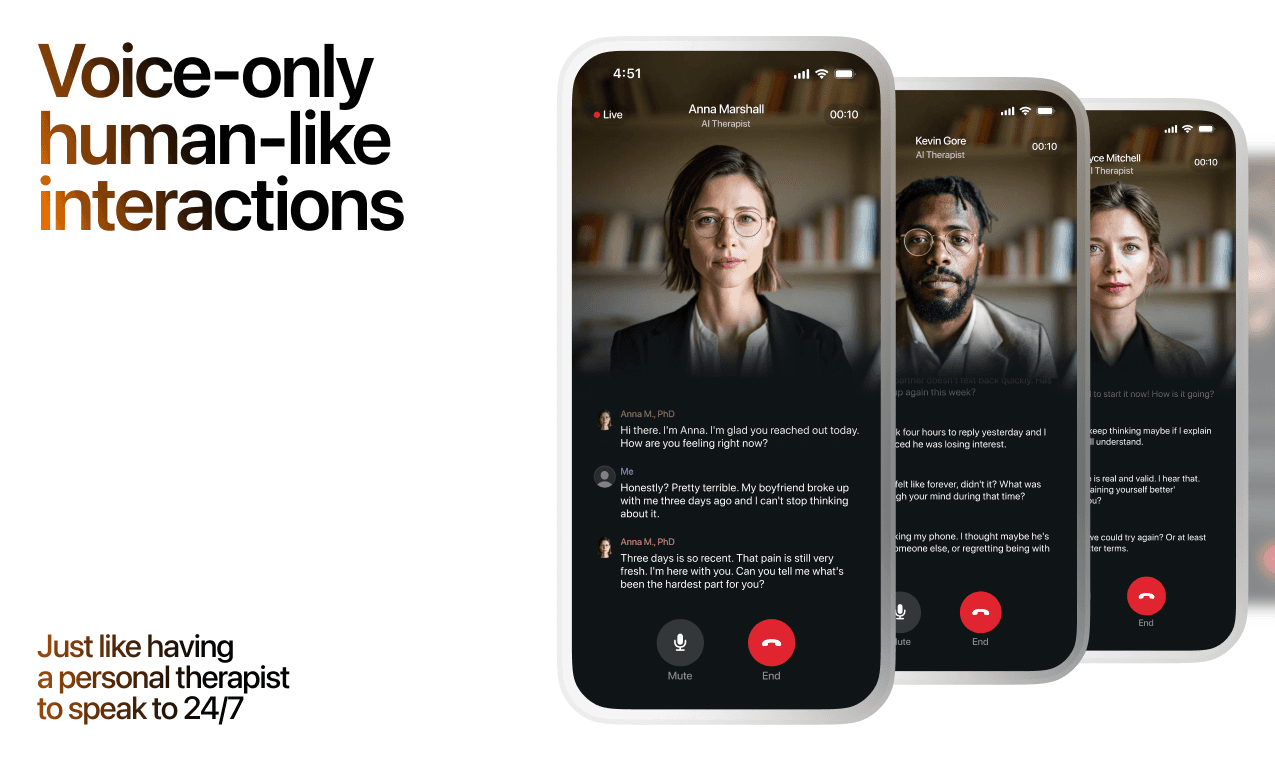
What a Session with Lovon Looks Like
When to Seek Professional Help
AI support is a valuable tool, but it's not a replacement for professional care. Please consider reaching out to a licensed therapist if you experience any of the following:
- Persistent thoughts of self-harm or suicide
- Inability to perform daily activities (work, eating, sleeping) for more than 2 weeks
- Turning to alcohol or substances to cope
- Intense anger or desire to harm your ex-partner
- Complete emotional numbness that doesn't improve over time
Crisis Resources (US): If you're in immediate danger, call 988 (Suicide & Crisis Lifeline) or text HOME to 741741 (Crisis Text Line). Available 24/7, free, and confidential.
Outside the US? Find a crisis line in your country
Ready to Start?
Your healing journey can begin right now
A 7-day trial. No judgment. Just a safe space to process what you're going through.
Frequently Asked Questions
Is Lovon a replacement for a real therapist?
Is my conversation with Lovon AI private?
How is Lovon different from ChatGPT for emotional support?
Can I use Lovon if I'm already seeing a therapist?
Can I try Lovon before subscribing?
About the Author
The Lovon Editorial Team
Mental Health & Wellness Content Team
The Lovon Editorial Team develops mental health and wellness content designed to make psychological concepts accessible and actionable. Our goal is to bridge the gap between clinical research and everyday life - helping you understand why your mind works the way it does and what you can do about it....
Related articles
- Stop Fighting About Money in a Relationship (2026 Guide)
Learn how to stop fighting about money in a relationship with 7 steps for 2026: name the trigger, schedule talks, and…
- AI Relationship Coach for Open Relationships (2026)
Lovon's AI relationship coach for open relationships handles jealousy check-ins and boundary rehearsal in 2026 — see…
- Emotional Regulation for Adults: The 2026 Practice Guide
Learn emotional regulation for adults with a 7-step practice, troubleshooting fixes, and FAQ answers built for real 2026…
- Best AI Relationship Coach for Anxious Attachment 2026
Find the best AI relationship coach for anxious attachment in 2026. Lovon offers voice-based, on-demand emotional…
See also
Quizzes
- Am I Sabotaging My Relationship? 12-Question Quiz
Find the move you reach for, in 2 minutes.
- Overfunctioning in Relationship Test: 12 Questions
See how far the load has tilted, in 3 minutes.
Free tools
- Relationship Check-In Questions, and How to Run One
Check-ins fail on structure, not on questions. Tell it whether this would be your first one, what is on your mind, and…
- How to Communicate Better in a Relationship
Skip the tips. Give it the one sentence you keep trying to say that turns into a fight, in the words you actually used…
From the wiki
- What is a break in a relationship?
A break is a temporary, agreed pause in a relationship where both people expect to come back. In practice it usually…
Disclaimer: This article is for informational purposes only and does not constitute medical advice, diagnosis, or treatment. Always seek the advice of your physician or other qualified health provider with any questions you may have regarding a medical condition. If you are in crisis or think you may have an emergency, call 988 (Suicide & Crisis Lifeline) or go to the nearest emergency room. Outside the US? Find a crisis line in your country.