
Lovon vs Psychology Today: which is better in 2026
Lovon vs Psychology Today: choose voice-based emotional support or a directory for finding a therapist. Compare care limits, privacy, and next steps.


Key Takeaways
- Lovon vs Psychology Today compares voice-based emotional support with a directory for finding human therapists.
- Lovon is best for on-demand voice support and self-reflection, not diagnosis or licensed clinical care.
- Psychology Today is best for comparing therapist profiles and starting a search for professional care.
- Neither an automated conversation nor a directory search replaces emergency mental health support.
Choose Lovon if you want on-demand voice conversations for everyday emotional support; choose Psychology Today if you want to find a human therapist. This 2026 comparison separates a mental health support app from a therapist directory so you can choose the right next step, not just the more appealing interface.
TL;DR
- Lovon vs Psychology Today compares voice-based emotional support with a directory for finding human therapists.
- Lovon is best for on-demand voice support and self-reflection, not diagnosis or licensed clinical care.
- Psychology Today is best for comparing therapist profiles and starting a search for professional care.
- Neither an automated conversation nor a directory search replaces emergency mental health support.
Why this matters
An emotional support app and a therapist directory solve different problems. One gives you a place to talk; the other helps you find someone qualified to provide care.
That distinction matters when you feel overwhelmed. If you want to unpack a difficult workday, a voice conversation fits that task. If you need an assessment, treatment, or help with symptoms affecting daily life, finding a licensed professional is the more appropriate goal.
The useful question in 2026 is not which platform replaces therapy. It is whether your next step is emotional support or a search for clinical care. You can also use both for separate purposes.
At a glance
| Dimension | Lovon | Psychology Today |
|---|---|---|
| Best for | Everyday emotional support through voice conversations | Finding a human therapist |
| Standout feature | On-demand spoken conversations with an automated companion | Therapist profiles and directory search |
| Conversation format | You speak with an automated system | You search for a professional, then discuss their session format |
| Reflection and preparation | Interactive support for organizing feelings and exploring coping tools | Reading about mental health and researching potential therapists |
| Privacy decision | Review how the app handles voice and conversation data | Review directory practices and the contacted provider's policies |
| Clinical care | Not a licensed clinician or a replacement for treatment | A route to finding professionals; the directory itself is not treatment |
| Crisis support | Not an emergency service | Directory browsing is not emergency care |
| Pricing model | Review the app's current billing terms | Discuss treatment billing with the individual provider |
The app wins for support; Psychology Today wins for finding care
Start with what you want to happen next. Do you want to talk through an upsetting moment, or do you want to identify a professional who can work with you?
For the first task, an on-demand voice app offers a direct interaction. You can describe what happened, explore how you feel, and ask for help considering a coping step. You are using a support tool, not beginning a clinical relationship.
For the second task, Psychology Today offers a therapist directory. You can review profiles and search around practical criteria such as location and areas of focus. The next step is contacting a provider, not receiving therapy from the directory.
Best for everyday reflection: the voice app. Best for finding a therapist: Psychology Today. Neither option needs to fail for the other to be useful; each has a different job.
Lovon offers spoken support; Psychology Today offers provider discovery
The voice therapy app lets you have spoken conversations for emotional support, coping tools, and self-reflection. It is built with input from PhD psychologists, but that input does not make the app a licensed clinician.
Voice is the central difference. If you prefer to explain a stressful interaction aloud rather than write it out, the format matches that preference. You do not need a polished account of what happened before beginning a conversation.
The limitation is equally clear: an automated response is not a therapist's assessment. A response that sounds reassuring can still misunderstand your situation or miss important context.
Psychology Today's standout feature is provider discovery. Profiles give you information to begin evaluating possible therapists, but reading a profile does not establish whether you will feel understood in sessions.
- Voice support: best for talking through everyday feelings with an automated companion.
- Provider discovery: best for researching people who offer professional care.
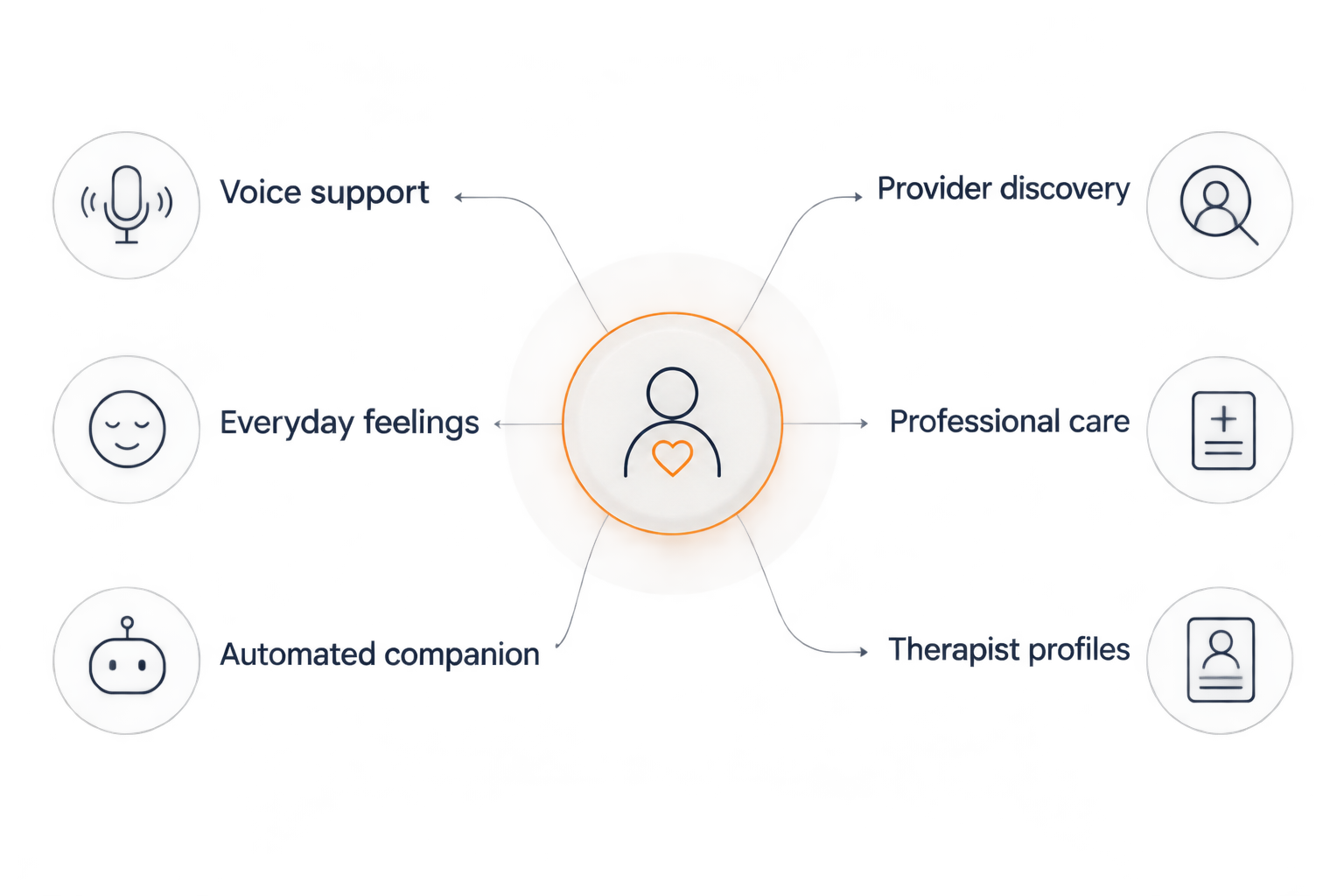 Two columns distinguish automated voice support from finding a professional therapist.
Voice conversations win for talking; profiles win for comparing therapists
A voice conversation and a provider profile demand different kinds of effort. In a conversation, you explain your experience. In a directory, you evaluate information and decide whom to contact.
If you are tired of turning feelings into carefully edited messages, speaking offers a different format. But voice also requires a setting where you feel comfortable being overheard. A shared home, workplace, or public space deserves consideration before you talk about sensitive details.
Psychology Today makes more sense when your task is comparison. You can consider a therapist's stated approach, professional background, and focus before reaching out. Treat that information as a starting point for questions, not proof of a personal fit.
For your 2026 decision, choose the format that serves the task. Talking is not therapist shopping, and therapist shopping is not a therapy session. Keeping those activities separate prevents misleading expectations about either option.
Both support preparation, but neither preparation task is treatment
You can use a support conversation to organize what you want to discuss with a therapist. You can use directory research to identify the kind of help you want to ask about. Both activities support preparation without being equivalent to clinical care.
Try writing down 3 questions before choosing your next step:
- What has been hardest to manage?
- What do I want help understanding or changing?
- Am I seeking everyday support, professional assessment, or both?
These are planning questions, not a screening test. You do not need to diagnose yourself before contacting a therapist or describe your feelings perfectly before asking for help.
The voice app's strength is interaction around what you bring to the conversation. Its limit is that automated guidance cannot establish a diagnosis or replace an individualized treatment plan.
Psychology Today's strength is helping you research professionals and mental health topics. Its limit is that reading and searching do not create a therapeutic relationship. This is a tie for preparation, with different formats rather than interchangeable care.
Neither deserves a privacy win without checking the terms
Mental health information is sensitive whether you speak it into an app or send it through an inquiry form. In 2026, evaluate the actual data practices instead of assuming that a mental health label guarantees confidentiality.
For a voice support app, review how recordings, transcripts, account information, and conversation history are handled. Check deletion controls and whether information is shared with service providers or used to improve systems. These are questions to investigate, not promises about this app's practices.
For a directory, distinguish the website from the professional you contact. Review how an inquiry is handled, then ask the provider about their communication tools and confidentiality policies before sharing a detailed history.
Use this 3-step privacy check:
- Read the relevant privacy terms before entering sensitive details.
- Identify what information the service asks you to share.
- Decide what you are comfortable disclosing through that channel.
Privacy is a tie until you have assessed the relevant policies. A warm conversational tone is not evidence of data protection, and a professional-looking profile is not a substitute for checking credentials.
Psychology Today wins when your goal is a licensed professional
If you want a professional assessment or ongoing treatment, Psychology Today is the better starting point of these 2 options. Its directory is designed to help you find practitioners; the support app is not a licensed clinician.
Begin with practical fit. Look for a professional whose license, location, and stated scope match the care you are seeking. Then ask about their experience with your main concern, their approach, and how they decide whether they are the right provider for you.
A profile is an introduction, not a guarantee. Confirm important details directly with the professional, and verify licensure through the appropriate licensing authority rather than relying only on a listing.
Keep therapy and psychiatry distinct, too. If your goal includes medication assessment, look for an appropriately licensed prescriber. Planning around psychiatrist appointment wait times means asking a practice about its intake process and arranging suitable support while you wait; an automated conversation does not fill the role of a prescribing clinician.
The directory wins for finding clinical care, not for delivering care itself. The actual therapeutic relationship begins with the professional you choose, under that provider's arrangements.
Neither is the right choice for an emergency
Neither a voice support app nor a therapist directory is an emergency response service. Do not rely on automated replies or wait for a directory inquiry when you need immediate help staying safe.
In the United States, call or text 988 to reach the Suicide & Crisis Lifeline if you are in suicidal crisis or emotional distress. Call 911 if there is immediate physical danger or a medical emergency.
You do not need to finish comparing platforms before seeking help. If possible, tell someone you trust what is happening and ask them to stay with you while you connect with appropriate support.
This is a tie on limits: neither option replaces crisis care. Finding a therapist remains important for ongoing needs, but a search process is different from urgent assistance.
Pricing: separate app billing from professional treatment billing
For Lovon, review the current pricing and billing terms before committing. Check what the payment covers, how renewal works, and how you end a paid arrangement. Do not assume that an app payment purchases care from a licensed therapist.
For a professional found through Psychology Today, discuss billing directly with the provider. Ask how sessions are billed, what payment arrangements apply, and what your insurer requires if you intend to use benefits. A directory listing does not establish your individual coverage.
These are different purchasing decisions. App billing concerns access to a software service; professional treatment billing concerns care delivered by a practitioner. Compare each against the job you need done, rather than treating them as cheaper and more expensive versions of the same thing.
For a 2026 budget decision, confirm the service first and the payment terms second. Predictable billing is useful only when the service matches your needs. Neither option earns a value win simply because its payment structure sounds easier.
Final verdict: choose the next step you actually need
Choose Lovon if you want an everyday voice support companion
Best for: someone who wants to talk through stress, relationship frustrations, or difficult feelings with an automated support tool. The mental health app fits self-reflection and coping support, with a clear boundary: it is not a licensed clinician.
Use it with a specific purpose. Name what is bothering you and finish by identifying 1 next action, such as writing down a question for a therapist or preparing a calmer conversation. Do not use reassuring replies as evidence that professional care is unnecessary.
Choose Psychology Today if you want to find a human therapist
Best for: someone ready to research and contact professionals for assessment or ongoing therapy. The directory fits a provider search, especially when you want to compare stated specialties, approaches, and practical details.
Expect to confirm fit directly. A listing helps you decide whom to contact; it does not guarantee that a particular professional will meet your needs. You can also use a separate support tool while pursuing care, without confusing the roles.
| Dimension | Winner |
|---|---|
| Everyday emotional support | Voice support app |
| Finding a therapist | Psychology Today |
| Spoken automated interaction | Voice support app |
| Comparing professional profiles | Psychology Today |
| Reflection and preparation | Tie: different approaches |
| Privacy | No winner without policy review |
| Clinical care search | Psychology Today |
| Emergency support | Neither |
| Payment fit | Choose by service and confirmed terms |
One last thing
Your next step does not have to be your only source of support. A place to reflect and a professional who provides care can serve different roles in the same week.
Before opening either option, finish this sentence: I need help with ___. Then choose the action that answers it: talk through an everyday feeling, research a therapist, or seek urgent human support. That distinction matters more than picking a universal winner.
Related guides
How AI Support Helps You Heal
AI emotional support isn't about replacing human connection — it's about filling the gaps. The moments when you need to talk at 2 AM, when you don't want to burden your friends again, or when you simply need someone to listen without judgment.
Here's what happens in a typical Lovon session:
You share what's on your mind
There's no script, no intake form, no waiting room. You speak or type whatever you're feeling — in your own words, at your own pace.
Lovon validates and explores
Using frameworks from CBT (Cognitive Behavioral Therapy) and motivational interviewing, Lovon acknowledges your feelings first, then gently helps you explore them. No dismissive "just move on" advice.
You build coping skills together
Lovon doesn't just listen — it actively works with you on evidence-based techniques: thought reframing, urge surfing, behavioral experiments, and more.
What a Session with Lovon Looks Like

Lovon is AI support, not a replacement for professional care. If things have been hard to get through for weeks, or you are thinking about harming yourself, talk to a doctor or a licensed therapist.
Ready to Start?
Your healing journey can begin right now
A 3-day trial. No judgment. Just a safe space to process what you're going through.
Frequently Asked Questions
Is Lovon better than Psychology Today?
Does Psychology Today provide therapy itself?
Can a voice support app diagnose anxiety or depression?
Can I use an emotional support app while seeing a therapist?
How should I compare the costs of these options?
Which option is more private in 2026?
What should I use if I need immediate crisis support?
About the Author

The Lovon Editorial Team
Mental Health & Wellness Content Team
The Lovon Editorial Team develops mental health and wellness content designed to make psychological concepts accessible and actionable. Our goal is to bridge the gap between clinical research and everyday life - helping you understand why your mind works the way it does and what you can do about it....
Related articles
- Best AI apps for postpartum depression support in 2026
Compare the best AI apps for postpartum depression support. Choose voice, text, or mood reflection alongside clinical…
- Mental health app for medical residents: complete 2026 guide
Choose a mental health app for medical residents that fits shift work. Compare voice support and licensed care, protect…
- Best BetterHelp alternatives for anxiety support
Compare BetterHelp alternatives for anxiety. Choose Lovon for AI voice support, a licensed therapist for treatment, or…
- Best AI therapy apps with voice conversations in 2026
Compare AI mental health apps with voice conversations. Lovon leads for emotional support; see where general assistants…
See also
Quizzes
- Emotional Contagion Test: Which Moods Do You Catch?
See how moods spread to you and through you, in 3 minutes.
- Fight, Flight, Freeze or Fawn? Stress Response Quiz
Find your first stress response in 3 minutes.
Free tools
- AI Mental Health Coach
This is a free AI mental health coach for ordinary hard stretches: stress, low days, worry that will not switch off, a…
- 60-Second Mental Health Check-In
How are you feeling today, really? Five quick sliders and one feeling word show what stands out, how today compares with…
From the wiki
- Why do I feel sad when I'm alone?
Being alone does not create the sadness. It removes the noise that was keeping it out of earshot, so whatever queued up…
Disclaimer: This article is for informational purposes only and does not constitute medical advice, diagnosis, or treatment. Always seek the advice of your physician or other qualified health provider with any questions you may have regarding a medical condition. If you are in crisis or think you may have an emergency, call 988 (Suicide & Crisis Lifeline) or go to the nearest emergency room. Outside the US? Find a crisis line in your country.