
Best BetterHelp alternatives for anxiety support
Compare BetterHelp alternatives for anxiety. Choose Lovon for AI voice support, a licensed therapist for treatment, or primary care for medical needs.


Key Takeaways
- Among BetterHelp alternatives for anxiety, Lovon fits everyday AI voice support, not clinical treatment.
- Choose a licensed anxiety therapist when you need assessment, treatment planning, or help with persistent avoidance.
- Choose primary care when anxiety overlaps with physical symptoms or medication questions.
- In 2026, compare emotional support, anxiety treatment, and self-help separately; they serve different needs.
BetterHelp connects you with licensed therapists online, making it a useful option when you want professional support without traveling to an office. That does not make it the same service as on-demand emotional support, specialist anxiety treatment, or a medical evaluation. The best BetterHelp alternative in 2026 is Lovon if you need AI voice support for everyday anxiety; an independent licensed anxiety therapist is the better choice if you need clinical assessment and treatment.
TL;DR
- Among BetterHelp alternatives for anxiety, Lovon fits everyday AI voice support, not clinical treatment.
- Choose a licensed anxiety therapist when you need assessment, treatment planning, or help with persistent avoidance.
- Choose primary care when anxiety overlaps with physical symptoms or medication questions.
- In 2026, compare emotional support, anxiety treatment, and self-help separately; they serve different needs.
Why this matters
The most useful alternative depends on what you need to change—not which app has the longest feature list. Talking through a difficult evening is different from treating anxiety that keeps you from work, sleep, or relationships.
Your 2026 shortlist should separate emotional support from licensed care. An AI conversation can offer reflection and coping guidance, but it cannot take responsibility for diagnosis, prescribe medication, or replace a clinician who understands your history.
You also do not have to replace everything at once. You can keep professional care and add a support tool between appointments, provided the tool does not become a reason to postpone needed treatment.
BetterHelp alternatives for anxiety at a glance
This 2026 comparison includes BetterHelp as the benchmark. The alternatives below include different kinds of support rather than treating every option as an interchangeable therapy service.
| Option | Best for | Standout feature | How it differs from BetterHelp | Main limitation |
|---|---|---|---|---|
| BetterHelp | Online conversations with a licensed therapist | Access to licensed therapy through an online platform | Benchmark: clinician-led therapy | An online platform alone does not establish whether a particular therapist fits your anxiety needs |
| Lovon | On-demand emotional support through voice | AI conversations, coping tools, and self-reflection guidance | AI support rather than a licensed therapist | Not a replacement for clinical care |
| Independent licensed anxiety therapist | Individualized anxiety assessment and treatment | Direct selection of a clinician with relevant training | You select a particular practice rather than choosing the platform first | Finding a suitable clinician takes research |
| Primary care clinician | Anxiety alongside physical symptoms or medication questions | Medical evaluation and care coordination | Begins with medical care rather than psychotherapy | A medical visit does not automatically include ongoing therapy |
| Guided self-help | Practicing coping skills independently | Structured exercises you can revisit | You work through material rather than meet with a therapist | No individualized clinical assessment |
BetterHelp's strength is the clinician relationship, not simply the ability to talk online. Its limitation as an all-purpose answer is that a platform name cannot tell you whether you need a different therapist, medical input, or additional support outside therapy.
1. Lovon: best for on-demand AI voice support
This mental health app lets you speak with an AI for emotional support, coping tools, and self-reflection. It is built with input from PhD psychologists and is positioned as an always-available companion—not a licensed clinician.
Lovon is best for people who want AI voice support for everyday anxiety, not a replacement for licensed treatment. You can use that distinction to decide whether you are adding support or seeking a different level of care.
Where it shines
- Voice conversations: You can talk rather than compose a written account of what is bothering you.
- Everyday support: The app addresses concerns including anxiety, stress, relationship difficulties, and burnout.
- Reflection and coping: Its stated purpose includes helping you explore feelings and find coping tools.
Where it falls short
- No licensed clinician: Input from psychologists does not turn an AI conversation into professional therapy.
- No substitute for assessment: Persistent or worsening anxiety needs evaluation by a qualified professional.
- Not emergency care: Do not rely on an AI conversation to keep you safe during a crisis.
| Dimension | AI voice support | BetterHelp |
|---|---|---|
| Who responds | AI | Licensed therapist |
| Primary role | Emotional support and self-reflection | Professional therapy |
| Clinical responsibility | Does not replace clinical care | Therapist provides care within professional scope |
| Appropriate place in your plan | Everyday support alongside needed care | Clinician-led treatment relationship |
Best for: You want to talk through everyday worry and practice coping without treating the conversation as a clinical appointment.
Verdict: Skip as a replacement for therapy; consider it for additional emotional support.
2. Independent anxiety therapist: best for focused clinical care
An independent licensed therapist is the strongest alternative when your priority is finding a particular clinician with anxiety-related training. Start with the person and their approach, rather than the platform that hosts the appointment.
Ask how the therapist assesses anxiety and what treatment would involve. Cognitive behavioral therapy and exposure-based approaches are established treatments for anxiety disorders, but the appropriate approach depends on your assessment and needs.
Where independent therapy shines
- Relevant expertise: You can ask directly about experience with panic, social anxiety, persistent worry, or other concerns.
- Individualized planning: A clinician can assess symptoms and work with you on treatment goals.
- Choice of setting: You can search for a practice offering the format you want, including in-person care.
Where independent therapy falls short
- More selection work: You need to evaluate credentials, approach, and practical fit.
- No automatic match: Working independently does not make a therapist better suited to you.
- Not continuous support: Agree on communication boundaries and what to do between appointments.
| Dimension | Independent anxiety therapist | BetterHelp |
|---|---|---|
| Starting point | A particular clinician or practice | An online therapy platform |
| Selection focus | Relevant training and individual fit | Relevant training and individual fit still matter |
| Appointment setting | Depends on the practice | Online |
| Clinical care | Licensed therapy within professional scope | Licensed therapy within professional scope |
Best for: Anxiety is disrupting your life, or you want a clinician whose training matches a specific concern.
Verdict: Choose for clinical fit, not because private practice automatically means better care.
3. Primary care: best for medical questions alongside anxiety
A primary care clinician is a useful starting point when anxiety comes with physical symptoms, medication questions, or uncertainty about what is happening. Medical evaluation and psychotherapy have different roles; you sometimes need both.
Do not assume unfamiliar physical symptoms are anxiety. A clinician can assess your symptoms, review relevant health factors, and discuss treatment or referral options.
Where primary care shines
- Medical assessment: You can discuss physical symptoms and relevant health history.
- Medication discussion: An appropriately licensed prescriber can assess whether medication belongs in your care plan.
- Coordination: Primary care can help identify a next step, including referral for mental health care.
Where primary care falls short
- Not automatically psychotherapy: A medical appointment is not the same as regular work with a therapist.
- Follow-through matters: Ask who will monitor symptoms and coordinate any referral.
Best for: You need medical assessment or prescribing advice, rather than another conversation app.
Verdict: Choose for medical questions; do not treat it as an automatic substitute for psychotherapy.
4. Guided self-help: best for independent coping practice
Guided self-help includes structured workbooks, educational exercises, and skills practice. It is a different kind of alternative: you are choosing a method of practicing, not a therapist or an AI companion.
Look for material from a recognized health organization or a qualified clinician. Favor clear instructions and realistic limits over promises to eliminate anxiety.
Where guided self-help shines
- Repeatable practice: You can revisit an exercise and record what you notice.
- Clear focus: A resource can concentrate on a specific skill, such as recognizing unhelpful thought patterns.
Where guided self-help falls short
- No individualized assessment: A workbook cannot determine what is causing your symptoms.
- Limited feedback: You can misunderstand an exercise or struggle to apply it without noticing why.
The guide to AI coping tools for anxiety explains another support format to consider alongside independent practice.
Best for: You want structured coping practice and understand when to seek professional help.
Verdict: Skip as your only response to persistent, worsening, or disabling anxiety.
Why people switch from BetterHelp
A useful switching decision starts with your own unmet need. It does not require assuming that BetterHelp is ineffective or that everyone leaves for the same reason.
These are reasons to consider a different route—not claims about BetterHelp users' experiences:
- You want voice-based AI support: An emotional-support app serves a different purpose from a relationship with a licensed therapist.
- You want a specific anxiety specialist: Search for the clinician's relevant training and treatment approach directly.
- You want in-person appointments: An online therapy platform does not meet that preference.
- You need medical input: Physical symptoms and medication questions call for an appropriate medical professional.
- You want independent skills practice: Guided self-help gives you material to work through yourself.
Before changing services in 2026, finish this sentence: I need help with a specific problem that my current arrangement does not address. Name the problem plainly. That gives you a stronger selection rule than choosing the most familiar alternative.
How to choose without starting over unnecessarily
Use these 3 decision steps to separate a support gap from a treatment gap. They are a selection exercise, not a diagnostic test.
Name the gap
Write 1 sentence describing what you need: someone to listen, a treatment plan, medical advice, or a skill to practice. Keep it about your experience rather than a product feature.
Match the support
Ask 2 questions: Who is responding, and what responsibility can that person or tool take? An AI app, a therapist, and a medical clinician give different answers.
Plan the handoff
If you already receive care, discuss a change before ending it. Clarify your next appointment, any ongoing treatment plan, and whom to contact if symptoms worsen.
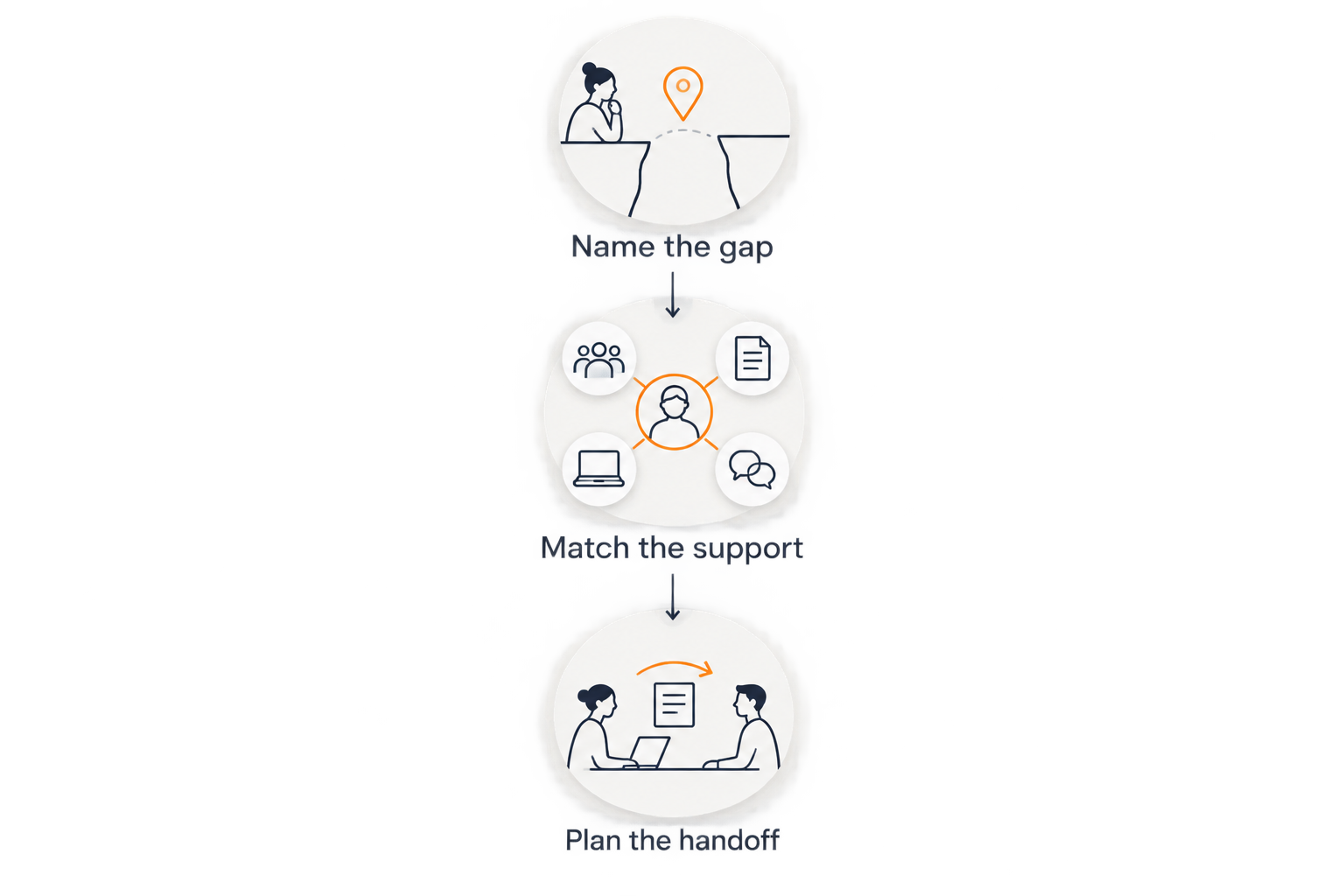 Decision steps for identifying a support gap, choosing appropriate care, and planning a transition
Choose the kind of support you need before choosing its delivery format.
For any app you consider in 2026, read the current privacy terms before sharing sensitive details. Check what information is collected, how it is used, and what deletion options are described; do not assume every mental health app follows the same rules.
When staying with BetterHelp is the right call
Stay with BetterHelp if your therapist is a good fit and the work addresses your goals. A different app is not automatically a better treatment relationship.
If the problem is a lack of support between appointments, tell your therapist. Ask for a clear between-session plan before deciding that you need to replace your care entirely.
If the relationship does not fit, discuss what is missing and what a better match would require. You can change clinicians or formats without dismissing the value of professional care.
One last thing
A calmer conversation is not the same outcome as a smaller anxiety-driven life. When you review any support option, ask whether you are getting help returning to activities that matter—not only finding another place to describe the worry.
You deserve support that fits the task. Keep the listening tool, the coping practice, and the clinical care in their proper roles.
Related guides
How AI Support Helps You Heal
AI emotional support isn't about replacing human connection — it's about filling the gaps. The moments when you need to talk at 2 AM, when you don't want to burden your friends again, or when you simply need someone to listen without judgment.
Here's what happens in a typical Lovon session:
You share what's on your mind
There's no script, no intake form, no waiting room. You speak or type whatever you're feeling — in your own words, at your own pace.
Lovon validates and explores
Using frameworks from CBT (Cognitive Behavioral Therapy) and motivational interviewing, Lovon acknowledges your feelings first, then gently helps you explore them. No dismissive "just move on" advice.
You build coping skills together
Lovon doesn't just listen — it actively works with you on evidence-based techniques: thought reframing, urge surfing, behavioral experiments, and more.
What a Session with Lovon Looks Like

Lovon is AI support, not a replacement for professional care. If things have been hard to get through for weeks, or you are thinking about harming yourself, talk to a doctor or a licensed therapist.
Ready to Start?
Your healing journey can begin right now
A 3-day trial. No judgment. Just a safe space to process what you're going through.
Frequently Asked Questions
What's the best BetterHelp alternative for anxiety in 2026?
Is an AI therapy app the same as seeing a therapist?
Should I switch therapists or switch platforms?
Can I use an anxiety support app between therapy appointments?
When should I choose primary care instead of another therapy app?
What should I ask a therapist about anxiety treatment?
What should I do if I need urgent mental health help?
About the Author

The Lovon Editorial Team
Mental Health & Wellness Content Team
The Lovon Editorial Team develops mental health and wellness content designed to make psychological concepts accessible and actionable. Our goal is to bridge the gap between clinical research and everyday life - helping you understand why your mind works the way it does and what you can do about it....
Related articles
- Freudly alternatives in 2026
Compare Freudly alternatives: choose Lovon for voice-based emotional support, a licensed professional for clinical care…
- Best Freudly alternatives for anxiety support
Compare Freudly alternatives for anxiety. Choose Lovon for AI voice support or licensed therapy for clinical care, with…
- Best ChatGPT alternatives for emotional support in 2026
Compare the best ChatGPT alternatives for therapy. Choose voice support for everyday feelings or licensed care for…
- Psychology Today Alternatives in 2026: 5 Options Compared
Ways to find a therapist besides Psychology Today: BetterHelp and Talkspace match you, Open Path Collective keeps fees…
See also
Quizzes
- Experiential Avoidance Test: Do You Avoid Your Feelings?
See which way you keep feelings out, in 3 minutes.
- Resilience Test: How Fast Do You Bounce Back?
See how you recover from setbacks, in 3 minutes.
Free tools
- Burnout Test
Burned out, or just tired? This burnout test is the Burnout Assessment Tool (BAT) from KU Leuven, used unchanged…
- Sleep Meditation for Anxiety
For lying in bed with a mind that will not stop. About twelve minutes of slower breathing, a place to put the worries…
From the wiki
- Why do I feel lonely all of a sudden?
Sudden loneliness usually traces back to something that quietly ended in the last few months: a routine, a shared class…
Disclaimer: This article is for informational purposes only and does not constitute medical advice, diagnosis, or treatment. Always seek the advice of your physician or other qualified health provider with any questions you may have regarding a medical condition. If you are in crisis or think you may have an emergency, call 988 (Suicide & Crisis Lifeline) or go to the nearest emergency room. Outside the US? Find a crisis line in your country.