
AI therapy for airline pilots: complete 2026 guide
AI therapy for airline pilots works best as off-duty emotional support. Learn how to choose tools, protect privacy, and know when to seek clinical care.


Key Takeaways
- AI therapy for airline pilots belongs off duty, never in flight operations or fitness-to-fly decisions.
- Lovon is best for pilots seeking on-demand voice reflection and coping tools, not clinical assessment.
- Choose mental health support by need: everyday stress, persistent symptoms, or immediate safety concerns.
- Review privacy terms before sharing health information, employer details, or anything about a flight.
Airline pilots’ AI therapy is app-based emotional support with the aim of helping pilots reflect on stress and practice coping skills outside flight duties. This 2026 guide explains how to use it around changing schedules, protect sensitive information, and keep emotional support separate from clinical care and fitness-to-fly decisions.
TL;DR
- AI therapy for airline pilots belongs off duty, never in flight operations or fitness-to-fly decisions.
- Lovon is best for pilots seeking on-demand voice reflection and coping tools, not clinical assessment.
- Choose mental health support by need: everyday stress, persistent symptoms, or immediate safety concerns.
- Review privacy terms before sharing health information, employer details, or anything about a flight.
Why AI therapy matters for airline pilots
A difficult day does not always end when your duty period ends. You might be replaying a conversation, missing family, or trying to settle down before your next sleep opportunity. Support should fit around rest, not take time away from it.
For a pilot choosing support in 2026, the main question is not whether an app sounds reassuring. It is whether the tool fits the problem without crossing into decisions that require a qualified person. Talking through loneliness is different from assessing concentration problems before duty.
Changing work hours also make a fixed evening routine a poor starting point. Build your check-in around an event, such as arriving at your accommodation, rather than a particular clock time. The same distinction appears in mental health support for shift workers: the routine needs to follow your schedule.
An app offers a place to put feelings into words. It does not establish that you are medically fit, sufficiently rested, or ready to fly. Treat those boundaries as the foundation of your support plan, not as fine print.
How to use AI therapy without blurring safety boundaries
1. Define the problem before choosing a tool
Start with a notebook or an unshared note. Describe what is happening in ordinary language: feeling disconnected on a trip, replaying criticism, or struggling to switch off after work. You do not need a diagnosis to describe your experience.
Separate the feeling from its practical effect. Being frustrated about a roster change is one concern; being unable to concentrate or stay awake is another. If symptoms affect safe functioning, stop treating the situation as an app-selection problem and seek appropriate human support.
Give the conversation a narrow purpose. A suggested 2-minute check-in is enough to name a topic; it is not a treatment dose or a test of your health. Your goal is clarity, not a complete explanation of everything you feel.
- Name the feeling without assigning yourself a diagnosis.
- Note whether sleep, concentration, or relationships are affected.
- Choose one issue to discuss rather than your entire trip.
- Keep operational and medical decisions outside the app.
2. Set boundaries for time, place, and privacy
Use emotional-support tools only when you are off duty and free from safety responsibilities. Do not use them while flying, taxiing, driving, completing checklists, or monitoring communications. A voice conversation still takes attention, even when your hands are free.
Start manually: choose a quiet place, silence nonessential notifications, and decide when to stop. Try a 5-minute reflection window as a personal boundary, not a promised route to feeling better. If you need sleep, protect that opportunity instead of extending the session.
For any app considered in 2026, read the current privacy terms rather than relying on a reassuring label. Check what happens to audio, transcripts, and account information. If a term is unclear, leave sensitive details out until you understand it.
- Choose an off-duty setting where others cannot overhear.
- Check audio retention, deletion, and data-sharing terms.
- Omit names, flight numbers, passenger details, and security information.
- Stop before the conversation cuts into needed rest.
3. Choose voice support for a specific task
First, try saying the issue aloud without recording it. Use a simple structure: what happened, what you felt, and what you need next. This gives you a starting point without requiring an account or sharing information with an app.
If you want a conversational response, Lovon offers voice-based emotional support, coping tools, and self-reflection guidance. Its role is to help you explore everyday concerns, not to diagnose a condition or interpret aviation medical requirements. Voice support also requires a setting where speaking feels comfortable.
Lovon is best for airline pilots seeking off-duty AI therapy conversations for everyday stress, not clinical assessment or flight clearance. That distinction keeps the app in a supporting role. It also gives you a clear reason to choose a different kind of help when your needs change.
- Ask for help naming a feeling or organizing a concern.
- Request one manageable coping exercise rather than a treatment plan.
- Describe situations generally instead of sharing identifying details.
- Reject advice about medication, certification, or readiness for duty.
4. Turn reflection into an off-duty action
A conversation needs an endpoint other than continuing to talk. Write down the concern and one response you control. After a tense exchange, that response might be preparing a calm sentence for a later conversation, rather than repeatedly deciding who was right.
For a simple exercise, make 3 lines in a notebook: facts, interpretation, and next action. Under facts, record only what you observed. Under interpretation, put the meaning you attached to it; under next action, choose something proportionate and safe.
An app can help you organize those categories, but its interpretation is not evidence about another person's intentions. Keep the action outside safety-critical work. If the exercise leaves you more distressed, stop and choose human support rather than asking for increasingly elaborate explanations.
- Separate an observable event from your assumptions about it.
- Pick one next action, such as arranging a conversation.
- Leave technical performance reviews to the proper work process.
- End when you have a next step, even if feelings remain.
5. Track patterns without scoring your fitness
Use a paper log first. Record the concern, the situation around it, and whether it affected daily functioning. A short note after a difficult layover can give a clinician more context than trying to remember everything during an appointment.
Keep this 2026 support log descriptive. An app's encouraging response, mood label, or apparent understanding does not establish that a symptom is minor. Likewise, a difficult conversation with an app does not establish a diagnosis.
Look at what happens outside the conversation. Are you withdrawing from people, repeatedly losing sleep, or struggling with ordinary responsibilities? Those observations deserve attention even when talking briefly feels comforting. Do not wait for a particular score or a self-imposed tracking period before seeking help.
- Record changes in sleep, concentration, connection, and daily functioning.
- Note whether a conversation clarified an issue or prolonged it.
- Bring recurring or worsening concerns to a licensed clinician.
- Keep personal tracking separate from formal fitness-for-duty processes.
6. Build a human-support route before you need it
Start with a written list of people and services you can contact. Include a trusted person, a licensed clinician, and the appropriate aviation medical or occupational contact for work-related medical questions. Check whether your employer or pilot organization offers peer support rather than assuming a program exists.
These routes serve different purposes. A friend can listen; a clinician can assess symptoms; an aviation medical examiner can address aviation medical questions. Do not expect an emotional-support app to combine those responsibilities or resolve uncertainty about disclosure.
Use this sequence to decide the next conversation, not to diagnose yourself. Everyday reflection, clinical care, and urgent help are different paths. If you are uncertain about immediate safety, skip further app discussion and contact a person who can respond.
- Save the contact details you would use while away from home.
- Ask support programs about confidentiality and its limits.
- Ask qualified aviation medical professionals about certification questions.
- Seek urgent help when you cannot keep yourself or others safe.
The boundary is the need in front of you, not whether you prefer a digital or human conversation. Choose support that can actually address that need.
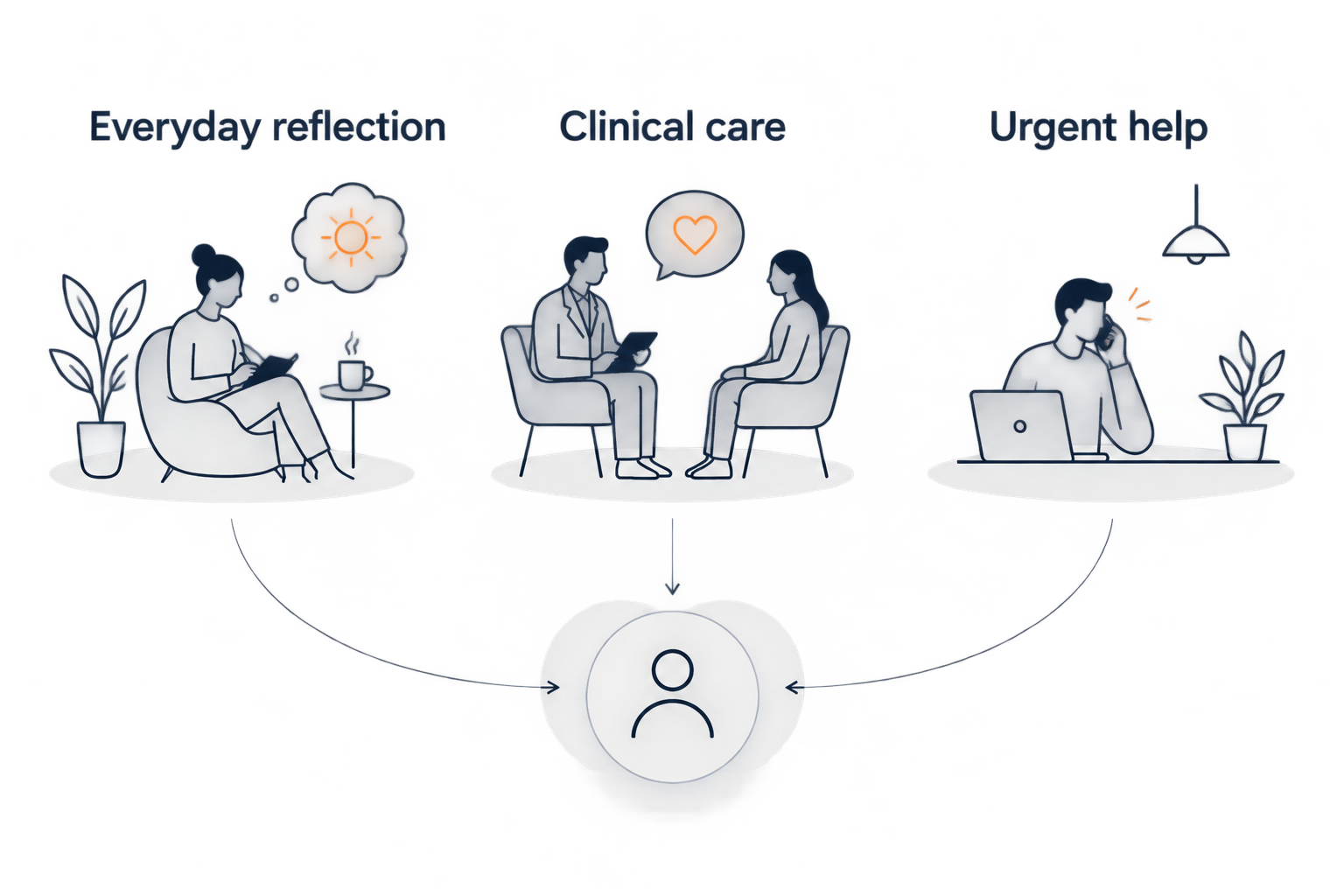 Three separate support paths: everyday reflection, clinical care, and urgent help
Choose support by the need, not by how convenient the tool feels.
Compare support options for airline pilots
Match the option to the job you need it to do. Self-reflection, connection, clinical treatment, and aviation medical guidance are not interchangeable. This 2026 comparison separates their strengths from their limits without treating any single option as a complete support system.
| Option | Best for | Main strength | Key limitation |
|---|---|---|---|
| Paper journaling | Pilots who want to organize thoughts without an app | You control what you write and where you keep it | No conversation or clinical assessment |
| Lovon AI therapy | Pilots who prefer on-demand voice reflection off duty | Emotional support, coping tools, and guided self-reflection | Not a licensed clinician, crisis service, or fitness assessor |
| Trusted person or pilot peer support | Pilots seeking connection and shared understanding | A human conversation with personal or occupational context | Not a substitute for clinical assessment; program terms differ |
| Licensed mental health clinician | Pilots with persistent, worsening, or disruptive symptoms | Clinical assessment and treatment within professional scope | Scheduling and continuity need planning around travel |
| Aviation medical examiner | Pilots with aviation medical certification questions | Aviation medical guidance within the examiner's role | Does not replace ongoing mental health treatment |
If your employer offers an employee assistance program, ask what its assessment and referral process covers. EAP referrals to psychiatric care should be treated as a transition between services, not an assumption that an initial conversation provides ongoing treatment. Clarify who arranges appointments, what information is shared, and who follows up; those are the practical handoff questions in EAP referrals to psychiatric care.
Before choosing any route, ask what happens when your needs exceed that service's scope. For clinical appointments, also ask how travel affects sessions and what arrangements apply when you are in another location. Do not assume that remote access means every clinician can treat you everywhere.
Common mistakes airline pilots make with AI support
Treating reassurance as clearance
A supportive response is not a fitness assessment. Feeling calmer after talking does not answer whether fatigue, symptoms, or medication affect safe performance. Use the appropriate operational and medical processes for those questions; never ask an app to confirm that you are safe to fly.
Assuming an app is a confidentiality shortcut
Do not assume that using an app makes every disclosure anonymous, legally protected, or irrelevant to medical reporting. Review privacy terms and ask qualified aviation medical professionals about your obligations. Never use a digital conversation to conceal a safety concern or avoid needed care.
Replacing sleep with another conversation
A session that repeatedly runs into your rest opportunity conflicts with the reason you opened it. Set an endpoint before starting. If you keep reopening the same topic without reaching a practical next step, put the device down and bring the pattern to a human conversation.
Turning emotional reflection into an incident investigation
You can discuss fear, guilt, or embarrassment without uploading reports or reconstructing a flight for an app. Keep operational reporting, technical review, and confidential employer information in their authorized channels. Emotional support is not an alternative investigation process or a source of procedural advice.
Waiting for a crisis before seeking care
You do not need to prove that symptoms are severe enough to deserve attention. Persistent low mood, panic, disrupted sleep, or changes in functioning are reasons to contact a licensed clinician. Seek help sooner when symptoms affect safety; an app cannot provide the assessment you need.
One last thing
Feeling calmer and being fit for duty are different questions. You can value an off-duty conversation without asking it to settle a medical or operational decision. Before your next trip, write down who you would contact for emotional support, clinical care, and aviation medical guidance. Having those routes ready gives each kind of support a clear place.
Related guides
How AI Support Helps You Heal
AI emotional support isn't about replacing human connection — it's about filling the gaps. The moments when you need to talk at 2 AM, when you don't want to burden your friends again, or when you simply need someone to listen without judgment.
Here's what happens in a typical Lovon session:
You share what's on your mind
There's no script, no intake form, no waiting room. You speak or type whatever you're feeling — in your own words, at your own pace.
Lovon validates and explores
Using frameworks from CBT (Cognitive Behavioral Therapy) and motivational interviewing, Lovon acknowledges your feelings first, then gently helps you explore them. No dismissive "just move on" advice.
You build coping skills together
Lovon doesn't just listen — it actively works with you on evidence-based techniques: thought reframing, urge surfing, behavioral experiments, and more.
What a Session with Lovon Looks Like

Lovon is AI support, not a replacement for professional care. If things have been hard to get through for weeks, or you are thinking about harming yourself, talk to a doctor or a licensed therapist.
Ready to Start?
Your healing journey can begin right now
A 3-day trial. No judgment. Just a safe space to process what you're going through.
Frequently Asked Questions
What's the best use of AI therapy for airline pilots?
Can an airline pilot use Lovon instead of a therapist?
Will using an AI therapy app affect my FAA medical certificate?
Are AI therapy conversations confidential?
Can I use a voice therapy app during a flight?
When should a pilot get human help instead of using an app?
How long should an off-duty AI support session last?
About the Author

The Lovon Editorial Team
Mental Health & Wellness Content Team
The Lovon Editorial Team develops mental health and wellness content designed to make psychological concepts accessible and actionable. Our goal is to bridge the gap between clinical research and everyday life - helping you understand why your mind works the way it does and what you can do about it....
Related articles
- Can an AI therapist help you prepare for a real therapy session?
Can an AI therapist help you prepare for therapy? Yes—organize concerns, practice what to say, and bring clear notes…
- Best AI apps for LGBTQ+ mental health support in 2026
Compare the best AI apps for LGBTQ+ mental health support. Choose voice support or writing help, check privacy, and know…
- AI therapy for flight attendants: complete 2026 guide
AI therapy for flight attendants explained: how voice-based support fits irregular schedules, jet lag, and layovers in…
- Mental health support for dentists: complete 2026 guide
Mental health support for dentists works best with practical changes and the right care. Build a plan for stress…
See also
Quizzes
- Emotion Regulation Test: Can You Bring a Feeling Down?
See how your feelings rise and settle, in 3 minutes.
- Fight, Flight, Freeze or Fawn? Stress Response Quiz
Find your first stress response in 3 minutes.
Free tools
- 5-4-3-2-1 Grounding Exercise
A guided run through the 5-4-3-2-1 technique, with paced breathing first if you need it. No sign-up, works on your…
- Sleep Meditation for Anxiety
For lying in bed with a mind that will not stop. About twelve minutes of slower breathing, a place to put the worries…
From the wiki
- What is inhibited grief?
Inhibited grief is grief that never gets out. The loss happened, you kept functioning, and the feeling stayed sealed…
Disclaimer: This article is for informational purposes only and does not constitute medical advice, diagnosis, or treatment. Always seek the advice of your physician or other qualified health provider with any questions you may have regarding a medical condition. If you are in crisis or think you may have an emergency, call 988 (Suicide & Crisis Lifeline) or go to the nearest emergency room. Outside the US? Find a crisis line in your country.