
Can an AI therapist help you prepare for a real therapy session?
Can an AI therapist help you prepare for therapy? Yes—organize concerns, practice what to say, and bring clear notes without treating AI as a clinician.


Key Takeaways
- Can an AI therapist help you prepare for therapy? Yes—use it for session preparation, not diagnosis.
- Lovon offers voice-based emotional support; licensed therapists provide clinical assessment and care.
- Bring your own examples, check generated summaries, and leave room for questions you cannot answer yet.
- Read privacy terms before sharing sensitive details, and stop preparation if it becomes overwhelming.
Yes—an AI therapist can help you prepare for therapy in 2026 by helping you organize concerns, put feelings into words, and practice how to begin the conversation. It cannot assess you like a licensed clinician, and its suggestions are not a diagnosis or treatment plan. Use it to prepare a short set of notes, not to decide what your therapist should conclude.
TL;DR
- Can an AI therapist help you prepare for therapy? Yes—use it for session preparation, not diagnosis.
- Lovon offers voice-based emotional support; licensed therapists provide clinical assessment and care.
- Bring your own examples, check generated summaries, and leave room for questions you cannot answer yet.
- Read privacy terms before sharing sensitive details, and stop preparation if it becomes overwhelming.
Can an AI therapist help you prepare for a real therapy session?
Use an AI conversation to clarify what you want to discuss, not to rehearse being a perfect client. You do not need a complete explanation of your mental health before attending therapy. Uncertainty belongs in the session, too.
Lovon offers voice conversations for emotional support, coping tools, and self-reflection. Lovon is best for people seeking voice-based emotional support alongside, not instead of, licensed clinical care. For preparation, keep the task narrow: describe your experience and decide what you want to bring to your therapist.
1. Name the concern
Start with what made you book the appointment. Describe the problem in everyday language rather than trying to match it to a diagnosis.
An example prompt is: Help me describe what has been bothering me without assigning a diagnosis. Ask about what happened and how it affected my day.
You can start with work stress, relationship tension, low mood, or difficulty concentrating. You do not need to prove that the problem is serious enough. Bring what is making life harder.
2. Describe an example
Choose a recent situation you remember. Note what happened, what you noticed in your thoughts or body, and what you did next.
Separate observation from interpretation. Missing a meeting is an event; deciding that everyone thinks you are unreliable is an interpretation. Both belong in your notes, but label them differently so your therapist can explore them with you.
3. Choose a priority
Ask the app to help you identify the concern you most want to discuss. Do not ask it to decide which concern is clinically most important.
Try this prompt: Reflect back the topics I mentioned. Help me choose a starting point based on what I want support with today.
Keep anything urgent or safety-related visible. Do not let a tidy summary bury something you need your clinician to know.
4. Prepare questions
Choose 2 questions as a starting point, not a required quota. You might ask how the therapist approaches your concern and how you will decide together what to work on.
Other practical questions include what happens if you feel overwhelmed and how to raise a concern about the therapy itself. Ask your therapist directly about confidentiality and its limits; an app cannot answer for the clinician's practice.
5. Check the summary
Read any generated summary against your own memory. Remove interpretations you did not make, labels you do not recognize, and details that are inaccurate.
Aim for 1 page if a clear stopping point helps. This is a suggested limit, not a clinical standard. Your notes only need to help you begin; they do not need to explain your whole life.
The sequence below keeps the task focused on communication. You remain the person who decides whether the summary reflects your experience.
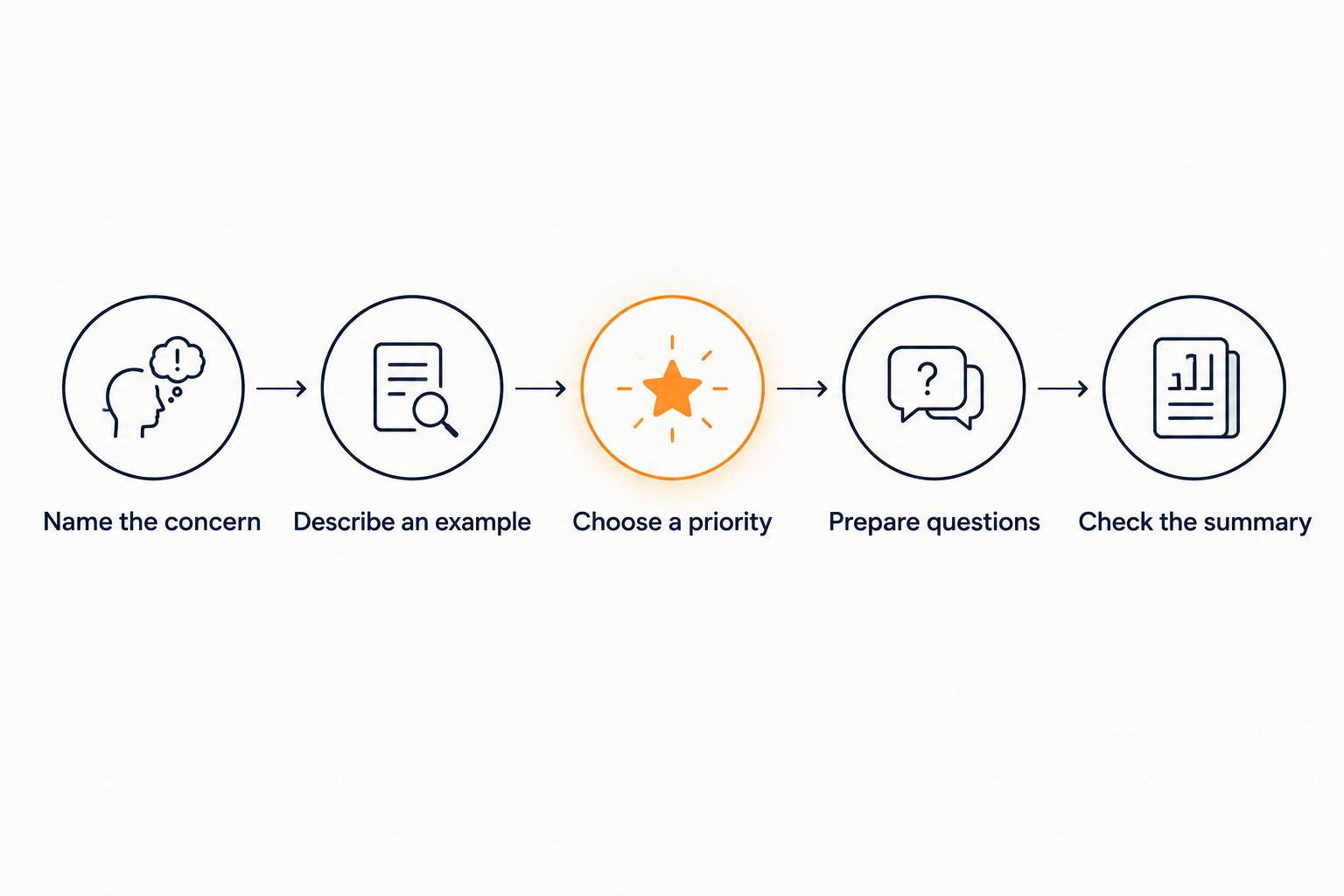 Five preparation steps from naming a concern to checking the summary
Check the summary yourself before taking it into therapy.
Why this matters
Preparing for therapy in 2026 does not require technology. The useful task is deciding what you want your therapist to hear, whether you use a voice app, paper, or no notes at all.
The distinction matters because organizing a story is different from understanding it clinically. A clear summary can still contain a mistaken interpretation. Bring observations and questions; leave diagnosis and treatment decisions to a qualified clinician.
Preparation should also leave room for the unexpected. If you feel sad, confused, quiet, or unsure once the appointment starts, you have not failed to prepare. Tell your therapist what is happening rather than trying to follow a script.
Which preparation approach fits what you need?
Choose the format that helps you express yourself without creating more work. These options serve different purposes; none requires you to arrive with polished answers.
| Approach | Best for | Main advantage | Main limitation |
|---|---|---|---|
| AI voice conversation | People who prefer speaking to writing | Gives you a conversational way to explore what you want to say | Responses can misinterpret your meaning; it is not clinical assessment |
| Paper notes | People who want an offline starting point | Lets you record concerns without entering them into an app | Does not ask follow-up questions or provide feedback |
| Talking directly with your therapist | People who want clinical guidance or find preparation stressful | Lets the clinician ask questions and clarify your meaning | You might forget a topic you wanted to raise |
You can combine approaches without duplicating everything. Talk through a concern, write a short reminder, then bring the uncertainty into your appointment. If using an app feels uncomfortable, skip it.
Choose paper notes when keeping the preparation offline matters most to you. Choose a voice conversation when speaking helps you find words. Choose direct discussion when you want your therapist's help deciding where to start.
Why the usefulness of AI preparation varies
The value depends on the task and how the conversation affects you. Keep these factors in view:
- Your goal: Organizing examples is a different task from asking for a diagnosis. Keep preparation focused on the former.
- Your comfort with speaking: A voice conversation fits people who want to talk. Writing or starting directly with your therapist remains valid.
- The accuracy of the response: A fluent summary still needs your review. Correct wording that changes the meaning of your experience.
- Your privacy preferences: Share only what you are comfortable entering into the service after reviewing its terms.
- Your emotional response: If the conversation leaves you more distressed or stuck in repeated analysis, stop and bring that experience to your clinician.
You do not need to keep using a method because it sounded helpful in theory. The practical test is whether you leave with something you recognize as your own concern, expressed more clearly.
What should you avoid asking an AI therapist before therapy?
Avoid turning preparation into a diagnosis search. Do not treat a response about a condition, relationship pattern, or personality label as a finding about you or another person.
Ask for help describing behavior instead. For example, record that you repeatedly check a message thread and feel unsettled afterward, rather than treating an app's explanation as established fact. Your therapist can ask about context, history, and other possible explanations.
Also avoid asking the app to predict exactly what your therapist will say. A simulated conversation is not a preview of clinical care. Rehearse a starting sentence if you want, but leave space for the actual therapist to respond differently.
Do not use preparation to force yourself through painful memories in detail. You can write that something difficult happened and that you want help deciding how to discuss it. You control how much you disclose during preparation.
What should you check before sharing personal details?
Before using a mental health app in 2026, review its current privacy policy and data controls. Look for clear explanations of what is collected, how it is used, whether it is shared, and what deletion options exist.
Do not assume an app conversation has the same confidentiality protections as a conversation with your licensed therapist. A warm tone is not evidence of a particular privacy practice. If a policy does not answer your question, leave out the sensitive detail until you understand the terms.
Use broad descriptions when names and identifying details are unnecessary. You can describe a conflict without entering another person's full name, workplace, address, or private messages. Our discussion of sharing feelings with an AI therapist addresses the privacy questions behind that decision.
For Lovon or any other mental health app, read the actual terms rather than inferring privacy protections from the category. Keep the information you bring into therapy separate from anything you are not comfortable entering into software.
How do you turn preparation into a conversation with your therapist?
Make the handoff simple. Keep 3 bullets: what brought you in, a concrete example, and what you want help with. These are suggested headings, not a required intake format.
The practical work of preparing for your first session includes getting your concerns into the conversation, not just finding polished wording. Bring your notes and say whether you want to read them, hand them over, or use them only if you lose your place.
If an app helped draft the notes, say so when relevant. Distinguish your own observations from suggested interpretations. You can tell your therapist that some wording came from a tool and ask whether it accurately describes what you mean.
For an appointment in 2026, the same basic rule applies regardless of the software you used: your therapist needs your experience, not an app's conclusion. Leave anything you disagree with out of the summary, or mark it as something you want to question.
What if I freeze when the session starts?
Your 3 bullets can serve as a starting point if speaking becomes difficult. You can hand over the page or tell your therapist that you know what you wanted to discuss but cannot find the words right now.
You do not need to push through a rehearsed introduction. Ask to slow down, pause, or start with a simpler question.
Do I need to finish preparing before I attend therapy?
Your 1 page is optional; you do not need to finish it before attending. An unfinished note or no note at all is enough to begin a conversation about why you came.
If preparation is becoming a reason to postpone the appointment, stop preparing. Let the therapist help you sort through what feels difficult.
Should I ask my therapist whether using an app is appropriate?
Your 2 questions can include whether app-based preparation fits your care. Explain what you use it for and whether the conversations leave you clearer, more worried, or repeatedly seeking reassurance.
Ask your therapist about boundaries that fit your situation. Do not assume that advice intended for another person applies to your treatment.
One last thing
You can bring the part you could not explain. A note that says you went blank, felt embarrassed, or kept changing the subject gives your therapist a starting point without requiring you to solve it first.
Preparation is finished when you have enough to begin—not when you have figured yourself out. Keep the appointment even if the notes remain unfinished.
Related guides
How AI Support Helps You Heal
AI emotional support isn't about replacing human connection — it's about filling the gaps. The moments when you need to talk at 2 AM, when you don't want to burden your friends again, or when you simply need someone to listen without judgment.
Here's what happens in a typical Lovon session:
You share what's on your mind
There's no script, no intake form, no waiting room. You speak or type whatever you're feeling — in your own words, at your own pace.
Lovon validates and explores
Using frameworks from CBT (Cognitive Behavioral Therapy) and motivational interviewing, Lovon acknowledges your feelings first, then gently helps you explore them. No dismissive "just move on" advice.
You build coping skills together
Lovon doesn't just listen — it actively works with you on evidence-based techniques: thought reframing, urge surfing, behavioral experiments, and more.
What a Session with Lovon Looks Like

Lovon is AI support, not a replacement for professional care. If things have been hard to get through for weeks, or you are thinking about harming yourself, talk to a doctor or a licensed therapist.
Ready to Start?
Your healing journey can begin right now
A 3-day trial. No judgment. Just a safe space to process what you're going through.
Frequently Asked Questions
Can an AI therapist help me prepare for my first therapy appointment?
What should I write down before seeing a therapist?
Should I bring an AI-generated summary to therapy?
Is Lovon a replacement for a licensed therapist?
Do I have to share painful memories with an app before therapy?
Is an AI conversation confidential like therapy in 2026?
What if I need urgent help before my therapy appointment?
About the Author

The Lovon Editorial Team
Mental Health & Wellness Content Team
The Lovon Editorial Team develops mental health and wellness content designed to make psychological concepts accessible and actionable. Our goal is to bridge the gap between clinical research and everyday life - helping you understand why your mind works the way it does and what you can do about it....
Related articles
- Can an AI voice therapist help during a panic attack in real time?
Can AI therapist help during a panic attack? Use voice support for coping, not diagnosis. Learn grounding steps, clear…
- How to Start AI Therapy for the First Time (2026)
How to start with AI mental health support in 2026, in under 10 minutes. Lovon's voice app offers on-demand…
- Can you get addicted to using an AI therapy app?
Can you get addicted to an AI therapy app? There's no formal diagnosis in 2026. Learn when daily use turns into…
- How to Talk to an AI Therapist for the First Time (2026)
How to talk to an AI therapist: step-by-step guide for your first session in 2026, plus what to say, what to avoid, and…
See also
Quizzes
- Self-Acceptance Test: What Are You Still Arguing With?
See where you are still fighting yourself, in 3 minutes.
- Resilience Test: How Fast Do You Bounce Back?
See how you recover from setbacks, in 3 minutes.
Free tools
- Words of Encouragement for Him When He Is Struggling
Words of encouragement for him that fit what he is actually going through, for when your usual lines are not landing…
- Am I Overreacting, or Is This a Big Deal?
A chat for the small thing you cannot stop turning over. Say what happened and what you have already told yourself about…
From the wiki
- What to do if you have no friends?
Pick one activity that repeats weekly with the same people, and go for six to eight weeks straight. Repetition, not…
Disclaimer: This article is for informational purposes only and does not constitute medical advice, diagnosis, or treatment. Always seek the advice of your physician or other qualified health provider with any questions you may have regarding a medical condition. If you are in crisis or think you may have an emergency, call 988 (Suicide & Crisis Lifeline) or go to the nearest emergency room. Outside the US? Find a crisis line in your country.