
Midlife Crisis Signs 2026: What They Mean and Next Steps
Spot the real midlife crisis signs in 2026, tell them apart from depression, and get a step-by-step plan for navigating the transition without regret.
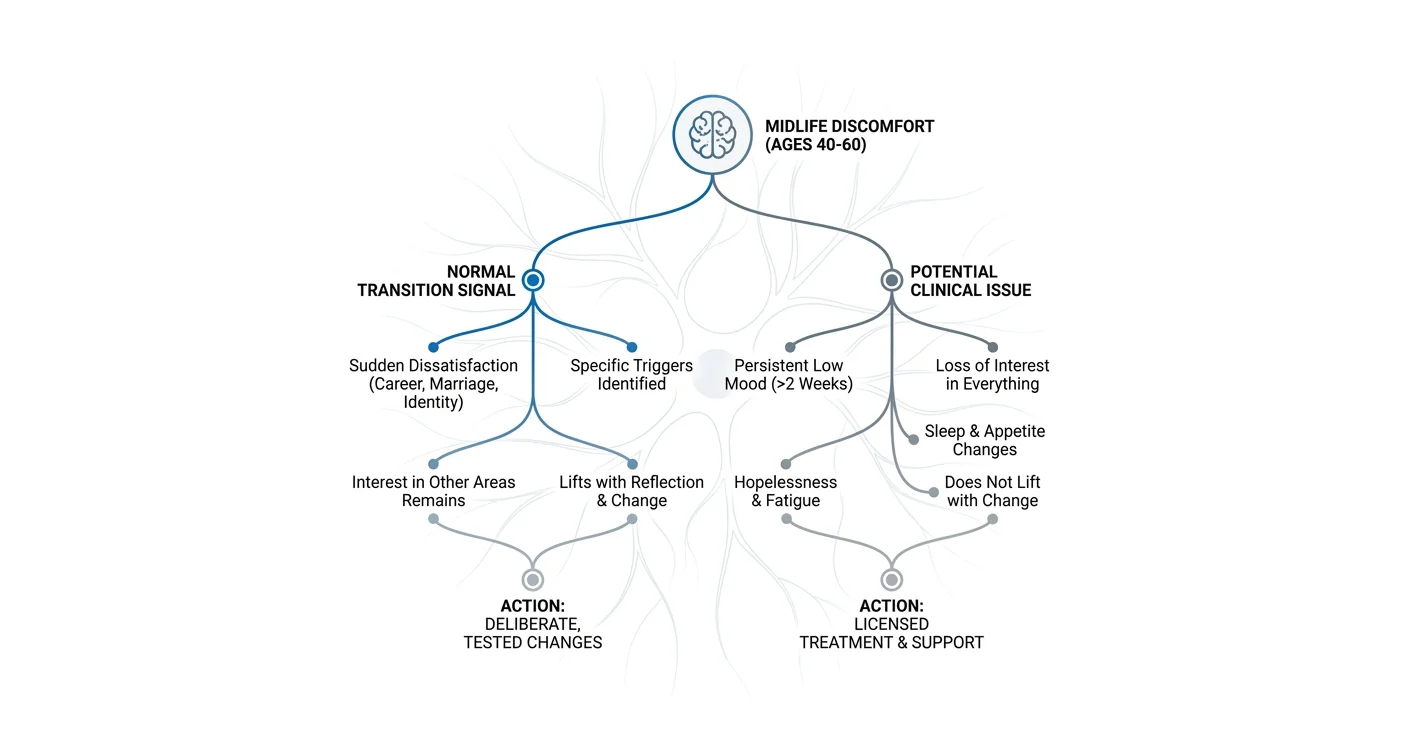

Key Takeaways
- Midlife crisis signs include sudden dissatisfaction with your career, marriage, or identity, usually between ages 40
- The transition itself is not a diagnosis — treat it as a signal to reassess, not a reason to blow up your life
- Distinguishing a midlife crisis from clinical depression matters: one lifts with reflection and change, the other
- Small, deliberate moves — naming the feeling, testing changes before making them permanent — beat impulsive
A midlife crisis doesn't arrive with a warning label — it shows up as sudden restlessness, a marriage that feels flat, or a career you spent twenty years building that now feels pointless. This guide breaks down the real midlife crisis signs, walks through what to do about them step by step, and tells you when the discomfort is a normal transition versus something that needs more support.
TL;DR
- Midlife crisis signs include sudden dissatisfaction with your career, marriage, or identity, usually between ages 40 and 60.
- The transition itself is not a diagnosis — treat it as a signal to reassess, not a reason to blow up your life overnight.
- Distinguishing a midlife crisis from clinical depression matters: one lifts with reflection and change, the other needs treatment.
- Small, deliberate moves — naming the feeling, testing changes before making them permanent — beat impulsive overhauls in 2026 as much as they did a decade ago.
Why this matters
Calling something a "midlife crisis" can sound like a punchline — the sports car, the affair, the sudden yoga retreat. The lived experience is less funny: a persistent sense that your life doesn't fit anymore, paired with anxiety about how much time is left to fix it.
Left unexamined, that discomfort tends to leak into decisions you'll regret — quitting a stable job on impulse, ending a relationship without trying repair first, or numbing out with spending or substances. Left completely ignored, it can also mask something clinical. The line between burnout vs depression and a midlife identity shift is not always obvious, and getting that distinction wrong means you either overreact to a normal life stage or underreact to a mental health condition that needs real treatment.
The goal here isn't to talk you out of change. It's to help you tell the difference between a signal worth acting on and a mood worth riding out, then give you a structured way to respond either way.
What you'll need
- Two weeks of honest self-observation — a notes app, journal, or voice memo works; you're tracking patterns, not writing an essay
- One person who will tell you the truth — a spouse, close friend, or sibling who won't just agree with whatever you say
- A private space to talk through what's actually bothering you, whether that's a therapist, a support group, or an AI voice support session you can use at 11pm when the thought won't leave you alone
- A financial snapshot — you can't evaluate a career or lifestyle change without knowing what you can actually afford to risk
- Patience for a 60 to 90 day window before making any irreversible decision
The steps
1. Name what's actually changed
Most people describe a midlife crisis as a vague fog — "I just feel off" — without identifying the specific trigger. Vague feelings produce vague, often destructive responses.
Spend three days writing down every moment you feel the dissatisfaction spike. Is it during your commute? After scrolling old photos? When a colleague younger than you gets promoted? By day three, a pattern usually surfaces: career stagnation, physical aging, an empty-nest transition, or a marriage that's been coasting for years.
Common mistake: journaling in generalities like "I'm unhappy" instead of specifics like "I resent that I haven't changed jobs in nine years." Specific triggers are actionable; vague unhappiness isn't.
2. Separate the feeling from the fantasy
Midlife crisis signs often come bundled with a fantasy solution — a new partner, a total career pivot, a move across the country. The fantasy feels like the answer, but it's usually a stand-in for something narrower: wanting to feel desired again, wanting autonomy, wanting to matter.
Ask what the fantasy is actually giving you emotionally. If the answer is "feeling like I have options again," you may not need to leave your marriage — you might need to rebuild a sense of agency inside it, or outside it, in ways that don't require detonating everything.
3. Rule out a mood disorder before you rule in a life crisis
This step gets skipped constantly, and it's the one that matters most. Persistent low mood, loss of interest in everything (not just your job), sleep and appetite changes, and hopelessness that doesn't lift when things go well are signs of depression, not a normal midlife transition.
Review the functional depression signs that get mistaken for "just being tired" or "just going through something." If several apply and have lasted more than two weeks, this isn't a life-stage adjustment — it's a clinical picture that needs a licensed provider, not just a career change.
Expected outcome: by the end of this step you know whether you're navigating a transition or managing a treatable condition alongside it — often it's both.
4. Talk it out before you act it out
Decisions made in isolation, at 2am, after a bottle of wine, are how midlife crises turn into divorces and bankruptcies people regret in 2026 the same way they did in 2006. Talking it through — with a partner, a therapist, or a voice conversation you can have on your own schedule — slows the impulse long enough for it to become a decision instead of a reaction.
An AI voice therapist won't replace a licensed clinician for a major life decision, but it's useful for the 11pm spiral when no one else is awake and you need to think out loud before you do something you can't undo.
5. Reassess the career piece on its own timeline
Career stagnation is one of the most common midlife crisis triggers, and it's also the one people act on fastest and regret most. Before quitting or making a drastic pivot, separate "I hate this specific role" from "I hate my whole field" from "I'm burned out and need rest, not a new job."
Explore career burnout coaching support to pressure-test whether the fix is a new job, a sabbatical, or a boundary change inside the job you already have. Buy the reflection time; skip the resignation letter until you've done it.
6. Rebuild the relationship instead of exiting it
If the midlife crisis is showing up as distance from a spouse or partner, resist the urge to interpret that distance as proof the relationship is over. Long relationships go flat for stretches — it's common, not fatal, and it responds to deliberate effort more often than people expect.
Try structured conversation before structural change: a weekly check-in, a shared project, or professional support aimed at communication rather than exit planning. Couples who address the flatness directly in year 15 to 20 report better outcomes than those who wait for a crisis to force the conversation.
7. Test changes before you make them permanent
Once you've isolated the real trigger and ruled out a mood disorder, test small versions of the change before committing fully. Want a new career? Freelance in it for three months first. Want more independence in your marriage? Take a solo trip before deciding you need to leave. Want to feel physically different? Start training before you buy the motorcycle.
Common mistake: treating the first available exit as proof the current life is wrong. Testing separates a real signal from a temporary mood.
Talk it through before you act on it
Have a private voice conversation with an AI companion whenever the 2am spiral hits.
Troubleshooting
Problem: You feel nothing has changed, but everyone around you says you're different. Blind spots are common during this transition. Ask the one honest person in your life for specifics — dates, incidents, patterns — rather than a general impression.
Problem: The dissatisfaction lifts for a day, then crashes back harder. That pattern — brief relief followed by a heavier crash — looks more like mood instability than a life-stage adjustment. Track it for a week and bring the pattern to a licensed provider if it repeats.
Problem: You've made one drastic change already and it didn't help. One impulsive decision rarely fixes a root cause. Go back to step one and identify the actual trigger instead of trying a second drastic change.
Problem: Your partner thinks you're overreacting; you think they're not taking it seriously. Both of you are half right. The feeling is real; the proposed solution might be premature. Bring in a neutral structure — stress management techniques as a shared starting point can lower the temperature enough to talk.
Problem: You're using the crisis label to avoid dealing with an actual clinical issue. If sleep, appetite, and interest in everything have been off for weeks, "midlife crisis" is doing a lot of avoidance work. Name it accurately so you get the right kind of help.
Tools and resources
- Daily journaling, even five minutes, to track triggers instead of moods
- A financial snapshot before evaluating any career or lifestyle change
- Someone outside your household who will contradict you when needed
- AI voice therapy for late-night processing between appointments or when no one else is available
- A licensed therapist or physician if mood symptoms last more than two weeks
What to do next
Once you've isolated whether you're dealing with a life transition, a mood disorder, or both, the next move is building a daily practice that keeps you regulated while you make bigger decisions slowly. Lovon's AI voice sessions give you a place to talk through the 2am version of the thought before it turns into a 6am decision — useful support, not a replacement for a licensed clinician when the picture looks clinical.
FAQ
What are the most common midlife crisis signs?
The most common midlife crisis signs are sudden dissatisfaction with your career or marriage, a preoccupation with aging or mortality, impulsive decisions you wouldn't normally make, and a restless feeling that time is running out. These typically surface between ages 40 and 60 and cluster around identity, not a single event.
Is a midlife crisis a real mental health condition?
No, a midlife crisis is not a clinical diagnosis in 2026 — it's a life-stage transition, not a disorder. If symptoms include persistent low mood, loss of interest in everything, or hopelessness lasting more than two weeks, that points toward depression instead, which does need clinical evaluation.
How long does a midlife crisis usually last?
A midlife crisis typically runs anywhere from a few months to a couple of years, easing as people identify the real trigger and make deliberate changes instead of impulsive ones. Crises that drag on past two years without any resolution often have an untreated mood or relationship issue underneath them.
How do I know if it's a midlife crisis or depression?
A midlife crisis usually centers on specific dissatisfaction — career, marriage, aging — while interest in other parts of life stays intact. Depression flattens interest across the board, including things you normally enjoy, and comes with sleep, appetite, or energy changes that don't lift with reflection alone.
Should I make major life changes during a midlife crisis?
Test any major change on a small scale before committing to it permanently — freelance before quitting, take a solo trip before separating, start training before buying the motorcycle. Decisions made within days of the feeling starting have a much higher regret rate than ones tested over 60 to 90 days.
Can talking to someone help with a midlife crisis?
Yes, talking through the specific trigger with a partner, friend, therapist, or an AI voice companion slows the impulse to act before you've actually decided anything. Processing out loud, even briefly, tends to separate the real signal from the passing mood.
Does a midlife crisis affect men and women differently?
The core signs overlap heavily, but the flashpoints differ — men more often report career and physical-decline triggers, while women more often report identity shifts tied to caregiving roles or empty-nest timing. Neither pattern is universal, and both respond to the same slow, deliberate approach.
When should I see a professional instead of just riding it out?
See a licensed provider if the low mood lasts more than two weeks, if you have thoughts of self-harm, or if you've already made an impulsive decision you regret. Lovon and similar tools support day-to-day processing but are not a substitute for licensed clinical care in situations like these.
One last thing
The part almost nobody mentions: the people who navigate this transition best aren't the ones who resist change entirely or the ones who blow everything up. They're the ones who get specific about the trigger fast, test small versions of the fix, and give themselves 60 to 90 days before anything becomes permanent. The crisis passes. The decisions you make during it are what stick.
Related guides
How AI Support Helps You Heal
AI emotional support isn't about replacing human connection — it's about filling the gaps. The moments when you need to talk at 2 AM, when you don't want to burden your friends again, or when you simply need someone to listen without judgment.
Here's what happens in a typical Lovon session:
You share what's on your mind
There's no script, no intake form, no waiting room. You speak or type whatever you're feeling — in your own words, at your own pace.
Lovon validates and explores
Using frameworks from CBT (Cognitive Behavioral Therapy) and motivational interviewing, Lovon acknowledges your feelings first, then gently helps you explore them. No dismissive "just move on" advice.
You build coping skills together
Lovon doesn't just listen — it actively works with you on evidence-based techniques: thought reframing, urge surfing, behavioral experiments, and more.
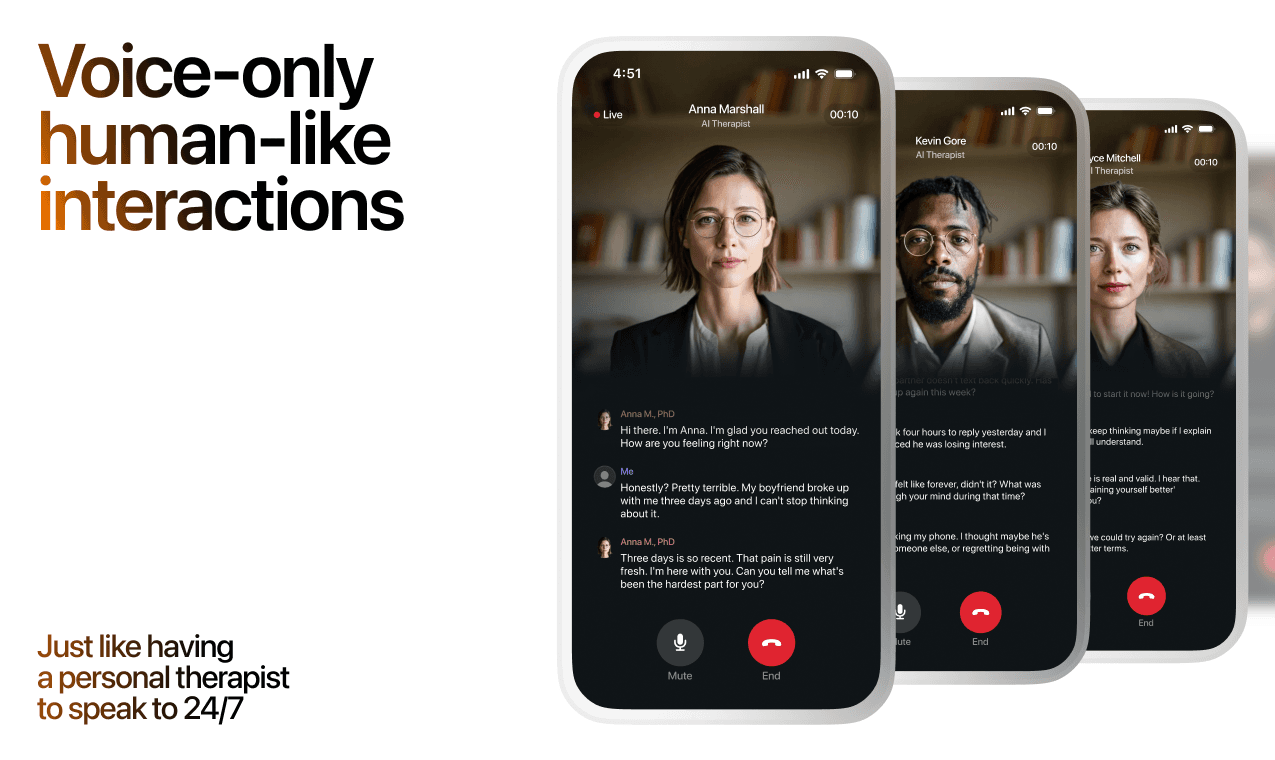
What a Session with Lovon Looks Like
When to Seek Professional Help
AI support is a valuable tool, but it's not a replacement for professional care. Please consider reaching out to a licensed therapist if you experience any of the following:
- Persistent thoughts of self-harm or suicide
- Inability to perform daily activities (work, eating, sleeping) for more than 2 weeks
- Turning to alcohol or substances to cope
- Intense anger or desire to harm your ex-partner
- Complete emotional numbness that doesn't improve over time
Crisis Resources (US): If you're in immediate danger, call 988 (Suicide & Crisis Lifeline) or text HOME to 741741 (Crisis Text Line). Available 24/7, free, and confidential.
Outside the US? Find a crisis line in your country
Ready to Start?
Your healing journey can begin right now
A 7-day trial. No judgment. Just a safe space to process what you're going through.
Frequently Asked Questions
Is Lovon a replacement for a real therapist?
Is my conversation with Lovon AI private?
How is Lovon different from ChatGPT for emotional support?
Can I use Lovon if I'm already seeing a therapist?
Can I try Lovon before subscribing?
About the Author

The Lovon Editorial Team
Mental Health & Wellness Content Team
The Lovon Editorial Team develops mental health and wellness content designed to make psychological concepts accessible and actionable. Our goal is to bridge the gap between clinical research and everyday life - helping you understand why your mind works the way it does and what you can do about it....
Related articles
- Stop Self-Isolating Depression: 2026 Step-by-Step Fix
Self-isolating depression breaks with small, specific steps, not motivation. Get the 2026 plan, troubleshooting, and…
- ADHD and Anxiety: How the Two Conditions Overlap (2026)
ADHD and anxiety share symptoms but have different causes. Learn how they feed each other and what daily strategies…
- Emotional Dysregulation in Adults: Signs, Fixes 2026
Emotional dysregulation in adults explained: signs, causes, and a 7-step coping plan for 2026. Body-first tools that…
- AI Therapy for Postpartum Depression: What Works in 2026
AI therapy for postpartum depression works best when it's voice-based and available at 3am — see what to look for, what…
See also
Quizzes
- Shame Test: Do You Read Mistakes as Verdicts?
See which exit your shame takes, in 3 minutes.
- Alexithymia Test: Can You Name What You Feel?
See where your feelings lose their names, in 3 minutes.
Free tools
- Attachment Trigger Plan for Anxious and Avoidant Patterns
Pick your pattern, tick the moments that set it off, and finish one card for each: your body signal, the thing you will…
- How to End a Friendship Without a Scene
A chat for working out how to end a friendship clearly, without a grievance list or a slow ghost. Tell it how long you…
From the wiki
- What to do if you have no friends?
Pick one activity that repeats weekly with the same people, and go for six to eight weeks straight. Repetition, not…
Disclaimer: This article is for informational purposes only and does not constitute medical advice, diagnosis, or treatment. Always seek the advice of your physician or other qualified health provider with any questions you may have regarding a medical condition. If you are in crisis or think you may have an emergency, call 988 (Suicide & Crisis Lifeline) or go to the nearest emergency room. Outside the US? Find a crisis line in your country.