
Can an AI voice therapist help during a panic attack in real time?
Can AI therapist help during a panic attack? Use voice support for coping, not diagnosis. Learn grounding steps, clear limits, and when to seek urgent help.


Key Takeaways
- Can AI therapist help during a panic attack? It can offer coping prompts, not diagnosis or guaranteed relief.
- Lovon offers voice-based emotional support; it is not a licensed clinician or an emergency service.
- Choose simple grounding over a long conversation when speaking or concentrating feels difficult.
- New or severe physical symptoms need medical assessment, even if you have experienced panic before.
An AI voice therapist can offer real-time support during a panic attack by talking you through grounding or a coping exercise, but it cannot confirm that your symptoms are panic or guarantee relief. Use it as optional support, not medical assessment or emergency care. If you have new or severe chest pain, fainting, severe trouble breathing, or symptoms unlike previous attacks, seek urgent medical help rather than waiting for an app to respond.
TL;DR
- Can AI therapist help during a panic attack? It can offer coping prompts, not diagnosis or guaranteed relief.
- Lovon offers voice-based emotional support; it is not a licensed clinician or an emergency service.
- Choose simple grounding over a long conversation when speaking or concentrating feels difficult.
- New or severe physical symptoms need medical assessment, even if you have experienced panic before.
Why this matters
During panic, choosing what to do can feel harder than usual. A spoken prompt gives you something specific to follow, without requiring you to read a long explanation or organize your thoughts perfectly.
That does not make the voice a clinician. For your 2026 support plan, separate help with coping from help deciding whether you are medically safe. These grounding techniques for anxiety and panic explain the coping side; new or concerning symptoms belong with a healthcare professional.
You do not need to tell your whole story during an attack. The immediate task is simpler: get somewhere safe, choose a manageable next step, and reach a person when you need one.
Can an AI voice therapist help during a panic attack in real time?
Yes, as a source of coping prompts and emotional support—not as a way to rule out a medical emergency. A voice app can provide conversational guidance, but a reassuring response is not evidence that your symptoms are harmless.
Use this sequence if you are considering voice support during an episode:
- Check safety. Stop any activity that puts you at risk. If you are driving, pull over safely before using your phone or starting an exercise.
- Choose support. Seek medical help for new, severe, or unfamiliar symptoms. For a familiar episode covered by a clinician's plan, follow that plan.
- Ask simply. Request a short grounding prompt rather than a detailed explanation of panic.
- Try grounding. Notice your surroundings or the support beneath your feet. Keep breathing comfortable rather than forcing deep breaths.
- Reassess. Stop the conversation if it adds distress. Contact a trusted person or healthcare professional instead of repeatedly asking the app whether you are safe.
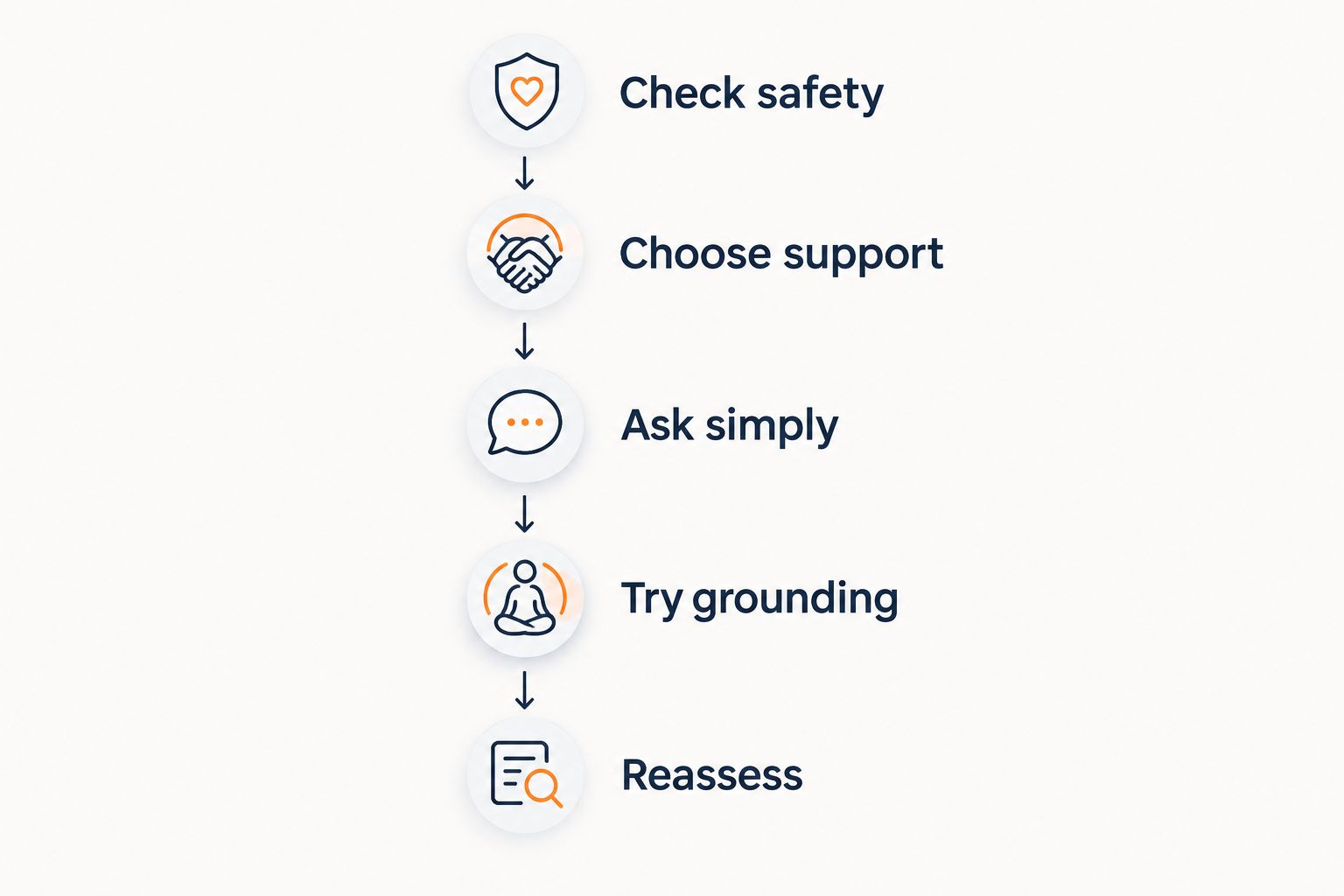 Five steps for choosing and using voice support during a possible panic attack
Safety comes before starting a coping conversation.
This is a support sequence, not a diagnostic test. You do not have to complete it before asking someone for help, and you should not delay urgent care to see whether grounding works.
What should you ask the voice app to do?
Keep your request narrow. For example: Help me focus on my surroundings. Give me one short instruction, then pause. This asks for a manageable interaction without asking the app to identify the cause of your symptoms.
You can also say: Please avoid long explanations. I want a simple grounding exercise. These are suggested requests, not promises about how any particular app will respond.
If the response becomes confusing, repetitive, or frightening, stop. You do not owe the conversation your attention, and you do not need to finish an exercise that feels unhelpful.
Which kind of support fits the moment?
Choose support by what you need, not by which option sounds most reassuring. An app, a trusted person, a licensed clinician, and emergency services have different roles. None is interchangeable with all the others.
| Support option | Best for | What it offers | Main limitation |
|---|---|---|---|
| AI voice app | Optional coping prompts during a familiar episode | Spoken emotional support and guidance through a simple exercise | Cannot examine you, diagnose symptoms, or rule out an emergency |
| Trusted person | Human company and practical help | Staying with you, listening, or helping you contact care | Is not necessarily trained to assess symptoms |
| Licensed clinician | Repeated attacks and an individual treatment plan | Assessment, treatment, and advice suited to your history | A routine appointment is not emergency care |
| Emergency services | Possible medical emergency or immediate danger | Urgent assessment and response | Not a substitute for ongoing panic treatment |
A trusted person does not need a perfect script to help. You can ask them to stay nearby, speak slowly, or help you make a call. Avoid making the app your only route to support.
When reviewing support options in 2026, check their actual role. A product described as a therapist still needs clear limits; the name alone does not establish clinical qualifications, crisis response, or effectiveness for panic attacks.
What can voice support do—and what can it not do?
Voice support can keep the task small
A useful coping conversation focuses on something you can do now: notice the floor, describe an object, or identify a sound. It does not require you to explain why the attack started or solve the underlying problem while distressed.
Speaking also gives you an alternative to typing. That is a practical difference, not proof that voice works better for everyone. If listening or answering adds pressure, silence or support from someone nearby is a valid choice.
Voice support cannot establish medical safety
An app cannot examine you or rule out a heart, lung, neurological, or other medical problem through conversation. Even detailed descriptions do not turn its response into a medical assessment.
Do not ask a voice app to certify that chest pain is “just anxiety.” A previous panic diagnosis does not explain every future symptom. New symptoms, a change in your usual pattern, or uncertainty about your safety deserve professional assessment.
Voice support is not treatment for recurring panic
Getting through an episode and treating recurring panic are different tasks. Repeated attacks, fear of another attack, or avoiding everyday activities are reasons to speak with a licensed mental health professional or primary care clinician.
Cognitive behavioral therapy is an established treatment for panic disorder. A clinician can assess whether it fits your needs and discuss other treatment options; an app conversation does not replace that work.
Why the usefulness of real-time support varies
There is no single response that makes every panic episode easier. Keep these factors in mind when deciding whether to continue a voice conversation:
- Symptom familiarity: A familiar pattern already assessed by a clinician is different from an unexplained first episode.
- Ability to engage: Speaking, listening, or following instructions can feel difficult during intense distress. Shorter prompts reduce the task, but you can stop entirely.
- Exercise fit: Focusing on breathing feels helpful to some people and uncomfortable to others. External grounding offers another focus.
- Your surroundings: Traffic, noise, lack of privacy, or an unsafe location can make a voice conversation impractical.
- Access to people: A trusted person or clinician can provide kinds of help an app cannot, including practical assistance and medical assessment.
For a 2026 coping plan, write down your alternatives before you need them. Your plan should still work if your phone is unavailable, the app misunderstands you, or you simply do not want to talk.
What grounding can you try while listening?
Start with the room around you rather than a detailed analysis of your body. Place your feet on a stable surface if that is comfortable. Name something you can see, and describe its color or shape.
A familiar sensory exercise uses these prompts:
- 5 things you can see: Look for ordinary objects around you.
- 4 things you can feel: Notice contact with your chair, clothing, or the floor.
- 3 things you can hear: Identify sounds without deciding whether they are pleasant.
- 2 things you can smell: Notice scents already present; do not search for anything strong.
- 1 thing you can taste: Notice an existing taste, or skip this step.
These counts organize your attention; they are not a dose or a test. You can use fewer senses, keep your eyes open, or focus only on a neutral object. Adapt the exercise to your sensory needs.
If attention to breathing makes you more distressed, return to your surroundings. Avoid forcing large breaths or prolonged breath-holding. Do not breathe into a paper bag, because symptoms that resemble panic can have other causes.
The aim is not to perform grounding correctly or force the feeling away. It is to give yourself a manageable focus while deciding what support you need next.
When should you stop using the app and get human help?
Get urgent medical help for symptoms that are new, severe, or different from your usual pattern. Examples include significant chest pain, fainting, severe difficulty breathing, or sudden weakness. Do not wait for an app to agree with your decision.
In the United States, call 911 for a medical emergency or immediate danger. If you are experiencing suicidal thoughts or emotional distress, call or text 988 to reach the Suicide & Crisis Lifeline; immediate physical danger still calls for emergency services.
Contact someone you trust if being alone feels unsafe or you need practical help. You can say plainly that you are frightened and want company while you decide what to do.
An app's calm tone does not change these boundaries. In 2026, the safest rule remains straightforward: software reassurance is not medical clearance.
Where does Lovon fit into a panic support plan?
Lovon is best suited to people seeking voice-based emotional support, not medical assessment during a possible emergency. Lovon offers spoken conversations, coping tools, and self-reflection guidance for everyday mental health struggles.
The practical benefit of Lovon voice support is the option to talk instead of type. The limit is equally important: Lovon is not a licensed clinician, does not replace clinical care, and should not be treated as proof that physical symptoms are safe.
Consider an app as one optional part of a broader plan. Before sharing sensitive information, read the current privacy terms and understand how voice data is handled; do not assume that a mental health app has the same confidentiality arrangements as your clinician.
What should you do after the episode settles?
Once you feel able, make a brief note of what happened, what you noticed, and what helped or made things harder. You do not need a detailed transcript. Bring recurring episodes or changes in symptoms to a healthcare professional.
Ask a clinician to help you distinguish familiar symptoms from warning signs and create a written response plan. If you have prescribed medication, follow the instructions you were given rather than advice generated in a conversation.
For your 2026 plan, keep the essentials accessible: your clinician's instructions, a trusted contact, and the point at which you will seek urgent help. Practice a grounding exercise when you are relatively settled so you are not learning every step during distress.
One last thing
You do not have to feel completely calm before asking for help. You can make a call while frightened, request company without explaining everything, or stop an exercise halfway through.
Save a short instruction somewhere accessible: Check safety, choose support, take the next manageable step. A useful plan gives you choices. It does not make an app conversation something you must complete before reaching a person.
Related guides
How AI Support Helps You Heal
AI emotional support isn't about replacing human connection — it's about filling the gaps. The moments when you need to talk at 2 AM, when you don't want to burden your friends again, or when you simply need someone to listen without judgment.
Here's what happens in a typical Lovon session:
You share what's on your mind
There's no script, no intake form, no waiting room. You speak or type whatever you're feeling — in your own words, at your own pace.
Lovon validates and explores
Using frameworks from CBT (Cognitive Behavioral Therapy) and motivational interviewing, Lovon acknowledges your feelings first, then gently helps you explore them. No dismissive "just move on" advice.
You build coping skills together
Lovon doesn't just listen — it actively works with you on evidence-based techniques: thought reframing, urge surfing, behavioral experiments, and more.
What a Session with Lovon Looks Like

Lovon is AI support, not a replacement for professional care. If things have been hard to get through for weeks, or you are thinking about harming yourself, talk to a doctor or a licensed therapist.
Ready to Start?
Your healing journey can begin right now
A 3-day trial. No judgment. Just a safe space to process what you're going through.
Frequently Asked Questions
Can an AI therapist stop a panic attack immediately?
Is it safe to use a voice app during my first panic attack?
What should I say to an AI voice therapist when I feel panicky?
Is talking to an app better than calling a friend?
Should I do breathing exercises if they make me feel worse?
Can Lovon replace therapy for panic disorder?
Who should I call if I feel unsafe during a panic attack?
About the Author

The Lovon Editorial Team
Mental Health & Wellness Content Team
The Lovon Editorial Team develops mental health and wellness content designed to make psychological concepts accessible and actionable. Our goal is to bridge the gap between clinical research and everyday life - helping you understand why your mind works the way it does and what you can do about it....
Related articles
- Mental health app for medical residents: complete 2026 guide
Choose a mental health app for medical residents that fits shift work. Compare voice support and licensed care, protect…
- AI Coping Tools for Medical Trauma & PTSD (2026)
AI coping tools for medical trauma PTSD compared: what to look for, which options to buy or skip, and how voice-based AI…
- Can anxiety cause chest pain like a heart attack?
Can anxiety cause chest pain like a heart attack? Yes. Learn why symptoms overlap, when to call 911, and why medical…
- AI Coping Tools for Panic Attacks While Driving (2026)
The best AI coping tools for panic attacks while driving in 2026 — hands-free grounding, breathing cues, and voice AI…
See also
Quizzes
- Hyper-Empathy Test: When Feeling for Others Costs You
See where too much empathy is costing you, in 3 minutes.
- Inner Critic Test: How Harsh Is the Voice in Your Head?
See what kind of critic you live with, in 3 minutes.
Free tools
- 5-4-3-2-1 Grounding Exercise
A guided run through the 5-4-3-2-1 technique, with paced breathing first if you need it. No sign-up, works on your…
- Journal Prompts
Pick how you feel, what you want to write about, or both, and get three prompts with room to write right under them…
From the wiki
- What to do if you have no friends?
Pick one activity that repeats weekly with the same people, and go for six to eight weeks straight. Repetition, not…
Disclaimer: This article is for informational purposes only and does not constitute medical advice, diagnosis, or treatment. Always seek the advice of your physician or other qualified health provider with any questions you may have regarding a medical condition. If you are in crisis or think you may have an emergency, call 988 (Suicide & Crisis Lifeline) or go to the nearest emergency room. Outside the US? Find a crisis line in your country.