
Can financial stress cause anxiety attacks?
Can financial stress cause anxiety attacks? Yes. Learn why money worries trigger panic, what to do during a surge, and when to seek medical care.


Key Takeaways
- Can financial stress cause anxiety attacks? Yes. Money worries can trigger intense anxiety and panic symptoms.
- New or severe physical symptoms need medical attention, even when financial anxiety seems like the trigger.
- Address the immediate distress and the money problem separately; calming down does not require solving every bill.
- Lovon offers emotional support for everyday money stress, not diagnosis, emergency care, or licensed treatment.
Yes, financial stress can trigger intense anxiety and, in some people, panic attacks. Money worries can activate your body's stress response, but new chest pain, severe breathing trouble, or fainting should not be assumed to be anxiety. This 2026 guide explains the connection, what to do during a surge, and when to get help.
TL;DR
- Can financial stress cause anxiety attacks? Yes. Money worries can trigger intense anxiety and panic symptoms.
- New or severe physical symptoms need medical attention, even when financial anxiety seems like the trigger.
- Address the immediate distress and the money problem separately; calming down does not require solving every bill.
- Lovon offers emotional support for everyday money stress, not diagnosis, emergency care, or licensed treatment.
Can financial stress cause anxiety attacks?
Financial stress can trigger anxiety attacks because threats to housing, food, income, or stability can set off your body's alarm response. Your heart can race, your muscles can tighten, and your breathing can change while you are reading a bill or thinking about an overdue payment.
Anxiety attack is an everyday phrase, not a formal diagnosis. A panic attack is a sudden surge of intense fear or discomfort; understanding the difference between a panic attack and an anxiety attack helps you describe your experience without diagnosing yourself.
| Experience | What it can feel like | Important distinction |
|---|---|---|
| Financial worry | Repeated thoughts about bills, income, or debt | Worry alone does not establish an anxiety disorder |
| Escalating anxiety | Tension, restlessness, difficulty concentrating, or trouble sleeping | Distress can build around a recognizable money problem |
| Panic attack | A sudden surge of fear with symptoms such as racing heart, sweating, trembling, or breathlessness | Panic attacks can have a trigger or happen without an obvious one |
| Medical problem | Chest pain, breathing difficulty, dizziness, or other physical symptoms | Symptoms overlap with anxiety and sometimes need urgent assessment |
Having a panic attack after a financial setback does not automatically mean you have panic disorder. A clinician considers the pattern of attacks, ongoing fear, avoidance, and possible medical explanations.
Why this matters
Money stress is not just a budgeting problem. If opening your banking app brings on shaking or nausea, advice to simply spend less misses the immediate distress.
The reverse matters, too: a calming exercise cannot remove an eviction notice or replace lost income. You deserve support for both the emotional reaction and the practical problem. Neither one cancels out the other.
Why financial anxiety varies from person to person
The same bill does not produce the same reaction in everyone. The amount matters, but so do the consequences and what the situation means to you.
- Threats to basic needs: Worry about rent, groceries, utilities, or medication carries real consequences. Treat that concern as a practical need, not a thinking error.
- Uncertainty: Unpredictable income or an unclear payment deadline can leave you repeatedly checking for updates.
- Previous experiences: Earlier periods of financial insecurity can shape how threatening a new setback feels.
- Sleep disruption: Worry can interfere with sleep, and poor sleep can make anxiety harder to manage.
- Shame and conflict: Hiding a bill or fearing a partner's reaction can add another layer of distress.
- Existing anxiety: If you already struggle with anxiety, a money problem can become another trigger rather than a separate issue.
These factors help explain a reaction; they do not prove its cause. If symptoms begin after a medication change, substance use, or a new physical illness, tell a medical professional rather than attributing everything to money stress.
What should you do during a money-triggered anxiety surge in 2026?
Start by checking safety, not your account balance. If symptoms are new, severe, or different from previous episodes, seek medical help instead of trying to confirm that they are panic.
For familiar anxiety symptoms without warning signs, try the following sequence. These are coping options, not a test you have to pass or a promise that symptoms will stop immediately.
- Check safety. Sit somewhere secure. If you are driving, pull over safely before doing anything else.
- Pause the trigger. Put down the bill or banking app briefly. A 60-second pause is a starting point, not a required recovery time.
- Find your surroundings. Feel your feet against the floor and name 5 objects you can see. Choose simple descriptions rather than searching for the perfect answer.
- Ease your breathing. Let your breath stay gentle and unforced. Avoid repeatedly taking large breaths; if focusing on breathing makes you more distressed, return your attention to the room.
- Choose one action. Once you feel steadier, identify the next practical step, such as finding a due date or asking someone to sit with you while you make a call.
You do not need to feel completely calm before asking for support. You also do not need to keep staring at the trigger to prove you can handle it.
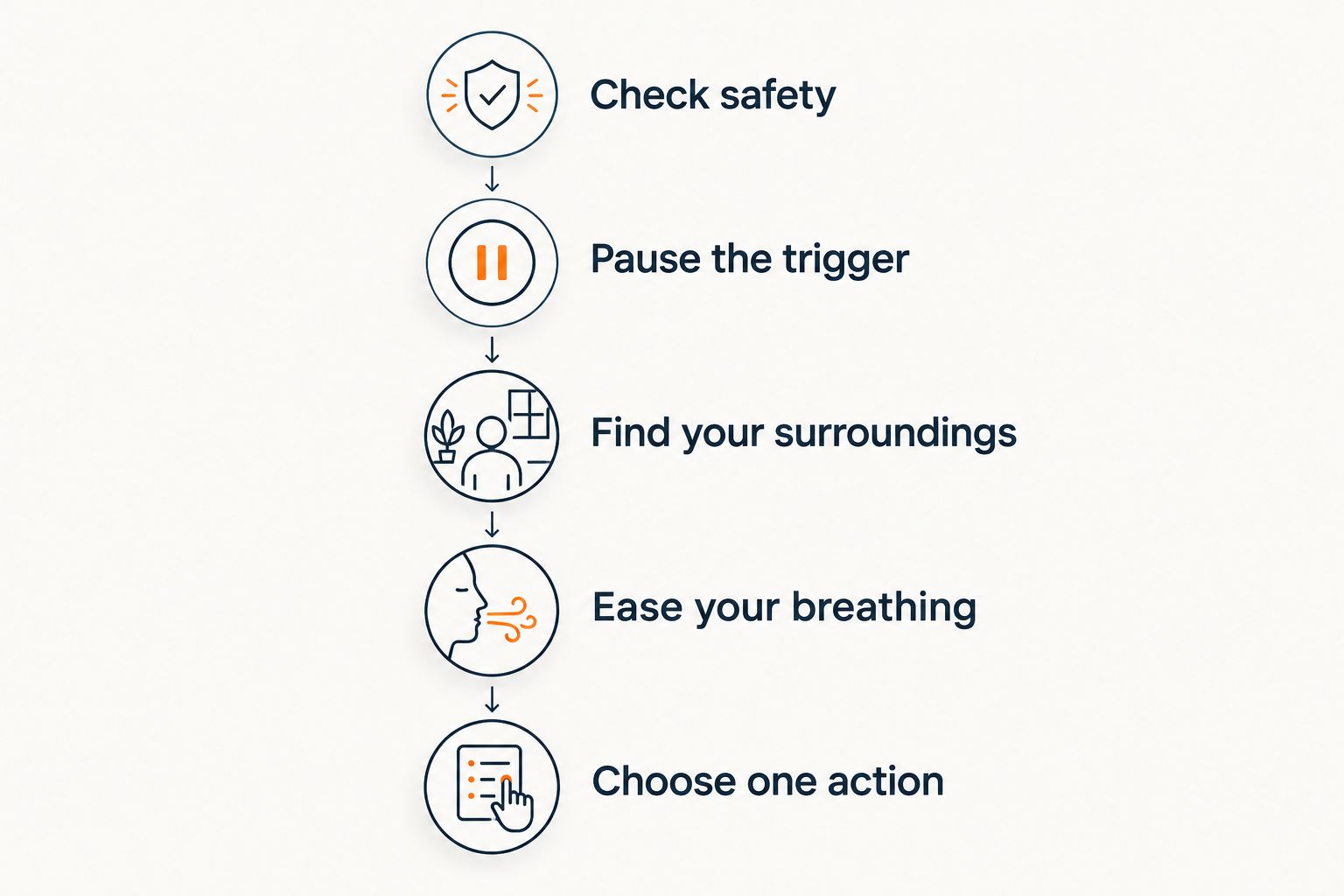 A coping sequence from checking safety to choosing one practical action
Check safety first, then return to the money problem when you feel steadier.
What if grounding does not help?
Grounding is an option, not an obligation. If counting objects frustrates you or paying attention to your body increases fear, try a different anchor: describe the room, listen to a familiar sound, or speak with someone you trust.
Persistent or worsening symptoms need more than repeated self-help exercises. Seek professional assessment, especially if episodes are changing how you work, sleep, travel, or manage everyday tasks.
Build a manageable money-stress plan for 2026
After the immediate surge, separate what you know from what you fear. A statement has an amount and a deadline; the thought that your entire future is ruined is a prediction, not another line on that statement.
Try a 10-minute planning appointment with yourself. That is a suggested boundary for the task, not a treatment dose or a deadline for feeling better.
Write down the actual problem
Record the bill, deadline, and question you need answered. Keep the language factual: a payment is overdue, a paycheck is delayed, or you do not know which account covers an expense.
Then put the feared outcome on a separate line. This lets you take a real consequence seriously without treating every worst-case possibility as something already happening.
Pick the next contact
Choose the person or organization connected to the immediate problem. Depending on your situation, that might be a billing office, landlord, benefits office, or qualified financial counselor.
Ask what options exist and what information is needed. Do not assume an extension, assistance program, or changed payment arrangement is available until it is confirmed.
Make the task smaller
If opening every statement feels impossible, start with the document linked to the most urgent basic need. Ask a trusted person to stay nearby if that makes the task more manageable.
A brief pause can help you return to a task; indefinite avoidance leaves the practical issue untouched. Decide when you will come back, rather than waiting for a day when money feels completely comfortable.
Protect the conversation
If you share finances, describe the problem and the help you need without turning the discussion into a verdict about either person's character. Ask for a pause if the conversation becomes too heated to continue productively.
If someone controls your access to money, threatens you, or monitors your help-seeking, prioritize safety. That situation needs support beyond ordinary budgeting or communication advice.
When should you seek professional help in 2026?
Seek help when anxiety repeatedly interferes with daily life—not only when you reach a breaking point. Frequent attacks, disrupted sleep, missed work, avoiding essential bills, or using alcohol to get through financial tasks are reasons to talk with a professional.
A primary care clinician can assess physical symptoms and consider medical contributors. A licensed mental health professional can assess anxiety and discuss treatments, including cognitive behavioral therapy when appropriate.
The money problem does not have to disappear before care begins. In virtual therapy for anxiety and stress, the work can address fear, avoidance, and coping while practical financial support addresses the bills themselves. Remote appointments still require checking the clinician's credentials, location requirements, and suitability for your needs.
If money is a barrier to care, ask providers or local health services about payment arrangements, community services, and eligibility-based options. Confirm the terms directly; do not assume that an app and licensed therapy provide the same kind of support.
What should you tell a clinician?
Describe what happened before the episode, what your body felt like, and what you did afterward. Mention whether you now avoid banking apps, phone calls, work, or being alone because you fear another attack.
Bring information about sleep, caffeine, alcohol, medications, and any new health symptoms. You do not need to arrive with a diagnosis or a polished explanation to deserve an assessment.
Choosing support for financial anxiety in 2026
Different kinds of support address different parts of the problem. Choose based on the help you need, not on which option sounds easiest to access.
| Support option | Best for | What it offers | Limit to keep in mind |
|---|---|---|---|
| Licensed mental health care | Recurring attacks, avoidance, or anxiety affecting daily life | Assessment and an individualized treatment plan | Does not itself resolve debt or income loss |
| Primary care | New physical symptoms or questions about medical causes | Medical assessment and referrals when needed | Ongoing psychological treatment can require another provider |
| Qualified financial counseling | Understanding financial choices and next steps | Practical guidance about the money problem | Does not diagnose or treat anxiety |
| Emotional support app | Everyday reflection and coping between other supports | A place to talk through feelings and practice coping tools | Not a licensed clinician or emergency service |
Lovon is an AI-powered voice app for emotional support, coping tools, and self-reflection. You can use it to talk through the feelings around a bill or prepare what you want to discuss with a professional.
Lovon is best for everyday emotional support around money stress, not for diagnosing or treating panic attacks. That distinction matters more than whether a conversation feels reassuring.
Lovon is not a licensed clinician and does not replace clinical care. Keep financial credentials and identifying account details out of emotional support conversations; you can describe feeling frightened about a payment without sharing an account number.
When is it an emergency?
Call 911 in the United States for a suspected medical emergency, including new or severe chest pain, severe breathing difficulty, fainting, or stroke symptoms. A financial trigger does not rule out a medical problem.
If financial distress brings thoughts of suicide or you feel unable to stay safe, call or text 988 in the United States for crisis support. If there is immediate danger, call 911 or go to the nearest emergency department.
Do not use an emotional support app to decide whether an emergency is real. You do not have to be certain of the cause before seeking urgent help.
One last thing
Make the next step visible before the next wave of worry. Write down the document you need, the question you want answered, and the person you will contact.
You are not trying to solve your entire financial life while frightened. The goal is to make one necessary action easier—and get support for the distress that makes it hard.
Related guides
How AI Support Helps You Heal
AI emotional support isn't about replacing human connection — it's about filling the gaps. The moments when you need to talk at 2 AM, when you don't want to burden your friends again, or when you simply need someone to listen without judgment.
Here's what happens in a typical Lovon session:
You share what's on your mind
There's no script, no intake form, no waiting room. You speak or type whatever you're feeling — in your own words, at your own pace.
Lovon validates and explores
Using frameworks from CBT (Cognitive Behavioral Therapy) and motivational interviewing, Lovon acknowledges your feelings first, then gently helps you explore them. No dismissive "just move on" advice.
You build coping skills together
Lovon doesn't just listen — it actively works with you on evidence-based techniques: thought reframing, urge surfing, behavioral experiments, and more.
What a Session with Lovon Looks Like

Lovon is AI support, not a replacement for professional care. If things have been hard to get through for weeks, or you are thinking about harming yourself, talk to a doctor or a licensed therapist.
Ready to Start?
Your healing journey can begin right now
A 3-day trial. No judgment. Just a safe space to process what you're going through.
Frequently Asked Questions
Can financial stress cause anxiety attacks even if I have never had one before?
Can thinking about debt make my heart race?
Does a money-triggered panic attack mean I have panic disorder?
Should I keep checking my bank account until I feel reassured?
Will paying off debt stop my anxiety attacks?
What is the best support if money worries keep causing panic?
Can I use an emotional support app instead of seeing a therapist?
About the Author

The Lovon Editorial Team
Mental Health & Wellness Content Team
The Lovon Editorial Team develops mental health and wellness content designed to make psychological concepts accessible and actionable. Our goal is to bridge the gap between clinical research and everyday life - helping you understand why your mind works the way it does and what you can do about it....
Related articles
- Can anxiety cause nausea and stomach problems?
Can anxiety cause nausea? Yes. Learn how stress affects your stomach, what helps with mild symptoms, and which warning…
- Can chronic stress cause physical illness?
Can chronic stress cause physical illness? Yes. Learn how it affects sleep, blood pressure and existing conditions, plus…
- How long does an anxiety attack usually last?
How long does an anxiety attack last? There is no set time. Learn why the 5 to 20 minutes cited for most panic attacks…
- Can financial stress cause a relationship to break down?
Can financial stress cause a relationship to break down? Yes, but separation is not inevitable. Learn how to address…
See also
Quizzes
- Digital Stress Test: Texting, Likes and Read Receipts
See which part of being online wears on you, in 3 minutes.
- Alexithymia Test (Free): Do I Have Alexithymia?
See where your feelings lose their names, in 3 minutes.
Free tools
- 4-7-8 Breathing
Breathe in for four, hold for seven, breathe out for eight. The long out-breath is the point. Follow the circle; no…
- Sleep Meditation for Anxiety
For lying in bed with a mind that will not stop. About twelve minutes of slower breathing, a place to put the worries…
From the wiki
- What does it mean when you dream about your ex?
Dreaming about your ex usually reflects emotional processing, not prophecy and not a message from them. Your sleeping…
Disclaimer: This article is for informational purposes only and does not constitute medical advice, diagnosis, or treatment. Always seek the advice of your physician or other qualified health provider with any questions you may have regarding a medical condition. If you are in crisis or think you may have an emergency, call 988 (Suicide & Crisis Lifeline) or go to the nearest emergency room. Outside the US? Find a crisis line in your country.