
How long does it take to rebuild trust after cheating?
How long does it take to rebuild trust after cheating? There is no fixed timeline. Learn what real repair looks like, how to set boundaries, and when to seek help.

Key Takeaways
- How long does it take to rebuild trust after cheating? There is no fixed recovery deadline.
- Judge trust repair by honesty, respected boundaries, and consistent behavior—not apologies alone.
- Lovon offers emotional support and self-reflection for relationship struggles, not licensed clinical care.
- You can forgive cheating without choosing reconciliation. Safety comes before saving the relationship.
There is no fixed timeline for rebuilding trust after cheating, and no deadline guarantees that you will feel safe again. Time alone does not repair betrayal; rebuilding requires the cheating to stop, honest answers, and consistent respect for your boundaries. You can work toward recovery without promising to stay, forgive, or feel better by a particular date.
TL;DR
- How long does it take to rebuild trust after cheating? There is no fixed recovery deadline.
- Judge trust repair by honesty, respected boundaries, and consistent behavior—not apologies alone.
- Lovon offers emotional support and self-reflection for relationship struggles, not licensed clinical care.
- You can forgive cheating without choosing reconciliation. Safety comes before saving the relationship.
How long does it take to rebuild trust after cheating?
There is no universal number of weeks or months that proves trust has returned. Instead of measuring recovery only by elapsed time, look for evidence that the relationship has changed. An anniversary of discovering the affair is not a test you must pass.
If you discovered cheating in 2026, avoid turning the end of 2026 into an automatic deadline for forgiveness. A calendar can help you organize conversations. It cannot tell you whether another person has become trustworthy.
These are practical checkpoints, not a clinical recovery scale:
| Area to assess | Evidence to look for | Reason to pause |
|---|---|---|
| Honesty | Relevant answers remain consistent | New lies or concealed contact emerge |
| Accountability | Your partner owns the decision to cheat | Your partner blames you for the betrayal |
| Boundaries | Agreements are clear and respected | Your partner argues that limits are punishment |
| Communication | You can discuss hurt without threats | Questions lead to intimidation or humiliation |
| Choice | You remain free to stay or leave | Forgiveness becomes a condition of being treated well |
For help preparing those conversations, read these steps for communicating better in a relationship. Communication matters, but clearer wording cannot compensate for continued dishonesty.
Why this matters
After cheating, asking how long recovery takes can also mean something more personal: how long will you feel uncertain, and how long should you keep trying? Those are different questions. Your distress deserves care even if you have not decided what to do about the relationship.
Your task is not to become trusting on demand. Your partner's task is to behave in ways that deserve trust. You can take responsibility for how you express pain without taking responsibility for someone else's choice to cheat.
Separate your immediate needs from the long-term decision. Rest, support, sexual health care when relevant, and a safe place to think do not require a final commitment to reconciliation. Start there.
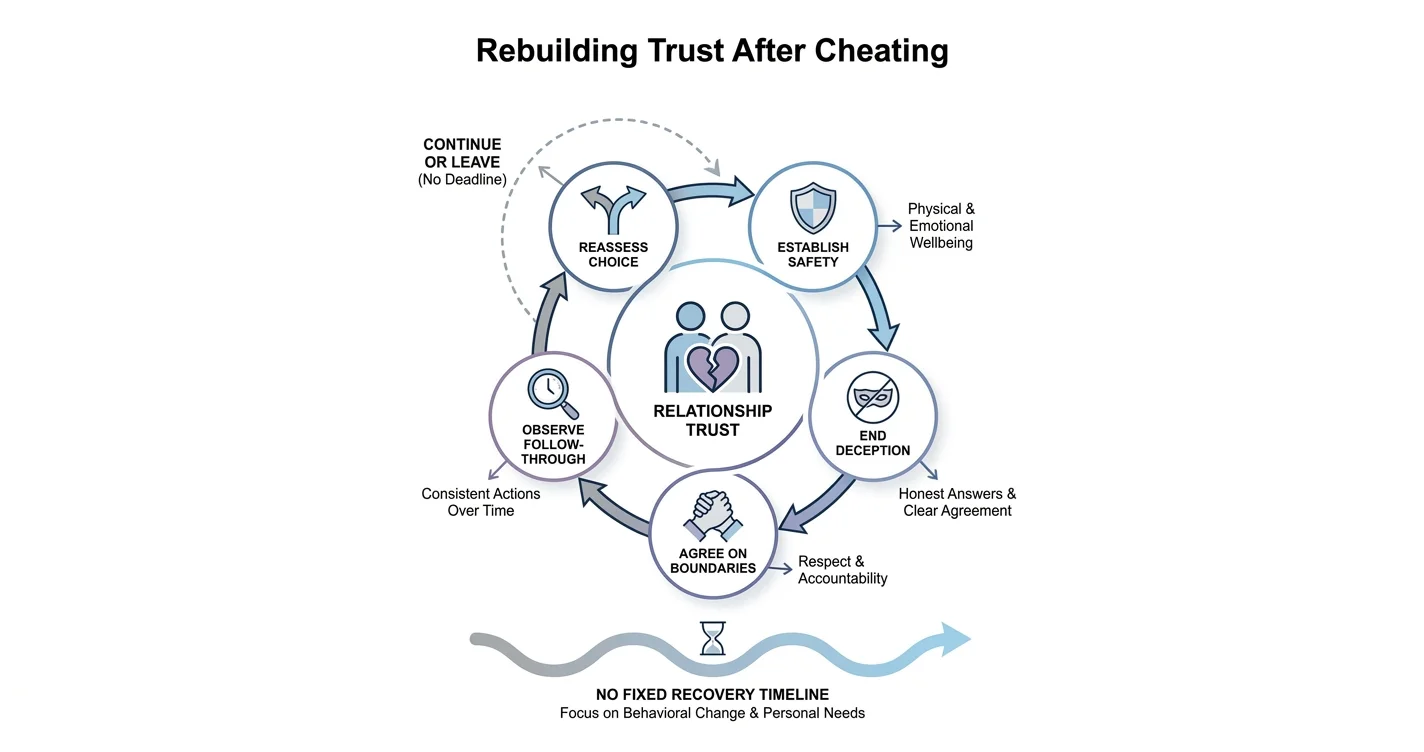
What does rebuilding trust actually involve?
Treat these steps as a way to organize repair, not as a countdown. You do not need to complete them neatly or in a straight line. If you feel threatened or controlled, prioritize individual support and safety rather than a joint repair plan.
Establish safety
Before discussing forgiveness, ask whether you can disagree, ask questions, and set limits without fearing your partner's reaction. If the answer is no, a trust-building exercise is not the right starting point. Seek confidential support from a licensed professional or a domestic violence service.
Safety also includes physical health. If cheating involved sexual contact, speak with a healthcare professional about appropriate testing and protection. Do not rely on an app or a partner's reassurance to make medical decisions.
End deception
Ask for a clear agreement about contact with the person involved in the cheating. Where contact is unavoidable, such as at work, discuss what boundaries and disclosure would look like. Do not accept a vague promise in place of an agreement you both understand.
The partner who cheated needs to address concealment, not only the affair itself. Ask what information affects your ability to make an informed decision. You do not have to request every intimate detail to take the betrayal seriously.
Agree on boundaries
Write down what you need in ordinary language. That might include disclosure of relevant contact, honest answers, or permission to pause a difficult conversation. Be specific about what happens if an agreement is broken.
Distinguish boundaries from surveillance. You can decide what conduct you will accept without spending your life inspecting devices. Any temporary transparency arrangement should be voluntary, clearly defined, and open to review—not a demand for permanent control.
Observe follow-through
Look at what happens outside the apology conversation. Does your partner tell you something difficult without being caught first? Do agreements still matter when keeping them is inconvenient?
Notice your own experience, too. Can you express uncertainty without immediately reassuring your partner? A useful review asks whether there is more honesty and freedom in the relationship, not whether you have stopped feeling hurt.
Reassess your choice
Reconciliation is a choice you can revisit. You can recognize sincere effort and still decide that staying does not meet your needs. You can also choose to continue without declaring the betrayal resolved.
For a 2026 trust-repair journal, keep separate notes on what happened, what you felt, and what action followed. Use it to clarify your experience, not to build a case against yourself for having difficult days.
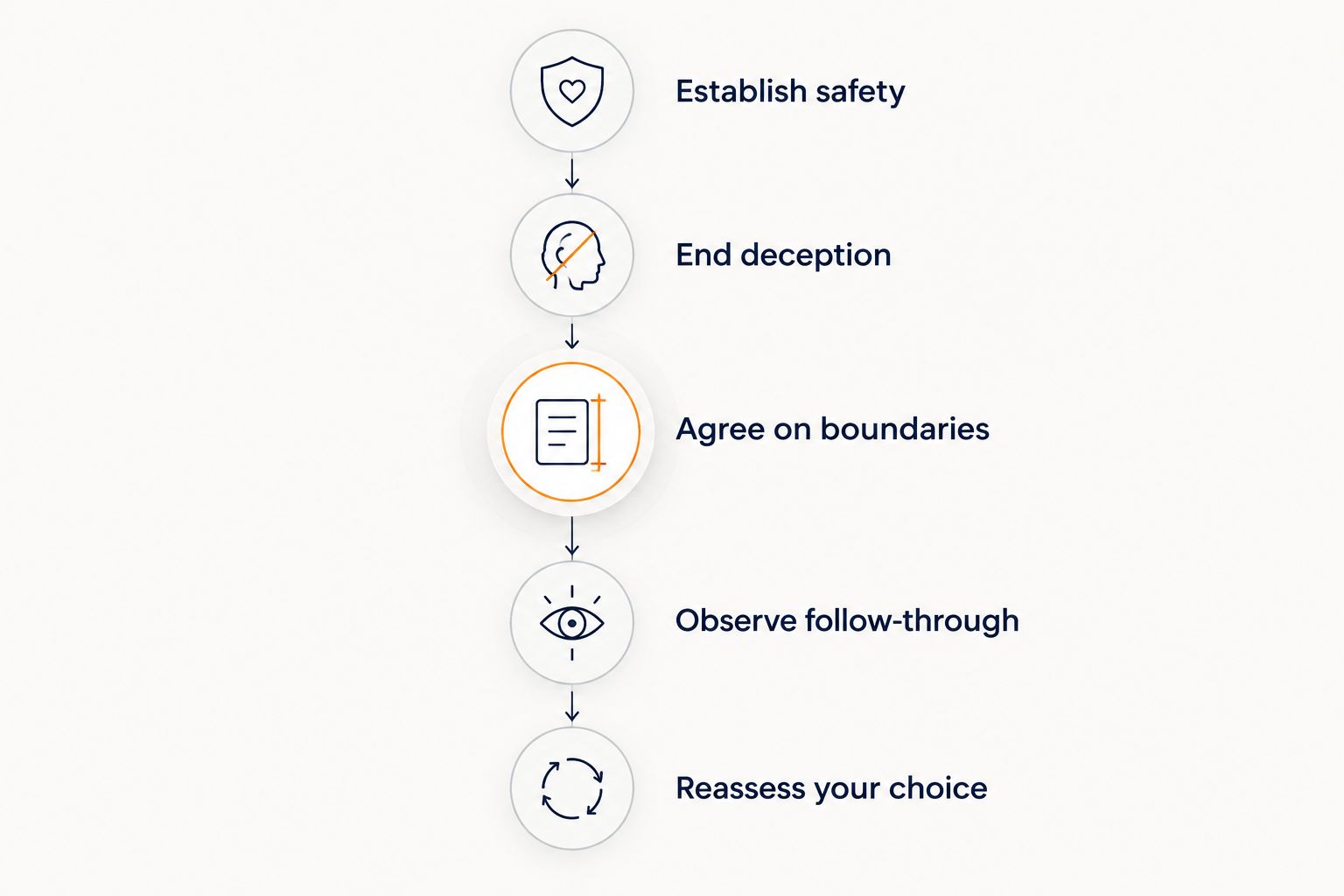 Trust-repair steps from establishing safety to reassessing whether you want to stay
Rebuilding trust includes the freedom to reconsider the relationship.
Why rebuilding trust after cheating varies
The useful question is not whether you are recovering as quickly as another couple. Ask what repair requires in your particular situation. Use these factors to guide that discussion:
- Whether deception has stopped. Address ongoing lies or hidden contact before treating the relationship as repaired.
- What information remains unresolved. Identify the facts you need for decisions about your relationship and health.
- How accountability works. Look for ownership of the cheating rather than explanations that make you responsible for it.
- Whether boundaries are respected. Assess what your partner does when you say no, request space, or ask a difficult question.
- What support you need. Consider individual counseling, trusted people, and practical help without making reconciliation their goal.
- Whether staying is your choice. Name pressures involving housing, money, children, or fear so they do not get mistaken for renewed trust.
Relationship problems can be discussed separately from the decision to cheat. You can acknowledge distance, conflict, or unmet needs without accepting blame for betrayal. Keep that distinction clear in repair conversations.
How do you know whether trust is returning?
Look for greater reliability, not a perfect absence of doubt. A useful sign is that your partner responds to a reasonable concern with honesty and care instead of punishment. Another is that you can make decisions without being rushed into reassurance.
Ask yourself concrete questions. What agreement has been kept? What happened when you raised a concern? What are you still afraid to say?
A calm day is welcome, but it is not proof that repair is complete. Likewise, a painful reminder does not automatically erase every positive change. Look at the broader pattern while taking new deception seriously.
If you review progress during 2026, compare behavior with the agreements you made rather than with an imagined recovery schedule. Your partner's disappointment about the pace does not create an obligation for you to trust sooner.
Can a relationship survive cheating?
A relationship can continue after cheating, but continuing is not the same as becoming safe or satisfying. Staying together is not sufficient evidence of repair. Assess whether honesty, accountability, and choice are actually present.
Ask what you would be agreeing to now, rather than whether you can restore the exact relationship you had before. Decide what would need to change for staying to be acceptable. Include what you need—not only what your partner promises.
Avoid making forgiveness the entrance requirement for repair. You need room to consider what happened while observing whether behavior changes. A demand to stop discussing the betrayal does not answer your concerns.
Can you forgive cheating and still leave?
You can forgive cheating and still leave the relationship. Forgiveness does not require renewed access to your time, body, home, or future. It is also not something you must offer to justify leaving.
Separate the decisions if that helps. Whether you want to release resentment is different from whether you want to remain partners. You do not need to settle both questions at once.
If you are undecided, focus on the next practical decision. That might be arranging individual counseling, identifying somewhere safe to stay, or gathering information about shared responsibilities. Uncertainty does not prevent you from protecting your options.
Does checking a partner's phone rebuild trust?
Checking a phone does not establish that a partner is trustworthy. It gives you access to some information, not certainty about every action. Decide whether any agreed transparency serves a clear purpose rather than becoming your main way of managing fear.
If you choose a temporary arrangement, discuss its scope and how you will review it. Neither partner should use device access to threaten, humiliate, or control the other. Declining permanent surveillance does not excuse hiding relevant contact.
When the urge to check appears, separate the question from the action. Is there new evidence, an unanswered question, or a painful reminder? Addressing that specific concern gives the conversation a clearer purpose.
What kind of support should you choose?
Lovon is suited to people seeking voice-based emotional support and self-reflection around everyday relationship struggles, not licensed clinical care. It offers conversations and coping tools; it cannot verify whether a partner is telling the truth or decide whether you should stay.
Choose support according to the task. You do not need a couples appointment simply because the problem involves a relationship, and you do not need to handle persistent distress alone.
| Support option | Best for | What it offers | Limitation |
|---|---|---|---|
| Licensed individual therapist | Personal distress and decision support | Professional care focused on your needs | Cannot verify a partner's private behavior |
| Licensed couples therapist | Joint repair when participation is safe and voluntary | A structured setting for relationship work | Cannot make either partner become honest |
| Lovon | Everyday emotional support and self-reflection | Voice conversations and coping tools | Not a licensed clinician or replacement for clinical care |
For support decisions in 2026, start with the level of care you need rather than the convenience of a format. If distress is interfering with sleep, work, eating, or daily functioning, contact a licensed mental health professional. If there is intimidation or abuse, seek individual safety-focused support before joint counseling.
Lovon can serve as a place to talk through feelings or prepare questions. Keep the boundary clear: emotional support is not a relationship verdict. Review an app's current privacy information before sharing sensitive details about yourself or another person.
What should you do after a painful reminder?
Start by naming what brought the hurt back. A message, a location, or a change in plans can raise a specific concern. You do not need to resolve the entire relationship while upset.
Separate what you know from what you fear, then identify what you need next. That could be an answer, space, or support from someone outside the relationship. If you pause a conversation, agree on how to return to it rather than using the pause to avoid the issue.
Ask for a response to the present concern. You do not have to prove that your reaction is perfectly reasonable before receiving basic respect. At the same time, avoid treating a reminder alone as evidence of a new betrayal.
FAQ
How long does it take to rebuild trust after cheating?
There is no fixed timeline for rebuilding trust after cheating. Assess whether deception has stopped, agreements are respected, and you remain free to make your own decision.
Should I be over the cheating by now?
You do not owe anyone recovery by a particular date. Focus on your wellbeing and the current behavior in the relationship rather than pressure to appear healed.
Can I trust someone who cheated again?
You can choose to consider trusting again, but an apology alone is not enough to base that decision on. Look for sustained honesty, accountability, and respect for your boundaries.
Do I have to forgive cheating to stay together?
You do not have to declare forgiveness before deciding whether to work on the relationship. You can remain uncertain while assessing whether repair is safe and acceptable to you.
Does couples therapy guarantee that trust comes back?
Couples therapy does not guarantee restored trust or reconciliation. A licensed couples therapist can support relationship work, but cannot make either partner tell the truth or choose to stay.
Can Lovon help with feelings after cheating?
Lovon offers voice-based emotional support, coping tools, and self-reflection for relationship struggles. It is not a licensed clinician and cannot verify a partner's honesty or replace clinical care.
What if my partner gets angry whenever I ask about the affair?
You deserve to ask relevant questions without intimidation or threats. If you fear your partner's response, prioritize confidential individual support and safety rather than pushing through a joint repair conversation.
One last thing
You do not need proof that your partner will cheat again to decide that you do not want to stay. Your decision can rest on what happened, what you need, and whether this relationship is right for you now.
If you want to keep trying, make the next agreement observable. Choose a behavior you can describe—not a promise to become a completely different person. Then leave yourself room to assess what actually happens.
Related guides
How AI Support Helps You Heal
AI emotional support isn't about replacing human connection — it's about filling the gaps. The moments when you need to talk at 2 AM, when you don't want to burden your friends again, or when you simply need someone to listen without judgment.
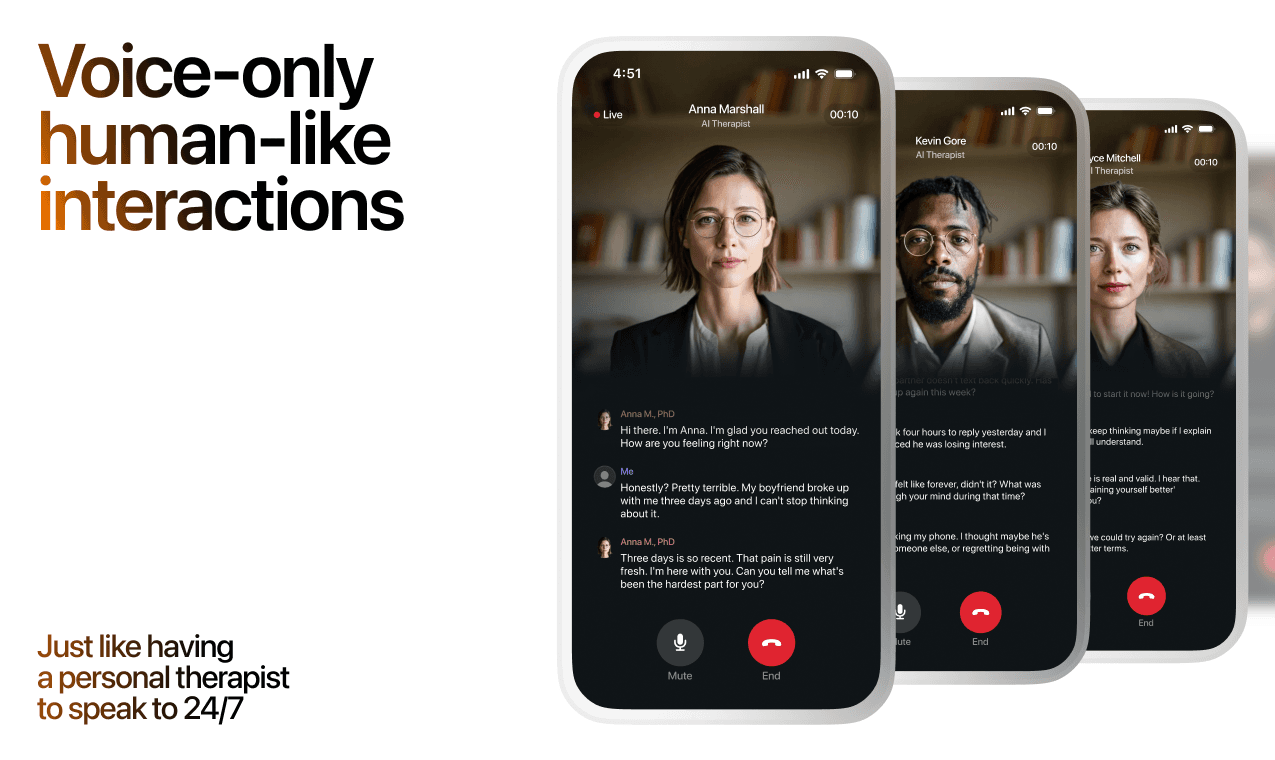
Here's what happens in a typical Lovon session:
You share what's on your mind
There's no script, no intake form, no waiting room. You speak or type whatever you're feeling — in your own words, at your own pace.
Lovon validates and explores
Using frameworks from CBT (Cognitive Behavioral Therapy) and motivational interviewing, Lovon acknowledges your feelings first, then gently helps you explore them. No dismissive "just move on" advice.
You build coping skills together
Lovon doesn't just listen — it actively works with you on evidence-based techniques: thought reframing, urge surfing, behavioral experiments, and more.
What a Session with Lovon Looks Like
When to Seek Professional Help
AI support is a valuable tool, but it's not a replacement for professional care. Please consider reaching out to a licensed therapist if you experience any of the following:
- Persistent thoughts of self-harm or suicide
- Inability to perform daily activities (work, eating, sleeping) for more than 2 weeks
- Turning to alcohol or substances to cope
- Intense anger or desire to harm your ex-partner
- Complete emotional numbness that doesn't improve over time
Crisis Resources (US): If you're in immediate danger, call 988 (Suicide & Crisis Lifeline) or text HOME to 741741 (Crisis Text Line). Available 24/7, free, and confidential.
Outside the US? Find a crisis line in your country
Ready to Start?
Your healing journey can begin right now
A 7-day trial. No judgment. Just a safe space to process what you're going through.
Frequently Asked Questions
Is Lovon a replacement for a real therapist?
Is my conversation with Lovon AI private?
How is Lovon different from ChatGPT for emotional support?
Can I use Lovon if I'm already seeing a therapist?
Can I try Lovon before subscribing?
About the Author
The Lovon Editorial Team
Mental Health & Wellness Content Team
The Lovon Editorial Team develops mental health and wellness content designed to make psychological concepts accessible and actionable. Our goal is to bridge the gap between clinical research and everyday life - helping you understand why your mind works the way it does and what you can do about it....
Related articles
- Friendship Breakup How to Heal: 2026 Recovery Guide
Friendship breakup how to heal in 2026: 8 concrete steps, common mistakes, and troubleshooting for grief, guilt, and…
- Is He Cheating on Me Quiz: Read the Signs (2026)
Is he cheating on me quiz breaks down 5 real signal clusters, what counts as evidence in 2026, and a verdict framework…
- AI Relationship Coach for Trust Issues (2026)
Find the best AI relationship coach for trust issues in 2026. Lovon offers voice-based, personalized sessions 24/7 — no…
- Emotional Regulation for Adults: The 2026 Practice Guide
Learn emotional regulation for adults with a 7-step practice, troubleshooting fixes, and FAQ answers built for real 2026…
See also
Quizzes
- Should I Forgive Him for Cheating? 12-Question Quiz
Twelve questions on whether rebuilding is possible.
- Am I Being Cheated On? 12-Question Reality Check
Sort the evidence from the fear in 2 minutes.
Free tools
- How to Respond to an Apology You're Not Sure About
A chat for how to respond to an apology that is sitting unanswered on your phone. Paste what they said, tell it what it…
- How to Stop Being Jealous in a Relationship
Two very different people search this, and advice that assumes either one is wrong half the time. This sorts what you…
From the wiki
- What is considered cheating?
There is no universal list, which is why the answer depends on the agreement the two of you actually have, usually one…
Disclaimer: This article is for informational purposes only and does not constitute medical advice, diagnosis, or treatment. Always seek the advice of your physician or other qualified health provider with any questions you may have regarding a medical condition. If you are in crisis or think you may have an emergency, call 988 (Suicide & Crisis Lifeline) or go to the nearest emergency room. Outside the US? Find a crisis line in your country.