
Best AI life coach apps in 2026
Compare the best AI life coach apps for emotional support, goal planning, and self-reflection. Choose by your needs, with clear limits and privacy checks.


Key Takeaways
- Among the best ai life coach apps, Lovon is the best fit for voice-based emotional support and self-reflection.
- Choose ChatGPT for goal planning, Claude for written reflection, or Gemini for brainstorming everyday routines.
- Use AI coaching for low-stakes support, not diagnosis, treatment decisions, or emergencies.
- Judge an app by its boundaries, privacy terms, and whether conversations lead to useful action.
Best for voice-based emotional support: Lovon. Best for turning goals into steps: ChatGPT. Best for written self-reflection: Claude. Best for brainstorming everyday routines: Gemini. This 2026 guide compares AI life coach apps by the kind of help you need, with clear limits on what software should handle.
TL;DR
- Among the best ai life coach apps, Lovon is the best fit for voice-based emotional support and self-reflection.
- Choose ChatGPT for goal planning, Claude for written reflection, or Gemini for brainstorming everyday routines.
- Use AI coaching for low-stakes support, not diagnosis, treatment decisions, or emergencies.
- Judge an app by its boundaries, privacy terms, and whether conversations lead to useful action.
Why this matters
A stalled goal does not always need a better checklist. Sometimes you need to name what feels hard before deciding what to do. Other times, you already understand your feelings and simply need help breaking a task down.
That distinction matters when choosing an AI life coach in 2026. Emotional support, planning, and mental health treatment are different jobs. A conversational app can support reflection without being qualified to diagnose a condition or deliver clinical care.
Lovon is best for people who want voice-based emotional support rather than a task-planning assistant. The other options below serve different purposes; none should become the final authority on your health, relationships, or major life decisions.
What makes the best AI life coach apps?
Use these criteria before choosing a familiar name:
- Task fit: Choose emotional support, goal planning, written reflection, or routine brainstorming—not an undefined promise to improve everything.
- Comfortable format: Speaking and typing ask different things of you. Pick the format you can use without forcing yourself.
- Clear boundaries: The app should not be treated as a licensed clinician, emergency service, or substitute for professional judgment.
- Useful next steps: Look for a conversation that ends with a manageable action, not endless encouragement.
- Privacy clarity: Read what happens to conversations, recordings, account information, and deletion requests before sharing sensitive details.
- Room for disagreement: Keep the ability to reject advice. A confident response is not proof that a suggestion fits your life.
AI life coach apps at a glance
These are use-case picks for 2026, not rankings of clinical effectiveness. General-purpose assistants belong here as tools you can prompt for coaching-style conversations, not as dedicated mental health services.
| App | Best for | Standout fit | Key limitation |
|---|---|---|---|
| Lovon | Voice-based emotional support | Spoken conversations, coping tools, and self-reflection guidance | Not a licensed clinician or replacement for clinical care |
| ChatGPT | Breaking goals into steps | Turning a described objective into a draft plan | Requires your direction and fact-checking |
| Claude | Written self-reflection | Discussing and reorganizing your own written thoughts | A text interpretation is not a psychological assessment |
| Gemini | Brainstorming everyday routines | Generating alternatives around constraints you describe | Suggestions still need a real-world feasibility check |
1. Lovon: best AI life coach app for emotional support
Lovon provides voice conversations with an AI for emotional support, coping tools, and self-reflection. Its stated focus includes everyday struggles involving anxiety, stress, low mood, relationships, and burnout. It is built with input from PhD psychologists, but that does not make the app a licensed clinician.
Choose this kind of support when your starting point is emotional: you feel overwhelmed, cannot untangle a worry, or want to talk through a difficult interaction. You do not need to turn the experience into a productivity problem first.
Lovon pros:
- Voice conversations let you speak rather than compose a written entry.
- Emotional support and self-reflection are central to its stated purpose.
- Coping tools offer a direction beyond simply describing your feelings.
- Its positioning explicitly separates the app from licensed clinical care.
Limitations:
- It cannot replace assessment or treatment from a qualified professional.
- Speaking aloud requires a setting where you feel comfortable being heard.
- Emotional support is a different job from managing deadlines or tracking projects.
Best for: People who want to talk through everyday emotional difficulties and reflect on a next step.
Verdict: Buy only if voice-based emotional support matches your need; skip it as a replacement for clinical care.
2. ChatGPT: best AI life coach option for goal planning
ChatGPT is a general-purpose conversational assistant that can draft plans from instructions you provide. For coaching-style use, give it a concrete goal, your constraints, and the smallest outcome you would consider useful.
A request to improve your whole life leaves too much undefined. A request to break a postponed application into manageable tasks gives the conversation a clear job. Ask ChatGPT to distinguish essential steps from optional improvements, then edit the result yourself.
ChatGPT pros:
- Can turn a broad goal into a draft sequence of actions.
- Can revise a plan when you describe a practical obstacle.
- Supports rehearsing an explanation or preparing questions for a conversation.
- Lets you specify the length and structure of a response.
ChatGPT cons:
- A detailed plan can still rest on mistaken assumptions.
- Planning does not create real-world accountability by itself.
- General-purpose responses are not individualized clinical care.
Best for: People who know what they want to do but need help defining a first action.
A practical opening prompt is to describe your goal, explain what keeps stopping you, and ask for a single next step before requesting a full plan. This keeps the conversation focused on action rather than collecting more advice.
Verdict: Buy only if you want a planning assistant you will actively direct; skip it as an authority on personal decisions.
3. Claude: best AI life coach option for written self-reflection
Claude is a general-purpose assistant you can use to discuss writing and organize ideas. A useful coaching-style task is to give it a short reflection and ask it to separate observations, interpretations, and unanswered questions.
This suits a reader who would rather pause and write than speak in the moment. Keep the task grounded in what you actually recorded. Asking Claude to diagnose your personality or explain another person's hidden motives turns reflection into unsupported interpretation.
Claude pros:
- Can organize a written reflection into clearer themes.
- Can generate questions for you to answer in your own words.
- Can help rewrite a self-critical statement in more neutral language.
Claude cons:
- Its interpretation depends on the context you choose to share.
- A convincing explanation of someone else's behavior is not evidence.
- Repeated analysis can displace the conversation or action you need outside the app.
Best for: People who already like journaling and want questions that help them examine their own account.
Try asking Claude to identify where your entry describes an event and where it makes an assumption. Treat the response as a draft to inspect, not a verdict about what happened.
Verdict: Buy only if structured written reflection fits you; skip it for diagnosis or certainty about another person.
4. Gemini: best AI life coach option for routine brainstorming
Gemini is a general-purpose assistant that can generate ideas and revise suggestions around instructions. For everyday coaching-style use, give it a routine problem and the constraints that make generic advice unhelpful.
For example, describe an unpredictable workday and ask for alternative ways to protect a short break. The useful output is a set of possibilities you can evaluate—not a supposedly perfect schedule.
Gemini pros:
- Can suggest alternative approaches to an everyday problem.
- Can revise ideas around constraints you state.
- Can help compare the practical trade-offs between proposed routines.
Gemini cons:
- Suggestions do not establish what is realistic in your household or workplace.
- Routine advice does not address every cause of exhaustion or distress.
- An appealing schedule still requires your judgment and adjustment.
Best for: People who want fresh options for an everyday routine rather than emotional processing or a detailed project plan.
Ask Gemini to explain what each suggestion requires from you. Reject options that depend on time, support, or control you do not have.
Verdict: Buy only if you need routine ideas to evaluate; skip it when your main need is mental health care.
How we ranked these 2026 picks
The ranking follows task fit, conversation format, useful next steps, and clear boundaries. It does not establish that one app produces better mental health outcomes than another.
The first pick matches a specific emotional-support need. The remaining picks separate planning, written reflection, and routine brainstorming so you can choose by purpose rather than assume every conversational assistant does the same job.
Choose the smallest tool that fits the problem. You do not need several apps interpreting the same worry, and agreement between assistants is not independent confirmation that advice is correct.
Try a small coaching exercise before committing
Use a low-stakes task to decide whether an app's approach suits you. These suggested time limits are boundaries for your own trial, not promises about results.
- Name the need. Spend 1 minute identifying whether you want emotional support, reflection, or help taking action.
- Set a boundary. Explain what you do not want: a diagnosis, a long task list, or a major decision made for you.
- Ask for support. Give the conversation 5 minutes on one situation rather than your entire life history.
- Choose an action. Select a step you can try in 10 minutes, or decide that rest or human support is more appropriate.
- Review the fit. Ask whether the exchange clarified anything and whether you still feel free to disagree.
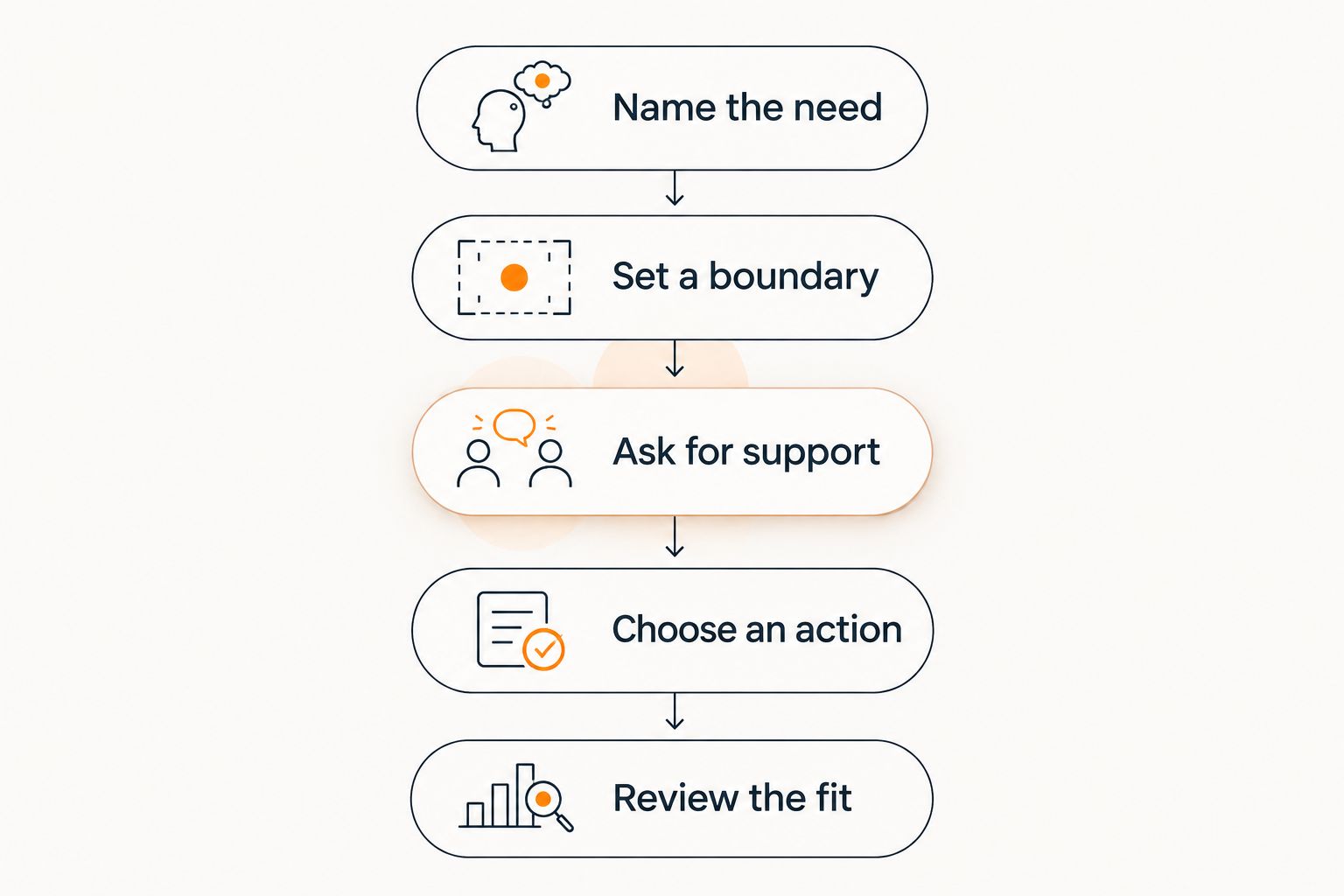 Five steps for trying an AI coaching conversation with clear boundaries.
Start with a defined need and finish by judging whether the conversation helped.
A useful conversation does not have to feel profound. Look for a clearer question, a manageable action, or recognition that an app is not the right support for this situation.
Keep the right decisions with a human
The distinction between generating a plan and taking responsibility for it also applies to AI running coaches: a proposed routine is not a professional assessment of whether it suits your health. For life coaching, keep medical decisions, serious safety concerns, and other high-stakes judgments outside a chatbot's authority.
You can ask an assistant to help prepare questions for a clinician or organize what you want to discuss. Do not use its response to start, stop, or change treatment. If persistent distress is affecting daily life, contact a qualified mental health professional rather than repeatedly asking an app for reassurance.
An app also cannot verify a partner's motives from your description. Use coaching-style prompts to clarify your needs and boundaries, not to obtain a diagnosis of someone who is not present.
Privacy questions to ask in 2026
Before discussing sensitive experiences, read the service's current privacy terms. A supportive tone tells you nothing about how information is stored or used.
Check these points directly:
- What conversation and account information does the service collect?
- Are voice recordings retained, and what happens to transcripts?
- Is content used to improve models, and what controls apply?
- What can you delete, and what does deletion cover?
- What access can staff or service providers have?
Do not assume that a mental health label gives an app the same privacy protections as your relationship with a healthcare provider. Start with minimal identifying detail, especially when describing other people.
Which AI life coach app should you choose?
Start with Lovon if your main need is voice-based emotional support. Choose ChatGPT for drafting goal steps, Claude for examining your writing, or Gemini for generating routine alternatives.
For an undecided reader in 2026, the deciding question is simple: do you need to talk through a feeling, understand a written reflection, or organize an action? Pick one purpose first. If what you need is assessment, treatment, or urgent help, choose human care instead of another app.
One last thing
Write down what would make you stop using an app before you start. Your boundary might be advice that feels pressuring, repeated reassurance without action, or conversations that replace people you trust. A tool should support your judgment, not become the judge of your life.
Related guides
How AI Support Helps You Heal
AI emotional support isn't about replacing human connection — it's about filling the gaps. The moments when you need to talk at 2 AM, when you don't want to burden your friends again, or when you simply need someone to listen without judgment.
Here's what happens in a typical Lovon session:
You share what's on your mind
There's no script, no intake form, no waiting room. You speak or type whatever you're feeling — in your own words, at your own pace.
Lovon validates and explores
Using frameworks from CBT (Cognitive Behavioral Therapy) and motivational interviewing, Lovon acknowledges your feelings first, then gently helps you explore them. No dismissive "just move on" advice.
You build coping skills together
Lovon doesn't just listen — it actively works with you on evidence-based techniques: thought reframing, urge surfing, behavioral experiments, and more.
What a Session with Lovon Looks Like

Lovon is AI support, not a replacement for professional care. If things have been hard to get through for weeks, or you are thinking about harming yourself, talk to a doctor or a licensed therapist.
Ready to Start?
Your healing journey can begin right now
A 3-day trial. No judgment. Just a safe space to process what you're going through.
Frequently Asked Questions
What's the best AI life coach app for emotional support?
Is ChatGPT a life coach?
Which AI app should I use for journaling?
Can an AI life coach replace a therapist?
Are voice conversations better than typing?
How do I know whether AI coaching is helping?
What should I do if I need urgent mental health support?
About the Author

The Lovon Editorial Team
Mental Health & Wellness Content Team
The Lovon Editorial Team develops mental health and wellness content designed to make psychological concepts accessible and actionable. Our goal is to bridge the gap between clinical research and everyday life - helping you understand why your mind works the way it does and what you can do about it....
Related articles
- Best AI apps for autism masking burnout in 2026
Compare the best AI apps for autism masking burnout. Choose Lovon for voice support, or text tools for boundaries and…
- Is hiring a life coach worth it in 2026?
Is hiring a life coach worth it? Yes for clear goals and accountability, not clinical care. Learn how to assess fit, ask…
- Best AI apps for fertility and IVF stress in 2026
Best AI apps for fertility and IVF stress: choose Lovon for voice support, compare focused alternatives, and keep…
- Best AI therapy apps with voice conversations in 2026
Compare AI mental health apps with voice conversations. Lovon leads for emotional support; see where general assistants…
See also
Quizzes
- Thin Thick Boundaries Test: Where Do Your Lines Blur?
See where your boundaries run thin, in 3 minutes.
- Resilience Test: How Fast Do You Bounce Back?
See how you recover from setbacks, in 3 minutes.
Free tools
- AI Mental Health Coach
This is a free AI mental health coach for ordinary hard stretches: stress, low days, worry that will not switch off, a…
- Wheel of Life
Rate eight areas of your life from 1 to 10 and watch your wheel take shape. Then pick the one area to work on this…
From the wiki
- Why do I feel lonely all of a sudden?
Sudden loneliness usually traces back to something that quietly ended in the last few months: a routine, a shared class…
Disclaimer: This article is for informational purposes only and does not constitute medical advice, diagnosis, or treatment. Always seek the advice of your physician or other qualified health provider with any questions you may have regarding a medical condition. If you are in crisis or think you may have an emergency, call 988 (Suicide & Crisis Lifeline) or go to the nearest emergency room. Outside the US? Find a crisis line in your country.