
Can journaling really help you process a breakup faster?
Can journaling help you get over a breakup? Yes, but not on a fixed timeline. Find practical prompts, spot rumination, and know when to seek support.


Key Takeaways
- Can journaling help you get over a breakup? Yes, but faster recovery is not guaranteed.
- Use breakup journaling to separate facts, feelings, and your next practical step.
- Pause when emotional processing becomes repeated self-blame or detective work about your ex.
- Lovon offers voice-based emotional support, not licensed clinical care or a guaranteed recovery timeline.
Yes, journaling can help you get over a breakup by giving you space to name your feelings, examine painful assumptions, and decide what you need next—but it does not guarantee faster healing. Writing that repeatedly replays the relationship without helping you shift perspective can leave you more stuck, so the goal is useful reflection, not more pages.
TL;DR
- Can journaling help you get over a breakup? Yes, but faster recovery is not guaranteed.
- Use breakup journaling to separate facts, feelings, and your next practical step.
- Pause when emotional processing becomes repeated self-blame or detective work about your ex.
- Lovon offers voice-based emotional support, not licensed clinical care or a guaranteed recovery timeline.
Can journaling really help you process a breakup faster?
Journaling is a tool for understanding your breakup, not a shortcut around grief. It gives you a place to express conflicting feelings without sending them to your ex or trying to make them sound reasonable to someone else.
If you are new to writing about emotions, start with this beginner’s guide to journaling for mental health. You do not need polished sentences, a detailed relationship history, or a daily streak.
The important distinction is what your writing asks you to do:
| Approach | Best for | Useful feature | Limitation |
|---|---|---|---|
| Structured reflection | Sorting out a specific trigger | Connects an event with a feeling, need, and response | Can feel restrictive when you just need to express yourself |
| Open-ended writing | Putting difficult feelings into words | Lets you write without an outline | Can turn into repetitive replay or self-blame |
| An unsent letter | Expressing something you cannot safely or usefully say | Gives unfinished thoughts somewhere to go | Can become rehearsal for unwanted contact |
Choose the approach that helps you understand yourself without treating your ex’s thoughts as a puzzle you must solve. None of these formats can promise an earlier recovery date.
Why this matters
After a breakup, you might want answers to questions that have no available answer: whether your ex misses you, when things changed, or whether a different conversation would have saved the relationship. A notebook cannot settle those questions.
It can help you ask more workable ones. What hurts today? What are you assuming? What would make the next part of your day more manageable?
If your breakup happened in 2026, messages, shared photos, and social feeds can become material for endless analysis. Use your journal to understand your response to those reminders, not to build a case about what every post means.
How to journal after a breakup in 4 steps
Treat these 4 steps as a flexible writing exercise, not a clinical protocol. Stop or change direction if writing feels overwhelming, and do not force yourself to describe experiences you are not ready to revisit.
Name the moment
Start with the event that brought up the feeling. Keep it specific and observable: seeing a photo, coming home to an empty apartment, or wanting to tell your ex about your day.
Describe what happened without adding an explanation of someone else’s motives. Seeing your ex online is an observation; deciding that their activity proves they never cared is an interpretation.
This distinction does not make the hurt less real. It simply keeps an uncertain explanation from becoming the foundation of the whole entry.
Separate the story
Write down the meaning you attached to the event. Then ask what you actually know and what remains uncertain.
For example, you can acknowledge feeling replaceable without declaring that you are replaceable. You can regret something you said without deciding that you caused every problem in the relationship.
Aim for a fair account, not a positive one. You do not have to turn a painful ending into a lesson before you are ready.
Identify the need
Ask what the feeling points toward now. You might need company, rest, reassurance, distance from reminders, or help with a practical problem the breakup created.
Be concrete. Missing your ex and needing someone to listen can exist together, but contacting your ex is not the only possible response to loneliness.
You also do not need to turn every feeling into a task. Sometimes the useful discovery is simply that you are sad and do not want to spend the evening alone.
Choose the next step
Close with something within your control. That might mean asking a friend to check in, eating a meal, putting away a reminder, or making an appointment with a therapist.
Choose a step that does not depend on your ex replying, apologizing, or changing their mind. Your journal can hold a wish for reconciliation without making reconciliation your only plan.
A complete entry does not have to end with relief. It can end with a clearer description of what hurts and a reasonable way to care for yourself afterward.
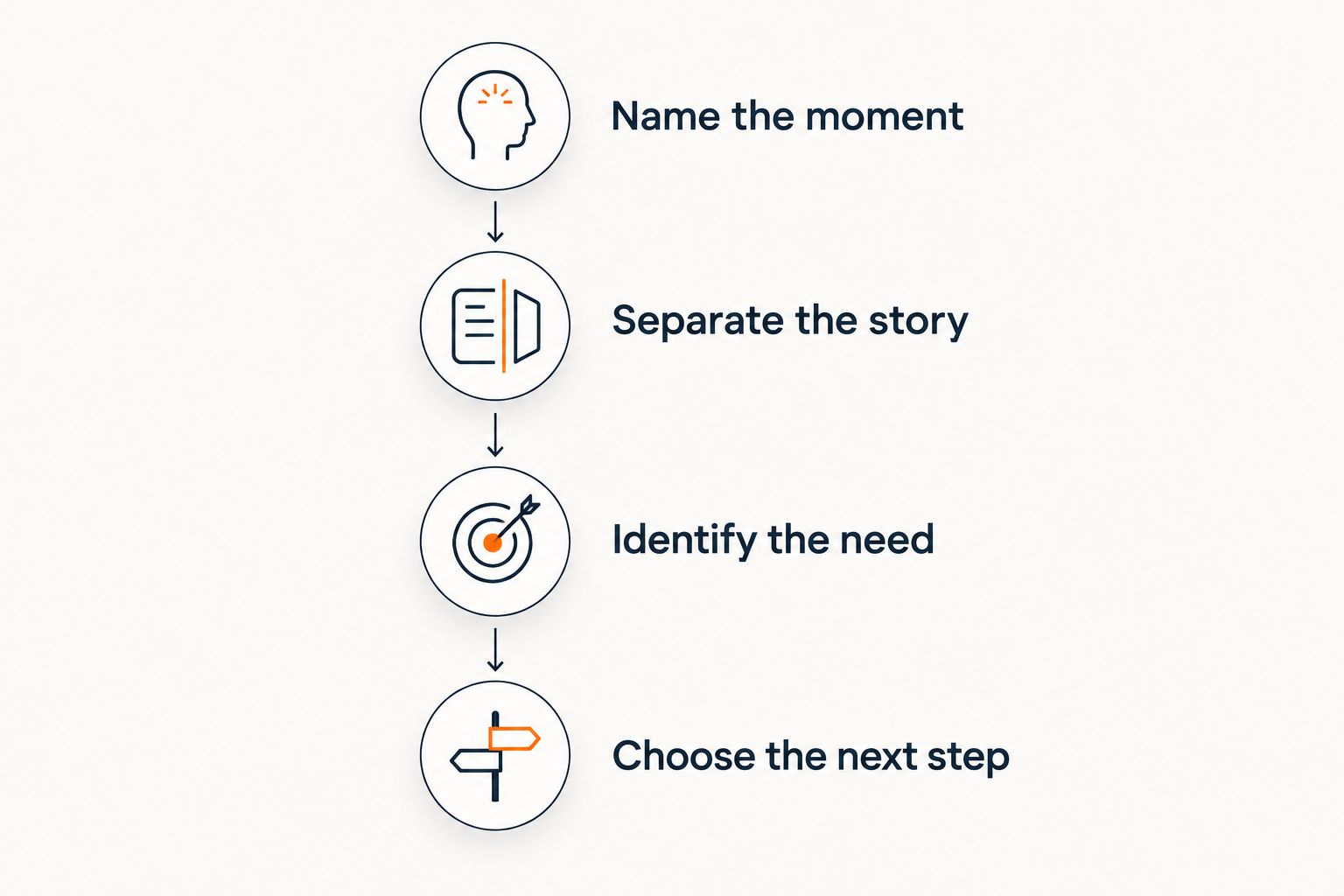 Four journaling steps from naming a painful moment to choosing a practical next step.
End with something you can do, rather than an answer only your ex can provide.
Structured reflection: best for sorting out a trigger
Use structured reflection when you keep returning to a particular event. A short set of questions can keep the entry focused on your experience rather than a full reconstruction of the relationship.
Try these 3 prompts:
- What happened, and what am I telling myself it means?
- What feeling or need deserves attention right now?
- What response would respect both my feelings and my boundaries?
The advantage is direction. The limitation is that a worksheet-like format can feel frustrating when your emotions are messy or hard to name.
Leave a prompt unanswered if it does not help. The structure should support you, not become another standard you feel you are failing to meet.
An unsent letter: best for unfinished conversations
An unsent letter gives you somewhere to put anger, affection, disappointment, or the apology you wish you had received. Write for expression rather than persuasion.
You can describe what you miss alongside what hurt. You do not have to make your ex entirely good or entirely bad to explain why the ending matters.
The limitation is the temptation to turn the exercise into a message. Decide before writing that the letter is private; if you later consider contact, make that decision separately, with attention to consent, safety, and existing boundaries.
Do not send a letter to someone who has asked you not to contact them. Emotional urgency does not cancel their boundary—or yours.
Open-ended writing: best for getting words out
Open-ended writing works as an option when prompts feel too demanding. Start with what you notice and let the entry remain unfinished if that is all you have capacity for.
You can write fragments, repeat yourself, or acknowledge contradictory feelings. Missing someone does not mean the breakup was wrong, and feeling relief does not mean the relationship meant nothing.
The limitation is lack of direction. If you repeatedly circle the same accusation or unanswered question, shift to a concrete prompt or close the journal.
For a digital journal in 2026, choose a format you feel comfortable using and review its privacy settings. Do not assume an entry is confidential simply because it sits inside an app.
Why journaling helps some days and not others
The same exercise does not fit every emotional state. These factors help you decide whether to continue, change the format, or reach for a different kind of support:
- The question you ask. Exploring what you need gives you something to work with; guessing your ex’s motives leaves the answer outside your control.
- Your level of distress. If writing leaves you overwhelmed, pause rather than pushing for a breakthrough.
- The material you revisit. Describing today’s loneliness is different from repeatedly rereading hurtful messages.
- Your privacy. Concern that someone will read your entries can limit what you feel safe expressing.
- Your support outside the journal. Writing cannot replace practical help, human connection, or clinical care when you need them.
You do not have to keep using a method just because it helped before. Adjusting the exercise is a reasonable response to what you notice, not evidence that you are doing recovery incorrectly.
How do I know whether journaling is becoming rumination?
Journaling becomes less useful when it repeatedly returns you to the same accusation, prediction, or unanswered question without helping you understand your needs. Watch for entries devoted to proving your worth, decoding your ex, or finding a perfect explanation for the ending.
Ask yourself 2 questions after an entry: Am I clearer about what I feel? Can I choose what to do next without getting an answer from my ex? These are reflection questions, not a diagnostic test.
If both answers are no, try a different format or stop for now. You can put your feet on the floor, look around the room, get a drink of water, or contact someone you trust.
A useful boundary for 2026 digital journaling is to keep old-message searches separate from writing. You do not need to reopen the conversation history to describe how you feel today.
How long does journaling take to help after a breakup?
There is no guaranteed journaling timeline for getting over a breakup. An entry can clarify a feeling without changing how much you miss someone, and a difficult day does not erase the practical changes you have made.
Look for useful changes rather than a deadline: recognizing a trigger, asking for support, or choosing not to act on an urge to contact your ex. Those changes matter even while sadness remains.
Should I journal if writing makes me feel worse?
You do not need to continue an exercise that repeatedly leaves you overwhelmed or less able to manage your day. Pause, use a less emotionally intense prompt, or talk with a licensed mental health professional about a better approach.
Feeling sad during an entry is not automatically a sign of harm. What deserves attention is a repeated pattern of escalating distress, harsh self-judgment, or difficulty returning to everyday activities afterward.
What if talking feels easier than writing?
Talking is another way to express what feels tangled, especially when a blank page becomes a barrier. You can speak without producing a polished story or reaching a conclusion.
Lovon is best for people who prefer voice-based emotional support, not clinical treatment. Lovon offers on-demand voice conversations, coping tools, and self-reflection guidance; it is not a licensed clinician or a replacement for clinical care.
Use Lovon’s mental health support as a companion to reflection, not as proof of what your ex thinks or a substitute for people you trust. A conversational response does not establish someone else’s intentions.
When should I get support beyond journaling?
Seek professional support when distress is persistent, worsening, or interfering with sleep, eating, work, or basic care. You do not need to wait until things feel unbearable to ask for help.
If the relationship involved threats, coercion, or abuse, prioritize safety and specialist support over finding closure through writing. Keep entries somewhere the other person cannot access if doing so is safe.
In the United States in 2026, call or text 988 for suicide or mental health crisis support. If you are in immediate danger or cannot stay safe, call 911 or go to the nearest emergency department; a journal or app is not emergency care.
One last thing
Your journal does not need to explain the entire relationship to be useful. It can hold a contradiction: you miss someone, and you do not want the relationship back as it was.
For your next entry in 2026, try writing about what you want your ordinary day to contain—not what would make your ex return. You are allowed to build a life that feels more like yours before the grief is finished.
Related guides
How AI Support Helps You Heal
AI emotional support isn't about replacing human connection — it's about filling the gaps. The moments when you need to talk at 2 AM, when you don't want to burden your friends again, or when you simply need someone to listen without judgment.
Here's what happens in a typical Lovon session:
You share what's on your mind
There's no script, no intake form, no waiting room. You speak or type whatever you're feeling — in your own words, at your own pace.
Lovon validates and explores
Using frameworks from CBT (Cognitive Behavioral Therapy) and motivational interviewing, Lovon acknowledges your feelings first, then gently helps you explore them. No dismissive "just move on" advice.
You build coping skills together
Lovon doesn't just listen — it actively works with you on evidence-based techniques: thought reframing, urge surfing, behavioral experiments, and more.
What a Session with Lovon Looks Like

Lovon is AI support, not a replacement for professional care. If things have been hard to get through for weeks, or you are thinking about harming yourself, talk to a doctor or a licensed therapist.
Ready to Start?
Your healing journey can begin right now
A 3-day trial. No judgment. Just a safe space to process what you're going through.
Frequently Asked Questions
Can journaling help you get over a breakup if you still love them?
Will journaling help me get over my ex faster?
What should I write in my journal after a breakup?
Should I journal about my breakup every day?
Is it normal to cry while journaling about an ex?
Should I send my ex what I wrote?
Can Lovon replace therapy while I recover from a breakup?
About the Author

The Lovon Editorial Team
Mental Health & Wellness Content Team
The Lovon Editorial Team develops mental health and wellness content designed to make psychological concepts accessible and actionable. Our goal is to bridge the gap between clinical research and everyday life - helping you understand why your mind works the way it does and what you can do about it....
Related articles
- Self Care After a Breakup: 40 Things That Actually Help
Self care after a breakup that actually helps: 40 specific things for sleep, food, people, your phone and your mind, a…
- Am I Over My Ex Quiz: 8 Real Markers (2026)
Take the am I over my ex quiz: 8 honest emotional markers that reveal whether you're truly ready to move on in 2026…
- Friendship Breakup How to Heal: 2026 Recovery Guide
Friendship breakup how to heal in 2026: 8 concrete steps, common mistakes, and troubleshooting for grief, guilt, and…
- Can't Sleep or Eat After a Breakup? Why, and What Helps
Can't sleep or eat after a breakup? Why your body reacts this way, what helps at 3 a.m. and at mealtimes, a simple…
See also
Quizzes
- Is My Marriage Over? Quiz: Should I Get a Divorce?
See where your marriage really stands in 4 minutes.
- Should I Give Him Another Chance? 12-Question Quiz
Twelve questions on whether anything has really changed.
Free tools
- AI Breakup Coach
This is a free AI breakup coach you can use right on this page. Tell it how long ago it ended, who ended it and what is…
- Breakup Meditation
For when it's over and it still hurts. Seven minutes of slow breathing, noticing where the breakup sits in your body…
From the wiki
- How to break up with someone you still love?
Loving someone does not mean the relationship works. If you have circled the same decision for months and the reasons…
Disclaimer: This article is for informational purposes only and does not constitute medical advice, diagnosis, or treatment. Always seek the advice of your physician or other qualified health provider with any questions you may have regarding a medical condition. If you are in crisis or think you may have an emergency, call 988 (Suicide & Crisis Lifeline) or go to the nearest emergency room. Outside the US? Find a crisis line in your country.