
Can you genuinely love two people at the same time?
Can you love two people at the same time? Yes. Learn how to separate genuine feelings from commitments, respect boundaries, and choose an honest next step.
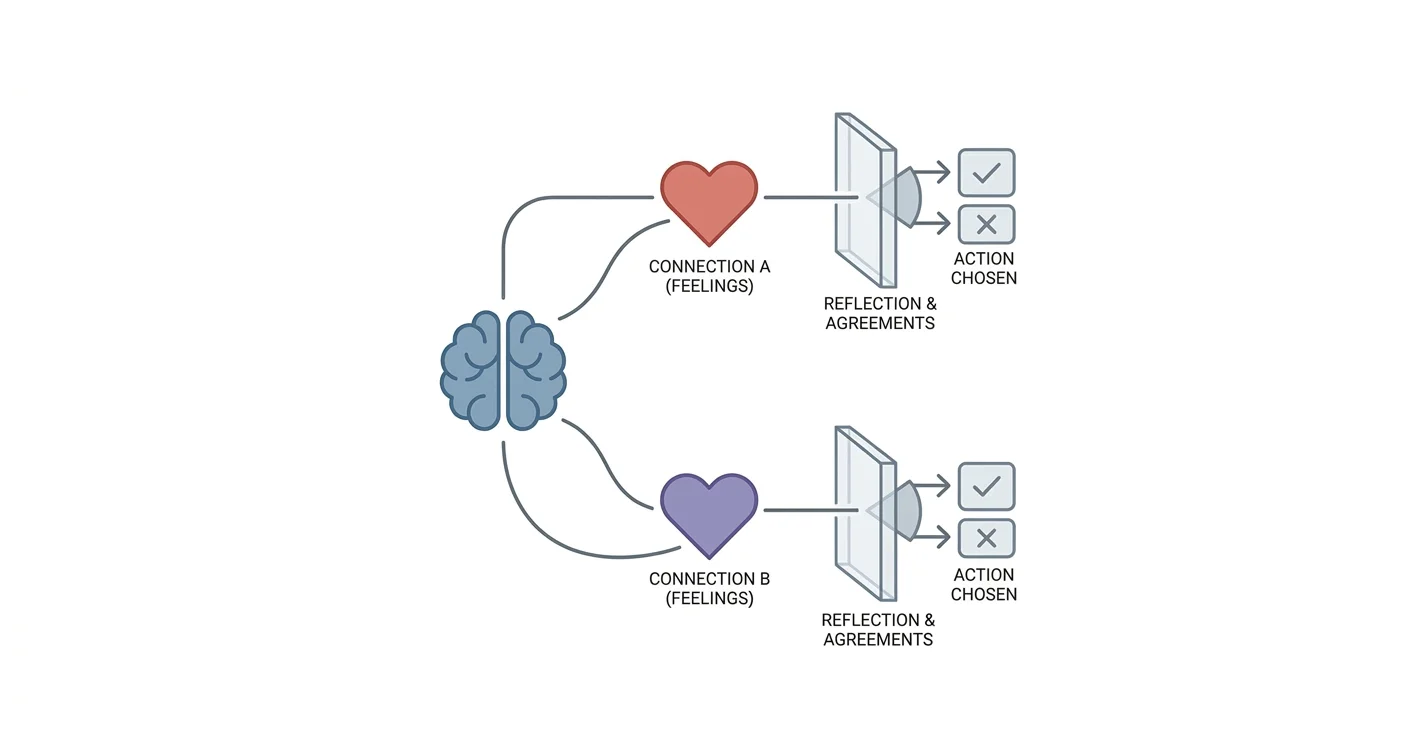

Key Takeaways
- Can you love two people at the same time? Yes. Genuine feelings and relationship commitments are separate questions.
- Romantic love does not remove the need for honesty, boundaries, and freely given consent.
- Compare everyday compatibility, not just the intensity of attraction or the fear of losing someone.
- Lovon offers relationship self-reflection support, not a verdict about whom you should choose.
Yes, you can genuinely love two people at the same time, including having romantic feelings for both. Those feelings do not automatically mean both relationships are compatible, equally deep, or possible within your existing commitments. You can acknowledge what you feel without treating it as permission to break an agreement.
TL;DR
- Can you love two people at the same time? Yes. Genuine feelings and relationship commitments are separate questions.
- Romantic love does not remove the need for honesty, boundaries, and freely given consent.
- Compare everyday compatibility, not just the intensity of attraction or the fear of losing someone.
- Lovon offers relationship self-reflection support, not a verdict about whom you should choose.
Can you genuinely love two people at the same time?
Yes. Caring deeply about one person does not make feelings for another person impossible. You might feel affection, attraction, emotional closeness, and concern for both people, while experiencing each connection differently.
But naming both feelings as love does not settle what to do. Ask what you actually know about each person, what you have promised, and whether your behavior respects everyone involved. If fear of losing someone makes those questions difficult, this guide to codependency vs. love offers another starting point.
Use the distinctions below as reflection prompts, not a test that proves whether your feelings are real.
| Experience | What to look at | What it does not establish |
|---|---|---|
| Romantic love | Care, attraction, knowledge of the person, and interest in their well-being | That a relationship will work |
| Attraction | A desire for closeness, romance, or physical intimacy | That you know the person deeply |
| Emotional attachment | Familiarity, shared history, and difficulty imagining separation | That staying together is the right choice |
| Idealization | A picture of someone built partly from hopes or limited information | That everyday life matches the imagined relationship |
These experiences can overlap. You do not need to dismiss one connection as fake to recognize that the other has a different place in your life.
Why this matters in 2026
The useful question is not only whether you love both people. It is whether your next action is honest, respectful, and consistent with the kind of relationship you want.
Feelings are information, not instructions. You can feel love and decide not to pursue it. You can also care deeply about someone and recognize that your expectations for a relationship do not fit.
Try separating your situation into three questions:
- What do I feel for each person?
- What relationship, if any, do I want with each person?
- What have the people involved actually agreed to?
Keeping those questions separate helps you avoid using an emotional truth to justify a decision someone else never consented to.
How do I tell whether both connections are love?
Look beyond the moments that feel intense. Consider whether you know each person's values, limitations, boundaries, and ordinary habits, rather than only the version you meet during exciting conversations.
Ask yourself what caring for each person looks like when you do not get what you want. Can you respect a refusal? Can you hear disappointment without trying to make the person reassure you?
You can also examine the comparison itself. A long-term partner carries shared responsibilities and unresolved disagreements. A newer connection might not have faced those conditions yet. Comparing the hardest parts of one relationship with the easiest parts of another is not a fair assessment.
Useful reflection prompts include:
- What do I appreciate about this person beyond how they make me feel?
- What difficulties have we faced together, and how did we respond?
- What do I know firsthand, and what am I imagining?
- Would I still respect their choices if they did not choose me?
- Do I want a shared life, or do I mainly want the feeling this connection gives me?
There is no single response that certifies love. Look for a fuller picture rather than a perfect label.
Why loving two people feels different in different situations
Your circumstances matter as much as the feelings themselves. Use these factors to understand the situation without turning any one factor into an explanation for everything.
- Relationship agreements: An exclusive relationship and an openly agreed non-monogamous relationship have different boundaries. Neither arrangement gives you permission to ignore those boundaries.
- Shared history: An established relationship includes experiences that a new connection has not had. History deserves attention, but it does not require you to stay.
- Everyday compatibility: Affection does not answer questions about family plans, responsibilities, communication, or the relationship structure each person wants.
- Stress and anxiety: Notice whether you are deciding from a settled understanding of your needs or trying to escape an uncomfortable moment.
- Fear of loss: Ask whether you want both relationships or feel unable to tolerate either person leaving. Those are different concerns.
- Available attention: Consider what you can honestly offer. Wanting a relationship is different from having the capacity to meet its commitments.
For your 2026 relationship decisions, write down the agreements that exist now—not the arrangement you hope everyone will eventually accept.
What should I do if I love two people?
Start with a pause in escalation, not a demand that you stop feeling. You can avoid making new promises while you work out what you want and what other people need to know.
The following sequence is a reflection exercise. It is not a deadline, a diagnostic tool, or a guarantee that nobody will be hurt.
Name the feelings
Describe each connection separately. Write about affection, attraction, trust, uncertainty, and what you know of the person's wishes. Avoid ranking either person as better or worse.
Separate facts from interpretations. A fact describes something that happened; an interpretation assigns meaning to it. Keep room for the other person to explain their own intentions.
Check agreements
Identify your current commitments. Consider exclusivity, flirting, sexual contact, emotional intimacy, and what you have agreed to disclose.
If a boundary is unclear, do not assume silence means permission. Clarify it before acting. If you have already crossed an agreement, focus on taking responsibility rather than finding a label that makes the breach sound harmless.
Set boundaries
Choose boundaries that prevent further confusion while you reflect. That might mean stopping flirtatious conversations or declining plans that you know would cross an existing agreement.
Explain relevant changes without promising an outcome you have not decided on. Taking space should not mean asking someone to wait indefinitely while you keep every possibility open.
Talk honestly
Discuss the choices that affect your partner's ability to consent to the relationship. Describe your uncertainty and behavior without blaming your partner for the feelings you have developed.
Honesty does not require a detailed comparison of two people. Share what is relevant to agreements and decisions. Leave space for the other person to be upset, ask questions, set limits, or leave.
Choose actions
Decide what you can offer now. You might recommit to exclusivity, end a relationship, or discuss a different structure if everyone genuinely wants that conversation.
You do not need absolute certainty about every feeling before acting responsibly. You do need to stop making incompatible promises.
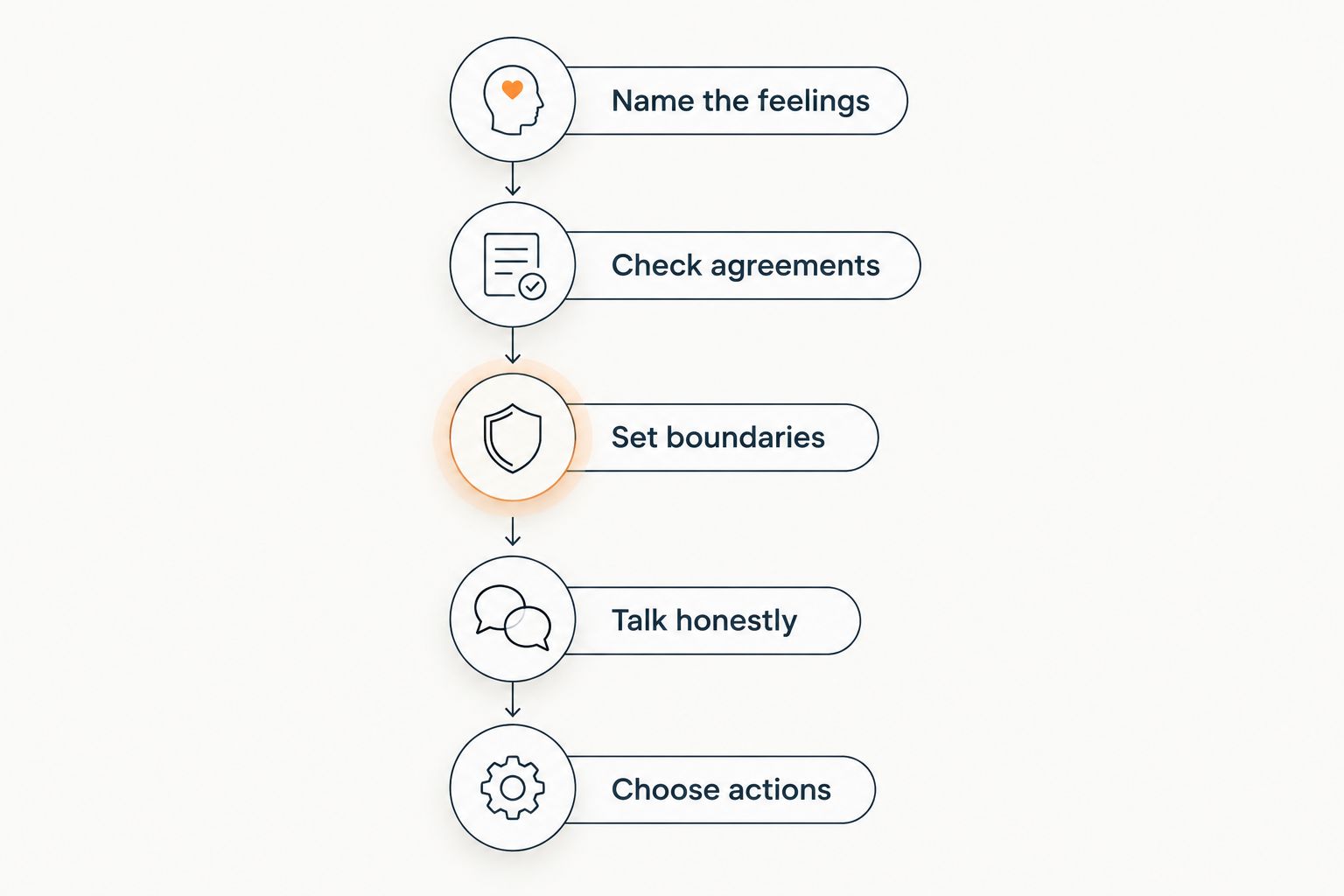 A reflection sequence from naming feelings to choosing actions
Understand your feelings while keeping your actions accountable to existing agreements.
Keep your 2026 reflection notes focused on your own choices. Recording what you want is useful; constructing an argument that someone else must accept it is not.
Which relationship choice fits what everyone wants?
There is no relationship structure that automatically solves divided feelings. Choose based on consent and compatibility, not on which option lets you avoid the hardest conversation.
The options below are not ranked. Each has a different purpose and a real limitation.
| Option | Best for | Benefit | Limitation |
|---|---|---|---|
| Recommit to exclusivity | People who genuinely want one exclusive partnership | Gives your actions a clear boundary | Requires accepting that another connection will not be pursued |
| End a relationship | People whose relationship goals no longer fit | Stops offering a commitment you cannot honestly maintain | Involves loss, even when love remains |
| Discuss consensual non-monogamy | People who independently want non-exclusivity | Allows an explicit conversation about multiple relationships | Does not work as a demand or erase an earlier breach of trust |
| Take clearly defined space | People who need room to reflect without escalation | Creates a boundary around an unsettled decision | Becomes unfair if expectations and limits remain vague |
If you want to preserve an exclusive relationship, do not ask your partner to compete for your commitment. Discuss the relationship's needs directly and set boundaries around the other connection.
If you want non-monogamy, your partner is allowed to decline. Wanting different relationship structures can be a genuine incompatibility, even when both people care deeply.
Does loving someone else mean I do not love my partner?
No. Feelings for someone else do not automatically cancel your love for your partner. They also do not prove that your current relationship is healthy or that it should continue.
Assess the existing relationship on its own terms: respect, safety, trust, shared goals, and willingness to address problems. Do not make the new person the only reason you examine those questions.
Is loving two people the same as cheating?
No. An internal feeling is different from behavior that breaches a relationship agreement. Cheating concerns the boundaries and commitments involved, not simply whether you experience attraction or affection.
Avoid relying on technicalities. If you are hiding conduct because you know it violates an agreement, address the conduct rather than arguing about whether it counts.
Can I stay with both people if everyone knows?
Only if everyone freely agrees to the relationship arrangement. Knowing that another relationship exists is not the same as consenting to it.
Consent also does not eliminate the need for ongoing conversations about boundaries, time, intimacy, and changing wishes. Nobody owes you non-monogamy to prove that their love is real.
When outside support helps
Consider a licensed therapist if this situation is disrupting your sleep, concentration, daily responsibilities, or ability to make decisions. Individual support can give you room to examine your values without asking either partner to manage your uncertainty.
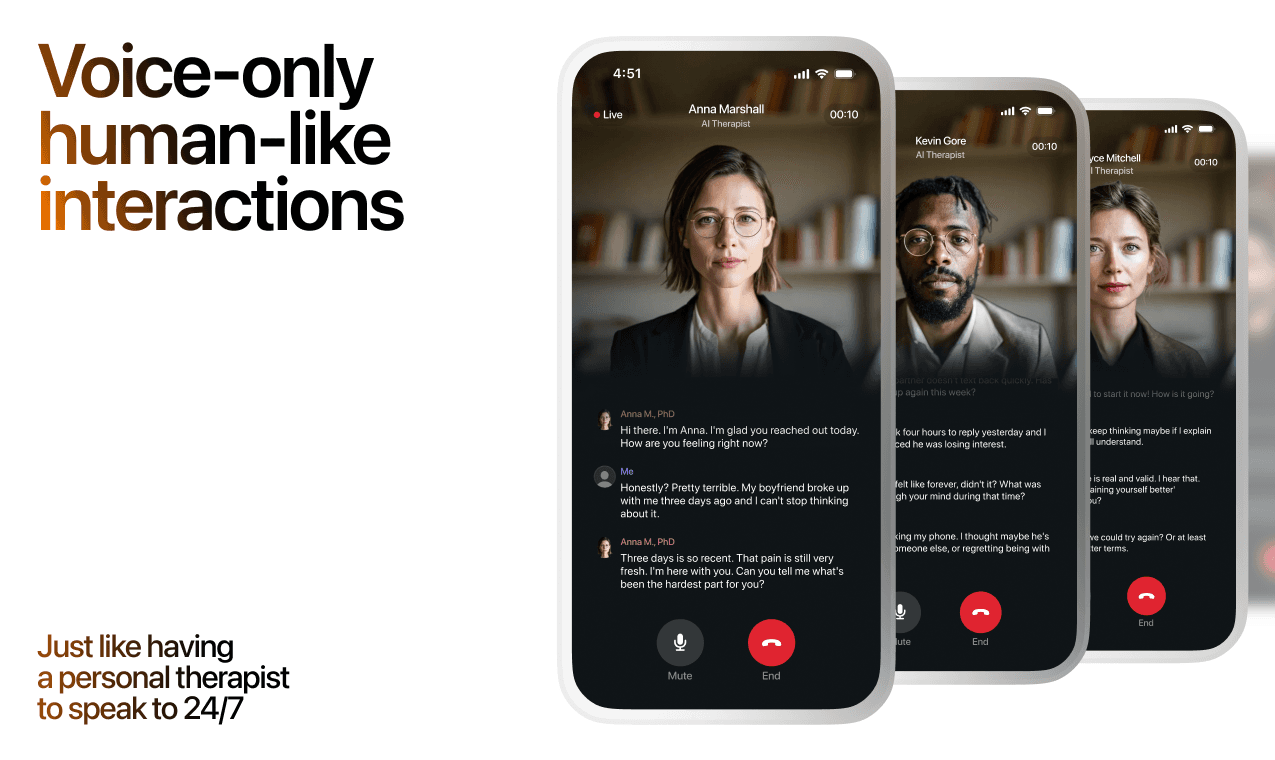
For everyday reflection, Lovon offers an AI-powered mental health app with voice conversations, emotional support, coping tools, and self-reflection guidance. Lovon is best suited to people seeking conversational support for everyday relationship concerns, not clinical care.
The benefit of Lovon as a mental health app is a place to talk through feelings and prepare questions. The limitation is equally important: it is not a licensed clinician, cannot know your partners' perspectives, and should not decide whom you love or whether you should leave.
When choosing support in 2026, distinguish help with reflection from professional care. If you fear retaliation, threats, or violence, prioritize safety and seek individual help before attempting a joint relationship discussion.
FAQ
Can you love two people at the same time and still be faithful?
Yes, you can have feelings for two people while keeping your relationship agreements. Faithfulness concerns your conduct and commitments, not the absence of every outside feeling.
Does loving two people mean I am polyamorous?
No, loving two people does not by itself determine your relationship identity. Consider whether you genuinely want consensual multiple relationships, rather than only wanting to keep these particular connections.
How do I know which person I love more?
There is no reliable score that measures which person you love more. Look at what you know about each relationship, the life you want, and the commitments you can honestly offer.
Should I tell my partner I have feelings for someone else?
Tell your partner about behavior and intended changes that affect your relationship agreements. A passing feeling and an ongoing hidden romantic connection call for different conversations; avoid using disclosure simply to transfer your guilt.
Can loving two people be just a crush?
Yes, a connection you describe as love can include attraction, a crush, or an imagined future. Give attention to what you know about the person beyond exciting moments and hoped-for possibilities.
Can a relationship survive feelings for someone else?
Yes, a relationship can continue when someone develops feelings for another person. Continuing requires a shared willingness to address relevant boundaries and decisions, not a guarantee that the feelings disappear.
Can Lovon tell me which person to choose?
No, Lovon cannot determine which person you should choose. The mental health app offers emotional support and self-reflection guidance, not a substitute for your judgment or licensed clinical care.
One last thing
You do not have to prove that one love was false to make a responsible choice. Both feelings can matter, and you can still choose not to pursue one of them.
Before your next conversation in 2026, finish this sentence: The commitment I can honestly offer now is… If you cannot finish it, avoid making a new promise. Start with the uncertainty you can name.
Related guides
How AI Support Helps You Heal
AI emotional support isn't about replacing human connection — it's about filling the gaps. The moments when you need to talk at 2 AM, when you don't want to burden your friends again, or when you simply need someone to listen without judgment.
Here's what happens in a typical Lovon session:
You share what's on your mind
There's no script, no intake form, no waiting room. You speak or type whatever you're feeling — in your own words, at your own pace.
Lovon validates and explores
Using frameworks from CBT (Cognitive Behavioral Therapy) and motivational interviewing, Lovon acknowledges your feelings first, then gently helps you explore them. No dismissive "just move on" advice.
You build coping skills together
Lovon doesn't just listen — it actively works with you on evidence-based techniques: thought reframing, urge surfing, behavioral experiments, and more.
What a Session with Lovon Looks Like
When to Seek Professional Help
AI support is a valuable tool, but it's not a replacement for professional care. Please consider reaching out to a licensed therapist if you experience any of the following:
- Persistent thoughts of self-harm or suicide
- Inability to perform daily activities (work, eating, sleeping) for more than 2 weeks
- Turning to alcohol or substances to cope
- Intense anger or desire to harm your ex-partner
- Complete emotional numbness that doesn't improve over time
Crisis Resources (US): If you're in immediate danger, call 988 (Suicide & Crisis Lifeline) or text HOME to 741741 (Crisis Text Line). Available 24/7, free, and confidential.
Outside the US? Find a crisis line in your country
Ready to Start?
Your healing journey can begin right now
A 7-day trial. No judgment. Just a safe space to process what you're going through.
Frequently Asked Questions
Is Lovon a replacement for a real therapist?
Is my conversation with Lovon AI private?
How is Lovon different from ChatGPT for emotional support?
Can I use Lovon if I'm already seeing a therapist?
Can I try Lovon before subscribing?
About the Author
The Lovon Editorial Team
Mental Health & Wellness Content Team
The Lovon Editorial Team develops mental health and wellness content designed to make psychological concepts accessible and actionable. Our goal is to bridge the gap between clinical research and everyday life - helping you understand why your mind works the way it does and what you can do about it....
Related articles
- Alexithymia: What It Is and How to Work Through It (2026)
Alexithymia blocks emotional connection by making feelings hard to name. Get the six-step approach, common pitfalls, and…
- Enmeshment in Relationships: Signs & Fix (2026)
Enmeshment in relationships blurs boundaries until feelings merge. See the signs, a 7-step untangling process, and…
- Chronic Guilt: Why You Feel Guilty All the Time (2026)
Chronic guilt runs even when you've done nothing wrong. Learn the 6 steps to identify its root cause and break the cycle…
- How to Set Boundaries With a Narcissist (2026 Guide)
Learn how to set boundaries with a narcissist without conflict: scripted language, the gray rock method, and…
See also
Quizzes
- Self Esteem Test: What Is Your Worth Resting On?
See what your sense of worth is resting on.
- Am I Codependent? 12-Question Self-Check
See how much of you is left over, in 2 minutes.
Free tools
- Self-Esteem Check-In
Eight statements, one read on three sides of self-esteem: your self-talk, how you act with people, and what you do with…
- How to Say No Politely (Without Over-Explaining)
A chat for how to say no politely when you have already decided and cannot get the word out. Tell it what you were…
From the wiki
- What is the bare minimum in a relationship?
The bare minimum is the smallest amount of effort a partner can give and still technically count as your partner…
Disclaimer: This article is for informational purposes only and does not constitute medical advice, diagnosis, or treatment. Always seek the advice of your physician or other qualified health provider with any questions you may have regarding a medical condition. If you are in crisis or think you may have an emergency, call 988 (Suicide & Crisis Lifeline) or go to the nearest emergency room. Outside the US? Find a crisis line in your country.