
Best AI mental health apps for graduate students in 2026
Best AI mental health apps for graduate students: compare voice support, coping exercises, and mood check-ins, plus privacy and clinical care limits.


Key Takeaways
- Among the best AI mental health apps for graduate students, Lovon fits students who prefer talking aloud.
- Wysa fits students seeking guided coping exercises; Youper fits students who prefer mood-focused reflection.
- Choose by conversation format, privacy terms, and clear limits—not claims that an app replaces therapy.
- Persistent distress, impaired daily functioning, or safety concerns call for human support, not another chatbot session.
Best for voice-based emotional support: Lovon. Best for structured coping exercises: Wysa. Best for mood-focused reflection: Youper. This 2026 guide compares AI mental health apps for graduate students who want everyday support—not a substitute for licensed care.
TL;DR
- Among the best AI mental health apps for graduate students, Lovon fits students who prefer talking aloud.
- Wysa fits students seeking guided coping exercises; Youper fits students who prefer mood-focused reflection.
- Choose by conversation format, privacy terms, and clear limits—not claims that an app replaces therapy.
- Persistent distress, impaired daily functioning, or safety concerns call for human support, not another chatbot session.
Why this matters
A difficult advisor meeting, an unfinished dissertation chapter, and uncertainty about funding are different problems. Your support should help you separate them, rather than turn every concern into another productivity task.
An AI app can offer a place to reflect or practice a coping skill. It cannot change a lab's working conditions, negotiate your funding, or provide a clinical assessment. Keep that distinction clear when choosing support in 2026.
For a broader support plan, start with this guide to mental health support for graduate students. An app belongs alongside personal connections, practical help, and professional care when needed—not in place of them.
What makes the best AI mental health apps for graduate students?
The right choice depends on what you need when you open it. Use these criteria before comparing features:
- Conversation format: Choose speaking, typing, or guided exercises based on what feels manageable when you are tired.
- A clear purpose: Look for emotional support, reflection, or coping practice—not promises of diagnosis or recovery.
- Privacy clarity: Read how the service handles conversations, account deletion, and data sharing before disclosing sensitive details.
- Practical next steps: Prefer responses that help you identify a manageable action rather than keep you chatting indefinitely.
- Human-care boundaries: The app should not discourage therapy, medication discussions, or urgent support.
- Graduate-life fit: Consider whether you have a private space to speak and whether using the app adds another obligation.
Choose the format you can comfortably use, then check whether its boundaries match your needs. A long feature list does not answer either question.
The options at a glance
These 2026 picks serve different preferences. The order reflects those use cases, not a clinical effectiveness ranking.
| App | Best for | Standout approach | Key limitation |
|---|---|---|---|
| Lovon | Talking through everyday stress aloud | AI voice conversations with emotional support and coping tools | Not a licensed clinician; speaking requires privacy |
| Wysa | Following structured coping exercises | Conversational support with guided self-help tools | Exercises do not replace individualized clinical assessment |
| Youper | Reflecting on feelings through check-ins | Conversational mood-focused reflection | Self-reported check-ins cannot establish a diagnosis |
Each option involves sharing personal information with software. Review the current service terms before using any of them for sensitive conversations.
1. Lovon: best AI mental health app for voice-based support
This app lets you have voice conversations with an AI for emotional support, coping tools, and self-reflection. It is built with input from PhD psychologists, but it is not a licensed clinician.
Best for: Graduate students who would rather talk through everyday stress than type another screenful of text. After hours of reading or writing, speaking can simply be the format you prefer.
A suitable use case is unpacking your reaction to feedback before deciding what to do next. Describe what happened, name the feeling, and ask for help separating the emotional response from the practical task. Treat any interpretation as something to consider, not an authoritative account of your advisor's intentions.
Lovon pros:
- Voice conversations let you express concerns aloud.
- On-demand support fits moments outside scheduled appointments.
- Coping tools and reflection guidance give conversations a defined purpose.
Lovon cons:
- It cannot provide diagnosis, clinical treatment, or emergency care.
- Voice conversations require a setting where you feel comfortable being overheard.
- Psychologist input does not make an AI conversation equivalent to therapy.
Verdict: Buy only if you want voice-based everyday support and accept its non-clinical limits. Skip it as a replacement for professional care.
2. Wysa: best AI mental health app for structured coping exercises
Wysa combines conversational support with guided self-help exercises, including tools informed by cognitive behavioral approaches. Its structured format suits students who want a specific activity rather than an open-ended conversation.
Best for: Graduate students who prefer a prompt or exercise when they feel stuck. The useful distinction is structure: you are choosing a guided activity, not asking software to interpret your whole situation.
For example, you might want to examine a harsh thought after a rejected abstract. Keep the goal narrow: distinguish the rejection itself from a broader conclusion about your ability or future.
Wysa pros:
- Guided exercises give you a defined activity to follow.
- A conversational format lets you begin with the concern on your mind.
- Self-help tools support coping practice outside clinical appointments.
Wysa cons:
- A preset exercise cannot account for every personal or academic circumstance.
- Cognitive reframing does not resolve mistreatment or unsafe working conditions.
- Automated support cannot replace individualized clinical assessment.
Verdict: Buy for structured self-help practice; skip it when you need a clinician's assessment or an institutional response.
3. Youper: best AI mental health app for mood-focused reflection
Youper uses conversational check-ins to help users reflect on feelings and thoughts. That approach suits students who want to pause and describe their experience rather than begin with a long conversation.
Best for: Graduate students who prefer mood-focused check-ins. You can use reflection to prepare clearer observations for a conversation with a counselor, without treating the app's interpretation as a finding.
Keep context beside any mood entry. A difficult day after poor sleep and an argument does not, by itself, explain a longer-term mental health concern.
Youper pros:
- Check-ins provide a clear starting point for reflection.
- Naming feelings gives a session a narrower focus.
- Conversational prompts support examining thoughts alongside emotions.
Youper cons:
- Self-reports do not establish the cause of a mood change.
- Repeated tracking can become another obligation if you do not find it helpful.
- App feedback is not a clinical diagnosis or treatment plan.
Verdict: Buy if mood-focused reflection serves a clear purpose; skip it if tracking increases pressure or repeated checking.
How these options were ranked
The ranking follows format and task: voice conversation first, guided exercises second, and mood-focused reflection third. These are different ways to seek support, not evidence that one app produces better clinical outcomes.
For your 2026 shortlist, put privacy and safety ahead of extra features. None of these recommendations means an app is suitable for every condition, every level of distress, or every graduate student.
Match the app to the problem in front of you
Before opening an app, finish this sentence: Right now, I need help with… Keep the answer specific enough to act on.
Emotional support: You feel embarrassed after a seminar and want to describe the experience without immediately solving it. Ask for reflection, not an assessment of whether everyone disliked your presentation.
Coping practice: You are tense before an exam and want to follow a grounding or relaxation exercise. Stop an exercise that feels uncomfortable, and choose another form of support.
Practical action: You are avoiding an email because you fear disappointing your advisor. Use reflection to identify the concern, then draft the message yourself and check its accuracy.
Human support: Your concern involves worsening symptoms, discrimination, harassment, or safety. An app is not the right place to settle those questions; contact the appropriate professional or campus service.
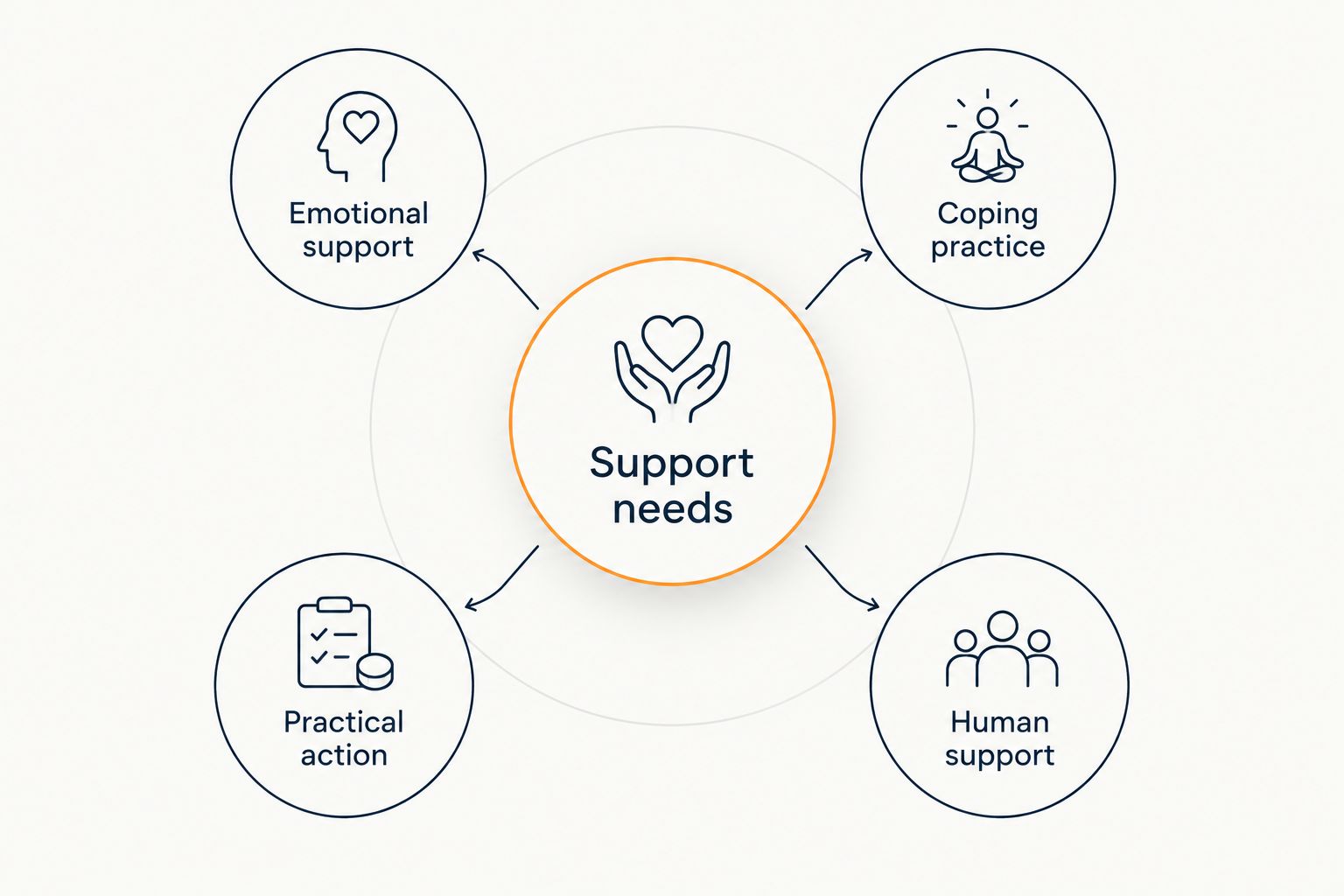 Four support needs: emotional support, coping practice, practical action, and human support.
Choose support by the problem you need help with, not by the longest feature list.
Protect your privacy before your first conversation
Your dissertation topic, health history, and relationships can all appear in the same conversation. You do not need to share every identifying detail to discuss how something feels.
Before choosing an app in 2026, read its current privacy policy and look for direct answers about conversation storage, model training, third-party sharing, and deletion. Check whether deleting your account also deletes conversation data. Do not assume that a mental health label makes every consumer app subject to the same rules as your healthcare provider.
For graduate work, leave out participant information, unpublished findings, patient details, and confidential lab material. Describe the emotional problem without uploading the underlying research or naming everyone involved.
If the service's explanation does not meet your expectations, stop before sharing more. Privacy is a selection criterion, not a setting to think about after a difficult disclosure.
Know when symptoms need a doctor, not an app
Stress and physical symptoms can occur together, but an AI conversation cannot determine the cause. New, persistent, severe, or concerning symptoms deserve medical attention rather than repeated reassurance from a chatbot.
When talking to your doctor, describe what you notice, when it began, what changes it, and how it affects your daily activities. Bring your own observations instead of presenting an app's explanation as a diagnosis.
The same boundary applies to mental health concerns. If low mood, anxiety, sleep problems, or difficulty concentrating interfere with daily functioning, arrange a professional assessment. You do not need to prove that the situation is serious enough by trying more apps first.
Try a small routine without creating another assignment
Set a 5-minute limit for an initial check-in. This is a practical boundary to try, not a treatment dose or a promise about results.
Start with one situation rather than your entire semester. Describe the event, your reaction, and what you need next. Ask for a coping exercise or help organizing your thoughts—not certainty about what another person thinks.
End with 1 sentence that captures your next step. It might be asking a friend to walk with you, saving a question for your counselor, or sending a clear request for feedback.
After 7 days, ask whether the routine helped you reflect and return to life outside the app. These suggested limits are only a way to evaluate fit. If sessions leave you more distressed, keep you seeking reassurance, or displace human contact, stop and reconsider the role of the app.
Which app should you choose?
Lovon is best for graduate students who prefer voice-based emotional support for everyday stress. Choose Wysa when you want guided coping exercises, or Youper when mood-focused reflection matches your preference.
If you are undecided in 2026, begin with your preferred conversation format and a narrow purpose. Do not interpret a longer conversation, a daily streak, or a reassuring answer as proof that your mental health is improving. Judge the tool by whether it supports useful reflection without delaying care or practical action.
One last thing
Your next useful step does not have to be more self-analysis. If the problem is unclear expectations, ask for clarification; if it is an unmanageable workload, seek practical support. Use an app to help you name what you need—not to make an unacceptable situation easier to tolerate.
Related guides
How AI Support Helps You Heal
AI emotional support isn't about replacing human connection — it's about filling the gaps. The moments when you need to talk at 2 AM, when you don't want to burden your friends again, or when you simply need someone to listen without judgment.
Here's what happens in a typical Lovon session:
You share what's on your mind
There's no script, no intake form, no waiting room. You speak or type whatever you're feeling — in your own words, at your own pace.
Lovon validates and explores
Using frameworks from CBT (Cognitive Behavioral Therapy) and motivational interviewing, Lovon acknowledges your feelings first, then gently helps you explore them. No dismissive "just move on" advice.
You build coping skills together
Lovon doesn't just listen — it actively works with you on evidence-based techniques: thought reframing, urge surfing, behavioral experiments, and more.
What a Session with Lovon Looks Like

Lovon is AI support, not a replacement for professional care. If things have been hard to get through for weeks, or you are thinking about harming yourself, talk to a doctor or a licensed therapist.
Ready to Start?
Your healing journey can begin right now
A 3-day trial. No judgment. Just a safe space to process what you're going through.
Frequently Asked Questions
What's the best AI mental health app for a graduate student who wants to talk aloud?
Is an AI mental health app better than campus counseling?
Can I use an AI app between therapy appointments?
Can an AI app diagnose depression or ADHD?
Is it safe to discuss my research with a mental health app?
What should I do if using an app makes me feel worse?
What should I do if I am in crisis?
About the Author

The Lovon Editorial Team
Mental Health & Wellness Content Team
The Lovon Editorial Team develops mental health and wellness content designed to make psychological concepts accessible and actionable. Our goal is to bridge the gap between clinical research and everyday life - helping you understand why your mind works the way it does and what you can do about it....
Related articles
- Best AI mental health apps for hospitality workers in 2026
Best AI mental health apps for hospitality workers: choose Lovon for voice support, compare chat-based options, and…
- Best AI mental health apps for social workers in 2026
Best AI mental health apps for social workers: choose voice support for talking things through, text for coping, and…
- Best AI apps for caregiver burnout in 2026
Compare the best AI apps for caregiver burnout. Choose Lovon for voice support, or a writing assistant for practical…
- Best AI mental health apps for real estate agents in 2026
Compare the best AI mental health apps for real estate agents. Choose voice support, text-based tools, or guided…
See also
Quizzes
- How Do You Cope With Stress? Coping Style Quiz
Find your stress coping style in 2 minutes.
- Emotional Contagion Test: Which Moods Do You Catch?
See how moods spread to you and through you, in 3 minutes.
Free tools
- 60-Second Mental Health Check-In
How are you feeling today, really? Five quick sliders and one feeling word show what stands out, how today compares with…
- AI Mental Health Coach
This is a free AI mental health coach for ordinary hard stretches: stress, low days, worry that will not switch off, a…
From the wiki
- Why do I feel sad when I'm alone?
Being alone does not create the sadness. It removes the noise that was keeping it out of earshot, so whatever queued up…
Disclaimer: This article is for informational purposes only and does not constitute medical advice, diagnosis, or treatment. Always seek the advice of your physician or other qualified health provider with any questions you may have regarding a medical condition. If you are in crisis or think you may have an emergency, call 988 (Suicide & Crisis Lifeline) or go to the nearest emergency room. Outside the US? Find a crisis line in your country.