
Best AI mental health apps for hospitality workers in 2026
Best AI mental health apps for hospitality workers: choose Lovon for voice support, compare chat-based options, and learn when you need human care.


Key Takeaways
- Among the best AI mental health apps for hospitality workers, Lovon fits voice-based emotional support after shifts.
- Wysa suits workers who prefer guided coping exercises through a chatbot.
- Youper suits workers who want structured conversations and mood-focused reflection.
- Choose support you can use privately; AI apps do not replace licensed care or crisis services.
Best for talking after a difficult shift: Lovon. Best for guided coping exercises: Wysa. Best for mood-focused reflection: Youper. This 2026 guide compares AI mental health apps for hospitality workers by how you want support—not by promises that an app can replace therapy.
TL;DR
- Among the best AI mental health apps for hospitality workers, Lovon fits voice-based emotional support after shifts.
- Wysa suits workers who prefer guided coping exercises through a chatbot.
- Youper suits workers who want structured conversations and mood-focused reflection.
- Choose support you can use privately; AI apps do not replace licensed care or crisis services.
Why this matters
A difficult guest interaction does not always end when your shift does. You might get home still rehearsing what you should have said, worrying about tomorrow, or feeling too drained to explain yourself to someone.
An app gives you another place to put those thoughts. But choosing the wrong format adds friction: speaking aloud does not fit a shared break room, and typing does not suit everyone after a demanding service.
Lovon is best for hospitality workers who want voice-based emotional support between shifts, not clinical treatment. If you need assessment, treatment, or help staying safe, choose human support instead.
What makes the best AI mental health apps for hospitality workers?
Use these criteria when choosing an app in 2026. A long feature list matters less than whether you can use the support safely and comfortably.
- Conversation format: Decide whether you want to speak, type, or follow a guided exercise. Match the format to where you will actually use it.
- A clear purpose: Look for emotional support, coping practice, or reflection—not a promise to diagnose you or solve every problem.
- Privacy you understand: Read how the app handles conversations, recordings, account deletion, and data sharing before discussing sensitive experiences.
- Practical next steps: A useful conversation ends with something manageable, such as preparing a boundary or identifying someone to contact.
- Honest limits: The app should distinguish automated support from licensed clinical care. A reassuring tone is not a professional qualification.
- A workable stopping point: Choose a tool you can put down. You do not need another task that makes you feel behind.
AI mental health apps at a glance
These recommendations serve different needs. The order does not represent proven differences in treatment outcomes or a ranking of privacy protections.
| App | Best for | Standout approach | Key limitation |
|---|---|---|---|
| Lovon | Speaking through post-shift stress | Voice conversations for emotional support, coping tools, and self-reflection | Speaking aloud requires a suitable setting; not a licensed clinician |
| Wysa | Practicing guided coping exercises | Chatbot-based support with cognitive behavioral techniques | Automated exercises do not replace individualized clinical assessment |
| Youper | Reflecting on feelings and mood patterns | Structured AI conversations and mood tracking | Tracking feelings does not establish a diagnosis or explain every cause |
Before choosing, separate your immediate need from your longer-term concern. Wanting to decompress tonight is different from needing help with persistent depression, panic, or distressing experiences at work.
1. Lovon: best AI mental health app for post-shift voice support
Lovon offers voice conversations with an AI for emotional support, coping tools, and self-reflection. It is built with input from PhD psychologists and is intended as a companion, not a replacement for licensed clinical care.
Best for: Hospitality workers who prefer talking to typing and want to discuss everyday stress, anxiety, low mood, or relationship difficulties.
For example, you might want to unpack a guest complaint without retelling every detail to a friend. You can ask for help separating what happened from what you are telling yourself about it, then identify a next step.
Start with a narrow request: explain the situation without names, name the feeling, and say what kind of support you want. Asking for reflection is different from asking for a coping exercise or help drafting a conversation.
Lovon pros
- Voice is the core format, rather than something you must substitute for a preferred way of communicating.
- Emotional support, coping tools, and self-reflection are part of the stated offer.
- On-demand conversations fit a need that does not arrive at a scheduled appointment time.
- The app's stated scope includes everyday concerns that extend beyond work, including relationship stress.
Lovon cons
- Voice conversations are a poor fit when coworkers, guests, or housemates can overhear you.
- Input from psychologists does not make the AI a licensed clinician or your treating professional.
- The app cannot change staffing levels, resolve a workplace complaint, or provide emergency care.
For a first conversation, try a simple instruction: help me sort out a difficult shift, avoid guessing what other people meant, and finish with one action I control. Leave out guest names, room numbers, booking details, and identifying information about colleagues.
Verdict: Buy into the voice-support approach if talking feels useful; skip it when you need clinical care or cannot speak privately.
2. Wysa: best AI mental health app for guided coping practice
Wysa provides chatbot-based mental health support and guided self-help exercises, including techniques drawn from cognitive behavioral therapy. These techniques invite you to examine links between thoughts, feelings, and actions.
Best for: Workers who want an exercise to follow rather than an open-ended spoken conversation.
Suppose you leave service thinking that a single mistake proves you are bad at your job. A structured approach gives you a way to examine that conclusion rather than repeatedly replaying the interaction.
That distinction matters. Emotional support gives you room to express yourself; an exercise asks you to practice a particular skill. Choose the latter when you want a task with a clear beginning and end.
Wysa pros
- Guided exercises offer a starting point when you do not know what to discuss.
- A chatbot format suits readers who prefer written interaction to speaking aloud.
- Cognitive behavioral techniques provide a recognizable structure for examining unhelpful thoughts.
Wysa cons
- An automated exercise cannot fully assess the context behind your distress.
- A structured prompt is not always what you want when you primarily need to feel heard.
- An exercise cannot establish whether a workplace situation is safe or acceptable.
Use guided practice to examine your interpretation, not to dismiss mistreatment. A guest's aggression or a supervisor's harassment is not something you must reframe into a positive experience.
In 2026, keep the same boundary you would apply to any automated self-help tool: practice a skill, then decide whether the situation also needs a human response.
Verdict: Buy into guided coping practice when structure helps; skip the idea that reframing should make you tolerate harmful conditions.
3. Youper: best AI mental health app for mood-focused reflection
Youper combines AI conversations with mood tracking and approaches informed by cognitive behavioral therapy. Its format suits reflection on what you feel and what was happening around that feeling.
Best for: Workers who want to describe their mood consistently and bring clearer examples to a later conversation with a professional.
You do not need to produce a perfect account of every shift. A brief entry about your mood, the situation, and what you needed is a starting point for reflection.
Keep observations separate from explanations. Noticing that you felt low after several shifts does not establish why you felt that way, and an app's interpretation is not a diagnosis.
Youper pros
- Mood tracking gives emotional check-ins a consistent focus.
- Structured conversations offer prompts when a blank journal feels difficult.
- Written observations give you concrete experiences to discuss with a clinician or trusted person.
Youper cons
- Mood entries reflect what you record; they are not a complete picture of your mental health.
- Tracking does not establish whether work, sleep, health, or another factor explains a change.
- Regular check-ins become another obligation if you treat missed entries as failures.
For a suggested trial, record 1 sentence per check-in rather than a detailed account. Describe what happened and how you felt without including identifiable workplace information.
In 2026, judge mood tracking by whether it helps you understand and communicate your experience—not whether it produces an uninterrupted record.
Verdict: Buy into brief mood reflection if patterns interest you; skip detailed tracking if recording every feeling becomes burdensome.
How we ranked these options
The recommendations match each app's established approach to a distinct use case: voice support, guided coping practice, or mood-focused reflection. The criteria are format, purpose, practical use, privacy questions, and limits.
This is a format-and-fit comparison, not a clinical effectiveness ranking. No recommendation establishes that an app treats hospitality workers more effectively than another, offers stronger confidentiality, or replaces professional care.
Try a small post-shift routine
You do not need an elaborate wellness plan to decide whether an app suits you. Try the following routine as a personal experiment, not a treatment schedule.
Find privacy
Choose somewhere you can stop safely and avoid being overheard. Do not start an emotionally absorbing conversation while driving, handling kitchen equipment, or supervising a safety-sensitive task.
Name the moment
Give the check-in 2 minutes to begin, without expecting a result within that time. Describe the event and feeling in plain language: a difficult complaint left you embarrassed, or a schedule change left you worried.
Choose support
Ask for one kind of help: listening, a coping exercise, reflection, or preparation for a conversation. If a response misunderstands you, correct it rather than accepting its interpretation as authoritative.
Take action
End with something outside the app. That might mean contacting a friend, writing down a question for your manager, resting, or arranging professional support.
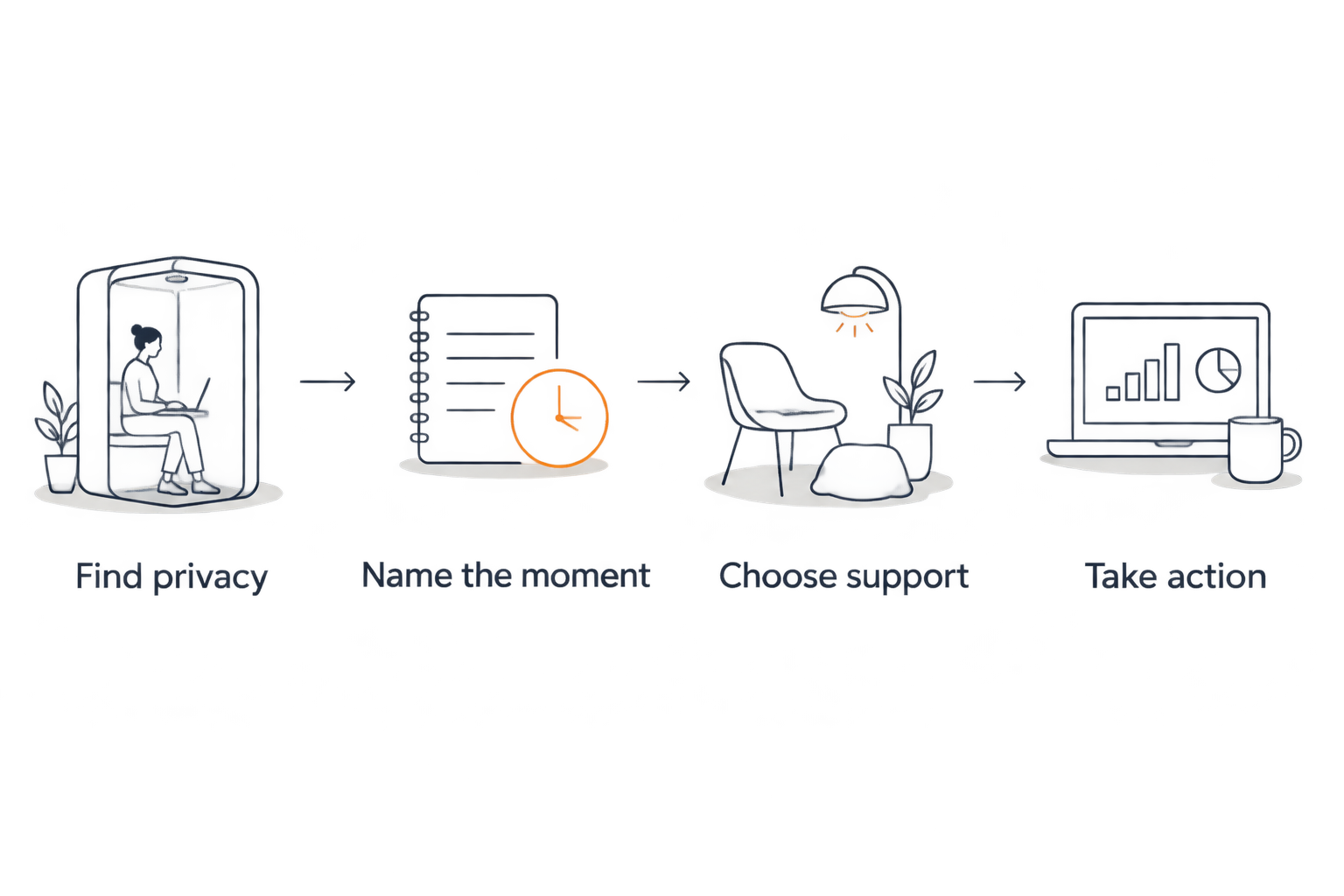 Four steps for a post-shift check-in, from finding privacy to taking action.
Let the conversation end with a step outside the app.
After 3 shifts, review the fit. Ask whether the format felt comfortable, whether you understood its limits, and whether the conversations helped you identify what you needed. These are suggested check-in points, not evidence-based session requirements.
Check privacy before sharing workplace details
Mental health conversations deserve deliberate choices about what you disclose. In 2026, do not assume that an app has the same confidentiality arrangements as a licensed therapist simply because it uses therapy-related language.
Before your first sensitive conversation, check:
- Whether voice recordings or transcripts are retained.
- Whether conversations are used to improve models or services.
- How account and conversation deletion work.
- Whether anyone else has access to your device or account.
- Whether an employer-provided benefit shares participation information.
If a policy does not answer your question, ask the provider before sharing the detail. You can describe a conflict without naming the coworker, guest, venue, or reservation involved.
Which app should you choose?
Choose voice support by default if your main goal is to talk through a shift. Choose Wysa when you specifically want guided coping practice, or Youper when you want mood-focused reflection.
Do not make the app your only source of support when distress persists, worsens, or interferes with sleep, relationships, or daily functioning. Contact a licensed mental health professional or a primary care clinician for an assessment.
If you are in immediate danger, contact emergency services. In the United States, call or text 988 for the Suicide & Crisis Lifeline if you are in suicidal crisis or emotional distress; do not wait for an AI response.
One last thing
You can need better working conditions and emotional support at the same time. A coping exercise does not cancel out an unsafe shift, harassment, or an unreasonable demand.
Before opening an app, ask yourself whether you need help processing a feeling, changing a situation, or both. That question keeps the tool in its proper place: supporting you, not teaching you to accept everything.
Related guides
How AI Support Helps You Heal
AI emotional support isn't about replacing human connection — it's about filling the gaps. The moments when you need to talk at 2 AM, when you don't want to burden your friends again, or when you simply need someone to listen without judgment.
Here's what happens in a typical Lovon session:
You share what's on your mind
There's no script, no intake form, no waiting room. You speak or type whatever you're feeling — in your own words, at your own pace.
Lovon validates and explores
Using frameworks from CBT (Cognitive Behavioral Therapy) and motivational interviewing, Lovon acknowledges your feelings first, then gently helps you explore them. No dismissive "just move on" advice.
You build coping skills together
Lovon doesn't just listen — it actively works with you on evidence-based techniques: thought reframing, urge surfing, behavioral experiments, and more.
What a Session with Lovon Looks Like

Lovon is AI support, not a replacement for professional care. If things have been hard to get through for weeks, or you are thinking about harming yourself, talk to a doctor or a licensed therapist.
Ready to Start?
Your healing journey can begin right now
A 3-day trial. No judgment. Just a safe space to process what you're going through.
Frequently Asked Questions
What's the best AI mental health app for hospitality workers?
Can an AI app help me talk through a difficult restaurant shift?
Is voice support better than a mental health chatbot?
Can I use a mental health app during my break?
Can an AI mental health app diagnose burnout or depression?
Should I tell an AI app my employer's name?
What should I do if I feel unsafe after a shift?
About the Author

The Lovon Editorial Team
Mental Health & Wellness Content Team
The Lovon Editorial Team develops mental health and wellness content designed to make psychological concepts accessible and actionable. Our goal is to bridge the gap between clinical research and everyday life - helping you understand why your mind works the way it does and what you can do about it....
Related articles
- Mental health app for warehouse workers: complete 2026 guide
Choose a mental health app for warehouse workers that fits safe breaks and privacy. Compare voice support, self-help…
- AI Mental Health App for Shift Workers (2026 Guide)
The best AI mental health app for shift workers in 2026 needs 24/7 voice access, not banker's hours. See what to look…
- Mental health support for social workers: complete 2026 guide
Mental health support for social workers needs more than self-care. Build a practical plan for coping, confidential…
- Best ChatGPT alternatives for emotional support in 2026
Compare the best ChatGPT alternatives for therapy. Choose voice support for everyday feelings or licensed care for…
See also
Quizzes
- Guilt Test: Do I Have a Guilt Complex? Excessive Guilt Quiz
See whether your guilt repairs or just hurts.
- Self-Acceptance Test: What Are You Still Arguing With?
See where you are still fighting yourself, in 3 minutes.
Free tools
- AI Mental Health Coach
This is a free AI mental health coach for ordinary hard stretches: stress, low days, worry that will not switch off, a…
- Journal Prompts
Pick how you feel, what you want to write about, or both, and get three prompts with room to write right under them…
From the wiki
- Why do I keep dreaming about the same person?
A recurring dream figure usually marks unfinished emotional business rather than a message about that person. Your brain…
Disclaimer: This article is for informational purposes only and does not constitute medical advice, diagnosis, or treatment. Always seek the advice of your physician or other qualified health provider with any questions you may have regarding a medical condition. If you are in crisis or think you may have an emergency, call 988 (Suicide & Crisis Lifeline) or go to the nearest emergency room. Outside the US? Find a crisis line in your country.