
Best AI mental health apps for social workers in 2026
Best AI mental health apps for social workers: choose voice support for talking things through, text for coping, and clear limits for personal use.


Key Takeaways
- Among the best ai mental health apps for social workers, Lovon suits voice-based emotional support and self-reflection.
- Wysa is the text-based option to consider for conversational coping exercises.
- Youper suits mood-focused conversations and reflection; choose by your preferred routine, not promises of treatment.
- Keep client information out of personal apps, and use human care for assessment, treatment, and urgent support.
Best for voice-based personal support: Lovon. Best for text-based coping exercises: Wysa. Best for mood-focused reflection: Youper. This 2026 guide compares options for social workers’ own well-being—not client assessment, case documentation, or clinical decision-making.
TL;DR
- Among the best ai mental health apps for social workers, Lovon suits voice-based emotional support and self-reflection.
- Wysa is the text-based option to consider for conversational coping exercises.
- Youper suits mood-focused conversations and reflection; choose by your preferred routine, not promises of treatment.
- Keep client information out of personal apps, and use human care for assessment, treatment, and urgent support.
Why this matters
An app for your own stress is a different purchase from software you use professionally. Start there. A conversational tool does not become suitable for client information simply because you work in mental health.
For a social worker, the useful question is specific: do you want to talk through your feelings, work through a coping exercise, or notice patterns in your mood? Those are personal-support tasks. They are not substitutes for supervision, a workplace safety process, or your own treatment.
Choose an app for the support task you need, not for how closely its language resembles a therapist. In this 2026 guide, each recommendation has a separate role so you can make that choice without treating unlike tools as interchangeable.
What makes the best AI mental health app for social workers?
Use these criteria before comparing names:
- Personal-support fit: The app should match your own emotional needs, not invite you to outsource professional judgment.
- Conversation format: Choose voice if speaking feels easier; choose text if you prefer composing and rereading your thoughts.
- Useful next steps: Look for coping tools or reflection prompts you can turn into a practical action.
- Clear boundaries: Distinguish automated emotional support from licensed care, supervision, and emergency services.
- Understandable data practices: Read how conversations, recordings, and account information are handled before sharing sensitive material.
- A manageable routine: Choose something you can use without turning self-care into another administrative task.
Privacy is a selection requirement, not a finishing touch. Before your first personal conversation, read the current terms and privacy policy. Check what is stored, how deletion works, and whether information is used to improve the service.
AI mental health apps at a glance
These recommendations compare support formats, not clinical effectiveness. The order starts with spoken emotional support, then moves to text-based coping and mood-focused reflection.
| App | Best for | Standout approach | Key limitation |
|---|---|---|---|
| Lovon | Speaking through everyday stress | Voice conversations with emotional support, coping tools, and self-reflection guidance | Not a licensed clinician or a replacement for clinical care |
| Wysa | Text-based coping exercises | Conversational support with self-help exercises | A text-led routine does not match a preference to speak aloud |
| Youper | Mood-focused reflection | Conversational check-ins focused on thoughts and feelings | Personal reflection does not provide professional supervision or clinical assessment |
The distinction is how you want to engage. None of these recommendations establishes suitability for client records, agency deployment, or independent crisis management.
1. Lovon: best AI mental health app for voice-based support
Lovon provides voice conversations for emotional support, coping tools, and self-reflection. It addresses everyday struggles such as anxiety, stress, low mood, relationship problems, and burnout, and is built with input from PhD psychologists.
Lovon is best for social workers who want to speak through everyday stress rather than type it out. Keep the conversation about your feelings and needs, not a reconstruction of someone else’s case.
For example, you can describe feeling tense after a difficult workday without sharing who you met, what happened to them, or where they receive services. Ask for help identifying what you are feeling or choosing a manageable next step. That keeps the purpose personal and clear.
Lovon pros:
- Voice is the core format for talking through feelings.
- Emotional support, coping tools, and reflection fit the same personal-support purpose.
- On-demand conversations suit moments when you want to talk without arranging an appointment.
Lovon cons:
- It is not a licensed clinician and does not replace clinical care.
- Speaking aloud requires a setting where other people cannot overhear you.
- Personal emotional support does not replace case consultation or supervision.
Best for: Your own spoken check-in when you want support with everyday feelings.
Verdict: Buy into the voice-first approach if talking suits you; skip it as a replacement for treatment or professional consultation.
2. Wysa: best AI mental health app for text-based coping
Wysa offers conversational emotional support and self-help exercises. Its text-based approach makes it an option when you prefer writing a thought before responding to it.
For a social worker choosing personal support in 2026, the decision is whether typing helps you slow down or feels like more work. Focus on that fit rather than assuming a conversational interface will meet every emotional need.
Wysa pros:
- Text lets you compose your response at your own pace.
- Coping exercises give the interaction a practical focus.
- Written exchanges suit people who prefer reading to speaking aloud.
Wysa cons:
- Typing is a poor fit when you specifically want a spoken conversation.
- Self-help exercises do not address workplace conditions or replace supervision.
- Automated conversation is not the same as an assessment by a licensed professional.
Best for: Personal text-based coping when you want an exercise rather than a spoken debrief.
Verdict: Buy into the text-based approach if writing helps you engage; skip it if another typing task is exactly what you want to avoid.
3. Youper: best AI mental health app for mood-focused reflection
Youper uses conversational check-ins to help you reflect on thoughts and feelings. Consider this approach when your main goal is to pay closer attention to your emotional patterns.
Keep the task narrow. You can reflect on feeling worried before work or disconnected afterward without asking an app to diagnose the cause or decide whether you are fit to practice.
Youper pros:
- Check-ins give reflection a clear starting point.
- A focus on thoughts and feelings suits a personal awareness routine.
- Conversations offer a way to put difficult-to-name experiences into words.
Youper cons:
- Repeated check-ins require a routine you are willing to maintain.
- Reflection alone does not change workload, staffing, or unsafe conditions.
- Mood-focused conversations do not replace diagnosis or treatment.
Best for: Personal reflection when noticing emotional patterns matters more than speaking aloud.
Verdict: Buy into the check-in approach if reflection is your goal; skip it as a substitute for assessment or workplace action.
How these recommendations are ranked
This 2026 shortlist ranks fit for distinct personal-support tasks: spoken support, text-based coping, and mood-focused reflection. The criteria are format, practical use, boundaries, and the routine each approach asks of you.
The ranking is not a claim that one app produces better clinical outcomes. Nor is it an endorsement for professional use with confidential information. Treat privacy review and any employer approval process as separate decisions that a buying guide cannot make for you.
Keep personal support separate from client work
Do not put identifiable client information into a personal mental health app. Changing a name is not enough if the remaining details still identify the person.
Leave out dates of birth, addresses, case numbers, recordings, documents, and distinctive combinations of circumstances. Do not paste progress notes into a conversation because you want help processing how the day felt. Describe your own response instead.
Use these boundaries when deciding where a concern belongs:
- Your feelings: Personal reflection about being worried, tired, frustrated, or overwhelmed.
- Client decisions: Approved supervision and consultation channels.
- Workplace concerns: The relevant manager, reporting process, or safety procedure.
- Clinical needs: Your own licensed healthcare professional when assessment or treatment is needed.
For a closer look at personal disclosure, read about sharing your feelings with an AI therapist. Read the app’s own current policies too; an article cannot substitute for those terms.
If you are considering a tool for clients rather than yourself, stop treating this as a personal app choice. Follow your organization’s review process, applicable professional requirements, and relevant legal obligations before introducing it into care.
A simple personal check-in routine
For your first check-in in 2026, give yourself a small task rather than asking an app to solve your working life. You do not need a detailed account of the day to begin.
Try the following as a suggested routine, not a treatment schedule:
- Choose privacy: Set aside 5 minutes somewhere you cannot be overheard. Keep client materials closed and out of the conversation.
- Name your feeling: Begin with 1 sentence about yourself, such as feeling tense, disappointed, or unable to switch off.
- Ask for support: Request a reflection prompt or a simple coping exercise. Decline suggestions that do not fit your situation.
- Choose an action: Finish with 1 practical step, such as taking a break or arranging a conversation with someone you trust.
The point is to leave with a clearer next move, not to produce a perfect account of your feelings. Stop the exchange if it becomes repetitive, upsetting, or unhelpful.
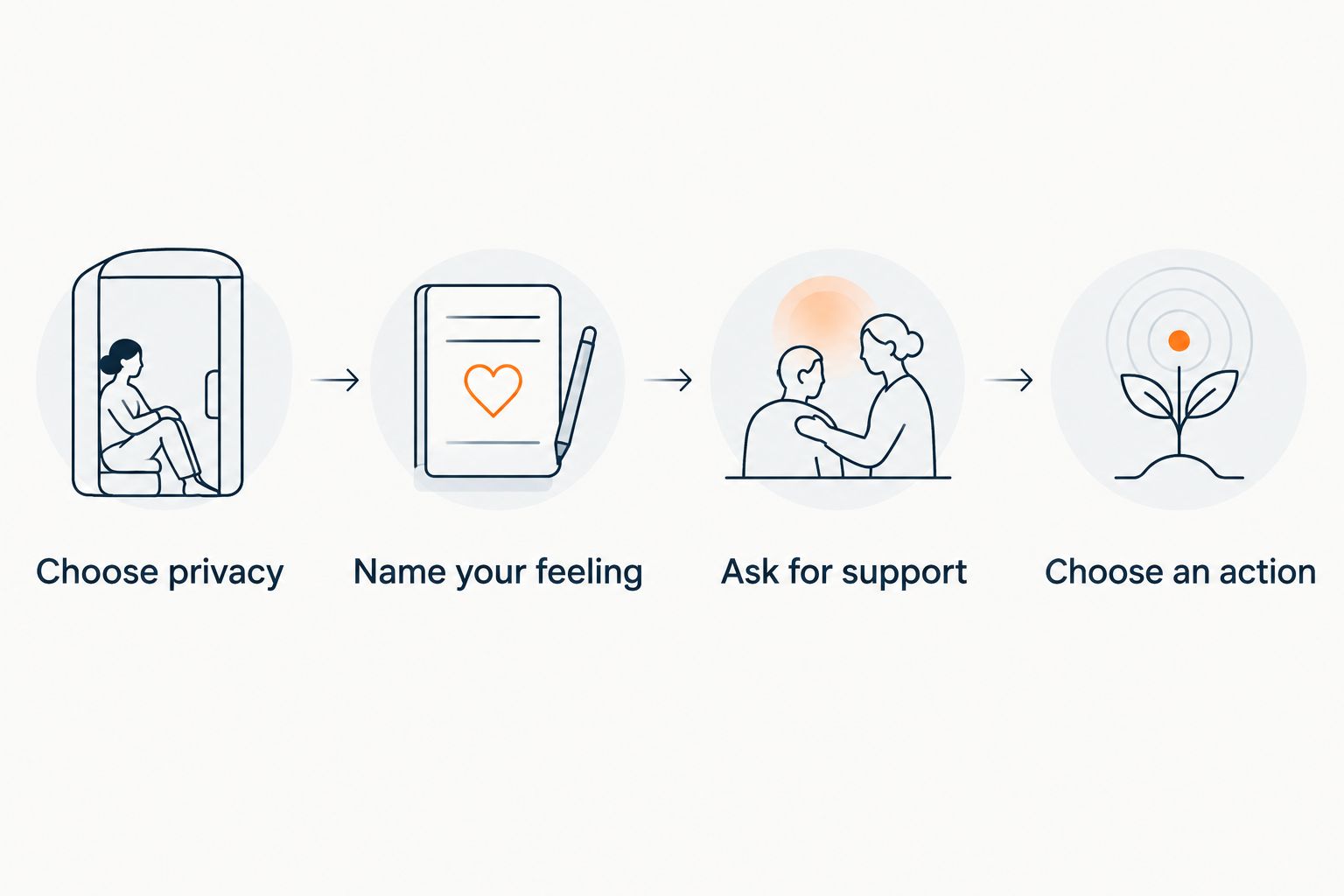 Four steps for a personal check-in, from choosing privacy to choosing an action
Keep the check-in about your feelings and finish with a practical next step.
Afterward, ask yourself whether the interaction served the task you chose. Did it help you name a feeling, consider a coping tool, or decide whom to contact? You do not owe an app continued use because you started a routine.
Which AI mental health app should you choose?
Choose the format you are most comfortable using while keeping the boundary clear. Spoken personal support is the default recommendation if you want to talk; text-based coping suits written interaction; mood-focused check-ins suit a reflection habit.
If your real need is help with a client decision, choose supervision instead. If you need assessment or treatment for your own symptoms, contact a licensed professional. An app can have a limited supporting role without becoming your main source of care.
For your 2026 choice, reject any decision process that skips privacy because the conversation feels reassuring. A supportive tone is not proof of clinical competence, confidentiality, or professional suitability.
One last thing
Make one boundary before your next check-in: talk about what the work brings up in you, not the private details of the people you support. That distinction gives the conversation a useful purpose without turning a personal app into an informal case record.
You are allowed to need support without turning that need into another professional task. Start with your own feeling, choose the appropriate kind of help, and let the app remain optional.
Related guides
How AI Support Helps You Heal
AI emotional support isn't about replacing human connection — it's about filling the gaps. The moments when you need to talk at 2 AM, when you don't want to burden your friends again, or when you simply need someone to listen without judgment.
Here's what happens in a typical Lovon session:
You share what's on your mind
There's no script, no intake form, no waiting room. You speak or type whatever you're feeling — in your own words, at your own pace.
Lovon validates and explores
Using frameworks from CBT (Cognitive Behavioral Therapy) and motivational interviewing, Lovon acknowledges your feelings first, then gently helps you explore them. No dismissive "just move on" advice.
You build coping skills together
Lovon doesn't just listen — it actively works with you on evidence-based techniques: thought reframing, urge surfing, behavioral experiments, and more.
What a Session with Lovon Looks Like

Lovon is AI support, not a replacement for professional care. If things have been hard to get through for weeks, or you are thinking about harming yourself, talk to a doctor or a licensed therapist.
Ready to Start?
Your healing journey can begin right now
A 3-day trial. No judgment. Just a safe space to process what you're going through.
Frequently Asked Questions
What’s the best AI mental health app for social workers?
Are these apps for social workers or for their clients?
Can I discuss a difficult client case with a personal AI app?
Is voice support better than text-based support?
Can an AI mental health app replace my own therapist?
What should I check before using an app for work-related stress?
What should I do if I’m in crisis instead of opening an app?
About the Author

The Lovon Editorial Team
Mental Health & Wellness Content Team
The Lovon Editorial Team develops mental health and wellness content designed to make psychological concepts accessible and actionable. Our goal is to bridge the gap between clinical research and everyday life - helping you understand why your mind works the way it does and what you can do about it....
Related articles
- Best AI mental health apps for hospitality workers in 2026
Best AI mental health apps for hospitality workers: choose Lovon for voice support, compare chat-based options, and…
- AI therapy for restaurant and hospitality workers: complete 2026 guide
AI mental health support for restaurant workers fits after-shift stress and burnout. See when Lovon helps, where it…
- Mental health app for medical residents: complete 2026 guide
Choose a mental health app for medical residents that fits shift work. Compare voice support and licensed care, protect…
- Best AI mental health apps for software engineers in 2026
Best AI mental health apps for software engineers compared. Choose voice support, guided chat, or mood reflection, with…
See also
Quizzes
- Loneliness Test: How Lonely Am I? 3 Kinds of Loneliness
See which kind of loneliness is thin, in 3 minutes.
- Coping Style Test: How Do You Actually Handle Stress?
See how you really cope under stress, in 3 minutes.
Free tools
- AI Anxiety Coach
This is a free AI anxiety coach you can use on this page. Tell it what you are anxious about, whether it is a thought…
- 60-Second Mental Health Check-In
How are you feeling today, really? Five quick sliders and one feeling word show what stands out, how today compares with…
From the wiki
- Why do I keep dreaming about the same person?
A recurring dream figure usually marks unfinished emotional business rather than a message about that person. Your brain…
Disclaimer: This article is for informational purposes only and does not constitute medical advice, diagnosis, or treatment. Always seek the advice of your physician or other qualified health provider with any questions you may have regarding a medical condition. If you are in crisis or think you may have an emergency, call 988 (Suicide & Crisis Lifeline) or go to the nearest emergency room. Outside the US? Find a crisis line in your country.