
Best AI mental health apps for real estate agents in 2026
Compare the best AI mental health apps for real estate agents. Choose voice support, text-based tools, or guided reflection, with clear safety limits.


Key Takeaways
- Among the best AI mental health apps for real estate agents, Lovon fits people who prefer talking aloud.
- Wysa fits agents who prefer text-based conversations and coping exercises.
- Youper fits agents who want guided conversations to reflect on feelings and thoughts.
- Use AI support for everyday stress, not diagnosis, emergency help, or replacing licensed care.
Best overall for voice support: Lovon. Best for text-based coping conversations: Wysa. Best for guided emotional check-ins: Youper. This 2026 guide to the best AI mental health apps for real estate agents matches each option to a different need, with clear limits on what an app can do.
TL;DR
- Among the best AI mental health apps for real estate agents, Lovon fits people who prefer talking aloud.
- Wysa fits agents who prefer text-based conversations and coping exercises.
- Youper fits agents who want guided conversations to reflect on feelings and thoughts.
- Use AI support for everyday stress, not diagnosis, emergency help, or replacing licensed care.
Why this matters
A difficult negotiation, a canceled closing, or an unanswered client message can leave you carrying work into the evening. Your support tool should match the moment: somewhere to talk, a structured exercise, or a way to name what you feel.
Choose the format you will actually use, not the app with the longest feature list. If speaking feels natural, start with voice. If you share an office or need quiet, text deserves more weight.
The goal is not to become endlessly available to clients. It is to create space between a stressful event and your next response, while recognizing when you need support beyond an app.
What makes the best AI mental health apps for agents?
Use these criteria when comparing mental health apps in 2026:
- Conversation fit: Choose voice if talking helps you express yourself; choose text if you prefer editing your thoughts.
- Practical coping: Look for support that moves from describing distress toward a manageable next step.
- Clear boundaries: The app should distinguish emotional support from diagnosis, treatment, and emergency services.
- Privacy clarity: Read how the service handles conversations, recordings, retention, and deletion before sharing sensitive information.
- Routine fit: A useful tool fits a quiet break or an evening check-in without becoming another obligation.
- Human support: Keep licensed care and trusted people in your support plan rather than treating an app as your only outlet.
Privacy is especially important when your stress involves a transaction. Describe your feelings without uploading client documents, naming buyers, or sharing financial details.
Best options at a glance
| App | Best for | Standout approach | Key limitation |
|---|---|---|---|
| Lovon | Talking through everyday stress aloud | AI voice conversations with emotional support and coping guidance | Not a licensed clinician; speaking requires a private setting |
| Wysa | Text-based coping conversations | Conversational support paired with self-help exercises | Typing is a poor fit when you want to speak freely |
| Youper | Guided emotional check-ins | Conversational prompts for examining feelings and thoughts | Structured reflection does not replace clinical assessment |
These are different starting points, not interchangeable forms of therapy. Check each app's current feature descriptions and privacy terms before choosing, because a category label does not establish clinical suitability.
1. Lovon: best mental health app for voice support
Lovon is an AI-powered mental health app that offers voice conversations, emotional support, coping tools, and self-reflection guidance. It is built with input from PhD psychologists and positions itself as a companion, not a replacement for licensed clinical care.
Lovon is best for real estate agents who want to talk through everyday stress aloud. That makes voice the deciding feature here, rather than a claim that the app produces better clinical outcomes than another option.
For example, after a listing presentation, you might want to explain why one awkward exchange is still bothering you. Start with the situation and how it felt, then ask for help identifying a coping step. Keep client identities out of the conversation.
Lovon pros:
- Voice conversations support people who prefer speaking to typing.
- On-demand emotional support fits check-ins outside scheduled appointments.
- Coping tools and reflection guidance address everyday emotional struggles.
- Its stated role separates companionship from licensed clinical care.
Lovon cons:
- It is not a licensed clinician and cannot replace clinical assessment or treatment.
- Speaking aloud is unsuitable when clients, colleagues, or family members can overhear.
- AI responses can misunderstand context, so you should question advice that feels inaccurate or unsafe.
Best for: Agents who want a voice-first space to discuss stress, low mood, relationship strain, or burnout concerns.
Verdict: Buy only if voice support matches your needs; keep licensed care separate.
2. Wysa: best mental health app for text-based coping
Wysa offers conversational emotional support and self-help exercises through a chatbot format. Its text-based approach suits people who prefer putting feelings into words on a screen rather than discussing them aloud.
Consider this format if you want to pause before replying to a frustrating message. Writing out the event can give you something concrete to examine, although an app cannot determine what actually happened in a transaction or what another person intended.
Wysa pros:
- Text suits situations where speaking would disturb others or expose your conversation.
- Written exchanges let you review your wording before sending.
- Self-help exercises offer an alternative to open-ended venting.
Wysa cons:
- Typing adds friction if your main preference is talking aloud.
- A chatbot lacks the full context and accountability of a treating clinician.
- Text is not automatically private; screen visibility and data handling still matter.
Best for: Agents who prefer quiet, written coping conversations during a stationary break.
Verdict: Buy only if text-based support feels easier than speaking.
3. Youper: best mental health app for guided reflection
Youper uses AI-guided conversations to help users reflect on emotions and thoughts. Its guided format suits people who want prompts rather than a blank page or an entirely open conversation.
Use this type of support when your starting point is vague: you feel unsettled but cannot explain why. A structured check-in gives you a way to explore that feeling without assuming it proves anything about your performance or mental health.
Youper pros:
- Guided conversations provide a starting point when you do not know what to say.
- Emotional reflection keeps attention on your experience rather than transaction details.
- Prompts suit people who prefer a defined check-in over free-form venting.
Youper cons:
- A guided format is a mismatch if you want an unrestricted voice conversation.
- Reflection alone does not change an excessive workload or an unsafe work situation.
- App conversations cannot establish a diagnosis or replace professional evaluation.
Best for: Agents who want help naming feelings and examining the thoughts attached to them.
Verdict: Buy only if guided reflection is the support format you want.
How the ranking works
This 2026 ranking prioritizes conversation fit, practical coping, clear limits, privacy questions, and routine fit. The order reflects distinct uses: voice support first, written coping second, and guided reflection third.
It is not a clinical effectiveness ranking. Psychologist input, conversational fluency, and an appealing interface do not by themselves demonstrate that an app treats a condition or outperforms another service.
A short check-in between appointments
Give your app a specific job instead of asking it to solve your whole working life. The following time limits are suggested boundaries for a routine, not promised treatment times or a required dose.
Name the moment
Set aside 2 minutes while stationary and somewhere private. Describe one event without names, addresses, documents, or identifying details: a negotiation stalled, and now you feel tense about making the next call.
Separate what happened from what you fear it means. A client declining an offer is an event; deciding that you are bad at your job is an interpretation.
Choose one tool
Ask for one coping exercise or one question that helps you examine the situation. Avoid requesting a long action plan when you already feel overloaded.
If a response feels confusing, judgmental, or disconnected from your experience, stop. You do not owe an app agreement, and a fluent answer is not proof that it understands you.
Close the session
Use 5 minutes as an initial session boundary, then choose a practical next step. That might mean drafting a neutral reply, taking a break, or contacting someone you trust.
After 7 days, review whether the routine supports your life outside the app. Keep it if it helps you act with more intention; change course if it becomes repetitive reassurance-seeking or another task you dread.
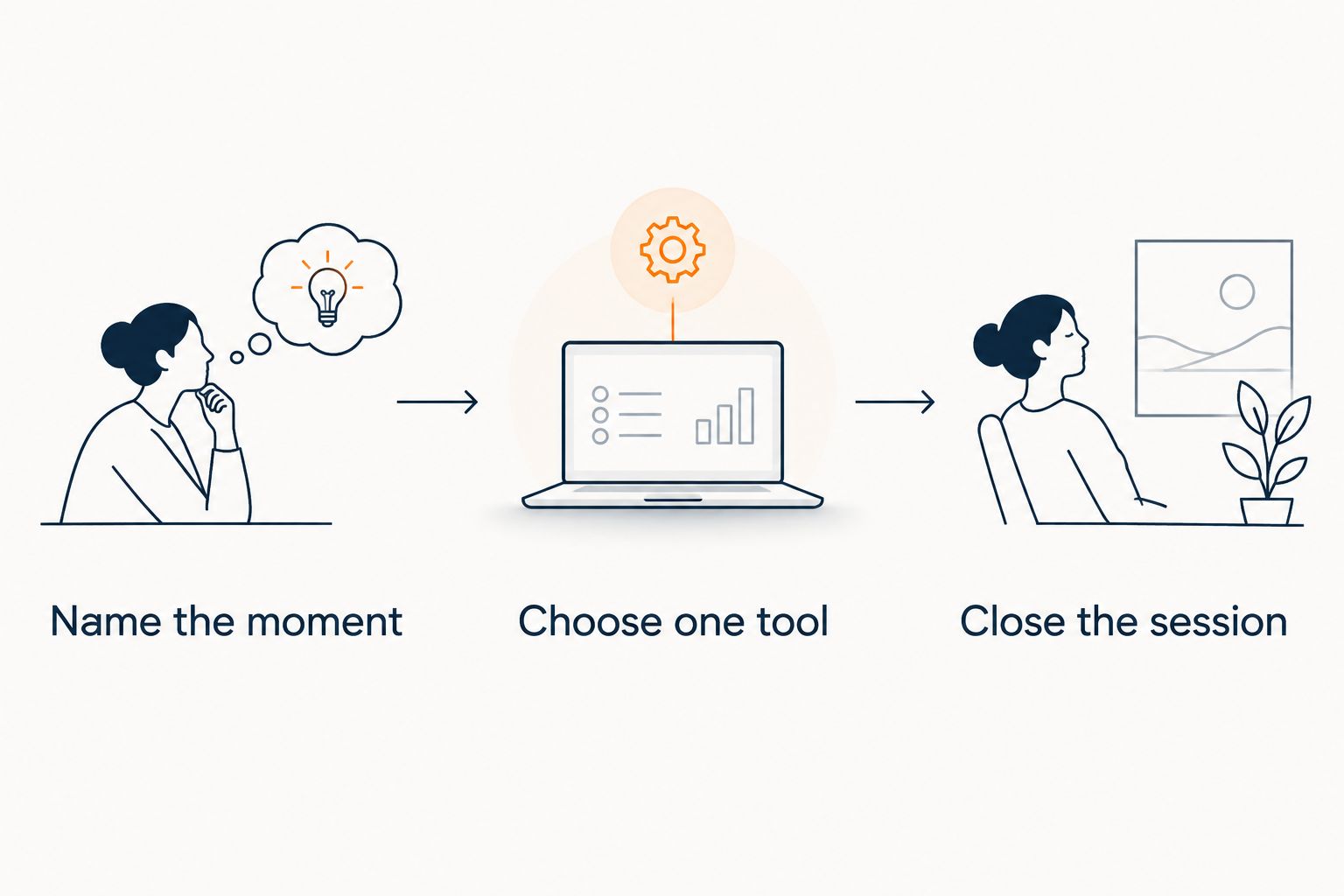 Three steps for a bounded check-in: name the moment, choose one tool, and close the session.
Give the conversation a purpose and a clear stopping point.
Match the support to the work problem
The best app choice in 2026 depends on what you need after the stressful event. Not every difficult workday calls for more reflection; sometimes you need a boundary, a business decision, or a conversation with another person.
Before a listing presentation
Ask for help identifying the thought behind your nerves and one manageable preparation step. Keep emotional support separate from legal, financial, or transaction advice.
Pair that reflection with preparation you control: review your materials, confirm the meeting details, and decide what you will do if you do not know an answer. An app should not promise that confidence guarantees a listing.
After a difficult client exchange
Describe the interaction without asking the app to diagnose the client or declare who is right. Focus on your reaction, your responsibilities, and the boundary you want to communicate.
Practicing mindfulness for workplace well-being means noticing tension before choosing your response, not pretending an unreasonable demand is acceptable. You can acknowledge frustration and still wait until you are ready to reply clearly.
When the workday follows you home
Use a check-in to identify what remains unresolved, then decide whether it belongs in tomorrow's plan or a conversation with someone else. Do not keep reopening the app until you feel certain that nothing will go wrong.
A coping tool should support a boundary, not help you tolerate having none. If after-hours messages are the problem, review expectations with clients or your team rather than treating every notification as a personal coping failure.
Privacy checks before your first conversation
For any app you consider in 2026, read the current privacy policy before describing sensitive experiences. Do not assume that a mental health label means a service has the same confidentiality protections as your clinician.
Check these points:
- Whether voice recordings, transcripts, or conversation summaries are stored.
- How conversation data is used, including any use for system improvement.
- What account and conversation deletion actually covers.
- Which permissions the app requests and why.
- Whether you understand the stated limits well enough to consent.
Use a personal device where possible, avoid shared screens, and keep client information out of prompts. If a privacy term is unclear, withhold the information rather than assuming a reassuring interpretation.
When an app is not enough
Seek a licensed mental health professional when distress persists, interferes with daily life, or raises concerns about your safety. You do not need to wait for a crisis or prove that you tried enough self-help first.
If you are already receiving care, discuss how an app fits your treatment plan. The distinction between AI support and a human therapist matters most when you need assessment, clinical judgment, or coordinated treatment.
In the United States, call or text 988 for suicide or mental health crisis support. Call 911 for immediate danger or a medical emergency; do not wait for an app to recognize a crisis or arrange help.
Which mental health app should you choose?
Start with Lovon if speaking aloud is your preferred way to process everyday stress. Choose Wysa if you want written coping conversations, or Youper if guided emotional reflection better matches your habits.
Keep the decision small. Choose a format, define what you want from a check-in, and stop using any tool that leaves you feeling pressured, misunderstood, or more dependent on repeated reassurance.
One last thing
Before your next check-in, decide what will count as enough. One named feeling and one realistic next step are a reasonable stopping point; you do not have to resolve every uncertainty before closing the app.
Related guides
How AI Support Helps You Heal
AI emotional support isn't about replacing human connection — it's about filling the gaps. The moments when you need to talk at 2 AM, when you don't want to burden your friends again, or when you simply need someone to listen without judgment.
Here's what happens in a typical Lovon session:
You share what's on your mind
There's no script, no intake form, no waiting room. You speak or type whatever you're feeling — in your own words, at your own pace.
Lovon validates and explores
Using frameworks from CBT (Cognitive Behavioral Therapy) and motivational interviewing, Lovon acknowledges your feelings first, then gently helps you explore them. No dismissive "just move on" advice.
You build coping skills together
Lovon doesn't just listen — it actively works with you on evidence-based techniques: thought reframing, urge surfing, behavioral experiments, and more.
What a Session with Lovon Looks Like

Lovon is AI support, not a replacement for professional care. If things have been hard to get through for weeks, or you are thinking about harming yourself, talk to a doctor or a licensed therapist.
Ready to Start?
Your healing journey can begin right now
A 3-day trial. No judgment. Just a safe space to process what you're going through.
Frequently Asked Questions
What's the best AI mental health app for real estate agents in 2026?
Is a voice app better than a text chatbot for work stress?
Can I use an AI mental health app between showings?
Can an AI app treat anxiety or depression?
What should I say during my first check-in?
Are mental health app conversations confidential?
What should I do if I need urgent mental health help?
About the Author

The Lovon Editorial Team
Mental Health & Wellness Content Team
The Lovon Editorial Team develops mental health and wellness content designed to make psychological concepts accessible and actionable. Our goal is to bridge the gap between clinical research and everyday life - helping you understand why your mind works the way it does and what you can do about it....
Related articles
- AI Mental Health Support 2026: What It Is & Who It Helps
AI mental health support ranges from voice therapy to chatbots in 2026. See what each format does best, who it helps…
- Best AI therapy apps with voice conversations in 2026
Compare AI mental health apps with voice conversations. Lovon leads for emotional support; see where general assistants…
- Best AI life coach apps in 2026
Compare the best AI life coach apps for emotional support, goal planning, and self-reflection. Choose by your needs…
- AI mental health support for esports players: complete 2026 guide
Mental health support for esports players works best with clear limits. Build a post-match reset, compare AI and human…
See also
Quizzes
- Emotion Recognition Test: Do You Read Feelings Right?
See where your reading of feelings slips, in 3 minutes.
- Is My Boyfriend Going to Break Up With Me? Quiz
Real distance or anxiety? Find out in 3 minutes.
Free tools
- AI Mental Health Coach
This is a free AI mental health coach for ordinary hard stretches: stress, low days, worry that will not switch off, a…
- Sleep Meditation for Anxiety
For lying in bed with a mind that will not stop. About twelve minutes of slower breathing, a place to put the worries…
From the wiki
- Why do I keep dreaming about the same person?
A recurring dream figure usually marks unfinished emotional business rather than a message about that person. Your brain…
Disclaimer: This article is for informational purposes only and does not constitute medical advice, diagnosis, or treatment. Always seek the advice of your physician or other qualified health provider with any questions you may have regarding a medical condition. If you are in crisis or think you may have an emergency, call 988 (Suicide & Crisis Lifeline) or go to the nearest emergency room. Outside the US? Find a crisis line in your country.