
How long does it take to notice benefits from voice journaling?
How long until voice journaling helps? There is no fixed timeline. Learn which changes to track, how to reflect safely, and when to seek support.


Key Takeaways
- Wondering how long until voice journaling helps? Track emotional clarity and daily functioning rather than a deadline.
- Voice journaling is a self-reflection tool, not a guaranteed treatment for anxiety or depression.
- Lovon offers voice-based emotional support, not licensed clinical care.
- Stop or change the exercise if talking leaves you overwhelmed or stuck in repetitive thinking.
Voice journaling has no guaranteed timetable: judge its usefulness by clearer feelings, a better understanding of a problem, or a practical next step—not a promised number of days. Feeling calmer after talking is different from lasting improvement in anxiety or depression, and journaling does not replace mental health care.
TL;DR
- Wondering how long until voice journaling helps? Track emotional clarity and daily functioning rather than a deadline.
- Voice journaling is a self-reflection tool, not a guaranteed treatment for anxiety or depression.
- Lovon offers voice-based emotional support, not licensed clinical care.
- Stop or change the exercise if talking leaves you overwhelmed or stuck in repetitive thinking.
How long does it take to notice benefits from voice journaling?
There is no reliable personal deadline you can set in advance. The useful question is what you want to change and whether your entries show that change. Being able to name a feeling is a different goal from sleeping better or handling conflict differently.
Use the distinctions below to decide what you are actually measuring. These are signs to look for, not promised stages or a treatment schedule.
| What you want to notice | What to look for | What it does not establish |
|---|---|---|
| Emotional clarity | You can describe what you feel and what happened | That the underlying problem is resolved |
| A useful next step | You identify a manageable action or request | That taking the action will be easy |
| Pattern awareness | You recognize a recurring situation or response | That you have a diagnosis |
| Everyday change | You respond differently outside the journal | That journaling alone caused the change |
If you are starting in 2026, choose a specific purpose before choosing a schedule. The guide to using voice journaling to reduce anxiety daily offers a related starting point.
Why this matters
A deadline turns a reflection habit into another task you can fail. You do not need to feel better on command, and an upsetting entry is not automatically a wasted entry. Still, distress is not proof that an exercise is working.
Look for usefulness without making yourself push through overwhelm. You can acknowledge a difficult feeling and then stop. You can also decide that talking into an app is not the right kind of support for you.
For your 2026 routine, separate the habit from the outcome. Completing an entry tells you that you practiced; it does not, by itself, tell you that your mental health improved.
What counts as a benefit from voice journaling?
Emotional clarity: name what is happening
Instead of asking whether you feel completely different, ask whether your description became more specific. Feeling bad is broad. Feeling disappointed after a canceled plan gives you something clearer to consider.
That distinction is useful even when the feeling remains uncomfortable. You are identifying your experience, not trying to talk yourself out of it. Avoid turning every feeling into an explanation about your personality or a diagnosis.
Pattern awareness: notice repetition without blaming yourself
Look for recurring situations across entries, such as feeling tense before a difficult conversation or saying yes when you wanted to decline. Treat a pattern as a question to explore, not a verdict about who you are.
You do not have to replay every recording. A short note about the topic and what you needed is enough for a personal review. If listening back feels exposing or upsetting, skip it.
Everyday change: use what you noticed
An entry can end with a small decision: ask for clarification, take a break, or prepare a question for a therapist. The next step should fit the actual problem. Not everything needs an immediate solution.
For example, recognizing that you need reassurance does not mean you must contact someone immediately. You can first decide what you want to ask and whether that person is an appropriate source of support.
Why the time to notice benefits varies
The same schedule does not fit every purpose. Before deciding that voice journaling is helping or failing, consider these practical differences:
- Your goal: Naming feelings, making a decision, and managing persistent symptoms are different tasks. Do not use the same success measure for all of them.
- Your topic: A frustrating meeting and a traumatic experience call for different levels of support. You do not need to explore your hardest memory alone.
- Your format: Speaking freely, answering a prompt, and having a guided conversation involve different activities. Choose the format that fits what you need.
- Your surroundings: Consider whether you can speak without being overheard. A routine that requires you to hide or rush deserves adjustment.
- Your other support: Keep professional care, trusted relationships, and practical help in view. Journaling does not need to carry the whole load.
These are considerations for shaping your routine, not a formula for predicting recovery. A 2026 app feature or a longer streak cannot tell you when you personally will feel better.
How can I check whether voice journaling is helping?
Use a small personal experiment rather than a treatment countdown. The suggested limits below are optional boundaries for the exercise—not research-backed doses or promises about when benefits begin.
- Choose a focus. Pick something narrow enough to describe, such as understanding why you felt upset after a conversation. Avoid asking yourself to solve your whole life in an entry.
- Name the feeling. Describe the situation and your reaction without judging either. If you cannot identify an emotion, start with what you noticed in your thoughts or behavior.
- Set a boundary. Try a 2-minute limit if an open-ended recording feels demanding. You can stop sooner; there is no minimum you must reach.
- Choose a next step. Finish with 1 sentence about what you need now. Rest, support, or leaving the issue alone for the moment are valid answers.
- Review the fit. Set a reminder for 7 days later to consider whether the routine feels useful, neutral, or unhelpful. This is a review point, not a recovery deadline.
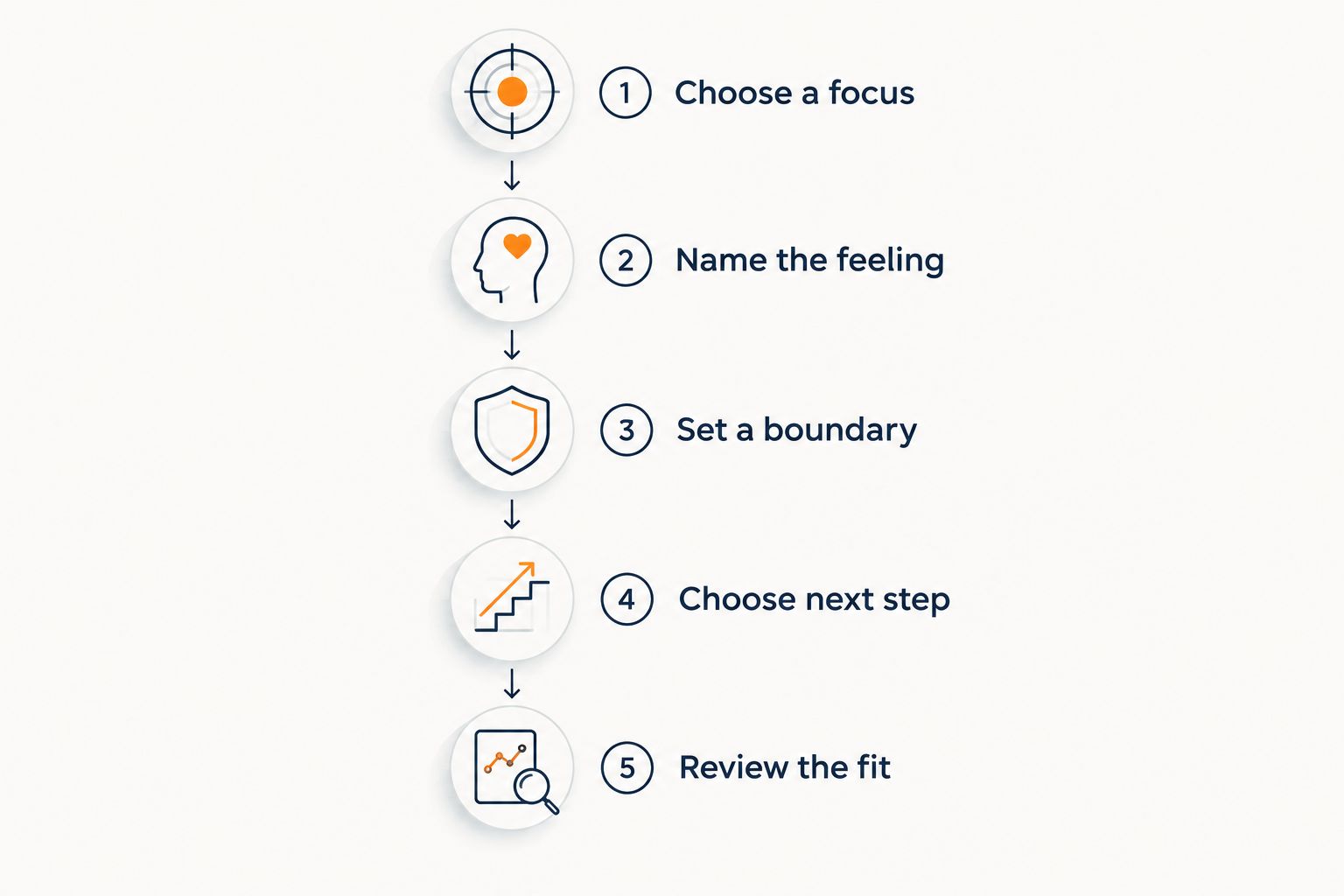 A reflection sequence from choosing a focus to reviewing whether the routine fits
Use the review to adjust the exercise, not to grade your recovery.
At the review, compare similar situations where possible. Ask whether you described your needs more clearly or did something useful afterward. Do not attribute every good or difficult day to the journal; other events still matter.
For a simple 2026 check-in, keep your notes brief. Record what you hoped to get from the entry, what you noticed afterward, and whether you want to repeat that approach. You do not need a detailed mood spreadsheet.
Is voice journaling better than typing or guided conversation?
Choose the format you can use comfortably, not the one with the strongest promise. A private recording, a typed entry, and a guided conversation are not interchangeable. Each has a practical advantage and a limitation.
| Format | Best for | Practical advantage | Limitation |
|---|---|---|---|
| Private voice recording | People who prefer speaking freely | Lets you describe an experience aloud without typing | Requires somewhere you can speak comfortably |
| Typed journal | People who want to edit or scan their words | Makes it straightforward to revise an entry | Still requires you to decide what to write |
| Guided voice conversation | People who want prompts while reflecting | Adds questions and responses to the exchange | Responses can be inaccurate or miss your meaning |
You can change formats without abandoning reflection. If speaking feels awkward, write a few words first. If editing becomes the whole activity, try describing the situation aloud without aiming for a polished account.
Where an app fits
Lovon is best suited to people seeking on-demand voice-based emotional support, not licensed clinical care. Lovon offers voice conversations, coping tools, and self-reflection guidance for everyday mental health struggles. That is a different experience from keeping a private audio diary.
Lovon voice support provides a conversational option when you want responses rather than a recording alone. Its limit matters: Lovon is not a licensed clinician, and an automated response is not a diagnosis or a substitute for professional judgment. Check current privacy information before sharing sensitive details.
What if talking makes me feel worse?
Stop the exercise if you feel overwhelmed, unsafe, or increasingly stuck. You do not need to finish the recording or keep exploring the subject to make the session count. Put the device down and turn your attention to your immediate surroundings.
Consider whether you are learning something new or repeating the same accusations, predictions, or questions. If you keep circling without a useful stopping point, switch tasks rather than extending the entry. A simple practical activity or contact with a trusted person is an alternative.
Do not use solo journaling to force yourself through traumatic memories. If entries repeatedly bring up intense distress, discuss that response with a licensed mental health professional. You can ask for help choosing a safer way to reflect.
When should I seek help instead of waiting for journaling to work?
Seek professional support when distress interferes with sleep, work, relationships, or basic daily care, or when symptoms persist or worsen. You do not need to complete a journaling trial before making an appointment. Bring a brief summary of what concerns you if that helps you explain it.
In the United States, call or text 988 for suicide or mental health crisis support. If there is immediate danger or a medical emergency, call 911. Do not wait for an app response or another journal entry when you need urgent help.
Your 2026 self-care plan can include both reflection and professional care. Using a journal does not commit you to handling everything alone, and seeking care does not mean the journal failed.
One last thing
Before your next entry, decide how you will end it. Choose a simple closing question: what do I need after this conversation? That gives reflection a boundary without demanding a happy ending.
The goal is not a perfect recording or a longer streak. It is a useful relationship with your own thoughts. If the exercise is not serving that goal, you are allowed to change it.
Related guides
How AI Support Helps You Heal
AI emotional support isn't about replacing human connection — it's about filling the gaps. The moments when you need to talk at 2 AM, when you don't want to burden your friends again, or when you simply need someone to listen without judgment.
Here's what happens in a typical Lovon session:
You share what's on your mind
There's no script, no intake form, no waiting room. You speak or type whatever you're feeling — in your own words, at your own pace.
Lovon validates and explores
Using frameworks from CBT (Cognitive Behavioral Therapy) and motivational interviewing, Lovon acknowledges your feelings first, then gently helps you explore them. No dismissive "just move on" advice.
You build coping skills together
Lovon doesn't just listen — it actively works with you on evidence-based techniques: thought reframing, urge surfing, behavioral experiments, and more.
What a Session with Lovon Looks Like

Lovon is AI support, not a replacement for professional care. If things have been hard to get through for weeks, or you are thinking about harming yourself, talk to a doctor or a licensed therapist.
Ready to Start?
Your healing journey can begin right now
A 3-day trial. No judgment. Just a safe space to process what you're going through.
Frequently Asked Questions
How long until voice journaling helps with anxiety?
Should I feel better after every voice journal entry?
How many minutes should I voice journal?
Do I have to voice journal every day?
Is voice journaling the same as therapy?
Do I need to listen back to my recordings?
When should I stop trying voice journaling?
About the Author

The Lovon Editorial Team
Mental Health & Wellness Content Team
The Lovon Editorial Team develops mental health and wellness content designed to make psychological concepts accessible and actionable. Our goal is to bridge the gap between clinical research and everyday life - helping you understand why your mind works the way it does and what you can do about it....
Related articles
- Can journaling really reduce stress?
Can journaling really reduce stress? Yes, it can help, but not everyone benefits. Learn what research shows, which…
- How long does exposure therapy take to work for phobias?
How long does exposure therapy take? There is no fixed deadline. Learn what progress looks like, what affects timing…
- How long does it take to feel better with AI therapy?
AI therapy eases stress within one session, but real relief from anxiety or low mood takes 6 to 8 weeks of steady use…
- Can journaling before bed improve sleep quality?
Can journaling before bed improve sleep? A short to-do list can help you settle. Learn what research supports, what to…
See also
Quizzes
- Self-Concept Clarity Test: Do You Know Who You Are?
See how clearly you know yourself, in 3 minutes.
- Is My Boyfriend Going to Break Up With Me? Quiz
Real distance or anxiety? Find out in 3 minutes.
Free tools
- Winter Blues Test
Ten quick questions about how the dark months change your mood, energy, sleep and social life. Then see how much…
- Journal Prompts
Pick how you feel, what you want to write about, or both, and get three prompts with room to write right under them…
From the wiki
- Why do I feel lonely all of a sudden?
Sudden loneliness usually traces back to something that quietly ended in the last few months: a routine, a shared class…
Disclaimer: This article is for informational purposes only and does not constitute medical advice, diagnosis, or treatment. Always seek the advice of your physician or other qualified health provider with any questions you may have regarding a medical condition. If you are in crisis or think you may have an emergency, call 988 (Suicide & Crisis Lifeline) or go to the nearest emergency room. Outside the US? Find a crisis line in your country.