
Is it normal to feel relieved after a breakup you didn't want?
Feeling relieved after a breakup is normal, even if you wanted to stay. Understand mixed emotions, ease guilt, and choose boundaries that support you.


Key Takeaways
- Feeling relieved after a breakup can coexist with grief, love, and disappointment.
- Relief alone does not prove a relationship was unhealthy or that reconciliation is right.
- Notice what feels easier: fewer arguments, less uncertainty, or more room for your own needs.
- Lovon offers voice-based emotional support for reflection, not licensed clinical care or emergency help.
Yes, feeling relieved after a breakup you didn't want is normal. You can miss someone and still feel lighter when uncertainty, conflict, or the effort of keeping the relationship together ends. Relief does not prove you never loved them, and it does not decide whether the breakup was right; this 2026 guide helps you understand the feeling without judging it.
TL;DR
- Feeling relieved after a breakup can coexist with grief, love, and disappointment.
- Relief alone does not prove a relationship was unhealthy or that reconciliation is right.
- Notice what feels easier: fewer arguments, less uncertainty, or more room for your own needs.
- Lovon offers voice-based emotional support for reflection, not licensed clinical care or emergency help.
Is it normal to feel relieved after a breakup you didn't want?
Yes. Wanting a relationship to continue and feeling relieved when it ends are not contradictory. You might have wanted the relationship to improve, rather than wanting it to continue exactly as it was.
These feelings can sit alongside each other:
| Feeling | What it can reflect | What it does not establish |
|---|---|---|
| Relief | A difficult situation or uncertainty has ended | That you never loved your ex |
| Sadness | You miss the person, connection, or shared future | That you should get back together |
| Guilt | You feel uncomfortable being okay after a loss | That feeling better hurts someone |
| Numbness | You feel disconnected or have trouble identifying emotions | That you have finished grieving |
If love is still there, these ways to cope with a breakup when you still love them offer a useful next step. You do not have to stop caring before you start looking after yourself.
Why this matters
You can turn relief into an accusation against yourself: perhaps the relationship meant nothing, or perhaps you should have left sooner. Neither conclusion follows from the feeling alone.
Treat relief as something to understand, not something to defend. Ask what has become easier and what still hurts. That gives you more useful information than trying to decide whether your reaction is acceptable.
Whether your breakup happened in 2026 or earlier, you do not owe anyone a particular display of heartbreak. You can be respectful toward your ex without making yourself feel worse to prove the relationship mattered.
Why relief after a breakup varies
Relief does not have one meaning. Consider whether any of these circumstances fit your experience; none is a diagnosis or proof of what happened in your relationship.
- Uncertainty ended. You no longer have to wonder whether your partner will stay, commit, or end things.
- Conflict stopped. You have distance from recurring disagreements, tense conversations, or unresolved problems.
- Relationship work paused. You are no longer trying to arrange every conversation, repair every disagreement, or keep the connection alive alone.
- Your time feels more like yours. You have more room to choose how you spend your evenings, attention, and energy.
- A difficult decision is over. You wanted things to work but felt stuck about what to do next.
- Hope no longer requires waiting. You are no longer organizing your life around changes you wanted but had not seen.
You might recognize several factors or none of them. Start with your actual experience rather than choosing the explanation that sounds most dramatic.
Relief also does not require a harmful relationship. A relationship can include kindness and affection while still involving mismatched needs, difficult logistics, or exhausting uncertainty.
Does feeling relieved mean I didn't really love my ex?
No. Feeling relieved after a breakup does not establish whether you loved your ex. Love describes your connection to someone; relief can describe how you feel about a situation ending.
You might miss their humor but not the arguments. You might want their company but not the uncertainty about your future. Both observations deserve space without canceling each other out.
Try separating the person from the relationship's daily reality. What do you miss about them specifically, and what do you not miss about being together?
That distinction also helps you remember the relationship accurately. You do not need to erase its good parts to acknowledge its difficulties.
Does relief mean the breakup was the right decision?
No. Relief alone cannot tell you whether the breakup was right. It tells you that something feels less burdensome now, not whether every problem was unchangeable.
Look at the relationship's repeated patterns instead. Could you express needs without being punished or dismissed? Did both people take responsibility for problems? Were your expectations compatible, and did actions match promises?
Do not use one calm afternoon—or one painful evening—as the whole case for reconciliation. If you consider reconnecting, identify what would need to change and whether both people genuinely want that change.
You can also decide not to evaluate reconciliation right now. An unwanted breakup does not create an obligation to persuade someone to return.
Can I feel relieved now and sad later?
Yes. Feeling relieved after a breakup does not prevent sadness from showing up later. A quiet evening, a familiar place, or a practical change can bring the loss into focus again.
A change in emotion does not make the earlier emotion false. You can enjoy an easier morning and cry that night without either reaction being a mistake.
Avoid turning each shift into a prediction about your recovery. Notice what you need today: company, rest, help with a practical task, or space to feel disappointed.
How to understand the relief without overthinking it
You do not need a complete explanation before you care for yourself. Use the following sequence as a reflection exercise, not a test you must pass.
1. Name the feeling
Describe what is present in plain language. Relief, sadness, anger, loneliness, and confusion are all valid descriptions; choose the words that fit rather than the ones you think you should use.
If you cannot identify a feeling, describe the experience instead. Perhaps your evenings feel quieter, you are checking your phone less, or you have trouble concentrating. These are observations, not diagnoses.
2. Separate the losses
Make 2 columns headed What I miss and What feels easier. Put specific experiences in each rather than rating your ex as entirely good or entirely bad.
For example, missing shared meals can sit beside enjoying evenings without arguments. Leave room for contradictory entries. The goal is accuracy, not a verdict.
3. Choose a boundary
Choose a boundary that supports your current needs. That might mean muting updates, keeping conversations focused on shared responsibilities, or declining a late-night discussion about the relationship.
Do not use distance as a tactic to make your ex return. If you share children, housing, belongings, or finances, focus on clear, practical arrangements rather than an all-or-nothing contact rule.
4. Ask for support
Tell someone what kind of help you want: listening, company, or practical assistance. You can ask them not to interpret your feelings or push you toward dating again.
You do not need to produce a perfectly consistent account. A supportive conversation can begin with the fact that you feel both upset and relieved.
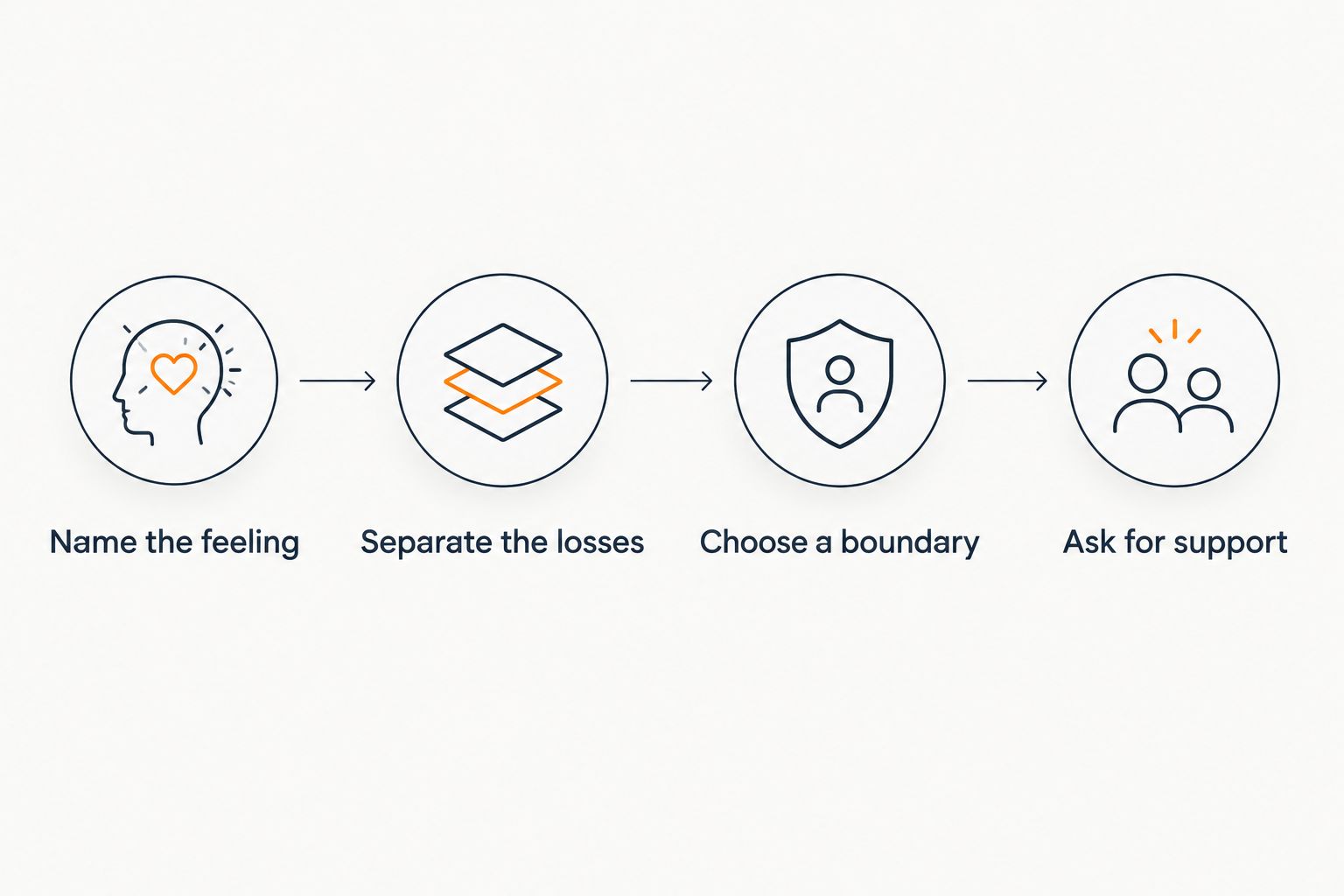 Four steps for understanding breakup relief and choosing support.
Understand the feeling before turning it into a decision about your ex.
Keep your reflection focused
Use these 3 questions when reflection starts turning into repeated self-questioning:
- What feels easier since the breakup?
- What do I miss that I can name specifically?
- What support would help me today?
For a forward-looking prompt, ask what you want the rest of 2026 to feel like outside a relationship. Focus on everyday needs—connection, rest, interests, or stability—rather than demanding a new version of yourself.
You can stop writing when you have identified a useful next action. More analysis is not always more clarity.
Where emotional support fits—and where it doesn't
Lovon is best for people who want voice-based emotional support while reflecting on everyday breakup feelings. You can talk through what happened, explore coping tools, and put mixed emotions into words.
The Lovon voice support app is not a licensed clinician or a replacement for clinical care. Its role is reflection and emotional support, not diagnosing you, determining your ex's motives, or deciding whether you should reconcile.
Choose support based on what you need, not on how serious you think your breakup is supposed to look.
| Support option | Best for | Useful role | Limitation |
|---|---|---|---|
| Trusted person | Company and practical help | Listening, shared activities, help with daily tasks | Personal opinions can crowd out your own perspective |
| Lovon voice support app | Talking through everyday emotions | On-demand conversation, coping tools, self-reflection | Not licensed clinical care or crisis support |
| Licensed mental health professional | Persistent distress or difficulty functioning | Assessment and treatment tailored to your needs | Requires finding a suitable professional and arranging care |
For support in 2026, keep that distinction clear: an app can be part of your support, but it should not become your only source of connection. Keep trusted people and professional care in the picture when you need them.
When should I seek professional help after a breakup?
Seek professional support when distress is persistent, worsening, or interfering with sleep, eating, work, relationships, or basic self-care. You do not have to wait until you are in crisis, and relief does not disqualify you from needing help.
Feeling lighter is different from feeling disconnected from everything. If you feel persistently unreal, emotionally shut off, or unable to engage with daily life, tell a healthcare professional what you are experiencing rather than diagnosing yourself from a single symptom.
If the relationship involved threats, stalking, coercion, or violence, prioritize safety over interpreting your feelings. Get help making a safety plan; you do not owe an unsafe person a private meeting or a final conversation.
In the United States, call or text 988 for suicide or mental health crisis support. If you face immediate danger or a medical emergency, call 911. These are crisis options, not substitutes for ongoing care.
One last thing
You do not have to turn relief into a judgment about either person. Sometimes the most useful question is not whether your ex was wrong for you, but what became easier when the relationship ended.
Before making another relationship decision in 2026, write down that answer in concrete terms. It can help you identify a need to protect—whether that is clearer communication, more independence, or less uncertainty—without rewriting everything you shared.
Related guides
How AI Support Helps You Heal
AI emotional support isn't about replacing human connection — it's about filling the gaps. The moments when you need to talk at 2 AM, when you don't want to burden your friends again, or when you simply need someone to listen without judgment.
Here's what happens in a typical Lovon session:
You share what's on your mind
There's no script, no intake form, no waiting room. You speak or type whatever you're feeling — in your own words, at your own pace.
Lovon validates and explores
Using frameworks from CBT (Cognitive Behavioral Therapy) and motivational interviewing, Lovon acknowledges your feelings first, then gently helps you explore them. No dismissive "just move on" advice.
You build coping skills together
Lovon doesn't just listen — it actively works with you on evidence-based techniques: thought reframing, urge surfing, behavioral experiments, and more.
What a Session with Lovon Looks Like

Lovon is AI support, not a replacement for professional care. If things have been hard to get through for weeks, or you are thinking about harming yourself, talk to a doctor or a licensed therapist.
Ready to Start?
Your healing journey can begin right now
A 3-day trial. No judgment. Just a safe space to process what you're going through.
Frequently Asked Questions
Is feeling relieved after a breakup normal if they ended it?
Can I still love my ex if I feel happier without them?
Why do I feel guilty for being okay after my breakup?
Does relief after a breakup mean my relationship was toxic?
How long should relief after a breakup last?
Should I tell my ex I feel relieved?
Should I get back together if I start missing my ex?
About the Author

The Lovon Editorial Team
Mental Health & Wellness Content Team
The Lovon Editorial Team develops mental health and wellness content designed to make psychological concepts accessible and actionable. Our goal is to bridge the gap between clinical research and everyday life - helping you understand why your mind works the way it does and what you can do about it....
Related articles
- Stages of a Breakup: 6 Phases and What Helps in Each
The stages of a breakup, mapped honestly: shock, bargaining, anger, the flat stretch, acceptance and rebuilding. What…
- AI Relationship Coach for Breakup Recovery 2026
The best AI relationship coach for breakup recovery in 2026. Lovon delivers voice-based, on-demand emotional support and…
- Can journaling really help you process a breakup faster?
Can journaling help you get over a breakup? Yes, but not on a fixed timeline. Find practical prompts, spot rumination…
- Should I Break Up With My Girlfriend? Signs It's Time To Break Up
Many of us believe a relationship will last forever. But at some point, you might start asking yourself a difficult…
See also
Quizzes
- Am I a Rebound? Quiz: Signs of a Rebound Relationship
Read the rebound signs honestly, in 3 minutes.
- Do I Miss My Ex or Am I Just Lonely? 12-Question Quiz
Find out what the missing is actually about.
Free tools
- Breakup Message Writer
A chat for saying it once. Tell it how long it has been and why now, and get a message you could actually send, plus the…
- No Contact Plan Builder
Name the hours you are most likely to text them, and get one if-then rule for each. Ends in a dated card you can…
From the wiki
- How to break up with someone you still love?
Loving someone does not mean the relationship works. If you have circled the same decision for months and the reasons…
Disclaimer: This article is for informational purposes only and does not constitute medical advice, diagnosis, or treatment. Always seek the advice of your physician or other qualified health provider with any questions you may have regarding a medical condition. If you are in crisis or think you may have an emergency, call 988 (Suicide & Crisis Lifeline) or go to the nearest emergency room. Outside the US? Find a crisis line in your country.