
Why Can't I Cry? Causes and Fixes in 2026
Can't cry even when you're sad? Freeze response, alexithymia, or dissociation are usually why. Steps to reconnect with emotion in 2026, plus when to get support.

Key Takeaways
- Why cant i cry usually traces back to freeze response, alexithymia, or dissociation, not weakness.
- Chronic stress shuts down tear production before you consciously decide to hold anything back.
- Grounding and voice journaling widen your window of tolerance faster than forcing emotion out.
- Numbness lasting more than a few weeks in 2026 is worth naming out loud, even to an AI voice like Lovon, before it
Feeling sad without a single tear coming out doesn't mean you're broken or cold. It usually means your nervous system picked a different survival strategy than crying, and that strategy can be unlearned.
TL;DR
- Why cant i cry usually traces back to freeze response, alexithymia, or dissociation, not weakness.
- Chronic stress shuts down tear production before you consciously decide to hold anything back.
- Grounding and voice journaling widen your window of tolerance faster than forcing emotion out.
- Numbness lasting more than a few weeks in 2026 is worth naming out loud, even to an AI voice like Lovon, before it becomes the default.
Why this matters
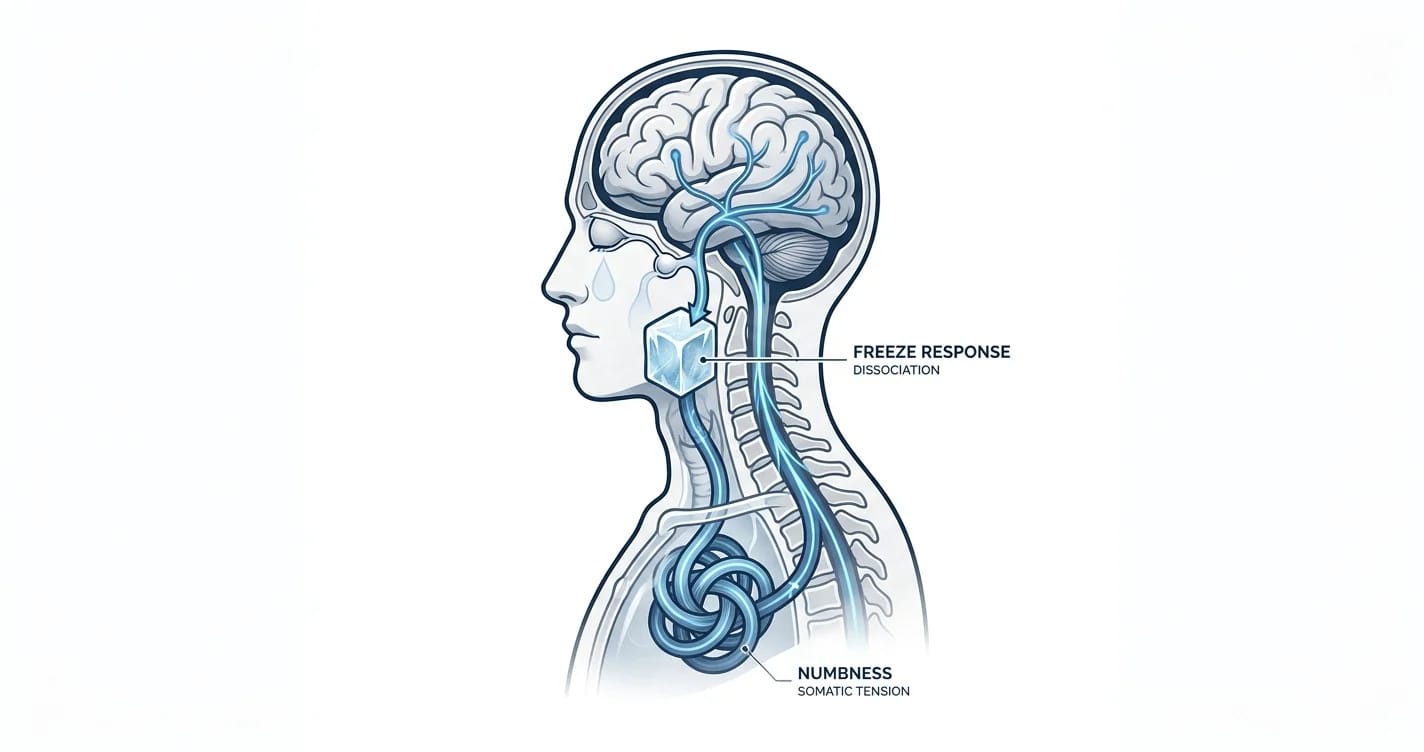
Crying is a nervous system release valve, not a personality trait. When you're stuck in a prolonged state of stress, your body can route sadness into numbness instead of tears as a protective move — this is closer to alexithymia or a freeze state than a character flaw.
People who ask "why cant i cry" are often high-functioning on the outside and flat on the inside. That gap is the actual problem to solve in 2026, not the absence of tears itself.
What you'll need
- 15 quiet minutes with no phone notifications
- A notes app, voice memo, or journal
- Honesty about what's been happening physically (sleep, meals, medication changes) over the last 30 days
- A private space where you won't be interrupted or watched
- Optional: the Lovon app if you want to talk through what comes up in real time
The steps
1. Rule out the physical stuff first
Dehydration, thyroid issues, certain medications (especially SSRIs), and chronic sleep debt can flatten emotional response at the biological level. This step matters because treating a body problem like a mental one wastes weeks.
Check three things: hours of sleep last night, water intake today, and any medication or dosage change in the last 60 days. If any of those shifted recently, that's your first lead, not your feelings.
Common mistake: assuming numbness is purely psychological before checking the basics.
2. Name what's happening in your body right now
Sit still and scan from your jaw down to your stomach. Tight throat, shallow breathing, and a heavy chest are signs your body is holding sadness somewhere physical instead of letting it move.
This matters because emotion that gets stuck in the body instead of processed often shows up as fatigue, irritability, or a flat mood weeks later. Naming the physical sensation out loud — even just "my throat is tight" — starts to unstick it.
Expected outcome: you'll usually locate one or two spots holding tension within 60 seconds.
3. Check whether you're in a freeze response
Freeze isn't just physical stillness — it's an emotional shutdown that happens when fight or flight didn't feel safe or possible. The freeze response can flatten your ability to cry for days or weeks after a stressful event, even one that happened months ago.
Ask yourself: did something overwhelming happen recently that you didn't get to react to in the moment? A tense meeting, a fight you walked away from, bad news you had to sit on. That delay is often where the freeze started.
Common mistake: waiting for a "big enough" reason to cry instead of recognizing the small overwhelming moment that triggered the shutdown.
4. Rule out dissociation
If sadness feels distant, like you're watching your own life from outside it, that's dissociation, not indifference. Dissociation mutes emotional intensity as a protective buffer, and tears are one of the first things it shuts off.
A quick check: does the sadness feel like it's happening to you, or does it feel like it's happening near you? If it's the second one, the fix isn't forcing tears — it's coming back into your body first.
Expected outcome: grounding through the senses (name five things you can see, four you can hear) usually narrows this gap within a few minutes.
5. Widen your window of tolerance before you try to feel more
Your window of tolerance is the zone where you can feel emotion without shutting down or spiraling. If it's narrow right now from stress, pushing yourself to cry harder just triggers more shutdown.
Spend two minutes on slow exhale breathing — four counts in, six counts out — before attempting any emotional processing. This widens the window enough that feeling doesn't automatically trigger freeze.
Common mistake: trying to force a cathartic cry session on a nervous system that's already maxed out.
6. Talk it out loud instead of writing it down
Speaking sadness out loud activates a different processing pathway than typing it. Say the sentence "I think I'm sad about ___" out loud, even alone in a room, and notice what shifts in your chest or throat.
This works because vocalizing forces specificity — vague sadness stays stuck, but a named sadness has somewhere to go. This is the same mechanism behind voice-based tools like Lovon: talking through it out loud surfaces what journaling alone sometimes misses.
Expected outcome: a lump in the throat or a single tear is a normal sign the block is loosening, not a failure to "really" cry.
7. Know when this is chronic, not situational
If you haven't cried in months regardless of what's happened — breakups, loss, exhaustion — that's a pattern worth naming to a professional, not something to push through alone. Long-term emotional flatness is a symptom, and in 2026 there are more low-barrier ways to talk it through than there were even five years ago.
Talk through the numbness out loud
Have a voice conversation with Lovon when journaling alone isn't cutting it.
Troubleshooting
- "I try to cry and nothing happens." Stop trying to force tears directly. Work on the body sensations first (tight throat, shallow breath) — tears are a downstream effect, not the starting point.
- "I cry at random things but not what actually hurts." This is common with dissociation. The random trigger (a commercial, a stranger's dog) is safe enough to feel; the real loss isn't yet. Both are valid entry points.
- "I used to cry easily and now I don't." Check for burnout or a medication change first. A sudden shift after months of normal crying often has a physical root.
- "I feel like I'm about to cry but it stops at my throat." That's the freeze response interrupting the release. Slow exhale breathing at that exact moment, not after, is what gets it moving.
- "I'm not sad, I'm just nothing." Flatness that persists for weeks, not days, is worth naming to a licensed clinician rather than working through solo.
Tools and resources
- Alexithymia — for a deeper look at why some people struggle to identify emotion at all, not just express it
- Freeze response — for the biology behind emotional shutdown under stress
- Dissociation — for grounding techniques that bring you back into your body
- Window of tolerance — for a framework on how much feeling you can hold before shutting down
- Lovon — for a voice conversation when you'd rather talk it through than type it out
What to do next
Once you've worked through the steps above and you're still flat weeks later, the next move is looking at whether your nervous system is dysregulated more broadly, not just around crying. Nervous system dysregulation covers the wider pattern — sleep, appetite, focus — that often shows up alongside emotional numbness.
FAQ
Why cant i cry even when I feel sad?
Most often it's your nervous system in a freeze state or dissociation, muting the release valve as a protective response, not a sign you don't care. Physical causes like dehydration, sleep debt, or certain medications can flatten it too.
Is not being able to cry a sign of depression?
It can be — emotional flatness is one symptom of depression, especially functional depression where you're still performing daily tasks. It's not the only cause, so rule out stress, freeze response, and medication changes first.
Can medication stop you from crying?
Yes, SSRIs and some other medications are known to blunt emotional intensity in some people, including the ability to cry. If a dosage or prescription changed in the last 60 days, that's worth mentioning to whoever prescribed it.
What is emotional numbness and how long does it last?
Emotional numbness is a reduced ability to feel or express emotion, often tied to stress, trauma, or dissociation. Situational numbness usually eases within days to a few weeks; numbness lasting months points to something chronic worth addressing directly.
How do I make myself cry when I need to release emotion?
Forcing tears rarely works — focus on body sensations like throat tightness and slow exhale breathing instead. Speaking the specific sadness out loud, rather than typing it, tends to loosen the block faster than trying to cry on command.
Is it normal to feel like crying but nothing comes out?
Yes, this is a common sign of a freeze response interrupting the release partway through. It usually means you're close to processing the emotion, not further from it.
When should I talk to someone about not being able to cry?
If the flatness lasts more than a few weeks regardless of what happens around you, or it comes with appetite, sleep, or focus changes, that's the point to talk to a licensed therapist. An AI voice conversation can help you name what's going on in the meantime, but it isn't a replacement for clinical care.
Does alexithymia mean I can't feel emotions at all?
No, alexithymia means difficulty identifying and naming emotions, not an absence of them. People with it still feel physical sensations tied to emotion, like a tight chest, they just struggle to label what the sensation means.
One last thing
The tight throat that stops right before a cry isn't a failed attempt — it's the closest signal your body gives that the block is loosening. Most people give up right there in 2026 because it feels like nothing happened, when it's actually the exact moment worth staying with for another 30 seconds.
Related guides
How AI Support Helps You Heal
AI emotional support isn't about replacing human connection — it's about filling the gaps. The moments when you need to talk at 2 AM, when you don't want to burden your friends again, or when you simply need someone to listen without judgment.
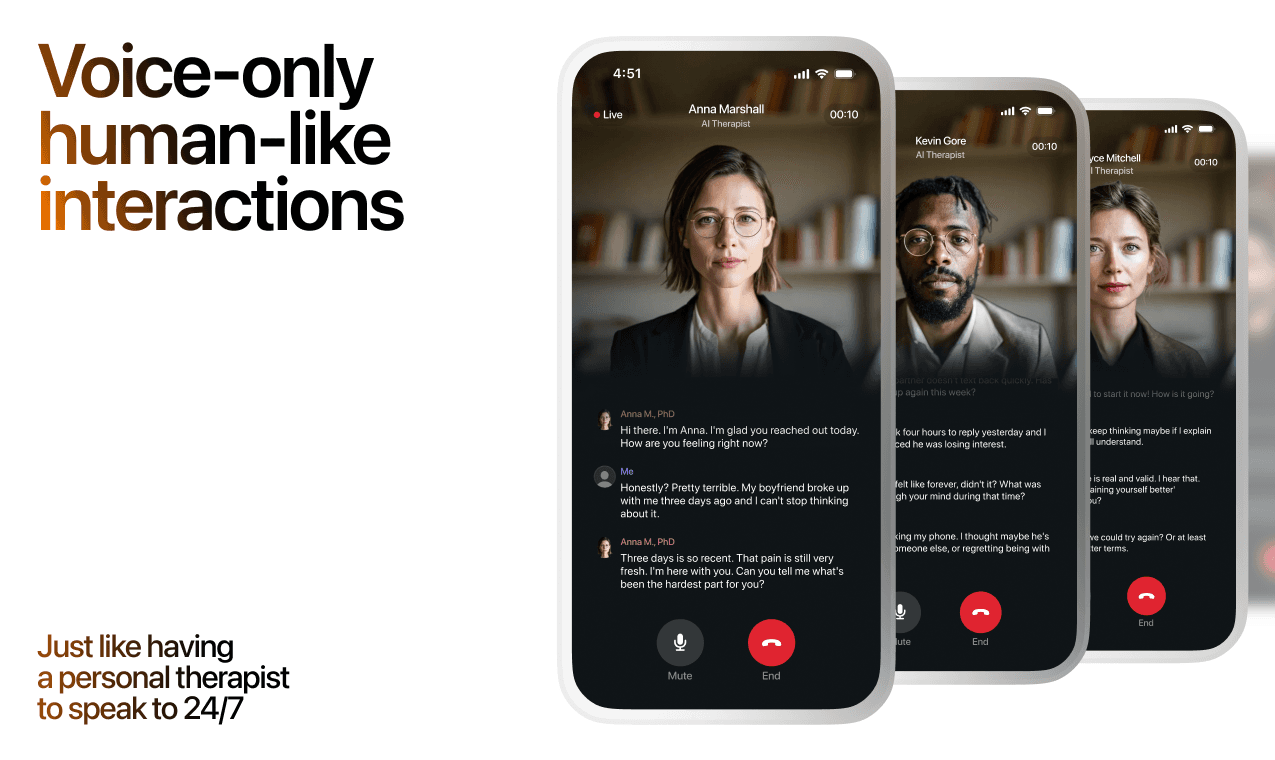
Here's what happens in a typical Lovon session:
You share what's on your mind
There's no script, no intake form, no waiting room. You speak or type whatever you're feeling — in your own words, at your own pace.
Lovon validates and explores
Using frameworks from CBT (Cognitive Behavioral Therapy) and motivational interviewing, Lovon acknowledges your feelings first, then gently helps you explore them. No dismissive "just move on" advice.
You build coping skills together
Lovon doesn't just listen — it actively works with you on evidence-based techniques: thought reframing, urge surfing, behavioral experiments, and more.
What a Session with Lovon Looks Like
When to Seek Professional Help
AI support is a valuable tool, but it's not a replacement for professional care. Please consider reaching out to a licensed therapist if you experience any of the following:
- Persistent thoughts of self-harm or suicide
- Inability to perform daily activities (work, eating, sleeping) for more than 2 weeks
- Turning to alcohol or substances to cope
- Intense anger or desire to harm your ex-partner
- Complete emotional numbness that doesn't improve over time
Crisis Resources (US): If you're in immediate danger, call 988 (Suicide & Crisis Lifeline) or text HOME to 741741 (Crisis Text Line). Available 24/7, free, and confidential.
Outside the US? Find a crisis line in your country
Ready to Start?
Your healing journey can begin right now
A 7-day trial. No judgment. Just a safe space to process what you're going through.
Frequently Asked Questions
Is Lovon a replacement for a real therapist?
Is my conversation with Lovon AI private?
How is Lovon different from ChatGPT for emotional support?
Can I use Lovon if I'm already seeing a therapist?
Can I try Lovon before subscribing?
About the Author

The Lovon Editorial Team
Mental Health & Wellness Content Team
The Lovon Editorial Team develops mental health and wellness content designed to make psychological concepts accessible and actionable. Our goal is to bridge the gap between clinical research and everyday life - helping you understand why your mind works the way it does and what you can do about it....
Related articles
- Why Do I Feel Like Everyone Hates Me? Causes & Fixes 2026
Feeling like everyone hates you is a cognitive distortion, not a fact. Learn the 7 causes and step-by-step fixes backed…
- Enmeshment in Relationships: Signs & Fix (2026)
Enmeshment in relationships blurs boundaries until feelings merge. See the signs, a 7-step untangling process, and…
- How to Set Boundaries With a Narcissist (2026 Guide)
Learn how to set boundaries with a narcissist without conflict: scripted language, the gray rock method, and…
- Self-Sabotage as Defense Mechanism and Conditional Love
You set a goal, work toward it diligently, and then—just as success comes within reach—you find yourself making…
See also
Quizzes
- Am I a People Pleaser? 12-Question Quiz
Where kindness stops and self-erasure starts.
- Boundaries Test: Free 12-Question Self-Check
See where your boundaries slip, in 3 minutes.
Free tools
- How to Respond to a Narcissist
Paste what they said. You get the part that actually needs answering separated from the part designed to pull you in, a…
- How to Respond to Gaslighting
Say what happened and what they say happened. You get what is actually established separated from what is being…
From the wiki
- What to do if you have no friends?
Pick one activity that repeats weekly with the same people, and go for six to eight weeks straight. Repetition, not…
Disclaimer: This article is for informational purposes only and does not constitute medical advice, diagnosis, or treatment. Always seek the advice of your physician or other qualified health provider with any questions you may have regarding a medical condition. If you are in crisis or think you may have an emergency, call 988 (Suicide & Crisis Lifeline) or go to the nearest emergency room. Outside the US? Find a crisis line in your country.