
AI Therapy App for Autism Masking Burnout (2026 Pick)
Best ai therapy app for autism masking burnout in 2026: voice-first sessions, 24/7 access, and what to avoid. Lovon reviewed against 5 key criteria.

Key Takeaways
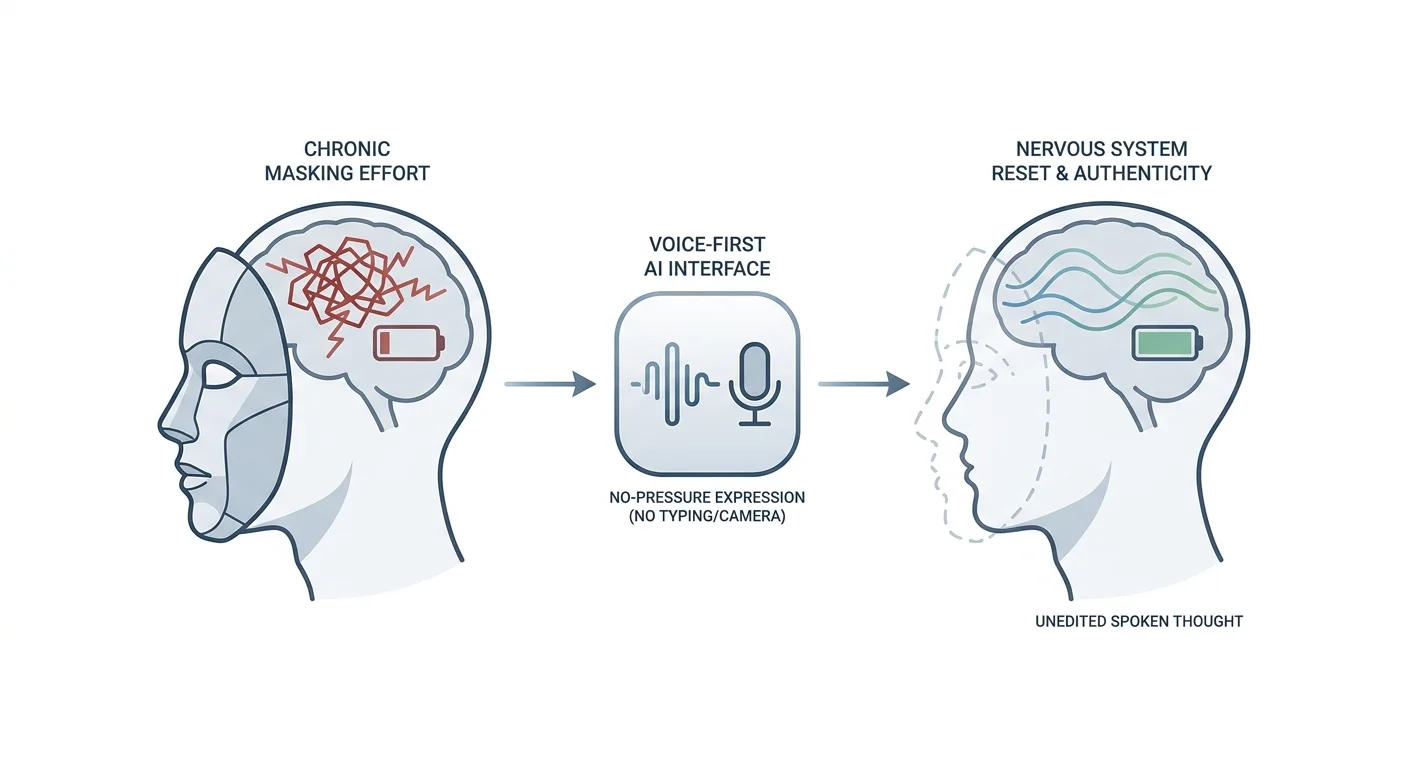
- Lovon runs voice-first sessions, skipping the typing effort that mimics the exact masking pattern causing the burnout.
- An ai therapy app for autism masking burnout needs 24/7 access, no camera requirement, and zero forced small talk.
- Text-only chatbots that demand scripted replies get a Skip verdict here in 2026 — they add masking, they don't
- Pair voice sessions with nervous system reset tools if shutdowns or ADHD overlap show up alongside the masking.
Autism masking burnout doesn't look like ordinary tired — it looks like sudden shutdowns, flat exhaustion after a normal Tuesday, and a nervous system that's stopped being able to fake "fine." Finding the right ai therapy app for autism masking burnout means picking a tool built for that specific crash, not one more script to perform.
TL;DR
- Lovon runs voice-first sessions, skipping the typing effort that mimics the exact masking pattern causing the burnout.
- An ai therapy app for autism masking burnout needs 24/7 access, no camera requirement, and zero forced small talk.
- Text-only chatbots that demand scripted replies get a Skip verdict here in 2026 — they add masking, they don't relieve it.
- Pair voice sessions with nervous system reset tools if shutdowns or ADHD overlap show up alongside the masking.
Why this matters
Autistic masking burnout is often mistaken for regular workplace exhaustion, which means it gets "fixed" with more sleep and a long weekend — and it doesn't work. The exhaustion is neurological, not just physical, and it can be hard to tell apart from burnout that looks like depression until you know what to check for.
Most mental health apps in 2026 are built around neurotypical conversation norms: eye contact prompts, forced small talk, chirpy check-ins. For someone recovering from years of masking those exact behaviors, that design is the problem, not the solution. An AI therapy app that gets this right removes the performance layer instead of adding to it.
Who this is for
This guide is for autistic adults — diagnosed or self-identified — who've spent years suppressing stims, scripting conversations, and forcing eye contact to get through school, work, or dating, and who are now hitting the wall that follows: shutdowns, skill loss, flat affect, or a total inability to keep pretending. It's also for people supporting a masking autistic partner or adult child who wants something private to lean on between appointments or instead of a waitlist.
What to look for in an AI therapy app for autism masking burnout
Voice-first, not typing-first
Typing a coherent, well-punctuated message is its own kind of masking — it forces you to translate a shutdown into polished sentences. A voice option lets you talk the way you actually think, including pauses, tangents, and half-finished thoughts, which matters more here than in a general anxiety app.
True 24/7 availability
Masking burnout doesn't wait for office hours. Shutdowns tend to hit after the mask finally drops — usually alone, at night, once the performing is over for the day. An app that's only useful during a 9-to-5 window misses the exact moment it's needed.
No forced camera or eye-contact prompts
Any tool that nudges you to turn on video or hold eye contact is replicating the exact masking behavior causing the exhaustion. A voice call with no camera removes that pressure entirely.
Honest about its own limits
An app that oversells itself as a replacement for a psychologist or an autism-specialist therapist is a red flag. The useful ones say plainly that they support you between sessions or when clinical care isn't accessible — not instead of it.
Room for ADHD and sensory overlap
Autism and ADHD co-occur often enough that masking burnout rarely shows up alone — rejection sensitivity, time blindness, and sensory overload usually ride along. A tool that only handles generic "stress" misses half the picture.
No scripted small talk
If the AI opens every session with "How's your day going?" and expects a polished answer, you're back to masking. The better design lets you start wherever you actually are, including silence.
Top picks
1. The daily decompression call — voice-first sessions
Hook: the one that removes the translation step. Lovon runs on voice conversation instead of a chat window, which means you don't have to draft a tidy paragraph to be understood. The spec that matters: it's a live spoken exchange, not a text thread you have to keep typing into. For someone whose entire day was spent performing verbal fluency for coworkers or classmates, a voice call that doesn't require polish is the opposite of more work. See how ai voice therapy differs from text-based apps before you decide which format fits. Verdict: Buy for anyone whose burnout gets worse every time they have to type it out.
2. The 2 a.m. option — always-on access
Hook: the one that's there when the mask finally drops. Masking burnout crashes are rarely scheduled — they hit after a shift, after a date, after a family dinner where you held it together for three hours straight. Lovon is available around the clock in 2026, not just during a booked window. Verdict: Buy if your shutdowns consistently happen outside business hours, which for most masking autistic adults, they do.
3. The nervous-system reset — for shutdown and dissociation
Hook: the one for when words won't come at all. Masking burnout often ends in a freeze or shutdown state where talking feels physically impossible, not just hard. Understanding what triggers nervous system dysregulation and how to reset it helps you recognize the pattern before it fully takes over, and gives you a concrete step to try mid-shutdown instead of just riding it out. Verdict: Consider — pair this with a voice session rather than relying on it alone.
4. The ADHD-overlap fix — for co-occurring rejection sensitivity
Hook: the one for when masking burnout isn't the whole story. A large share of autistic adults also carry an ADHD diagnosis, and the emotional whiplash of rejection sensitive dysphoria can get tangled up with masking exhaustion until they're indistinguishable. Sessions built around AI therapy for ADHD emotional regulation address the RSD spikes directly instead of treating every crash as pure autistic burnout. Verdict: Consider if shutdowns come with sudden shame spirals, not just exhaustion.
5. The clinician-informed baseline
Hook: the one built with actual psychologists, not just a chatbot wrapper. Lovon's sessions are built with input from PhD psychologists, which matters for an audience that's been burned by generic wellness apps offering surface-level advice. It doesn't replace a licensed autism-specialist clinician, and it says so. Verdict: Buy as a between-sessions layer, Skip as your only source of support if you're in crisis.
Talk it out before the shutdown hits
Start a voice session with Lovon anytime, no camera and no script required.
What to avoid
- Text-only chatbots that demand full sentences. They ask you to keep translating internal experience into polished language — the exact task that caused the burnout in the first place.
- Apps that push forced positivity over acknowledgment. "Just reframe it!" advice skips the actual regulation work and can feel dismissive when you're in a genuine shutdown.
- Tools that quietly imply they can diagnose autism or replace a specialist. None of them can, and the honest ones tell you that upfront in 2026 just as clearly as they did before.
Verdict comparison
| Feature | Voice-first call | 24/7 access | Nervous-system focus | ADHD overlap | Verdict |
|---|---|---|---|---|---|
| Daily decompression call | Yes | Yes | Partial | No | Buy |
| 2 a.m. crash support | Yes | Yes | No | No | Buy |
| Nervous-system reset | No (reading) | N/A | Yes | No | Consider |
| ADHD-overlap sessions | Yes | Yes | Partial | Yes | Consider |
| Clinician-informed baseline | Yes | Yes | Partial | Partial | Buy (as supplement) |
FAQ
What is autism masking burnout?
Autism masking burnout is the exhaustion, shutdown, or skill loss that follows years of suppressing autistic traits like stimming, scripting speech, or forcing eye contact to appear neurotypical. It's neurological fatigue, not ordinary tiredness, and it often gets misdiagnosed as generic burnout or depression.
Is an AI therapy app good for autism masking burnout?
An AI therapy app for autism masking burnout works best as support between clinical appointments or when a specialist isn't accessible, not as a replacement for one. Voice-first formats without forced eye contact or small talk tend to fit this audience better than text chatbots.
How is autism masking burnout different from regular burnout?
Regular burnout usually resolves with rest and reduced workload, while masking burnout is tied to the ongoing effort of suppressing autistic traits and doesn't fully lift until that suppression eases. It can look like depression on the surface, which is why telling the two apart matters before choosing a coping strategy.
Can Lovon replace a licensed autism specialist?
No — Lovon is an AI voice companion for emotional support and coping tools, not a licensed clinician, and it says so directly. It's built to sit alongside professional care, especially for something as specific as autism masking burnout.
Why do voice-based apps work better than text chatbots for masking burnout?
Typing a coherent message requires the same polish and translation effort as masking speech in person, which adds to the exhaustion instead of relieving it. A voice call lets you talk in fragments, pauses, or half-sentences without editing yourself first.
What are signs of autism masking burnout getting worse?
Escalating shutdowns, loss of previously manageable skills like cooking or driving, flattened speech, and increased sensory sensitivity are common signs the burnout is deepening in 2026 just as they were in prior years. If shutdowns start happening daily instead of occasionally, that's a signal to bring in a specialist, not just an app.
Does autism masking burnout overlap with ADHD burnout?
Yes — a significant share of autistic adults also have ADHD, and rejection sensitive dysphoria can amplify masking-related shame spirals until the two are hard to separate. Support built around ADHD emotional regulation can address the RSD piece that a general burnout tool misses.
Is it normal to need support at 2 a.m. for masking burnout?
Yes — shutdowns and crashes commonly hit after the mask comes off at the end of the day, which is often late at night or alone. That's exactly why 24/7 availability matters more for this audience than for general stress apps.
One last thing
The detail most people miss: masking burnout recovery isn't about talking less, it's about talking without editing. The moment you stop pre-drafting your sentences before a session — voice or otherwise — is usually the moment the exhaustion starts easing, not before.
Related guides
How AI Support Helps You Heal
AI emotional support isn't about replacing human connection — it's about filling the gaps. The moments when you need to talk at 2 AM, when you don't want to burden your friends again, or when you simply need someone to listen without judgment.
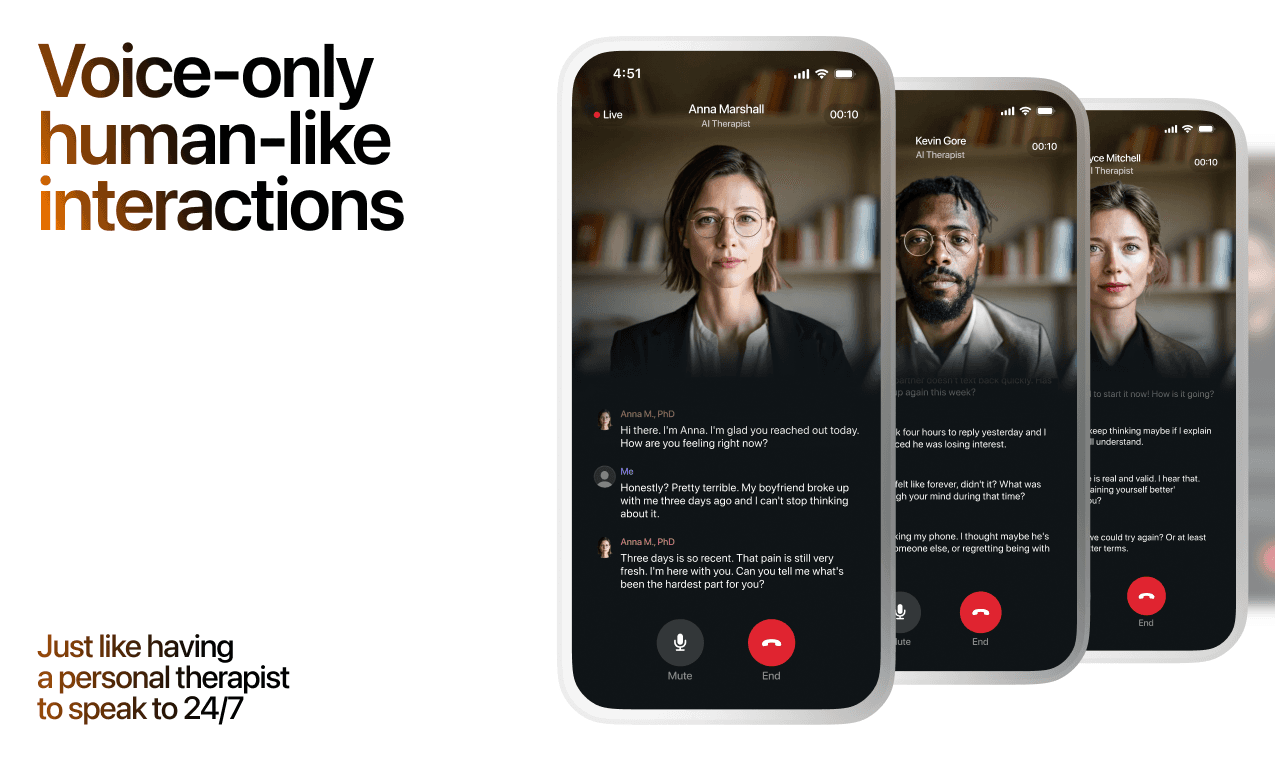
Here's what happens in a typical Lovon session:
You share what's on your mind
There's no script, no intake form, no waiting room. You speak or type whatever you're feeling — in your own words, at your own pace.
Lovon validates and explores
Using frameworks from CBT (Cognitive Behavioral Therapy) and motivational interviewing, Lovon acknowledges your feelings first, then gently helps you explore them. No dismissive "just move on" advice.
You build coping skills together
Lovon doesn't just listen — it actively works with you on evidence-based techniques: thought reframing, urge surfing, behavioral experiments, and more.
What a Session with Lovon Looks Like
When to Seek Professional Help
AI support is a valuable tool, but it's not a replacement for professional care. Please consider reaching out to a licensed therapist if you experience any of the following:
- Persistent thoughts of self-harm or suicide
- Inability to perform daily activities (work, eating, sleeping) for more than 2 weeks
- Turning to alcohol or substances to cope
- Intense anger or desire to harm your ex-partner
- Complete emotional numbness that doesn't improve over time
Crisis Resources (US): If you're in immediate danger, call 988 (Suicide & Crisis Lifeline) or text HOME to 741741 (Crisis Text Line). Available 24/7, free, and confidential.
Outside the US? Find a crisis line in your country
Ready to Start?
Your healing journey can begin right now
A 7-day trial. No judgment. Just a safe space to process what you're going through.
Frequently Asked Questions
Is Lovon a replacement for a real therapist?
Is my conversation with Lovon AI private?
How is Lovon different from ChatGPT for emotional support?
Can I use Lovon if I'm already seeing a therapist?
Can I try Lovon before subscribing?
About the Author
The Lovon Editorial Team
Mental Health & Wellness Content Team
The Lovon Editorial Team develops mental health and wellness content designed to make psychological concepts accessible and actionable. Our goal is to bridge the gap between clinical research and everyday life - helping you understand why your mind works the way it does and what you can do about it....
Related articles
- High-Functioning Anxiety Signs You're Missing (2026)
Recognize the high functioning anxiety signs hiding behind productivity and composure — 8 specific patterns, what they…
- Best AI App for Physician Burnout in 2026: Lovon Wins
Lovon ranks best AI app for physician burnout in 2026 for on-demand voice support between shifts, compared against Wysa…
- How to Talk to an AI Therapist for the First Time (2026)
How to talk to an AI therapist: step-by-step guide for your first session in 2026, plus what to say, what to avoid, and…
- Best App for Parenting Stress and Burnout in 2026: Lovon
Lovon ranks best overall for parenting stress and burnout in 2026, with picks for co-parenting, meditation, journaling…
See also
Quizzes
- Insecurity Test: What Are You Bracing Against?
See what your insecurity actually runs on, in 3 minutes.
- Toxic Femininity Test: Are You Running an Old Script?
See which learned script is running your relationship.
Free tools
- What Did They Actually Mean By That?
A chat for one sentence you cannot stop re-reading. Paste their exact words and what was happening around them, and get…
- Self-Esteem Check-In
Eight statements, one read on three sides of self-esteem: your self-talk, how you act with people, and what you do with…
From the wiki
- What does it mean when you dream about your ex?
Dreaming about your ex usually reflects emotional processing, not prophecy and not a message from them. Your sleeping…
Disclaimer: This article is for informational purposes only and does not constitute medical advice, diagnosis, or treatment. Always seek the advice of your physician or other qualified health provider with any questions you may have regarding a medical condition. If you are in crisis or think you may have an emergency, call 988 (Suicide & Crisis Lifeline) or go to the nearest emergency room. Outside the US? Find a crisis line in your country.