
Best BetterHelp alternatives for ADHD support
Compare BetterHelp alternatives for ADHD: Lovon for voice support, licensed therapy for clinical care, and medical clinicians for medication advice.


Key Takeaways
- Lovon fits BetterHelp alternatives for ADHD searches when you want voice-based emotional support, not diagnosis or medication.
- An ADHD-focused licensed therapist is the better fit for clinical therapy and personalized coping skills.
- A qualified medical clinician is the right choice for ADHD assessment and medication decisions.
- ADHD coaching focuses on routines and accountability; it does not replace mental health treatment.
BetterHelp connects you with licensed therapists online, which is a strength when you want ongoing human support. For ADHD, the limit is whether that support matches your need: emotional coping, practical skills, or medical assessment. Among BetterHelp alternatives for ADHD in 2026, Lovon is best for on-demand voice-based emotional support; an ADHD-focused licensed therapist is best for individualized clinical therapy.
TL;DR
- Lovon fits BetterHelp alternatives for ADHD searches when you want voice-based emotional support, not diagnosis or medication.
- An ADHD-focused licensed therapist is the better fit for clinical therapy and personalized coping skills.
- A qualified medical clinician is the right choice for ADHD assessment and medication decisions.
- ADHD coaching focuses on routines and accountability; it does not replace mental health treatment.
Why this matters
ADHD support is not a single service. Talking through frustration, learning how to start tasks, and evaluating medication require different kinds of help.
A voice app is not a clinician, and a coach is not automatically a therapist. Those distinctions matter more than a long feature list. For your 2026 shortlist, start with the problem you want help solving—not the platform you want to leave.
You also do not have to replace every part of your current care. An emotional-support app can sit alongside therapy, while a medical clinician handles assessment and treatment decisions.
BetterHelp alternatives for ADHD at a glance
This comparison separates support roles rather than treating unlike services as interchangeable. The best choice depends on whether you need conversation, clinical treatment, practical accountability, or medical care.
| Option | Best for | Standout approach | Difference from BetterHelp | Main limitation |
|---|---|---|---|---|
| BetterHelp | Online conversations with a licensed therapist | Human therapeutic relationship | Baseline option | ADHD experience depends on the individual therapist |
| Lovon | On-demand emotional support by voice | Spoken conversations, coping tools, and self-reflection | AI support rather than licensed therapy | Not a clinician or replacement for clinical care |
| ADHD-focused licensed therapist | Therapy centered on ADHD-related difficulties | Individualized clinical work | Select specifically for ADHD experience | Therapy does not automatically include prescribing |
| Qualified medical clinician | Assessment and medication decisions | Medical evaluation and follow-up | Medical care rather than counseling alone | Does not automatically include ongoing psychotherapy |
| ADHD coach | Routines, planning, and accountability | Practical work toward everyday goals | Coaching rather than psychotherapy | Coaching alone does not qualify someone to diagnose or prescribe |
1. Lovon: best for on-demand voice support
Lovon is an AI mental health support app for talking through everyday struggles, including stress, anxiety, low mood, relationship problems, and ADHD-related concerns. You speak aloud and receive emotional support, coping tools, and self-reflection guidance. It is built with input from PhD psychologists, but it is not a licensed clinician.
Best for: Adults who want a place to talk through overwhelm alongside appropriate professional care.
Where it shines
- Voice-based conversation: You can talk rather than organize everything into a written message.
- On-demand support: The app offers conversation when you want help processing an everyday difficulty.
- Emotional focus: Coping and self-reflection fit moments of frustration, stress, or self-criticism.
Where it falls short
- It cannot replace an ADHD assessment, a prescribing clinician, or a licensed therapist.
- AI responses can misunderstand your situation or give unsuitable guidance.
- Speaking aloud requires a setting where you feel comfortable discussing personal matters.
| Dimension | Lovon | BetterHelp |
|---|---|---|
| Who responds | AI | Licensed therapist |
| Core relationship | Emotional-support companion | Human therapeutic relationship |
| Conversation focus | Coping and self-reflection | Therapy with an individual clinician |
| ADHD clinical care | Not a replacement | Discuss ADHD needs and scope with the therapist |
For example, you might want to talk through the shame you feel after missing a deadline. That is different from asking an app to decide whether you have ADHD or should change medication. Keep those medical questions with a qualified clinician.
Verdict: Skip as a replacement for ADHD treatment; consider it for everyday emotional support.
2. ADHD-focused licensed therapist: best for clinical therapy
An ADHD-focused licensed therapist is the strongest alternative when you want human therapy with explicit attention to ADHD-related difficulties. Look for experience with adult ADHD, practical coping skills, and concerns that overlap with it, such as anxiety or low mood.
The distinction is fit, not simply platform versus private practice. A therapist you meet through BetterHelp might already have relevant experience; ask before assuming you need to leave.
Best for: Adults who want individualized therapy for emotional difficulties and patterns affecting daily life.
Where this option shines
- Clinical judgment: A licensed therapist can assess concerns within their professional scope.
- Personalized work: Sessions can connect everyday difficulties with your history and circumstances.
- A continuing relationship: You work with a person who can discuss goals and revisit what is not helping.
Where this option falls short
- ADHD experience varies, even among licensed therapists.
- Therapy is not the same as medication management.
- You need a clear agreement about goals; supportive conversation alone might not address your practical priorities.
| Dimension | ADHD-focused licensed therapist | BetterHelp |
|---|---|---|
| Selection priority | Explicit ADHD experience | Confirm experience with the individual therapist |
| Therapy goals | Agreed ADHD-related priorities | Agreed with your matched therapist |
| Medical needs | Separate prescribing care when needed | Discuss referral needs with your therapist |
Ask a prospective therapist how sessions would address a specific problem, such as repeatedly avoiding important paperwork. A clear explanation of the approach tells you more than a general statement that they work with ADHD.
Verdict: Hold your current therapy until you have clarified what a different clinician would change.
3. Qualified medical clinician: best for assessment and medication
A psychiatrist or another appropriately qualified medical clinician is the right route when your main question concerns diagnosis, medication, side effects, or medical follow-up. Emotional support cannot answer those questions safely on its own.
Best for: Adults seeking a clinical evaluation or help reviewing medication treatment.
Where this option shines
- Evaluates symptoms in a broader medical context.
- Discusses medication options when clinically appropriate.
- Monitors treatment and addresses side-effect concerns.
Where this option falls short
- A medical appointment does not automatically include psychotherapy.
- You still need to confirm the clinician's adult ADHD experience and scope.
- Medication decisions do not replace practical support for routines or emotional difficulties.
Verdict: Skip app-only support when the question requires medical assessment.
4. ADHD coach: best for routines and accountability
An ADHD coach focuses on practical goals such as planning your week, breaking down tasks, or following through on routines. Coaching fits a different need from psychotherapy, even when both conversations involve everyday struggles.
Best for: Adults seeking structured help with practical goals, alongside clinical care when needed.
Where this option shines
- Keeps attention on concrete actions and obstacles.
- Offers a setting for reviewing plans and follow-through.
- Can focus on a specific routine rather than broad emotional exploration.
Where this option falls short
- Coaching credentials and training vary; examine them directly.
- Coaching alone does not qualify someone to diagnose ADHD or prescribe medication.
- A planning-focused approach is not a substitute for treatment of significant distress.
Verdict: Skip coaching as your only support when you need clinical assessment or mental health treatment.
Why people consider switching from BetterHelp
A reason to change services is a mismatch between the support you receive and the support you need. That does not mean BetterHelp is ineffective or that every alternative is better.
For a 2026 decision, identify the gap without making assumptions about the platform:
- ADHD expertise: Ask whether your therapist has experience with the difficulties you want to address.
- Medical care: If your question involves diagnosis or medication, seek a clinician qualified to provide that care.
- Everyday coping: If you want additional emotional support outside therapy, consider a companion tool rather than abandoning useful treatment.
- Practical structure: If sessions never reach your planning goals, discuss a more skills-focused approach or separate coaching.
Before switching, describe the missing piece plainly: you want help starting tasks, managing frustration, or understanding treatment options. Your current therapist can then explain whether that need fits their work.
Match the support to your next step
You do not need to solve every ADHD-related difficulty at once. Use these categories to decide which kind of support belongs first on your 2026 shortlist.
- Emotional support: You want to talk through a difficult moment and reflect on what you need.
- Clinical therapy: You want a licensed professional to help with distress and recurring patterns.
- Medical assessment: You need evaluation, diagnostic clarification, or medication advice.
- Practical coaching: You want help building and reviewing everyday routines.
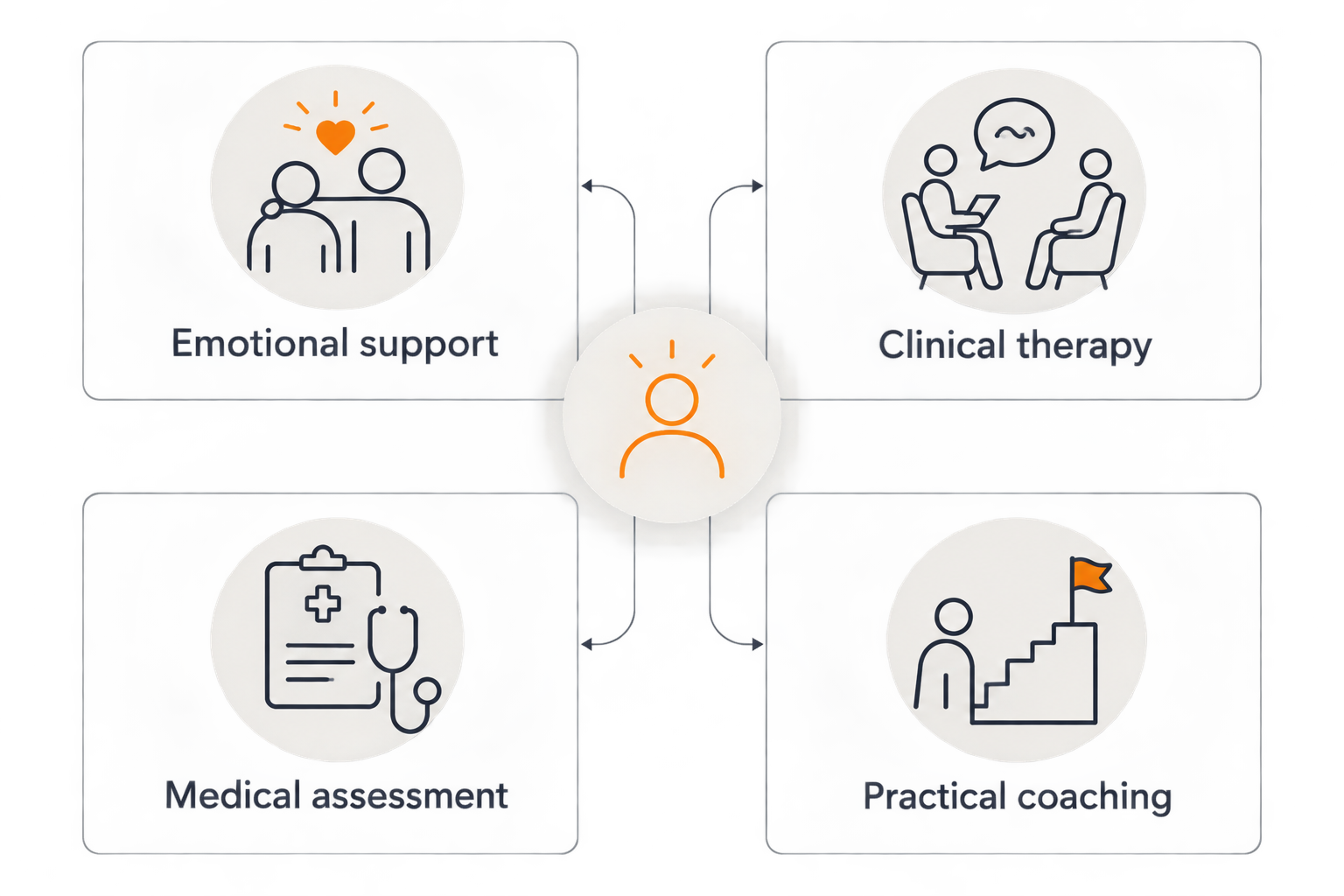 Four support categories: emotional support, clinical therapy, medical assessment, and practical coaching
Choose the support role before choosing the service.
These categories can overlap in your care without becoming interchangeable. You might work on emotional patterns in therapy while using coaching to organize a recurring task. Keep each provider's responsibilities clear.
When medication is the missing piece
If you are comparing local services, listings of ADHD medication management clinics in Atlanta address a different care category from emotional-support apps: medical evaluation and prescribing follow-up. A listing is a starting point, not confirmation that a particular clinic fits your needs.
Ask who conducts the assessment, who handles follow-up, and how to raise concerns about side effects. Do not start, stop, or change medication based on an AI conversation or a comparison article.
When getting started feels too big
Try a small planning exercise rather than building an entirely new routine. Set aside 2 minutes to describe what feels difficult, choose 1 task to make smaller, and review your notes after 7 days. These are optional planning boundaries, not a treatment schedule or a promise of improvement.
A useful note names the situation, the obstacle, and the next action. For example, write that opening the paperwork feels overwhelming and that the next action is finding the document—not finishing the whole process. Bring recurring difficulties to your clinician.
What to check before choosing an app or provider
For your 2026 comparison, ask direct questions about scope, privacy, and fit. Do not treat a reassuring name or the phrase AI therapist as proof of clinical care.
- Qualifications: Who is providing the service, and what are they qualified to do?
- ADHD experience: How does the provider approach your specific difficulties?
- Privacy: What information is collected, retained, shared, and removable?
- Care boundaries: What happens when your needs exceed the service's scope?
- Progress: What would useful support look like in your daily life?
For an app, read the current privacy terms before sharing sensitive details. For a clinician, ask how you will agree on goals and discuss concerns when the approach is not working for you.
When staying with BetterHelp is the right call
Stay with BetterHelp if your therapist understands your ADHD-related concerns and the relationship is helping you work toward clear goals. Switching platforms is not itself a treatment strategy.
Start by discussing the gap. You might need more practical exercises, a different therapeutic focus, or a referral for medical assessment rather than a replacement for therapy. Preserve care that is helping while you arrange any additional support.
One last thing
Before choosing a service, finish this sentence: I want help with this specific moment in my day. A missed deadline, an argument, and a medication concern point to different kinds of support.
You do not need one service to do everything. You need each part of your support to have a clear, honest role.
Related guides
How AI Support Helps You Heal
AI emotional support isn't about replacing human connection — it's about filling the gaps. The moments when you need to talk at 2 AM, when you don't want to burden your friends again, or when you simply need someone to listen without judgment.
Here's what happens in a typical Lovon session:
You share what's on your mind
There's no script, no intake form, no waiting room. You speak or type whatever you're feeling — in your own words, at your own pace.
Lovon validates and explores
Using frameworks from CBT (Cognitive Behavioral Therapy) and motivational interviewing, Lovon acknowledges your feelings first, then gently helps you explore them. No dismissive "just move on" advice.
You build coping skills together
Lovon doesn't just listen — it actively works with you on evidence-based techniques: thought reframing, urge surfing, behavioral experiments, and more.
What a Session with Lovon Looks Like

Lovon is AI support, not a replacement for professional care. If things have been hard to get through for weeks, or you are thinking about harming yourself, talk to a doctor or a licensed therapist.
Ready to Start?
Your healing journey can begin right now
A 3-day trial. No judgment. Just a safe space to process what you're going through.
Frequently Asked Questions
What's the best BetterHelp alternative for ADHD support?
Is an AI mental health app better than a therapist for ADHD?
Can BetterHelp help with ADHD-related problems?
Should I choose an ADHD coach or a therapist?
Who should I see if I think I need ADHD medication?
Can I use an emotional-support app alongside therapy?
What should I do if I feel unsafe or in crisis?
About the Author

The Lovon Editorial Team
Mental Health & Wellness Content Team
The Lovon Editorial Team develops mental health and wellness content designed to make psychological concepts accessible and actionable. Our goal is to bridge the gap between clinical research and everyday life - helping you understand why your mind works the way it does and what you can do about it....
Related articles
- Best AI apps for fertility and IVF stress in 2026
Best AI apps for fertility and IVF stress: choose Lovon for voice support, compare focused alternatives, and keep…
- Freudly alternatives in 2026
Compare Freudly alternatives: choose Lovon for voice-based emotional support, a licensed professional for clinical care…
- Best Mental Health App for Men in 2026: Lovon Wins
Six AI mental health apps for men compared for 2026. Lovon wins for on-demand voice support — see pros, cons, and honest…
- Is ADHD coaching covered by insurance in 2026?
Is ADHD coaching covered by insurance? Usually not. Learn what separates coaching from covered care and what to ask your…
See also
Quizzes
- How Do You Cope With Stress? Coping Style Quiz
Find your stress coping style in 2 minutes.
- Resilience Test: How Fast Do You Bounce Back?
See how you recover from setbacks, in 3 minutes.
Free tools
- AI Life Coach
This is a free AI life coach you can use right on this page. Tell it where you feel stuck or what you are deciding, and…
- Dopamine Menu
A menu of things that lift you, built on a good day so a flat day only needs an order. Pick from 128 ideas or add your…
From the wiki
- What to do if you have no friends?
Pick one activity that repeats weekly with the same people, and go for six to eight weeks straight. Repetition, not…
Disclaimer: This article is for informational purposes only and does not constitute medical advice, diagnosis, or treatment. Always seek the advice of your physician or other qualified health provider with any questions you may have regarding a medical condition. If you are in crisis or think you may have an emergency, call 988 (Suicide & Crisis Lifeline) or go to the nearest emergency room. Outside the US? Find a crisis line in your country.