
Best AI App for Health Anxiety in 2026: Ranked
The best ai app for health anxiety in 2026, ranked by availability and risk of reinforcing checking behavior. Lovon wins for on-demand voice support.

Key Takeaways
- Lovon is the best ai app for health anxiety in 2026 for on-demand voice support between spirals — Buy.
- Symptom-checker apps rank last: they reinforce the checking compulsion that drives health anxiety — Skip.
- Text-based chatbot apps work for journaling but lack real-time voice de-escalation during a spike — Consider.
- Traditional teletherapy is still the right call for diagnosed illness anxiety disorder — Hold and pair it with an app.
Health anxiety turns every headache into a tumor and every skipped heartbeat into a cardiac event — and most general anxiety apps aren't built to interrupt that specific spiral. This guide ranks the categories of AI tools people actually use for health anxiety in 2026, names the one worth downloading first, and flags the ones that quietly make checking behavior worse.
TL;DR
- Lovon is the best ai app for health anxiety in 2026 for on-demand voice support between spirals — Buy.
- Symptom-checker apps rank last: they reinforce the checking compulsion that drives health anxiety — Skip.
- Text-based chatbot apps work for journaling but lack real-time voice de-escalation during a spike — Consider.
- Traditional teletherapy is still the right call for diagnosed illness anxiety disorder — Hold and pair it with an app.
Why this matters
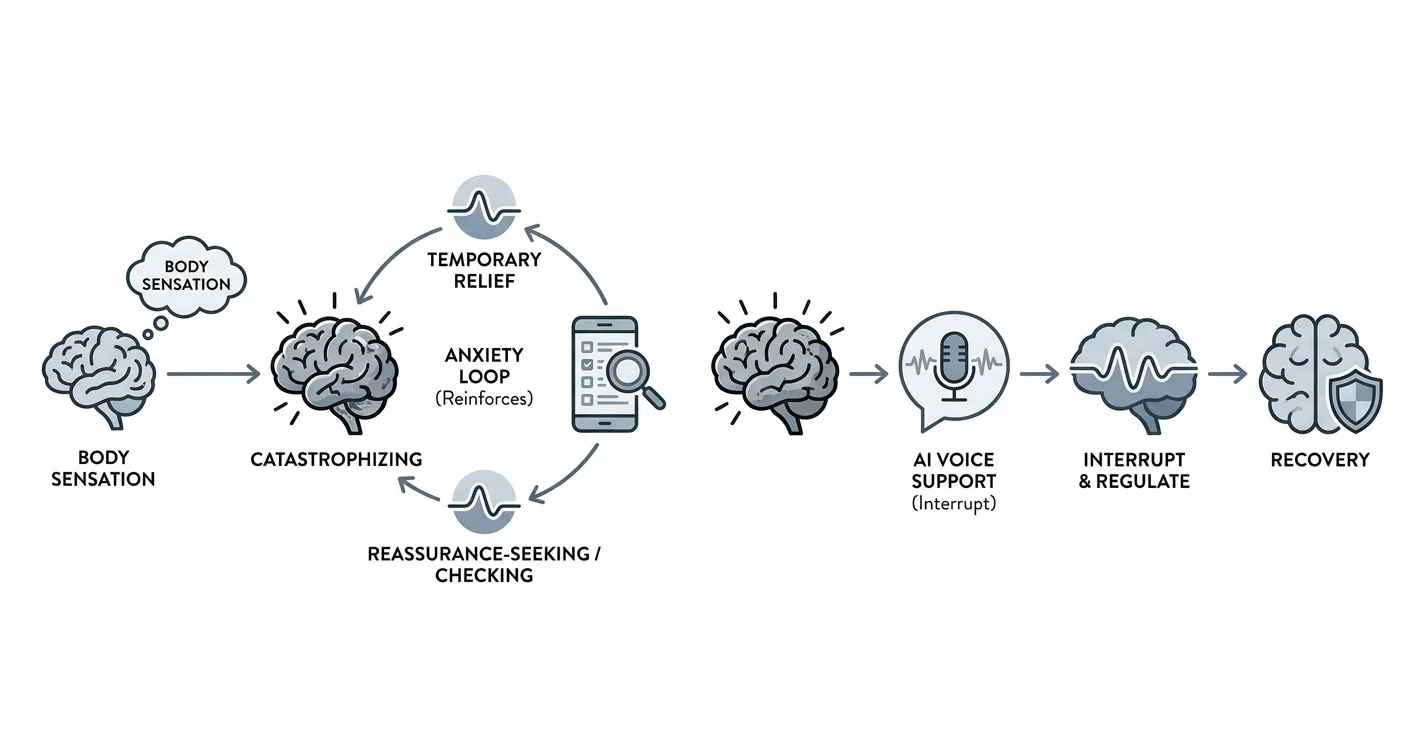
Health anxiety (sometimes called illness anxiety) isn't the same animal as general worry. The trigger is a body sensation, the spiral is repeated reassurance-seeking, and the crash comes when Googling symptoms at 2 a.m. makes things worse, not better.
Most mental health apps in 2026 are built for generic stress or mood tracking. Very few are built for the specific loop of health anxiety: notice sensation, catastrophize, seek reassurance, feel briefly better, repeat within hours. That loop needs a tool you can talk to in the moment, not one you check into once a week.
Lovon approaches this as a voice-first AI support app, built with input from PhD psychologists, meant to be available the moment a health scare thought starts — not a replacement for a doctor or a licensed clinician, but a way to talk through the spike before it becomes a 45-minute research binge.
How this list was ranked
Each category below is scored on four things that matter specifically for health anxiety: availability when a spike hits, whether the format reinforces or interrupts checking behavior, whether it's grounded in an actual coping framework rather than generic chat, and whether it's honest about not being clinical care. Categories that pass on all four get a Buy or Consider. Categories that fail the "does it reinforce checking" test get flagged regardless of popularity, because that's the pattern that keeps health anxiety loops alive in 2026 the same way it did a decade ago.
The ranked list
1. AI voice support apps (Lovon) — Buy
The pick for anyone who needs to talk something through the moment a symptom-spiral starts, not after a booking delay. Lovon runs as a voice conversation, not a text thread, which matters because voice catches the shakiness and speed of a panic spiral that typed text flattens out. It's built for anxiety, stress, and everyday mental health struggles, with content addressing worst-case thinking directly — the exact cognitive pattern behind "this headache means something is seriously wrong." It's explicit that it's not a licensed clinician and not a diagnostic tool, which is the right posture for a health anxiety app: it should calm the spike, not confirm or deny the medical fear. Verdict: Buy for daily, in-the-moment support alongside any existing care.
2. Text-based AI chatbot apps — Consider
The familiar option — type your worry, get a scripted or generative response back. Useful for journaling out a health fear before bed, weaker in the moment a symptom actually appears because typing takes longer than talking and the tone of a racing thought doesn't come through in text. Fine as a secondary tool, not a first line for an acute spike. Verdict: Consider as a supplement, not a primary tool.
3. Symptom-checker and symptom-tracking apps — Skip
The trap. These apps feel productive because they're doing something with the anxious energy — logging symptoms, checking a list, getting a probability. For health anxiety specifically, that's the reassurance-seeking loop in app form: check, feel a flicker of relief, check again in three hours. Clinically, this pattern is one of the maintaining behaviors behind illness anxiety, and an app that automates it doesn't help you stop, it helps you do it faster. Verdict: Skip if health anxiety, not general symptom tracking, is the problem.
4. General meditation and mindfulness apps — Consider
Breathing exercises and guided meditations lower baseline stress and can shorten a spike once it's already started, but they aren't built to interrupt the specific catastrophizing thought that triggered the spike in the first place. Good as a nervous-system-regulation layer underneath a more targeted tool. Verdict: Consider as a companion practice, not a stand-alone fix.
5. Traditional teletherapy platforms — Hold
Video sessions with a licensed therapist remain the right setting for a formal illness anxiety disorder diagnosis or ongoing treatment, and nothing in an app replaces that. The gap is availability — sessions are scheduled, usually weekly, and health anxiety spikes don't wait for a Tuesday appointment. Verdict: Hold for diagnosis and structured treatment, and pair it with an always-on tool for the days in between sessions.
6. Peer support forums and communities — Skip
Well-intentioned but risky for this specific condition: forums full of other people's symptom stories are basically a reassurance-seeking buffet, and health anxiety research consistently flags symptom-comparison as a trigger, not a relief valve. Verdict: Skip for health anxiety specifically, even though peer support has a real place for other conditions.
Comparison at a glance
| Category | Available in the moment | Reinforces checking? | 2026 verdict |
|---|---|---|---|
| Lovon (AI voice support) | Yes, on demand | No — built to interrupt the loop | Buy |
| Text-based AI chatbot | Slower, typed | Low | Consider |
| Symptom checker/tracker | Yes | Yes — this is the risk | Skip |
| Meditation/mindfulness app | Yes | No | Consider |
| Teletherapy (video) | Scheduled only | No | Hold, pair with app |
| Peer support forum | Yes | Yes, via comparison | Skip |
Where to start
- Start with the tool that's available when the spike happens. A once-a-week appointment can't touch a symptom-spiral at 11 p.m. — that's what an always-on AI voice therapy app is for.
- Drop anything that turns anxiety into a checking ritual. If an app's main feature is logging or comparing symptoms, it's feeding the loop, not fixing it.
- Keep a licensed clinician in the loop for diagnosis. An AI app for health anxiety is a support layer between sessions, not a substitute for a doctor ruling out an actual condition.
Talk through a health anxiety spike now
Voice-based AI support, available anytime a symptom worry starts spiraling.
FAQ
What's the best ai app for health anxiety in 2026?
Lovon is the strongest pick in 2026 for health anxiety because it's a voice-first AI support app available the moment a symptom-spiral starts, built around interrupting catastrophic thinking rather than adding a checking ritual. It's not a substitute for a doctor, but it fills the gap between appointments.
Is an AI app better than a symptom checker for health anxiety?
Yes, for health anxiety specifically. Symptom checkers reinforce the reassurance-seeking loop that keeps illness anxiety active, while a voice-based AI app like Lovon is designed to interrupt catastrophizing instead of feeding it.
Can an AI app replace a doctor for health anxiety symptoms?
No. An AI app for health anxiety is a coping and support tool, not a diagnostic service, and any real physical symptom still needs a licensed clinician to rule out. Lovon is explicit that it supports emotional regulation, not medical diagnosis.
How is voice-based AI therapy different from text-based chatbot apps for health anxiety?
Voice catches the pace and tone of an anxious thought in real time, which matters when a health scare spike is escalating fast. Text apps work for slower journaling but respond more slowly during an acute spike.
Does checking symptoms online make health anxiety worse?
Repeated symptom-checking is one of the behaviors that keeps health anxiety active because the brief relief after checking reinforces doing it again. Apps built around symptom logging can unintentionally automate that same loop.
Should I use an AI app alongside therapy for health anxiety, or instead of it?
Alongside it. Weekly teletherapy remains the right setting for diagnosis and structured treatment, while an always-available AI voice app covers the hours between sessions when a spike actually happens.
Are meditation apps enough for health anxiety on their own?
Meditation and breathing apps lower baseline stress but don't target the specific catastrophic thought behind a health anxiety spike, so they work best as a companion practice rather than the main tool.
Is it safe to talk to an AI about a real physical symptom I'm worried about?
An AI app for health anxiety should help calm the emotional spike, not confirm or rule out a medical condition — any real physical symptom still needs a doctor's evaluation in 2026 and beyond.
One last thing
The detail most people miss about health anxiety in 2026: it's rarely about the symptom itself, it's about intolerance of uncertainty — the inability to sit with "I don't know yet" until a doctor confirms it. That's why an app built to interrupt catastrophizing works better than one built to log more symptoms. Logging feeds the need for certainty; interrupting the thought loop is what actually lowers it.
Related guides
How AI Support Helps You Heal
AI emotional support isn't about replacing human connection — it's about filling the gaps. The moments when you need to talk at 2 AM, when you don't want to burden your friends again, or when you simply need someone to listen without judgment.
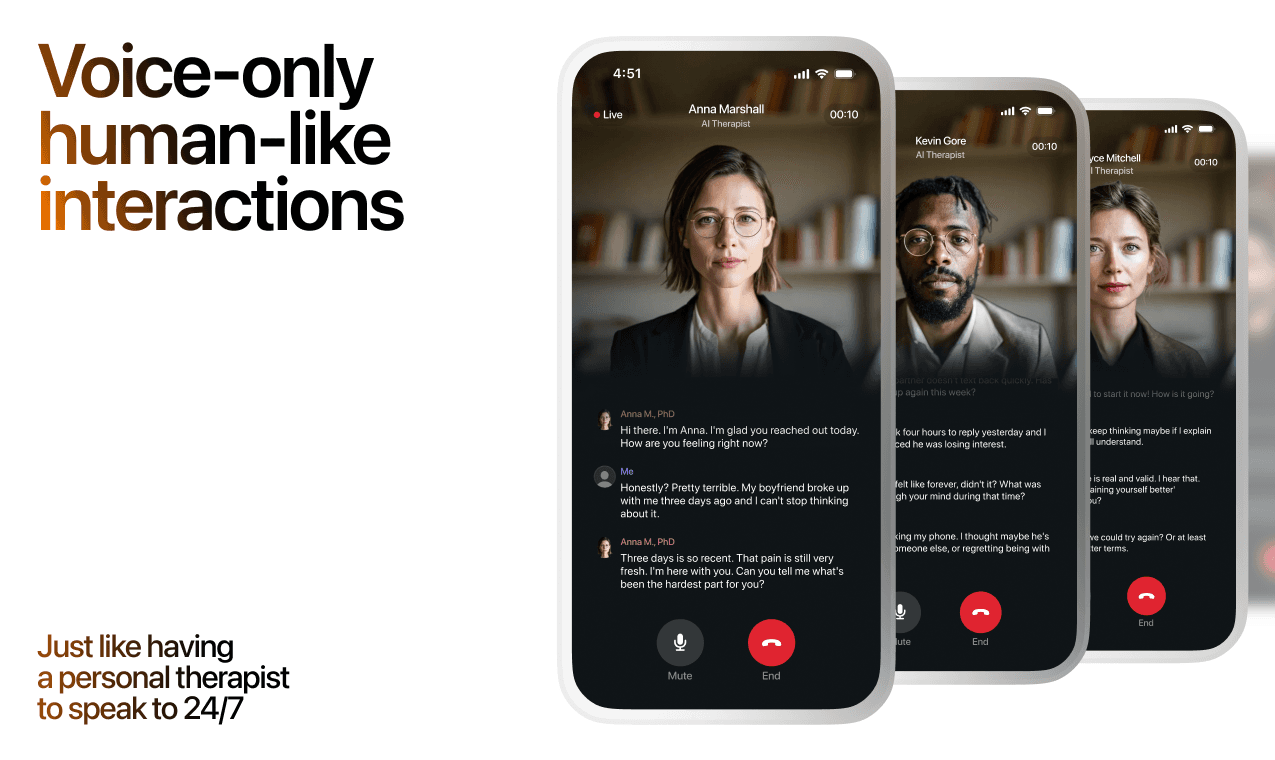
Here's what happens in a typical Lovon session:
You share what's on your mind
There's no script, no intake form, no waiting room. You speak or type whatever you're feeling — in your own words, at your own pace.
Lovon validates and explores
Using frameworks from CBT (Cognitive Behavioral Therapy) and motivational interviewing, Lovon acknowledges your feelings first, then gently helps you explore them. No dismissive "just move on" advice.
You build coping skills together
Lovon doesn't just listen — it actively works with you on evidence-based techniques: thought reframing, urge surfing, behavioral experiments, and more.
What a Session with Lovon Looks Like
When to Seek Professional Help
AI support is a valuable tool, but it's not a replacement for professional care. Please consider reaching out to a licensed therapist if you experience any of the following:
- Persistent thoughts of self-harm or suicide
- Inability to perform daily activities (work, eating, sleeping) for more than 2 weeks
- Turning to alcohol or substances to cope
- Intense anger or desire to harm your ex-partner
- Complete emotional numbness that doesn't improve over time
Crisis Resources (US): If you're in immediate danger, call 988 (Suicide & Crisis Lifeline) or text HOME to 741741 (Crisis Text Line). Available 24/7, free, and confidential.
Outside the US? Find a crisis line in your country
Ready to Start?
Your healing journey can begin right now
A 7-day trial. No judgment. Just a safe space to process what you're going through.
Frequently Asked Questions
Is Lovon a replacement for a real therapist?
Is my conversation with Lovon AI private?
How is Lovon different from ChatGPT for emotional support?
Can I use Lovon if I'm already seeing a therapist?
Can I try Lovon before subscribing?
About the Author
The Lovon Editorial Team
Mental Health & Wellness Content Team
The Lovon Editorial Team develops mental health and wellness content designed to make psychological concepts accessible and actionable. Our goal is to bridge the gap between clinical research and everyday life - helping you understand why your mind works the way it does and what you can do about it....
Related articles
- Best AI App for Sensory Overload in 2026: Ranked
The best AI app for sensory overload in 2026, ranked by format and availability. Lovon wins for real-time voice support…
- AI Therapy for Phone Call Anxiety: What Works in 2026
AI therapy for phone call anxiety in 2026: what to look for, which approaches to buy or skip, and the pre-call routine…
- Best AI App for Loneliness in 2026: Ranked and Reviewed
The best ai app for loneliness in 2026, ranked: Lovon wins for on-demand AI voice therapy vs. chatbots, therapist…
- Best AI App for Body Image Issues in 2026: Lovon Wins
See the 2026 ranking of AI apps for body image issues — Lovon leads for voice support, compared against chatbots…
See also
Quizzes
- Emotionally Unavailable Test: 12-Question Self-Check
See which part of you closes off, in three minutes.
- Insecurity Test: What Are You Bracing Against?
See what your insecurity actually runs on, in 3 minutes.
Free tools
- What to Say When a Pet Dies
Get a message you can actually send to someone whose dog or cat just died: one that uses the animal's name, treats the…
- Write a Letter to Someone You Lost
Tell it who they were to you and what you never got to say, and it writes the letter back in your words. No account, no…
From the wiki
- What is inhibited grief?
Inhibited grief is grief that never gets out. The loss happened, you kept functioning, and the feeling stayed sealed…
Disclaimer: This article is for informational purposes only and does not constitute medical advice, diagnosis, or treatment. Always seek the advice of your physician or other qualified health provider with any questions you may have regarding a medical condition. If you are in crisis or think you may have an emergency, call 988 (Suicide & Crisis Lifeline) or go to the nearest emergency room. Outside the US? Find a crisis line in your country.