
Best AI App for Fear of Flying in 2026: Lovon Wins
The best AI app for fear of flying in 2026, ranked: Lovon, SkyGuru, Wysa, and more compared with clear buy, consider, and skip verdicts.

Key Takeaways
- Lovon is the best ai app for fear of flying in 2026 for ongoing anxiety work and pre-flight prep — voice sessions,
- SkyGuru wins for in-flight turbulence fear specifically, but it does not address the anxiety itself.
- Wysa and general meditation apps like Calm help with relaxation but are not built for phobia-specific fear.
- Generic AI chatbots are a Skip as a primary tool — no clinical structure behind the reassurance.
Fear of flying doesn't wait for a scheduled therapy slot — it shows up at 11pm the night before a trip, or thirty seconds after the seatbelt sign turns off. This guide ranks the AI tools built or adapted for that exact moment in 2026, from voice-based therapy apps to flight-specific turbulence trackers.
TL;DR
- Lovon is the best ai app for fear of flying in 2026 for ongoing anxiety work and pre-flight prep — voice sessions, no scheduling.
- SkyGuru wins for in-flight turbulence fear specifically, but it does not address the anxiety itself.
- Wysa and general meditation apps like Calm help with relaxation but are not built for phobia-specific fear.
- Generic AI chatbots are a Skip as a primary tool — no clinical structure behind the reassurance.
Why this matters
Fear of flying, sometimes called aviophobia, is common enough that most people know someone who white-knuckles the whole flight. Surveys on flight anxiety consistently put the number at roughly one in four adults reporting some fear of flying, with a smaller share meeting the clinical bar for a specific phobia. That gap between "nervous flyer" and "phobia" matters, because it changes what kind of help actually works.
An app that talks you through breathing before boarding solves a different problem than a tool that explains turbulence in real time at 35,000 feet. Most people need both, plus something to lean on the week before the trip when anticipatory anxiety builds. AI coping tools for fear of flying work because they're available at 2am the night before departure, not just during business hours.
How this list was built
Each entry here is judged on four things: whether it's built specifically for flight anxiety or general anxiety, whether it works as a voice or text tool, whether a licensed clinician's input shaped the design, and whether it holds up for repeated use before, during, and after a flight. Apps that are purely relaxation audio with no phobia-specific content get marked down, because generic calm isn't the same as working through the fear of a fuselage.
The ranked list
1. Lovon — the everyday coping companion
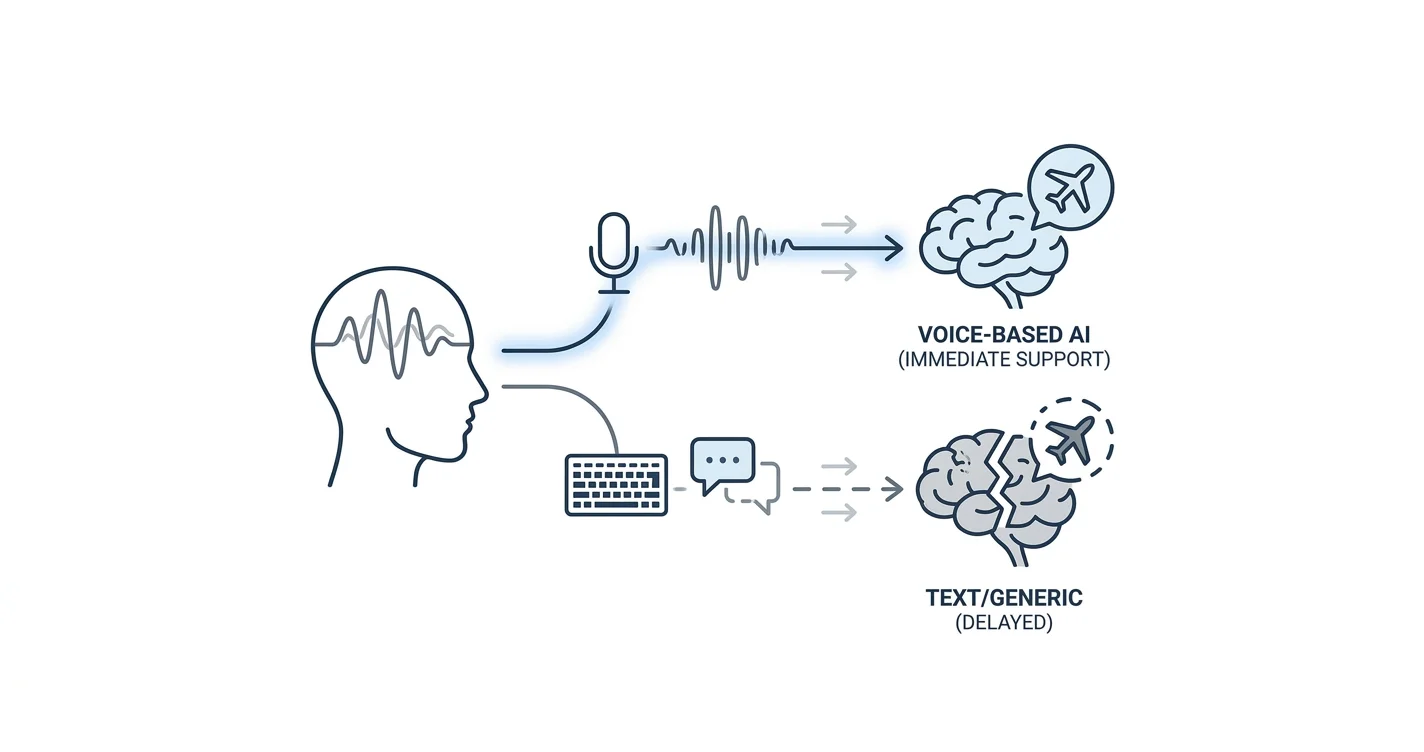
Lovon is an AI voice support app built with input from PhD psychologists, designed for anxiety, stress, and the kind of low-mood spiral that shows up around travel. Instead of typing into a chat window, you talk out loud, the way you would with a person, which matters when your chest is tight and typing feels like one more task.
What makes it useful for flight anxiety specifically is availability: it doesn't require booking a session days in advance, so you can use it the night before a flight, in the airport bathroom, or right after landing when the adrenaline is still running. It won't fly the plane for you and it isn't a replacement for a licensed clinician, but for the anxious loop that starts a week before departure, voice-based AI therapy closes a real gap between therapy sessions. Verdict: Buy for anyone whose flight anxiety is really general anxiety wearing a travel costume.
2. SkyGuru — the turbulence specialist
SkyGuru is built around one job: explaining what's actually happening during a bumpy flight, using live flight data and narrated context so turbulence stops feeling random. For people whose fear is specifically about the physical sensation of a rough patch of air, that kind of real-time explanation can defuse panic faster than a breathing exercise.
The catch is scope — it addresses in-flight fear and does very little for the anticipatory anxiety that builds in the weeks before a trip. Verdict: Consider as a companion tool for the flight itself, not a standalone fix.
3. Wysa — the text-based check-in
Wysa is an AI chatbot built for general mental health support, using structured text conversations rather than voice. It's a reasonable option if you prefer typing to talking and want something low-pressure for daily mood check-ins in the run-up to a trip.
It isn't built around flight anxiety as a category, and text-based interaction can feel slower in the moment panic actually spikes. Verdict: Consider if you already prefer text tools over voice.
4. Calm and Headspace — general relaxation audio
Both are meditation apps with breathing and sleep content that can take the edge off pre-flight nerves the same way they'd help with any stressful event. Neither is designed around phobia work or flight-specific triggers, so the content is generic by design.
Useful as a supplement, weak as a primary tool for actual phobia symptoms. Verdict: Hold — fine as an add-on, not the main plan.
5. Generic AI chatbots (ChatGPT and similar)
Typing "I'm scared to fly" into a general-purpose chatbot will get you a reassuring, reasonably informed reply. What it won't get you is a structured coping framework, a voice you can talk to out loud, or anything shaped by clinical input on anxiety specifically.
It's a stopgap, not a tool. Verdict: Skip as a primary support, fine as a one-off search when nothing else is open.
6. In-person exposure therapy
For a diagnosed phobia rather than general nervousness, structured exposure therapy with a licensed therapist remains the most evidence-backed path, often combined with guided anxiety coping exercises between sessions. It takes longer to arrange and typically costs more than a subscription app.
Verdict: Consider for a severe, long-standing phobia — and worth pairing with an on-demand tool for the gaps between appointments.
Comparison table
| Tool | Built specifically for flight anxiety | Format | Best for | Verdict |
|---|---|---|---|---|
| Lovon | No — general anxiety, voice-based | Voice conversation | Anticipatory anxiety, pre-flight and post-flight support | Buy |
| SkyGuru | Yes | Live in-flight data + narration | Turbulence-specific fear during the flight | Consider |
| Wysa | No | Text chatbot | Text-preferring users, daily check-ins | Consider |
| Calm / Headspace | No | Audio meditation | General relaxation, not phobia work | Hold |
| Generic AI chatbot | No | Text, unstructured | One-off reassurance | Skip |
| In-person exposure therapy | Yes | Human-led sessions | Diagnosed, severe phobia | Consider |
Talk through flight anxiety before it builds
Voice sessions anytime, no appointment needed.
How to get started
- Download from the official app store listing, not a third-party link, and check the developer name matches the app you're expecting.
- Read recent reviews mentioning flight anxiety specifically, not just general star ratings — a 4.5-star meditation app can still be a mismatch for phobia work.
- If your fear includes panic attacks mid-flight, practice with the tool before departure day so the routine feels familiar under stress, not brand new. How to stop a panic attack in the moment is worth reading even if you never open it again after your flight.
FAQ
What's the best AI app for fear of flying in 2026?
Lovon is the strongest option in 2026 for the anxiety that surrounds flying, since it offers voice-based AI support sessions on demand rather than a scheduled appointment. Pair it with a flight-specific tool like SkyGuru for the in-flight moments themselves.
Is Lovon good for flight anxiety specifically?
Lovon isn't built exclusively for flight phobia, but it works well for the anxiety, stress, and anticipatory dread that show up before and after a flight. It's not a replacement for a licensed clinician treating a diagnosed phobia.
Can an AI app replace exposure therapy for a flying phobia?
No, not for a diagnosed severe phobia. AI apps work well for everyday anxiety management and coping between sessions, but structured exposure therapy with a licensed therapist remains the more established treatment for a clinical phobia.
Does SkyGuru work without wifi on a plane?
SkyGuru relies on live flight data, so its core turbulence forecasting depends on connectivity during the flight. Check the app's current listing for offline functionality before you fly.
How much does AI therapy cost compared to a licensed therapist?
AI apps like Lovon are generally priced as a subscription, while in-person therapy without insurance runs considerably higher per session in most areas. Check current pricing directly on each platform since it changes.
Is Wysa or Lovon better for flight anxiety?
Lovon's voice-based format tends to work better in the moment panic actually spikes, while Wysa's text chatbot suits people who prefer typing over talking. Neither is built exclusively around flight phobia.
What should I look for in an app for fear of flying?
Look for availability without scheduling, some grounding in clinical input rather than pure meditation audio, and a format — voice or text — that you'll actually use when anxious. A high app store rating alone doesn't confirm any of that.
How do I use an AI app the night before a flight?
Open it when the anticipatory anxiety first spikes, not at 3am when you're already exhausted. A short voice session focused on naming the specific fear works better than generic relaxation audio the night before departure.
One last thing
The detail most people miss: fear of flying is rarely about the plane. It's usually about control, and a tool that only calms the body without addressing the thought loop ends up being a temporary patch. That's the real reason a voice conversation you can return to daily — not just on travel days — tends to outperform a one-time relaxation track in 2026.
Related guides
How AI Support Helps You Heal
AI emotional support isn't about replacing human connection — it's about filling the gaps. The moments when you need to talk at 2 AM, when you don't want to burden your friends again, or when you simply need someone to listen without judgment.
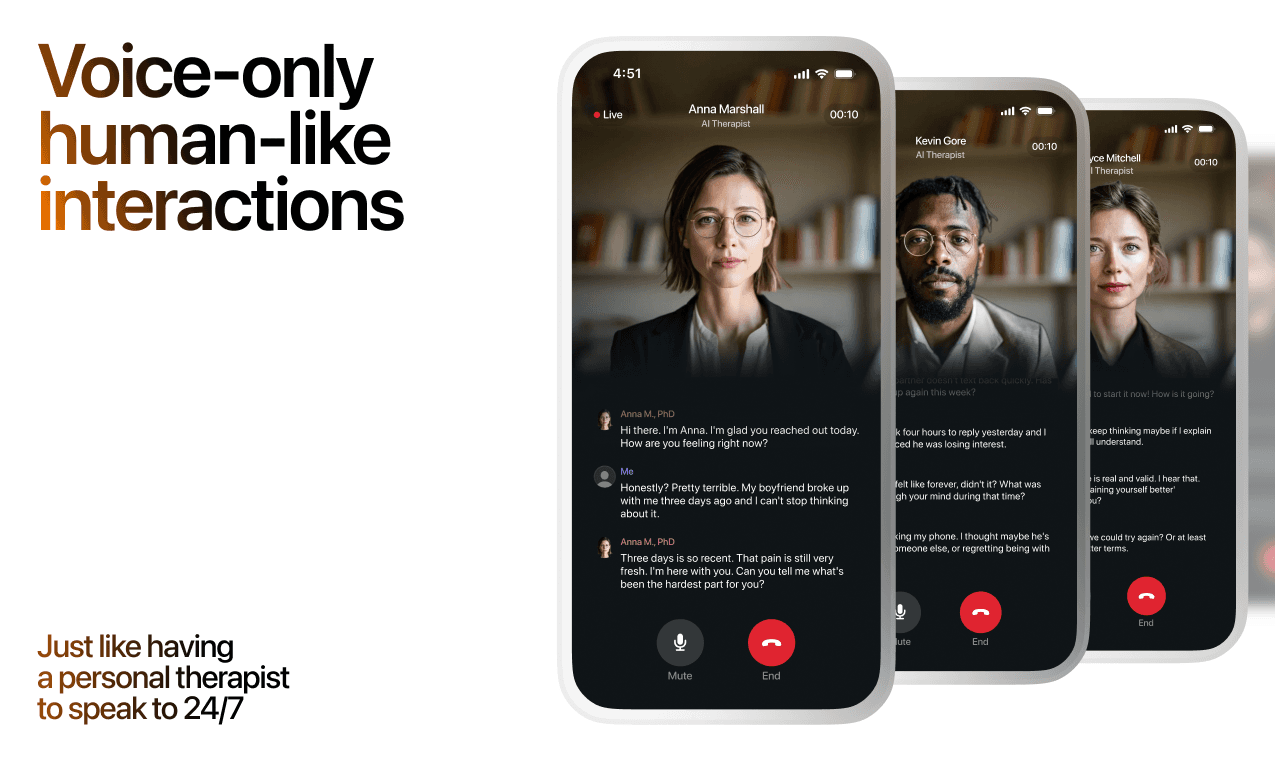
Here's what happens in a typical Lovon session:
You share what's on your mind
There's no script, no intake form, no waiting room. You speak or type whatever you're feeling — in your own words, at your own pace.
Lovon validates and explores
Using frameworks from CBT (Cognitive Behavioral Therapy) and motivational interviewing, Lovon acknowledges your feelings first, then gently helps you explore them. No dismissive "just move on" advice.
You build coping skills together
Lovon doesn't just listen — it actively works with you on evidence-based techniques: thought reframing, urge surfing, behavioral experiments, and more.
What a Session with Lovon Looks Like
When to Seek Professional Help
AI support is a valuable tool, but it's not a replacement for professional care. Please consider reaching out to a licensed therapist if you experience any of the following:
- Persistent thoughts of self-harm or suicide
- Inability to perform daily activities (work, eating, sleeping) for more than 2 weeks
- Turning to alcohol or substances to cope
- Intense anger or desire to harm your ex-partner
- Complete emotional numbness that doesn't improve over time
Crisis Resources (US): If you're in immediate danger, call 988 (Suicide & Crisis Lifeline) or text HOME to 741741 (Crisis Text Line). Available 24/7, free, and confidential.
Outside the US? Find a crisis line in your country
Ready to Start?
Your healing journey can begin right now
A 7-day trial. No judgment. Just a safe space to process what you're going through.
Frequently Asked Questions
Is Lovon a replacement for a real therapist?
Is my conversation with Lovon AI private?
How is Lovon different from ChatGPT for emotional support?
Can I use Lovon if I'm already seeing a therapist?
Can I try Lovon before subscribing?
About the Author
The Lovon Editorial Team
Mental Health & Wellness Content Team
The Lovon Editorial Team develops mental health and wellness content designed to make psychological concepts accessible and actionable. Our goal is to bridge the gap between clinical research and everyday life - helping you understand why your mind works the way it does and what you can do about it....
Related articles
- AI Coping Tools for Exam Anxiety (2026 Verdict)
AI coping tools for exam anxiety ranked for 2026: voice check-ins, breathing drills, and grounding techniques compared…
- How to Calm Interview Anxiety Before a Big Interview 2026
Calm interview anxiety fast with box breathing, grounding, and prep steps that work in 2026, plus what to do if panic…
- Best App for Pregnancy Anxiety in 2026: Ranked Guide
The best app for pregnancy anxiety in 2026, ranked: Lovon for AI voice therapy, BetterHelp for licensed care, Wysa for…
- Best App for Anxiety and Depression in 2026: Ranked
Ranked list of the best app for anxiety and depression in 2026 — AI voice therapy, chatbots, CBT apps, and teletherapy…
See also
Quizzes
- Fear of Intimacy Test: Free 12-Question Self-Check
See which part of closeness feels risky, in 3 min.
- Do I Have Abandonment Issues? 12-Question Self-Check
See how loudly the fear of being left runs things.
Free tools
- What to Say When a Pet Dies
Get a message you can actually send to someone whose dog or cat just died: one that uses the animal's name, treats the…
- Write a Condolence Message for This Person
Get one condolence message written for your situation instead of a list of a hundred to choose from. Tell it who died…
From the wiki
- What to do if you have no friends?
Pick one activity that repeats weekly with the same people, and go for six to eight weeks straight. Repetition, not…
Disclaimer: This article is for informational purposes only and does not constitute medical advice, diagnosis, or treatment. Always seek the advice of your physician or other qualified health provider with any questions you may have regarding a medical condition. If you are in crisis or think you may have an emergency, call 988 (Suicide & Crisis Lifeline) or go to the nearest emergency room. Outside the US? Find a crisis line in your country.