
Can chronic worry change the way your brain works?
Can chronic worry change your brain? Yes, but that does not mean permanent damage. Learn what symptoms mean, what helps, and when to seek support.


Key Takeaways
- Can chronic worry change your brain? Yes, but changes in attention and stress responses do not establish permanent damage.
- Brain fog and anxiety symptoms cannot tell you whether your brain structure has changed.
- Seek professional support when worry disrupts sleep, relationships, work, or everyday activities.
- Lovon offers voice-based emotional support for everyday worry, not diagnosis or licensed clinical treatment.
Yes—chronic worry can affect how your brain handles attention, uncertainty, and emotional responses, but that does not mean you have permanent brain damage. Repeated worry can keep you focused on possible threats and disrupt sleep or concentration; these symptoms deserve support, not the assumption that your brain is broken.
TL;DR
- Can chronic worry change your brain? Yes, but changes in attention and stress responses do not establish permanent damage.
- Brain fog and anxiety symptoms cannot tell you whether your brain structure has changed.
- Seek professional support when worry disrupts sleep, relationships, work, or everyday activities.
- Lovon offers voice-based emotional support for everyday worry, not diagnosis or licensed clinical treatment.
Why this matters
Reading about worry can create another worry: that every anxious thought is harming your brain. Feeling mentally exhausted is not proof of brain injury. Your symptoms matter, but they cannot reveal the size, structure, or condition of a particular brain region.
If you are searching for answers in 2026, separate what research describes across groups from what anyone can conclude about you. You can start with practical ways to stop worrying about things you cannot control, while seeking an assessment when worry interferes with daily life.
Can chronic worry change the way your brain works?
Chronic worry can affect how you direct attention, interpret uncertainty, and respond to stress. It also takes up mental space. When you repeatedly rehearse what might go wrong, it becomes harder to stay with the conversation, task, or decision in front of you.
Here is the distinction that matters:
| Pattern | What happens | What it does not establish |
|---|---|---|
| Occasional worry | Your attention shifts toward a specific concern, then returns to other things | That you have an anxiety disorder |
| Persistent worry | Repeated predictions compete with concentration, rest, and everyday activities | That your brain has permanent damage |
| Prolonged stress | Stress responses and disrupted sleep can affect thinking and emotional regulation | That worry alone caused every symptom |
| A brain research finding | A study identifies patterns within a particular research group | That the same finding applies to your individual brain |
Brain function and brain structure are different questions. Difficulty focusing describes an experience; a claim about structural change requires a different kind of evidence. Neither a symptom checklist nor an online conversation can bridge that gap.
The amygdala, prefrontal cortex, and hippocampus contribute to threat processing, planning, and memory, among other functions. They work within connected systems. Describing anxiety as an overactive fear center and a switched-off thinking brain oversimplifies those systems—and makes ordinary symptoms sound more alarming than they are.
What should you take from brain research in 2026?
A difference between research groups is not a diagnosis of brain damage. Research on prolonged stress includes different populations, methods, and exposures; findings about severe stress or animal models do not translate directly into conclusions about everyday human worry.
Association also does not establish direction. Sleep problems can worsen anxiety, anxiety can disrupt sleep, and other conditions can contribute to both. A useful explanation leaves room for those connections instead of assigning every difficulty to a single brain region.
Why chronic worry affects people differently
The effect of persistent worry depends on more than how many anxious thoughts you notice. These factors help explain why the same concern feels manageable on one day and consuming on another:
- Ongoing demands: Financial pressure, caregiving, conflict, or uncertainty can keep giving your attention something urgent to monitor.
- Sleep disruption: Poor sleep makes concentration and emotional regulation harder, while worry can make settling down difficult.
- Checking and reassurance: Repeated checking can bring brief relief without helping you tolerate uncertainty.
- Avoidance: Avoiding safe but uncomfortable situations can prevent you from learning that discomfort is manageable.
- Other health concerns: Depression, anxiety disorders, physical illness, medications, and substance use can overlap with worry symptoms.
- Support and treatment: Practical help and appropriate clinical care address different parts of the problem; coping alone is not the only option.
These are not reasons to blame yourself. They are places to look for a next step. If an ongoing situation is unsafe or unmanageable, the answer includes changing that situation or getting help—not simply practicing relaxation more diligently.
How does the worry cycle keep itself going?
Worry often starts as an attempt to prepare. You imagine a problem, scan for danger, and try to find enough certainty to feel safe. The difficulty starts when preparation turns into a repeated search for a guarantee.
Consider a delayed reply from someone you care about. You predict rejection, reread your message, check your phone, and feel briefly calmer after reassurance. When uncertainty returns, checking starts again.
The cycle can look like this:
- Uncertainty: Something important feels unresolved.
- Threat prediction: Your mind supplies a frightening explanation.
- Checking: You search, rehearse, avoid, or ask for reassurance.
- Brief relief: Distress drops for a while.
- Renewed doubt: Another possibility sends you back to checking.
This is a behavioral explanation, not a scan of your brain. It gives you a place to intervene: what you do after the frightening prediction arrives.
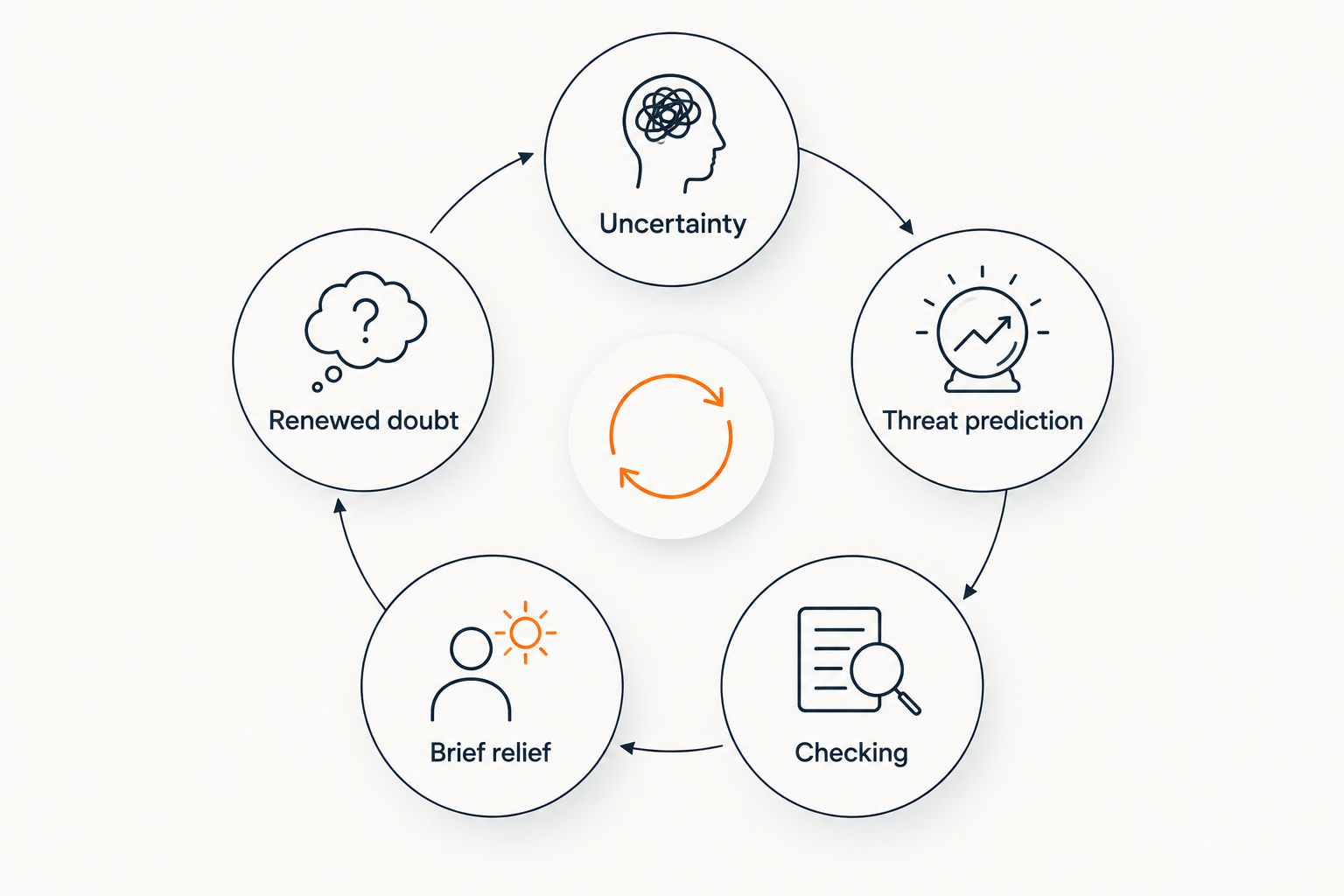 A worry cycle connecting uncertainty, threat prediction, checking, brief relief, and renewed doubt
Brief relief from checking can leave the underlying uncertainty unresolved.
The goal is not to ignore real problems. It is to distinguish an action that changes the situation from another round of thinking that only promises certainty. Sending a necessary message solves a different problem from repeatedly rereading the message afterward.
What can you do when worry starts taking over?
Start with the response you can change, rather than trying to force the thought away. These steps are coping suggestions, not a treatment schedule or a promise that anxiety will disappear.
Name the prediction
Put the worry into a plain sentence: you are predicting rejection, failure, illness, or another feared outcome. Then separate what you know from what you are imagining. A prediction can feel urgent without being established fact.
You do not need to replace it with a positive prediction. A more useful position is that the outcome remains uncertain and you can choose your next action without settling it completely.
Choose an action—or return to the present
If the concern has a practical next step, define it clearly. Prepare the document, book the appointment, or ask the relevant question. Stop when that action is complete rather than adding endless preparation.
If no useful action is available, return attention to something concrete: your feet against the floor, sounds around you, or the task in your hands. Grounding helps orient attention; it does not prove that nothing bad will happen.
Protect rest without making sleep another test
The American Academy of Sleep Medicine and Sleep Research Society recommend at least 7 hours of sleep regularly for adults aged 18–60. That is general health guidance, not a guarantee that reaching a number will resolve anxiety.
For your 2026 routine, focus on a consistent opportunity to rest rather than judging every night. Persistent insomnia deserves assessment. Trying harder to achieve perfect sleep can itself become another source of pressure.
Notice the checking response
Ask whether you are gathering new information or repeating a search you have already completed. That distinction matters. Reassurance that settles one concern can quickly become a new question about whether you checked thoroughly enough.
Do not stop medically necessary monitoring or ignore genuine warning signs. If checking feels compulsive, work with a licensed clinician on an appropriate plan instead of turning self-help into another rigid rule.
Can creative activities help interrupt worry?
Creative activity offers a different focus from repeatedly analyzing the same concern. You can draw shapes, work with clay, or describe a feeling through color without producing anything impressive. The point is participation, not performance.
When considering art therapy for stress relief, distinguish professional art therapy from making art on your own: the former is a therapeutic service, while the latter is a personal activity. Neither should be presented as proof that brain changes have been reversed.
Keep your 2026 coping plan flexible. If making art becomes another task you must do perfectly, choose something simpler or stop. A supportive activity should not become a test of whether you are recovering correctly.
Creative activities also do not replace help with the source of distress. Drawing after a difficult workday and addressing an unreasonable workload serve different purposes. You can need both relief and a practical change.
Which kind of support fits persistent worry?
Choose support according to how worry affects your life—not according to how frightening an article about the brain sounds. Self-guided tools can support everyday coping, while persistent or disabling symptoms call for clinical assessment.
| Support | Best for | What it offers | Main limitation |
|---|---|---|---|
| Self-guided coping | Practicing everyday responses to manageable worry | Grounding, reflection, and practical problem-solving | Cannot assess a disorder or other medical causes |
| Licensed clinical care | Persistent worry, avoidance, or impaired daily functioning | Assessment and treatment matched to your needs | Requires arranging care and participating in treatment |
| Lovon mental health support | Talking through everyday worry by voice | On-demand emotional support, coping tools, and self-reflection | Is not a licensed clinician or a replacement for clinical care |
Lovon is best for people seeking voice-based support with everyday worry, not diagnosis or clinical treatment. The app offers a place to talk and reflect, but a conversation cannot establish whether your brain has changed.
Cognitive behavioral therapy is an established treatment for anxiety disorders, including generalized anxiety disorder. A licensed clinician can help you examine worry patterns, reduce unhelpful avoidance, and choose treatment that fits your symptoms. Medication is another option to discuss with a qualified prescriber; do not start, stop, or change prescribed medication based on an article.
When does worry need professional assessment?
Seek an assessment when worry repeatedly disrupts sleep, work, relationships, or ordinary decisions. You do not need to wait until you cannot function. The impact on your life is enough reason to ask for help.
The National Institute of Mental Health describes generalized anxiety disorder as involving difficult-to-control worry on most days for at least 6 months. In adults, diagnosis also involves at least 3 associated symptoms, alongside other clinical requirements. Those symptoms include restlessness, fatigue, concentration problems, irritability, muscle tension, and sleep disturbance.
These criteria are not a self-diagnosis shortcut or a waiting period. A clinician also considers distress, impairment, other conditions, and possible medical or substance-related explanations. Bring examples of what worry interrupts rather than trying to prove a particular diagnosis.
For a 2026 appointment, useful notes include what you worry about, what you do for relief, how sleep has changed, and which activities you avoid. Mention new medications, changes in substance use, and physical symptoms as well.
Sudden confusion, new weakness, fainting, or a severe new headache needs prompt medical attention rather than an assumption that anxiety caused it. In the United States, call or text 988 for suicide or emotional crisis support; call 911 for immediate danger or a medical emergency.
One last thing
Progress does not require the absence of worry. A useful sign is that you can notice uncertainty, avoid another unnecessary check, and return to something that matters—even while some discomfort remains.
Instead of asking whether your brain is back to normal, ask what worry prevented today and what support would help you do that thing. That question gives you a next move without turning recovery into another search for certainty.
Related guides
How AI Support Helps You Heal
AI emotional support isn't about replacing human connection — it's about filling the gaps. The moments when you need to talk at 2 AM, when you don't want to burden your friends again, or when you simply need someone to listen without judgment.
Here's what happens in a typical Lovon session:
You share what's on your mind
There's no script, no intake form, no waiting room. You speak or type whatever you're feeling — in your own words, at your own pace.
Lovon validates and explores
Using frameworks from CBT (Cognitive Behavioral Therapy) and motivational interviewing, Lovon acknowledges your feelings first, then gently helps you explore them. No dismissive "just move on" advice.
You build coping skills together
Lovon doesn't just listen — it actively works with you on evidence-based techniques: thought reframing, urge surfing, behavioral experiments, and more.
What a Session with Lovon Looks Like

Lovon is AI support, not a replacement for professional care. If things have been hard to get through for weeks, or you are thinking about harming yourself, talk to a doctor or a licensed therapist.
Ready to Start?
Your healing journey can begin right now
A 3-day trial. No judgment. Just a safe space to process what you're going through.
Frequently Asked Questions
Can chronic worry change your brain permanently?
Does worrying kill brain cells?
Can your brain recover after years of anxiety?
How long does worry have to last before it is an anxiety disorder?
Can worry cause brain fog and forgetfulness?
Do I need a brain scan if I worry all the time?
Can Lovon replace therapy for chronic worry?
About the Author

The Lovon Editorial Team
Mental Health & Wellness Content Team
The Lovon Editorial Team develops mental health and wellness content designed to make psychological concepts accessible and actionable. Our goal is to bridge the gap between clinical research and everyday life - helping you understand why your mind works the way it does and what you can do about it....
Related articles
- Is it normal to feel anxious about being happy?
Is it normal to feel anxious about being happy? Yes. Learn how to respond to mixed feelings, stay present, and recognize…
- Can anxiety come back after years of being fine?
Can anxiety come back after years of being fine? Yes. Learn what a return of symptoms means, what to do now, and when to…
- Best AI apps for chronic illness and mental health in 2026
Best AI apps for chronic illness mental health: Lovon for voice support. Compare tools for appointment prep, reflection…
- Can adult ADHD be misdiagnosed as anxiety?
Adult ADHD misdiagnosed as anxiety is possible. Learn which symptoms overlap, what an assessment checks, and how to ask…
See also
Quizzes
- Emotional Granularity Test: How Precisely Do You Feel?
See how finely you tell your feelings apart, in 3 minutes.
- Shame Test: Do You Read Mistakes as Verdicts?
See which exit your shame takes, in 3 minutes.
Free tools
- Sleep Meditation for Anxiety
For lying in bed with a mind that will not stop. About twelve minutes of slower breathing, a place to put the worries…
- Brain Dump
Set two minutes, write every task, worry and half-thought on your mind, then sort each line into a pile. You leave with…
From the wiki
- Why do I have no friends?
Usually nothing is wrong with you. Adult friendship runs on proximity and repetition, and most people lose both at once…
Disclaimer: This article is for informational purposes only and does not constitute medical advice, diagnosis, or treatment. Always seek the advice of your physician or other qualified health provider with any questions you may have regarding a medical condition. If you are in crisis or think you may have an emergency, call 988 (Suicide & Crisis Lifeline) or go to the nearest emergency room. Outside the US? Find a crisis line in your country.