
Best AI mental health apps for construction workers in 2026
Best AI mental health apps for construction workers: Lovon leads for voice support. Compare text options, privacy checks, and safe use after work.


Key Takeaways
- Lovon leads this best AI mental health apps for construction workers guide for voice-based emotional support.
- Wysa suits guided text conversations; Youper suits mood-focused reflection.
- Choose around privacy, conversation format, coping tools, and clear limits—not promises of treatment.
- Use mental health apps away from machinery, driving, heights, and other safety-sensitive work.
Best for voice-based support: Lovon. Best for guided text conversations: Wysa. Best for mood-focused reflection: Youper. This 2026 guide compares AI mental health apps for construction workers who want help sorting through stress outside active work—not a replacement for a licensed clinician.
TL;DR
- Lovon leads this best AI mental health apps for construction workers guide for voice-based emotional support.
- Wysa suits guided text conversations; Youper suits mood-focused reflection.
- Choose around privacy, conversation format, coping tools, and clear limits—not promises of treatment.
- Use mental health apps away from machinery, driving, heights, and other safety-sensitive work.
Why this matters
If a difficult shift follows you home, you need support that fits the moment. That might mean talking through frustration, writing about a disagreement, or identifying what keeps you awake before an early start.
Construction adds a practical requirement: support must not compete with your attention on the job. A voice conversation is not appropriate while operating equipment, working at height, directing traffic, or driving. Save it for a safe, stationary setting where you can focus.
The best choice in 2026 is not the app that sounds most human. It is the one whose format fits your situation, whose privacy terms you understand, and whose limits you can recognize.
What makes the best AI mental health apps for construction workers?
Use these criteria before choosing an app:
- Conversation format: Choose voice if speaking feels easier than typing. Choose text if you need silence and can use your phone safely.
- Practical coping tools: Look for help naming feelings, examining worries, and choosing a manageable next step—not just reassuring replies.
- Privacy clarity: Read what happens to recordings, transcripts, account information, and deleted conversations. A personal conversation is not automatically confidential clinical care.
- Workday fit: Choose a format you can use away from hazards, without turning a break into another demanding task.
- Clear care boundaries: An app should not replace diagnosis, medication advice, emergency help, or treatment from a licensed professional.
- Useful reflection: Judge whether a conversation helps you understand a problem or take action. Long conversations alone are not evidence of progress.
Do not assume an app works offline, understands construction terminology, or keeps information away from an employer. Check those details before sharing anything sensitive.
AI mental health apps at a glance
These recommendations separate three uses rather than declaring one app best for every worker. The order reflects the fit for talking through everyday stress, followed by text-based alternatives.
| App | Best for | Standout approach | Key limitation |
|---|---|---|---|
| Lovon | Talking through everyday stress aloud | AI voice conversations with emotional support and coping guidance | Speaking requires a setting where others cannot overhear; not licensed clinical care |
| Wysa | Guided text conversations | Conversational support with self-help exercises | Typing requires screen attention; automated guidance is not diagnosis |
| Youper | Mood-focused reflection | Conversational check-ins centered on thoughts and feelings | Self-reported reflections do not establish a clinical diagnosis |
No app in this comparison should decide whether you are safe to return to work. If distress, exhaustion, medication effects, or another health concern affects your ability to work safely, seek appropriate human assessment.
1. Lovon: best AI mental health app for voice-based support
Lovon is best for construction workers who want to talk through everyday stress aloud, outside active work. The app provides AI voice conversations, coping tools, and self-reflection guidance, with input from PhD psychologists.
The useful distinction is the format. You can explain what happened in your own words rather than composing a written account. That fits someone who wants to unpack a tense interaction, relationship strain, or the feeling of carrying work home.
Pros:
- Voice conversations offer an alternative to typing.
- Emotional support and coping tools address everyday struggles such as stress, anxiety, and low mood.
- Self-reflection guidance gives a conversation a purpose beyond venting.
- On-demand support fits moments outside a scheduled clinical appointment.
Cons:
- Speaking aloud is a poor fit when coworkers or family can overhear.
- The app is not a licensed clinician and cannot replace clinical care.
- Voice support still needs your attention; hands-free does not mean distraction-free.
Best for: A worker who prefers speaking and has somewhere safe to talk after a shift.
Start with a specific request rather than your entire history. For example, describe a disagreement and ask for help separating what happened from what you fear it means. Avoid names, site addresses, client details, or confidential project information.
For a closer look at the format, read about how AI voice therapy differs from text-based apps.
Verdict: Buy for voice-first everyday support—not diagnosis or crisis care.
2. Wysa: best AI mental health app for guided text conversations
Wysa offers conversational mental health support and self-help exercises. Its text-based approach suits someone who would rather write than speak about a difficult day.
Choose guided text when you want a prompt to respond to instead of facing an empty journal. A written exchange also lets you pause before answering. It still requires a safe place to look at your phone.
Wysa pros:
- Text conversations do not require speaking aloud.
- Guided exercises provide structure for self-help.
- Writing gives you space to consider how you describe a problem.
Wysa cons:
- Typing requires visual attention and is unsuitable during active construction tasks.
- Automated responses can misunderstand context.
- Self-help guidance does not replace assessment by a licensed professional.
Best for: A worker who prefers quiet, written support and wants guided prompts rather than open-ended conversation.
Use Wysa for a bounded task: identify the concern, consider a different interpretation, and decide what to do next. Do not treat a reassuring response as confirmation that a workplace problem is resolved or that symptoms need no medical attention.
In 2026, review Wysa's current privacy terms and feature descriptions before entering sensitive information. Evaluate the features you intend to use rather than assuming every service under the same brand has identical protections.
Verdict: Buy for guided text-based self-help; skip during tasks requiring situational awareness.
3. Youper: best AI mental health app for mood-focused reflection
Youper uses conversational check-ins to help users reflect on thoughts and feelings. It suits someone whose main question is less about venting and more about understanding what is happening emotionally.
Use a check-in to describe your mood alongside its context: a difficult interaction, disrupted sleep, uncertainty about work, or strain at home. Treat the result as a starting point for reflection, not an explanation of what caused your symptoms.
Youper pros:
- Check-ins give emotional reflection a clear focus.
- Conversational prompts help organize thoughts and feelings.
- Written reflection gives you something specific to discuss with a clinician.
Youper cons:
- A check-in cannot determine whether symptoms reflect depression, anxiety, a medical condition, or another concern.
- Recording feelings is not the same as changing the circumstances behind them.
- Screen-based reflection is not appropriate while driving or operating equipment.
Best for: A worker who wants to describe emotional patterns and prepare clearer questions for human support.
Keep the goal modest. Notice what you are experiencing, identify what deserves attention, and choose an action outside the app. If check-ins repeatedly describe worsening distress, seek professional support rather than simply collecting more entries.
Verdict: Buy for mood-focused reflection—not self-diagnosis.
How these apps are ranked
This 2026 ranking prioritizes conversation format, practical self-help, workday fit, privacy questions, and clear limits. It is a fit-based buying guide, not a clinical effectiveness ranking or a claim that one app produces better health outcomes.
Voice comes first for readers who want to talk. Guided text and mood-focused check-ins fill different needs. None of these recommendations establishes construction-specific clinical validation, offline operation, or employer confidentiality.
How to fit support around a construction shift
Build a small routine around a safe stopping point—not around a hazardous task. The suggested times below are planning examples, not treatment doses or promises of results.
Stop safely
Wait until you are off the task and away from moving equipment or traffic. If you are in a vehicle, park safely before starting; do not begin an emotionally demanding conversation while driving.
Check privacy
Choose somewhere others cannot overhear or read your screen. Use a personal device when possible, and check workplace rules before using any app on company equipment.
Name the stress
Spend 2 minutes describing one concern. Separate the event from your interpretation: a supervisor corrected your work is an event; believing everyone thinks you are incompetent is an interpretation.
Choose an action
Set aside 5 minutes to identify a practical next step. That might mean preparing a question for your supervisor, arranging a medical appointment, or asking someone you trust to listen after work.
Reassess
Write 1 sentence about what you will do next. Then close the app and assess whether you need more support, rather than continuing the conversation simply because replies keep arriving.
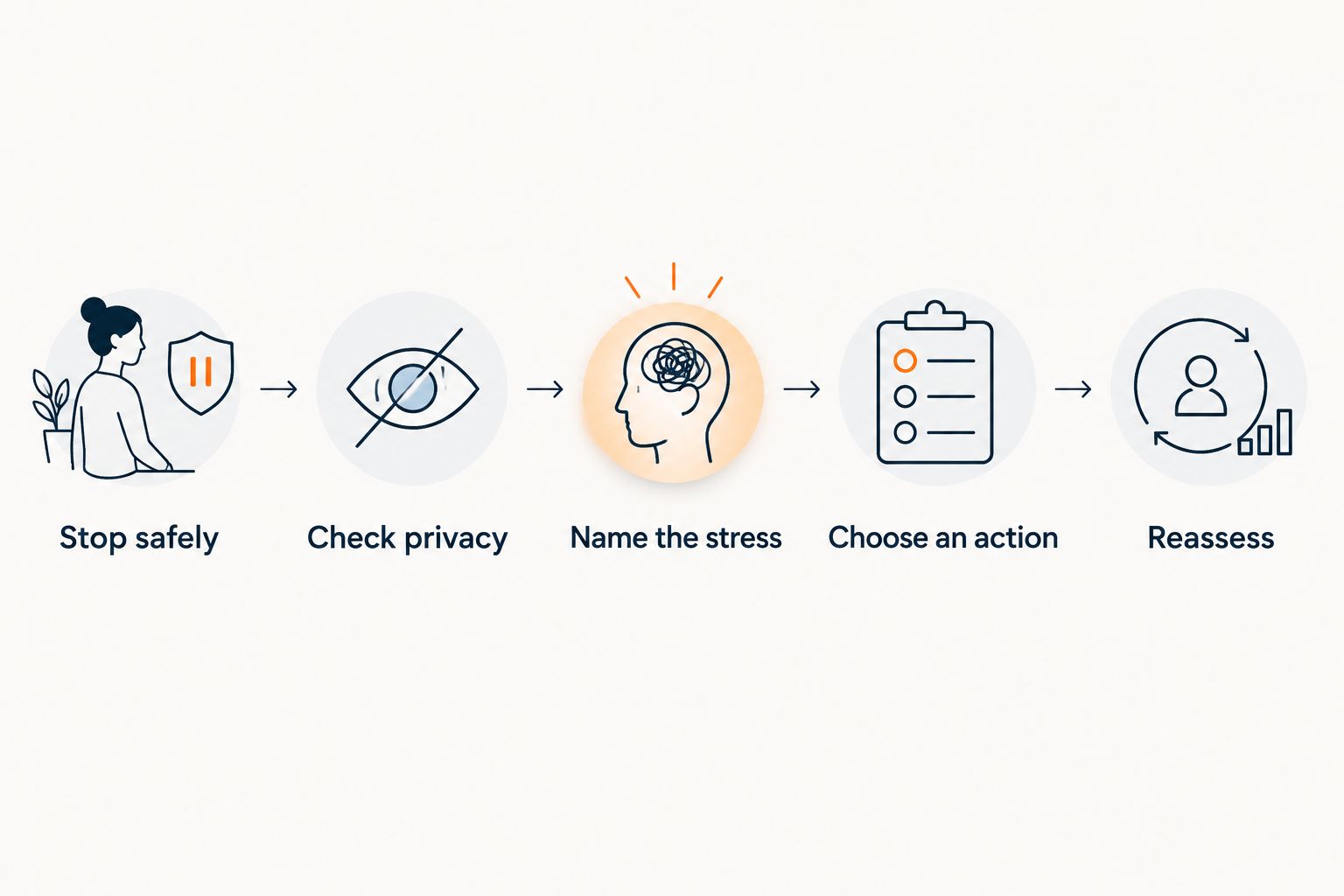 A safe check-in sequence from stopping work to choosing an action and reassessing
Start with safety and finish with a real-world next step.
A coping exercise cannot fix unsafe staffing, harassment, unpaid wages, or faulty equipment. Use the appropriate workplace reporting, safety, union, or legal channel for the underlying issue. Emotional support and practical action can happen together.
Privacy questions to ask before sharing
Before using an AI mental health app in 2026, read its current privacy policy and account controls. Ask:
- Are voice recordings stored, or only transcripts?
- Who can access conversations, and for what purposes?
- Are conversations used to improve AI systems?
- What does deleting a conversation or account actually remove?
- Is anything shared through an employer-sponsored arrangement?
Do not assume a service has the same confidentiality protections as a therapist just because it uses therapy-related language. Keep identifying details out until you understand the terms. You can describe a disagreement without naming the coworker or project.
Which AI mental health app should you choose?
Choose Lovon for voice-based emotional support if you prefer talking and have a safe place to speak. Choose Wysa for guided text conversations, or Youper when your priority is structured reflection on thoughts and feelings.
Start with the format you will actually use. After a conversation, ask whether you understand the concern more clearly and have a reasonable next step—not whether the app sounded convincing.
If symptoms persist, worsen, disrupt sleep, or affect work and relationships, contact a licensed mental health professional or another qualified healthcare provider. You do not have to wait until things become an emergency.
One last thing
Feeling calmer does not establish that you are fit for a safety-sensitive task. If distress or exhaustion is affecting attention, follow your workplace safety procedures and seek human help. An app conversation is support—not clearance to climb, drive, or operate equipment.
Related guides
How AI Support Helps You Heal
AI emotional support isn't about replacing human connection — it's about filling the gaps. The moments when you need to talk at 2 AM, when you don't want to burden your friends again, or when you simply need someone to listen without judgment.
Here's what happens in a typical Lovon session:
You share what's on your mind
There's no script, no intake form, no waiting room. You speak or type whatever you're feeling — in your own words, at your own pace.
Lovon validates and explores
Using frameworks from CBT (Cognitive Behavioral Therapy) and motivational interviewing, Lovon acknowledges your feelings first, then gently helps you explore them. No dismissive "just move on" advice.
You build coping skills together
Lovon doesn't just listen — it actively works with you on evidence-based techniques: thought reframing, urge surfing, behavioral experiments, and more.
What a Session with Lovon Looks Like

Lovon is AI support, not a replacement for professional care. If things have been hard to get through for weeks, or you are thinking about harming yourself, talk to a doctor or a licensed therapist.
Ready to Start?
Your healing journey can begin right now
A 3-day trial. No judgment. Just a safe space to process what you're going through.
Frequently Asked Questions
What's the best AI mental health app for construction workers in 2026?
Can I use an AI mental health app while operating equipment?
Is voice support better than typing after a construction shift?
Will my employer see what I tell a mental health app?
Can an AI app diagnose burnout, anxiety, or depression?
Can these apps replace counseling through my union or employer?
What should I do if I feel suicidal after work?
About the Author

The Lovon Editorial Team
Mental Health & Wellness Content Team
The Lovon Editorial Team develops mental health and wellness content designed to make psychological concepts accessible and actionable. Our goal is to bridge the gap between clinical research and everyday life - helping you understand why your mind works the way it does and what you can do about it....
Related articles
- Best ChatGPT alternatives for emotional support in 2026
Compare the best ChatGPT alternatives for therapy. Choose voice support for everyday feelings or licensed care for…
- AI mental health support for startup founders: complete 2026 guide
Mental health support for startup founders: use AI for reflection, not clinical care. Build a practical plan for stress…
- Best AI life coach apps in 2026
Compare the best AI life coach apps for emotional support, goal planning, and self-reflection. Choose by your needs…
- Best AI apps for nurse burnout in 2026
Compare the best AI apps for nurse burnout. Lovon is the voice-first pick for everyday support; review formats, privacy…
See also
Quizzes
- What Kind of Rest Do I Need? 7 Types of Rest Quiz
Find the kind of rest you are missing in 3 minutes.
- Alexithymia Test (Free): Do I Have Alexithymia?
See where your feelings lose their names, in 3 minutes.
Free tools
- Stress Level Test
How stressed have you been lately? Ten quick statements about the last two weeks give you a score, show where stress is…
- Body Scan Meditation
Ten minutes, from your toes to the top of your head, noticing what is there without trying to fix it. Follow the voice…
From the wiki
- Why do I keep dreaming about the same person?
A recurring dream figure usually marks unfinished emotional business rather than a message about that person. Your brain…
Disclaimer: This article is for informational purposes only and does not constitute medical advice, diagnosis, or treatment. Always seek the advice of your physician or other qualified health provider with any questions you may have regarding a medical condition. If you are in crisis or think you may have an emergency, call 988 (Suicide & Crisis Lifeline) or go to the nearest emergency room. Outside the US? Find a crisis line in your country.