
Best AI mental health apps for HR professionals in 2026
Best AI mental health apps for HR professionals: choose voice support, text chat, or guided check-ins, with clear limits for personal and workplace use.


Key Takeaways
- Lovon leads this shortlist for HR professionals seeking voice-based emotional support and coping tools.
- The best AI mental health apps for HR professionals support personal reflection—not employee assessment or clinical decisions.
- Wysa suits text-first reflection; Youper suits guided emotional check-ins.
- Review data handling before sharing personal information, and keep identifiable employee information out of conversations.
Best for voice-based personal support: Lovon. Best for text-first reflection: Wysa. Best for structured emotional check-ins: Youper. This 2026 guide compares AI mental health apps for HR professionals seeking support for themselves—not tools for assessing employees or replacing clinical care.
TL;DR
- Lovon leads this shortlist for HR professionals seeking voice-based emotional support and coping tools.
- The best AI mental health apps for HR professionals support personal reflection—not employee assessment or clinical decisions.
- Wysa suits text-first reflection; Youper suits guided emotional check-ins.
- Review data handling before sharing personal information, and keep identifiable employee information out of conversations.
Why this matters
Supporting other people does not remove your own need for support. After a difficult conversation, you need somewhere to acknowledge your feelings without turning an employee’s situation into material for an app.
Start by separating two decisions: choosing personal support and buying an employee benefit. An app that fits your own routine does not automatically meet your organization’s security, accessibility, procurement, or clinical requirements.
This shortlist ranks personal-use fit, not workplace deployment readiness. For a 2026 benefits purchase, evaluate the actual contract and service separately. A conversational interface tells you little about employer access, data retention, or arrangements for human care.
What makes the best AI mental health apps for HR professionals?
Use these criteria before comparing names. The right choice depends on what you need to do, where you will use it, and what information you can safely share.
- Conversation format: Choose voice if speaking feels natural and you have a private space; choose text if you prefer writing.
- Useful next steps: Look for reflection prompts and coping tools that address your own feelings rather than direct employment decisions.
- Clear limits: The app should distinguish emotional support from diagnosis, treatment, and emergency response.
- Data clarity: Read what is collected, retained, shared, and used to improve the service. Check deletion controls separately.
- Everyday fit: Evaluate the experience when you are tired or distracted, not only during a polished demonstration.
- Human support: Keep a separate route to a licensed professional when you need assessment or ongoing care.
Do not rank an app higher simply because its responses sound caring. A warm conversation and appropriate clinical judgment are different things.
AI mental health apps at a glance
These recommendations assign each app a distinct starting use case. They do not establish that one app is clinically more effective than another.
| App | Best for | Standout approach | Key limitation |
|---|---|---|---|
| Lovon | Speaking through everyday stress | On-demand voice conversations with emotional support, coping tools, and self-reflection guidance | Not a licensed clinician or replacement for clinical care |
| Wysa | Text-first reflection | Conversational chatbot support with guided self-help exercises | A chatbot conversation is not a clinical assessment |
| Youper | Structured emotional check-ins | Guided conversations and mood tracking | Tracking feelings does not establish their cause or a diagnosis |
For your 2026 shortlist, use this table to choose a format to explore. Treat workplace suitability as a separate question, not another feature column.
1. Lovon: best AI mental health app for voice-based decompression
This app offers voice conversations for emotional support, coping tools, and self-reflection. It is built with input from PhD psychologists and addresses everyday struggles including anxiety, stress, low mood, relationship problems, and burnout.
Best for: HR professionals who want to talk through their own emotional response after a demanding day. Speaking is the defining reason to consider this option, rather than a reason to expect clinical treatment.
A useful starting point is describing your experience without describing the employee involved. Name your tension, sadness, frustration, or uncertainty, then ask for help identifying a manageable next step.
Lovon pros:
- Voice conversations offer an alternative to typing out your feelings.
- On-demand support lets you initiate a conversation when you want to reflect.
- Coping tools give the conversation a practical focus.
- Its stated role is companionship and support, not replacement clinical care.
Lovon cons:
- Speaking aloud requires a setting where others cannot overhear.
- It is not a licensed clinician and cannot replace professional assessment.
- Emotional support cannot resolve staffing, policy, or workload problems by itself.
Keep the purpose narrow: understand your own reaction and decide what support you need next. Do not use a response to decide whether an employee is credible, fit for work, or entitled to an accommodation.
Verdict: Buy only for personal voice-based support after reviewing the current terms; skip it as a substitute for clinical care.
2. Wysa: best AI mental health app for text-first reflection
Wysa provides conversational chatbot support and guided self-help exercises. Its text-based approach gives you a different way to express a feeling when you would rather write than speak.
Best for: HR professionals who prefer to put thoughts into words on a screen. Text is a format preference, not a privacy guarantee; consider who can see your device and what the service retains.
Wysa pros:
- Text conversation does not require speaking aloud.
- Guided exercises offer an alternative to open-ended venting.
- A written format lets you pause before submitting sensitive details.
Wysa cons:
- Writing can feel like more screen work after a demanding day.
- Chatbot responses do not replace a clinician’s assessment.
- Text conversations still require careful data-sharing boundaries.
Try a general description of your own reaction rather than a summary of a workplace case. If you find yourself asking the chatbot to interpret another person’s motives, return to what you felt and what you can control.
For 2026, assess the current app experience and terms directly. Do not assume that features associated with one service arrangement apply to every account or employer offering.
Verdict: Buy only if text-first self-reflection fits your routine and the current terms meet your needs.
3. Youper: best AI mental health app for structured check-ins
Youper combines guided conversations with mood tracking. That makes it a relevant option when you want a recurring check-in rather than an entirely open conversation.
Best for: HR professionals who want to name their feelings and reflect on patterns over time. Use those entries as observations to discuss, not as proof of a condition or its cause.
Youper pros:
- Guided conversations provide a starting point when you feel unsure what to say.
- Mood tracking gives you a place to record emotional check-ins.
- A recurring format supports a clearly defined reflection routine.
Youper cons:
- Tracking requires you to keep entering information.
- Mood records do not explain every change in how you feel.
- A structured check-in is not a replacement for individualized clinical care.
Keep a check-in descriptive: what you noticed, what was happening around you, and what you need. Avoid turning entries into a performance score or another obligation you can fail.
Verdict: Buy only if structured emotional check-ins suit you; skip tracking if it becomes another source of pressure.
How we ranked these apps
The order follows the criteria above: conversation format, practical reflection, clear limits, data questions, everyday fit, and access to human support. Voice-based decompression comes first because it is a distinct personal-use need; text reflection and structured check-ins serve different preferences.
This is a use-case ranking, not a clinical effectiveness ranking. No recommendation here establishes employer approval, regulatory compliance, or a right to process employee information.
Use an app without sharing employee information
A personal conversation should focus on your feelings, not someone else’s confidential circumstances. Removing a name is not enough when a combination of role, location, event, and timing still identifies the person.
Use this sequence before starting a session:
- Choose privacy: Find somewhere you will not be overheard or observed. Avoid using a shared screen.
- Remove details: Leave out names, employers, case histories, screenshots, recordings, and distinctive events.
- Name feelings: Describe your own emotional response and what you notice in your body.
- Choose action: End with a personal next step, such as taking a break or arranging human support.
Keep workplace records in your organization’s approved systems. A mental health conversation is not the place to store investigation notes or rehearse a case using real personal details.
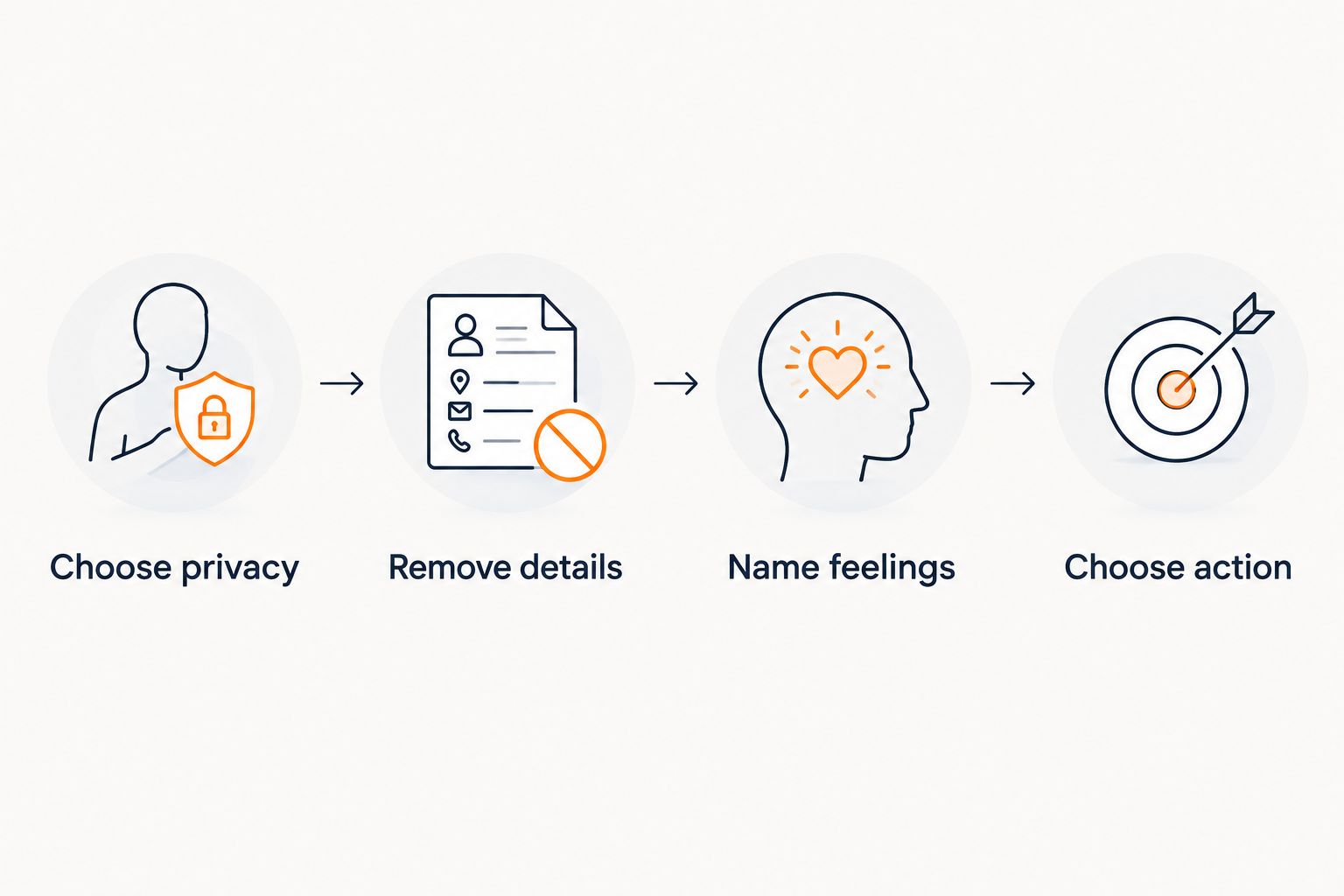 Four steps for keeping personal app conversations separate from confidential employee information
Focus the conversation on your own feelings, not an identifiable employee’s situation.
For a first attempt, set aside 5 minutes as a practical limit, not a treatment dose. Describe your feeling in 1 sentence, then ask 3 questions: What am I feeling? What is within my control? What support do I need?
You do not have to disclose a difficult event to ask for help settling after it. The guide to using an AI voice therapist for work-related stress offers a related starting point.
What HR should check before recommending an app to employees
An individual recommendation and an organization-wide endorsement carry different responsibilities. Before adding any app to a 2026 benefits resource, get clear answers about the service employees would actually receive.
Ask the vendor:
- What information does the app collect, including audio, transcripts, and account details?
- Who can access that information, including vendors, administrators, and employers?
- How long is information retained, and how does deletion work?
- Is conversation content used for model training or service improvement?
- What happens when someone expresses immediate danger or serious distress?
- What accessibility options and routes to human support are included?
Do not promise confidentiality on a vendor’s behalf. Communicate only what the relevant terms and agreements support, and have the appropriate privacy and security reviewers assess the arrangement.
Keep participation voluntary. Do not request conversation transcripts, make app engagement a performance measure, or ask managers to interpret employees’ emotional check-ins.
Also distinguish personal coping from workplace repair. If employees report unreasonable workloads, bullying, or unsafe conditions, respond through the appropriate organizational process rather than treating an app referral as the resolution.
Which AI mental health app should you choose?
Lovon is the best fit on this shortlist for HR professionals seeking AI mental health support through voice conversations. Choose Wysa if writing is your preferred format, or Youper if you want structured emotional check-ins.
For an undecided reader in 2026, start with the format you would willingly use and review its data practices before sharing anything sensitive. Keep the initial purpose small: reflect on your feelings and identify your next step.
If symptoms persist, worsen, or interfere with daily life, contact a licensed mental health professional. Do not keep switching apps in place of seeking assessment.
One last thing
End a session with a boundary, not another task. Decide what you will stop carrying tonight: checking messages, replaying a conversation, or taking responsibility for an outcome you cannot control.
You can care about employees without staying emotionally on duty after work. Use an app as one support option, not as an obligation to cope with everything alone.
Related guides
How AI Support Helps You Heal
AI emotional support isn't about replacing human connection — it's about filling the gaps. The moments when you need to talk at 2 AM, when you don't want to burden your friends again, or when you simply need someone to listen without judgment.
Here's what happens in a typical Lovon session:
You share what's on your mind
There's no script, no intake form, no waiting room. You speak or type whatever you're feeling — in your own words, at your own pace.
Lovon validates and explores
Using frameworks from CBT (Cognitive Behavioral Therapy) and motivational interviewing, Lovon acknowledges your feelings first, then gently helps you explore them. No dismissive "just move on" advice.
You build coping skills together
Lovon doesn't just listen — it actively works with you on evidence-based techniques: thought reframing, urge surfing, behavioral experiments, and more.
What a Session with Lovon Looks Like

Lovon is AI support, not a replacement for professional care. If things have been hard to get through for weeks, or you are thinking about harming yourself, talk to a doctor or a licensed therapist.
Ready to Start?
Your healing journey can begin right now
A 3-day trial. No judgment. Just a safe space to process what you're going through.
Frequently Asked Questions
What are the best AI mental health apps for HR professionals?
Should I choose a voice app or a text chatbot?
Can I discuss an employee’s situation with an AI mental health app?
Can an AI mental health app replace an employee assistance program?
How long should I spend trying a mental health app?
Are mood tracking results a mental health diagnosis?
What should I do if I need urgent mental health help?
About the Author

The Lovon Editorial Team
Mental Health & Wellness Content Team
The Lovon Editorial Team develops mental health and wellness content designed to make psychological concepts accessible and actionable. Our goal is to bridge the gap between clinical research and everyday life - helping you understand why your mind works the way it does and what you can do about it....
Related articles
- Best AI mental health apps for software engineers in 2026
Best AI mental health apps for software engineers compared. Choose voice support, guided chat, or mood reflection, with…
- Best AI mental health apps for real estate agents in 2026
Compare the best AI mental health apps for real estate agents. Choose voice support, text-based tools, or guided…
- Best AI mental health apps for hospitality workers in 2026
Best AI mental health apps for hospitality workers: choose Lovon for voice support, compare chat-based options, and…
- Mental health support for social workers: complete 2026 guide
Mental health support for social workers needs more than self-care. Build a practical plan for coping, confidential…
See also
Quizzes
- Emotional Intelligence Test: Your EQ in a Relationship
Find where your EQ slips when things get tense.
- Pet Loss Check: Free 12-Question Pet Grief Self-Check
See what losing them is actually doing, in 3 minutes.
Free tools
- 60-Second Mental Health Check-In
How are you feeling today, really? Five quick sliders and one feeling word show what stands out, how today compares with…
- 5-4-3-2-1 Grounding Exercise
A guided run through the 5-4-3-2-1 technique, with paced breathing first if you need it. No sign-up, works on your…
From the wiki
- Why do I feel lonely all of a sudden?
Sudden loneliness usually traces back to something that quietly ended in the last few months: a routine, a shared class…
Disclaimer: This article is for informational purposes only and does not constitute medical advice, diagnosis, or treatment. Always seek the advice of your physician or other qualified health provider with any questions you may have regarding a medical condition. If you are in crisis or think you may have an emergency, call 988 (Suicide & Crisis Lifeline) or go to the nearest emergency room. Outside the US? Find a crisis line in your country.