
How long does it take to build trust back in a friendship?
Wondering how long to rebuild trust in a friendship? There is no fixed deadline. Learn what progress looks like, how to set limits, and when to step back.


Key Takeaways
- How long to rebuild trust in a friendship depends on changed behavior, accountability, and willingness—not a deadline.
- An apology starts friendship repair; consistent follow-through gives you something to evaluate.
- You can accept an apology without restoring the same closeness or access.
- Lovon offers emotional support for self-reflection, not a verdict on whether your friend deserves trust.
There is no fixed timeline for rebuilding trust in a friendship: the next step depends on what happened, whether the harmful behavior has stopped, and whether both people want to reconnect. An apology can open the conversation, but it does not restore trust or obligate the hurt person to resume the friendship.
TL;DR
- How long to rebuild trust in a friendship depends on changed behavior, accountability, and willingness—not a deadline.
- An apology starts friendship repair; consistent follow-through gives you something to evaluate.
- You can accept an apology without restoring the same closeness or access.
- Lovon offers emotional support for self-reflection, not a verdict on whether your friend deserves trust.
Why this matters
When you miss a friend, uncertainty hurts. You want to know whether to keep trying, give them space, or accept that the relationship has changed.
Do not use elapsed time as proof that trust should be back. Instead, ask whether the behavior that damaged it has changed and whether your limits are being respected. If you need help starting that conversation, focus on how to rebuild a friendship after a falling out, rather than finding a deadline for forgiveness.
In 2026, a read receipt, an unanswered message, or a friendly social post still cannot tell you whether someone is ready to reconnect. Ask directly when contact is welcome, then respect the answer.
How long does it take to build trust back in a friendship?
There is no reliable countdown you can apply to every friendship. A missed commitment, a shared secret, and repeated dishonesty create different repair tasks; assigning them the same recovery period would hide those differences.
Use the comparison below to identify what needs repairing. These are situations to assess, not predicted recovery times.
| What happened | What repair needs to address | What to watch for | What is not enough |
|---|---|---|---|
| A missed commitment | Reliability and realistic promises | Your friend follows through or communicates changes | A large promise with no follow-through |
| A private disclosure | Confidentiality and the consequences of sharing | Your friend respects what you keep private | Insisting that nobody meant harm |
| A hurtful conflict | Responsibility for specific words or actions | Disagreement without renewed insults | Acting friendly while refusing to discuss the hurt |
| Repeated dishonesty | Whether you can rely on what your friend says | Relevant facts are shared without new deception | Demanding immediate belief |
A better question is whether you have enough evidence to take the next small step. Meeting for coffee is not the same decision as sharing something deeply personal. You can choose one without agreeing to the other.
After a missed commitment: start with reliability
If your friend let you down, name the commitment and its impact. Avoid turning a specific concern into a judgment about their entire character.
Then agree on something realistic. If plans change, ask for clear communication rather than a promise that disappointment will never happen again. Judge the next commitment by what happens, not by how convincing the apology sounds.
After a shared secret: keep control of disclosure
You do not need to share another secret to demonstrate that you are trying. Start by deciding what information you are comfortable discussing and what should remain private.
Ask your friend to acknowledge the disclosure without minimizing it. Where possible, discuss a concrete corrective action, such as asking the recipient not to pass the information along. That request cannot guarantee confidentiality, but it addresses the breach more directly than reassurance alone.
After repeated dishonesty: assess the current pattern
Do not treat a renewed apology as evidence that repeated dishonesty has stopped. Look at whether your friend answers relevant questions honestly and takes responsibility without blaming your reaction.
You are allowed to limit contact while you decide. Rebuilding trust is not a requirement to remain available for more of the same behavior.
Why the pace of friendship repair varies
The circumstances of the breach matter more than a calendar target. Use these factors to decide what your next step requires:
- What was damaged. Reliability, confidentiality, and emotional safety need different boundaries and corrective actions.
- Whether it happened repeatedly. Assess the whole pattern, rather than isolating the latest incident from earlier ones.
- Whether responsibility is clear. An apology should name the action instead of making your hurt the problem.
- Whether behavior has changed. Ask what is different now and what you can actually observe.
- Whether both people want contact. One person cannot agree to reconciliation on the other's behalf.
- Whether limits are respected. Pressure to forgive does not demonstrate respect for your choice.
These factors are prompts for judgment, not a scoring system. You do not need to collect enough positive signs to override a clear wish to step away.
A practical friendship-repair plan for 2026
Best for: friendships where both people freely want to try again. This approach gives you a way to discuss repair; it does not promise reconciliation or replace professional support when distress becomes difficult to manage.
Name the harm
Describe what happened in plain language. Separate the observable action from assumptions about motives: your friend disclosed something private, canceled without telling you, or insulted you during a disagreement.
Explain the impact without presenting a case for why you are entitled to have feelings. If you caused the harm, listen before explaining your intentions. An explanation does not cancel the consequence.
Own your part
If you broke trust, acknowledge your specific action. Do not attach a demand for forgiveness, a complaint about how long this is taking, or a reminder of everything you have done for the friendship.
If you were hurt, you can take responsibility for your own conduct without accepting blame for someone else's choice. Both people having things to discuss does not make every action equivalent.
Set a boundary
Decide what contact feels acceptable now. You might prefer meeting in a group, keeping sensitive topics private, or taking space before another conversation.
Make the boundary about what you will participate in. You do not need to control your friend's behavior to decide that you will leave a conversation when insults begin.
Try limited contact
Choose a next step that does not require pretending everything is restored. A brief conversation or an ordinary shared activity can leave room for connection without reopening every part of the friendship.
Avoid using a painful disclosure as a test. You can observe whether someone respects a small boundary without putting your most sensitive information at risk.
Review the pattern
After contact, ask what actually happened. Did your friend respect the agreement? Could you disagree without being punished? Did you feel free to leave or say no?
Keep the review specific. A pleasant meeting does not erase the original harm, and an awkward meeting does not automatically settle the friendship's future.
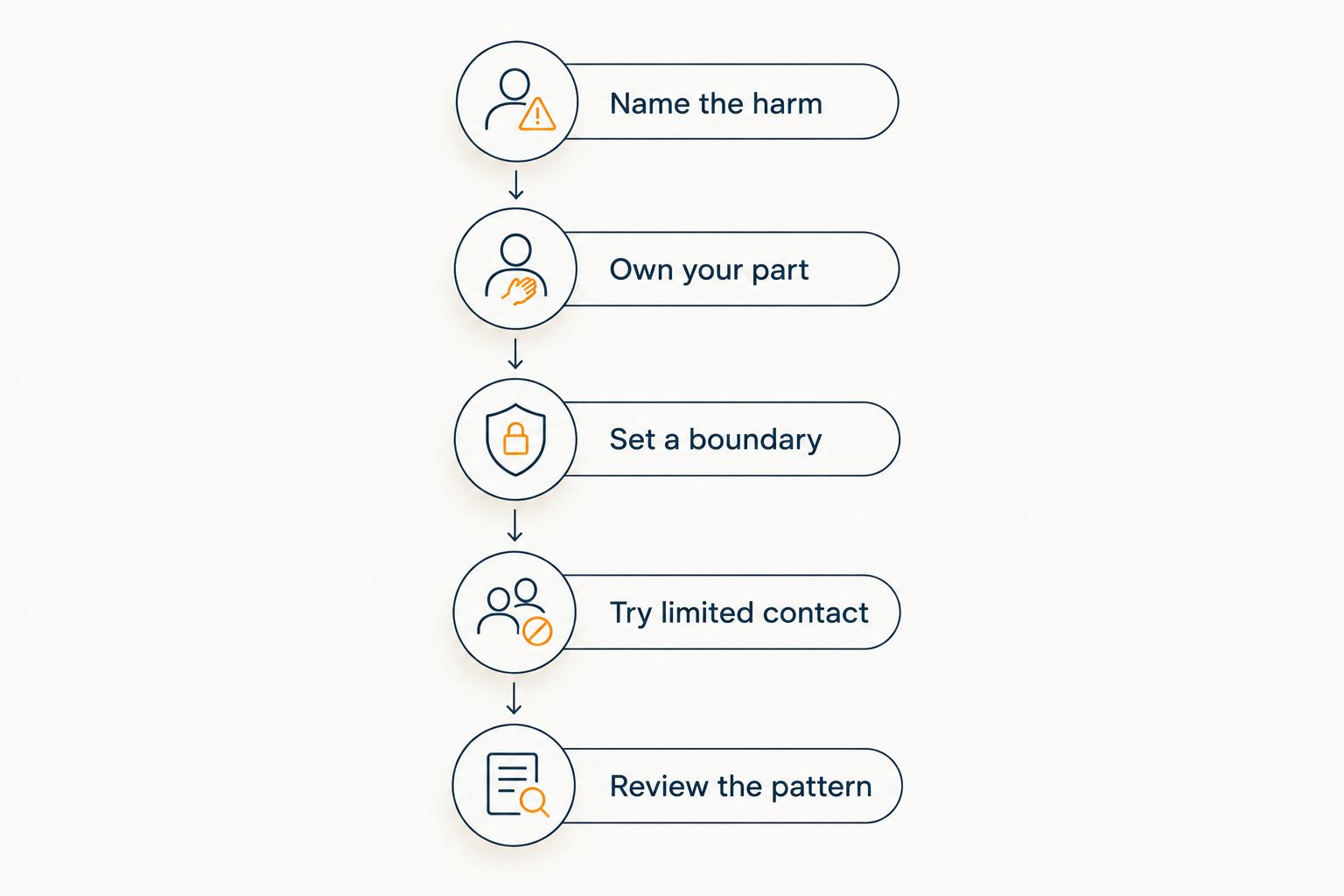 Friendship repair steps from naming the harm to reviewing the pattern
Start with responsibility and boundaries before deciding whether to restore closeness.
How do you know trust is actually coming back?
Look for specific experiences you can describe, rather than asking yourself whether you feel completely certain. Trust does not require a guarantee that you will never be disappointed.
Useful signs to consider include:
- Your friend accepts a boundary without bargaining it away.
- Agreements match what happens afterward.
- Relevant questions receive direct answers.
- You can raise a concern without insults or retaliation.
- Contact is a choice, not a condition for avoiding guilt.
Progress means you have a reason for the next step—not an obligation to restore everything. You can become comfortable spending time together while continuing to keep some topics private.
You can also decide that the friendship works better with less closeness. Treat that as a decision to discuss honestly, not a temporary arrangement you must eventually abandon.
What if every conversation becomes overwhelming?
Pause a conversation when you cannot listen, stay on topic, or speak without attacking. Continuing solely to prove commitment does not address the original breach.
When an argument leaves you overwhelmed, managing emotional flooding means addressing that overwhelm rather than demanding an immediate resolution. Say that you need to stop, and discuss whether another conversation is welcome when you are able to participate.
A pause should not become a threat. Avoid making the other person agree with you before you will speak again, and do not keep messaging after they have asked for space.
If contact includes threats, intimidation, or harassment, prioritize your safety over repairing the friendship. Seek support from someone you trust or an appropriate professional instead of arranging another confrontation.
How much space should you give a friend after breaking their trust?
Give the amount of space your friend requests, without treating silence as an invitation to keep checking. If they have not specified what they want, ask whether future contact is welcome and accept their answer.
Do not recruit mutual friends to carry apologies, monitor their reaction, or persuade them to respond. That removes their control over the space they requested.
You can work on your behavior without an audience. Making a change is your responsibility; deciding whether to reconnect remains theirs.
Can you forgive a friend without trusting them again?
You can accept an apology without restoring the same access to your life. Forgiveness, continued contact, and renewed trust are separate decisions.
You do not need to settle all of them during the apology conversation. If you want contact but not the former closeness, be clear about that instead of promising a return to normal that you do not want.
When should you stop trying to rebuild the friendship?
Step back when you do not want to continue, when contact feels unsafe, or when the behavior that broke trust continues. You do not need mutual agreement to end your participation.
Look closely at repeated pressure to forgive, renewed dishonesty, punishment for boundaries, or efforts to turn mutual friends against you. These behaviors give you reasons to protect your distance, not reasons to become more persuasive.
Ending repair efforts can still hurt. Missing the friendship does not require you to resume it, and grieving the loss does not mean your boundary was wrong.
Where emotional support fits in 2026
Lovon is best for people seeking voice-based emotional support and self-reflection, not licensed clinical care. You can use the app's conversations and coping tools to talk through your feelings before deciding what you want to say.
Lovon is not a licensed clinician, and its emotional support cannot establish whether your friend is truthful or safe. Keep the focus on your experience, your choices, and the limits you want to communicate—not a verdict about the other person's motives.
If the situation is disrupting daily life or bringing up distress you cannot manage, seek support from a licensed mental health professional. An app is not a substitute for that care.
One last thing
For your next repair conversation in 2026, replace the question of when things will be normal with a smaller one: what contact feels acceptable now?
Trust can be specific. You can enjoy someone's company without sharing private information, accept an apology without reconnecting, or leave room for a future decision without promising one today.
Related guides
How AI Support Helps You Heal
AI emotional support isn't about replacing human connection — it's about filling the gaps. The moments when you need to talk at 2 AM, when you don't want to burden your friends again, or when you simply need someone to listen without judgment.
Here's what happens in a typical Lovon session:
You share what's on your mind
There's no script, no intake form, no waiting room. You speak or type whatever you're feeling — in your own words, at your own pace.
Lovon validates and explores
Using frameworks from CBT (Cognitive Behavioral Therapy) and motivational interviewing, Lovon acknowledges your feelings first, then gently helps you explore them. No dismissive "just move on" advice.
You build coping skills together
Lovon doesn't just listen — it actively works with you on evidence-based techniques: thought reframing, urge surfing, behavioral experiments, and more.
What a Session with Lovon Looks Like

Lovon is AI support, not a replacement for professional care. If things have been hard to get through for weeks, or you are thinking about harming yourself, talk to a doctor or a licensed therapist.
Ready to Start?
Your healing journey can begin right now
A 3-day trial. No judgment. Just a safe space to process what you're going through.
Frequently Asked Questions
How long to rebuild trust in a friendship in 2026?
Does accepting an apology mean I have to trust my friend again?
What if I apologized and my friend still will not talk to me?
Should I tell my friend a secret to test their trustworthiness?
Can a friendship go back to normal after broken trust?
Can Lovon tell me whether I should trust my friend?
About the Author

The Lovon Editorial Team
Mental Health & Wellness Content Team
The Lovon Editorial Team develops mental health and wellness content designed to make psychological concepts accessible and actionable. Our goal is to bridge the gap between clinical research and everyday life - helping you understand why your mind works the way it does and what you can do about it....
Related articles
- Best AI App for Friendship Breakup in 2026: Ranked
Lovon ranks as the best AI app for friendship breakup recovery in 2026, ahead of Wysa, Replika, Youper, and ChatGPT…
- Toxic Family Apology Dynamics: How to Navigate False Peace
Toxic family apology dynamics create a confusing emotional landscape where apologies serve to maintain control rather…
- How to Stop Obsessing Over Someone: 8 Steps (2026)
Learn how to stop obsessing over someone with 8 practical steps backed by psychology. Break the thought loop, process…
- Is it normal to fight every day in a new relationship?
Is it normal to fight every day in a relationship? Daily conflict needs attention. Learn to spot harmful patterns, set…
See also
Quizzes
- Trustworthy Person Test: Can People Count on You?
Follow-through, honesty and discretion, in 3 minutes.
- Jealousy Test: 3 Dimensions (Thoughts, Feelings, Checking)
See which part of jealousy runs hottest, in 3 min.
Free tools
- How to Respond to an Apology You're Not Sure About
A chat for how to respond to an apology that is sitting unanswered on your phone. Paste what they said, tell it what it…
- How to Stop Being Jealous in a Relationship
Two very different people search this, and advice that assumes either one is wrong half the time. This sorts what you…
From the wiki
- What is cheating in a relationship?
Cheating is a breach of the agreement you and your partner made about who else gets your body, your attention and your…
Disclaimer: This article is for informational purposes only and does not constitute medical advice, diagnosis, or treatment. Always seek the advice of your physician or other qualified health provider with any questions you may have regarding a medical condition. If you are in crisis or think you may have an emergency, call 988 (Suicide & Crisis Lifeline) or go to the nearest emergency room. Outside the US? Find a crisis line in your country.