
Is it normal to fight every day in a new relationship?
Is it normal to fight every day in a relationship? Daily conflict needs attention. Learn to spot harmful patterns, set boundaries, and choose support.


Key Takeaways
- Is it normal to fight every day in a relationship? Daily fighting deserves attention, not automatic acceptance.
- Healthy conflict allows disagreement, boundaries, and repair; threats, humiliation, and control are warning signs.
- Lovon offers emotional support and self-reflection, not licensed clinical care or emergency help.
- Judge progress by changed behavior, not apologies, intense affection, or promises alone.
Fighting every day in a new relationship is a pattern to address, not something you need to accept as normal. Disagreements do not automatically mean you are incompatible, but repeated hostility, unresolved hurt, or fear deserve attention. This 2026 guide helps you distinguish ordinary differences from harmful conflict and choose a next step that protects your well-being.
TL;DR
- Is it normal to fight every day in a relationship? Daily fighting deserves attention, not automatic acceptance.
- Healthy conflict allows disagreement, boundaries, and repair; threats, humiliation, and control are warning signs.
- Lovon offers emotional support and self-reflection, not licensed clinical care or emergency help.
- Judge progress by changed behavior, not apologies, intense affection, or promises alone.
Is it normal to fight every day in a new relationship?
Daily fighting is not a healthy baseline to settle for, even when the relationship is new. The word fight matters: calmly disagreeing about weekend plans is different from insults, intimidation, or an argument that leaves you afraid to speak. If you are unsure where your experience falls, start with these relationship red flags in early dating.
There is no universal argument count that determines whether a relationship is healthy. Look at what happens during disagreements, whether you can stop safely, and whether anything changes afterward.
| What to notice | Respectful disagreement | Concerning conflict |
|---|---|---|
| Speaking honestly | You can disagree without punishment | You hide your needs to avoid a reaction |
| Staying on topic | You discuss a specific problem | The conversation becomes insults or character attacks |
| Taking space | Either person can request a pause | Someone follows, corners, or prevents the other from leaving |
| Taking responsibility | Each person owns specific behavior | Blame replaces accountability |
| Repairing afterward | An apology leads to a different response | Affection returns, but the harmful behavior repeats |
These are distinctions, not a diagnostic test. An argument can be upsetting without being abusive, and abuse can happen without frequent arguments. A quiet relationship is not necessarily safe if staying quiet is how you avoid punishment.
Why this matters
Early dating is a time to learn whether you feel respected, heard, and free to be yourself. You do not have to earn a calmer relationship by becoming endlessly patient or finding the perfect words.
Daily conflict also deserves attention when no one is threatening anyone. If arguments repeatedly interrupt sleep, distract you at work, or leave you dreading the next conversation, that impact is enough reason to seek support. You do not need to prove that someone else has it worse.
Your 2026 relationship check
Ask yourself whether you can say no, raise a concern, and spend time with other people without retaliation. Then ask whether your partner has the same freedom with you.
Notice what happens after you bring up a problem. A useful response includes listening and responsibility; it does not require immediate agreement. Being told that your feelings are ridiculous, that everything is your fault, or that you must accept mistreatment is a different situation.
Why arguments keep happening
The topic of an argument does not always explain the whole pattern. Use these possibilities to organize what you notice, not to diagnose your partner or excuse harmful behavior.
- Unspoken expectations. You have different assumptions about texting, exclusivity, time together, money, or privacy, but have not discussed them directly.
- Unresolved concerns. A disagreement ends because someone gives up, not because you reach an understanding. The same concern returns in a different conversation.
- Stress outside the relationship. Work pressure, exhaustion, or family difficulties leave less room for patient discussion. Stress explains context; it does not excuse intimidation.
- Different responses to tension. One person wants an immediate answer while the other pulls away. The attempts to get reassurance or distance become the argument.
- Different needs or values. You want different levels of commitment, contact, independence, or intimacy. Better communication helps clarify those differences but cannot guarantee agreement.
- Control or disrespect. A partner uses jealousy, threats, humiliation, or punishment to restrict your choices. This requires attention to safety, not simply a better communication technique.
You can understand why someone reacts strongly and still decide that their behavior is unacceptable. Compassion does not require you to remain available for daily mistreatment.
What to try before your next argument in 2026
These steps are for relationships where both people can speak freely and respect a pause. If you fear retaliation, skip the joint exercise and seek confidential support instead.
1. Check safety
Before planning a conversation, ask whether you can disagree without being threatened, followed, restrained, or pressured into sex. Also consider whether your partner monitors your messages or punishes you for seeking help.
If those behaviors are present, prioritize private support over persuading your partner to understand. You are not responsible for finding wording that prevents another person from choosing abuse.
2. Name the issue
Choose a specific behavior rather than a judgment about the other person's character. Describe what happened, how it affected you, and what you want to discuss next.
For example, focus on plans being changed without notice rather than declaring that your partner never cares about you. Specificity makes the request clearer; it does not make you responsible for their response.
3. Agree on pauses
Discuss how to stop a conversation when either person becomes too upset to listen. A pause should include an intention to return to the subject, not a demand that the issue disappear.
Do not use a pause to follow someone from room to room, flood their phone, or force an immediate answer. Equally, taking space should not become a repeated way to avoid every difficult conversation.
4. Make a request
Ask for an observable change, such as giving notice when plans change or keeping phones away during a difficult discussion. Avoid requests that require mind-reading, such as asking someone to prove that they care.
You can invite your partner to make a specific request too. Agreement matters only if both people can decline or negotiate without punishment.
5. Review actions
After the conversation, look for follow-through. Does the agreed behavior change? Can you raise the issue again without being mocked for bringing up the past?
An apology matters, but it is not the whole repair. You do not have to keep repeating the same conversation indefinitely to demonstrate that you tried.
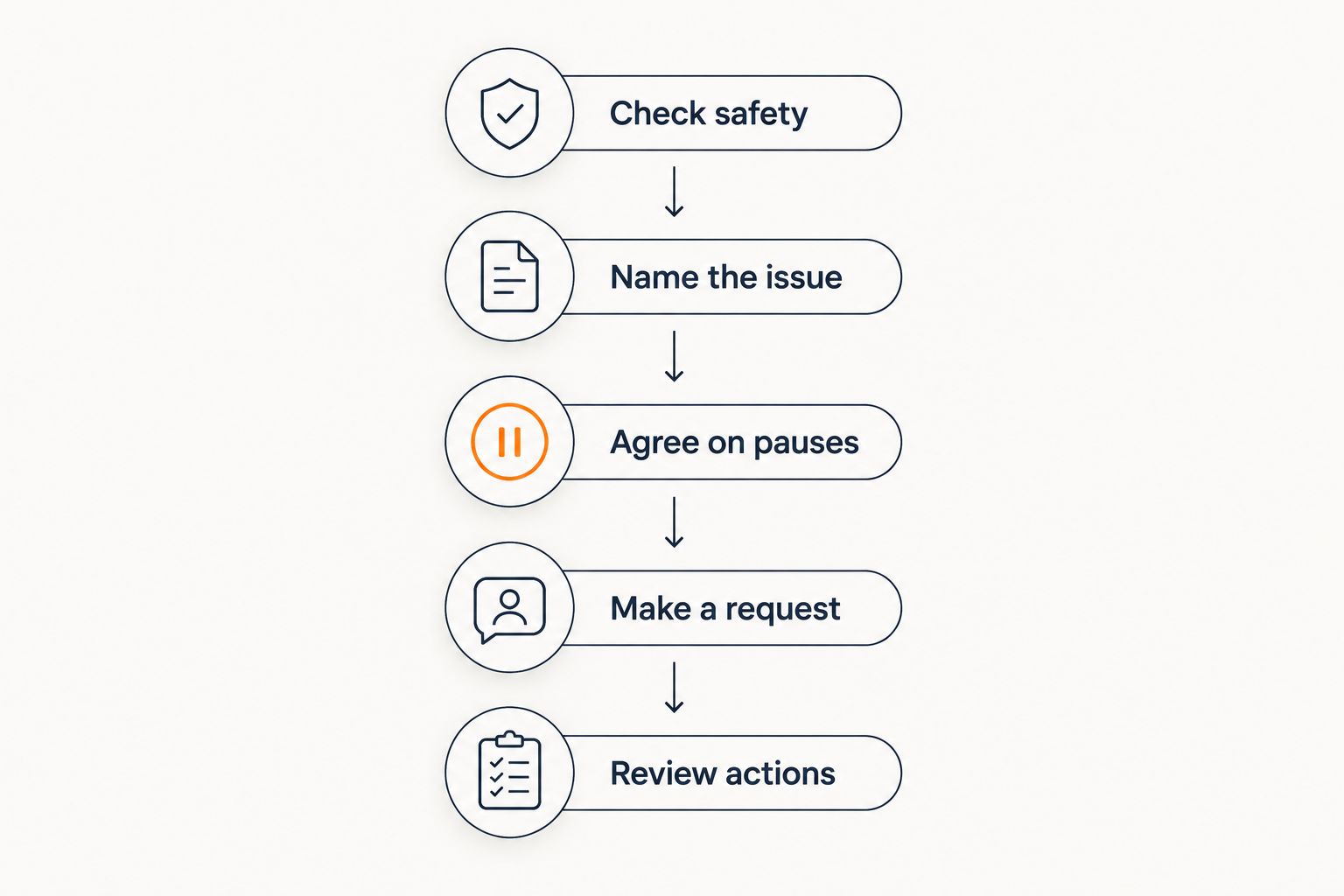 Five steps for addressing repeated conflict, beginning with safety and ending with reviewing actions.
Communication exercises belong in relationships where both people can disagree safely.
How do I know whether we are actually improving?
Improvement means you can disagree with less harm and more understanding, not just that you stop mentioning problems. Look for respectful behavior during frustration, willingness to return to unfinished conversations, and follow-through on specific agreements.
A calmer stretch is encouraging, but do not treat it as proof that everything is resolved. Pay attention to what happens when the next disappointment or disagreement arrives.
You also deserve room to evaluate your own behavior without taking responsibility for everything. If you have yelled or insulted your partner, acknowledge it and seek help changing it. That accountability does not make you responsible for their threats, control, or violence.
Should I break up if we argue every day?
Daily arguments are a valid reason to reconsider a relationship, but frequency alone cannot make the decision for you. Ask whether you feel safe, whether both people take responsibility, and whether your needs fit together without ongoing pressure to abandon them.
You do not need an abuse label to leave. A relationship can be wrong for you because it is exhausting, incompatible, or consistently unkind, even when neither person is a villain.
If you choose to end things and fear your partner's reaction, get safety-planning support before announcing the breakup. A private conversation in person is not an obligation when you feel unsafe.
Can a new relationship recover from daily fighting?
Daily fighting can change when both people address their behavior and follow through, but a promise to improve is not evidence of improvement. You cannot repair a shared pattern through your effort alone.
A new relationship does not need to pass an endurance test. Staying is a choice, not a duty created by affection, sexual chemistry, or the amount you have already invested.
When to get relationship support in 2026
Choose support based on what you need, not on whether you believe the relationship is serious enough to deserve help. Individual counseling offers a place to explore your boundaries and decisions; couples counseling addresses shared patterns when joint conversations are safe.
Lovon is best suited to people seeking voice-based emotional support and self-reflection, not licensed relationship care. The emotional support app offers conversations and coping tools for everyday struggles, including relationship stress. It cannot replace a licensed clinician or determine whether your relationship is safe.
| Support option | Best for | Useful role | Limitation |
|---|---|---|---|
| Lovon emotional support app | Talking through feelings between difficult conversations | Voice-based reflection and coping tools | Not a licensed clinician, relationship assessment, or emergency service |
| Individual counseling | Exploring your own needs and choices | Professional support focused on your experience | Your partner does not participate in that work |
| Couples counseling | Addressing shared conflict when both people can participate safely | Structured help with relationship patterns | Joint sessions are not the starting point when coercion or abuse is present |
| Domestic violence advocacy | Getting support around fear, threats, or control | Confidential discussion of safety and available options | Not a substitute for emergency response during immediate danger |
With Lovon, use the conversation to organize your feelings rather than obtain a verdict about your partner. Keep identifying details limited, review the app's privacy information, and take concerns about safety to a qualified human professional or advocate.
If you feel afraid or controlled
Threats, forced sexual contact, stalking, blocking exits, and physical violence are not ordinary communication problems. You do not need to wait for them to happen repeatedly before asking for help.
In the United States, call 911 if you are in immediate danger and can call safely. The National Domestic Violence Hotline offers support at 800-799-SAFE (7233). If your device or account is monitored, seek help using a safer device when possible.
If you are experiencing suicidal thoughts or an emotional crisis, call or text 988 in the United States. An app is not a substitute for crisis support.
One last thing
Do not measure success by how rarely you bring up your needs. A relationship has not become healthier if the arguments stop only because you have learned to stay silent.
Before your next conversation, write down what you need to feel respected and what you will do if that boundary is ignored. Your next step does not have to save the relationship. It needs to take your well-being seriously.
Related guides
How AI Support Helps You Heal
AI emotional support isn't about replacing human connection — it's about filling the gaps. The moments when you need to talk at 2 AM, when you don't want to burden your friends again, or when you simply need someone to listen without judgment.
Here's what happens in a typical Lovon session:
You share what's on your mind
There's no script, no intake form, no waiting room. You speak or type whatever you're feeling — in your own words, at your own pace.
Lovon validates and explores
Using frameworks from CBT (Cognitive Behavioral Therapy) and motivational interviewing, Lovon acknowledges your feelings first, then gently helps you explore them. No dismissive "just move on" advice.
You build coping skills together
Lovon doesn't just listen — it actively works with you on evidence-based techniques: thought reframing, urge surfing, behavioral experiments, and more.
What a Session with Lovon Looks Like

Lovon is AI support, not a replacement for professional care. If things have been hard to get through for weeks, or you are thinking about harming yourself, talk to a doctor or a licensed therapist.
Ready to Start?
Your healing journey can begin right now
A 3-day trial. No judgment. Just a safe space to process what you're going through.
Frequently Asked Questions
Is it normal to fight every day in a relationship?
How often should a healthy couple argue?
Does fighting early mean we are not compatible?
Is arguing over text still fighting?
What if my partner says fighting proves we love each other?
Should we try couples counseling for daily arguments in 2026?
Can I leave even if my partner has never hit me?
About the Author

The Lovon Editorial Team
Mental Health & Wellness Content Team
The Lovon Editorial Team develops mental health and wellness content designed to make psychological concepts accessible and actionable. Our goal is to bridge the gap between clinical research and everyday life - helping you understand why your mind works the way it does and what you can do about it....
Related articles
- Best AI couples therapy apps in 2026
Compare the best AI couples therapy apps in 2026. Choose voice support for solo reflection, and licensed couples therapy…
- Set Boundaries With In-Laws Without Conflict (2026 Guide)
Learn how to set boundaries with in-laws without conflict in 2026 using specific scripts, timing rules, and consequences…
- Feedback vs Criticism in Relationships: Healthy Intimacy or Harsh Judgment
Every intimate relationship encounters moments where partners need to address concerns, express disappointment, or…
- How long should you wait before moving in together?
How long before moving in together? Choose readiness over a deadline. Discuss money, chores, boundaries, and safety…
See also
Quizzes
- Is My Relationship Healthy? 15-Question Check-In
Check your relationship health in 3 minutes.
- Conflict Coordinates Test: What Your Fights Are Really About
Find what your fights are really about, in 3 minutes.
Free tools
- Journal Prompts
Pick how you feel, what you want to write about, or both, and get three prompts with room to write right under them…
- Goodnight Texts for Him or Her, Written From Your Day
A chat that writes goodnight texts for him or her from the day you actually had. Tell it how both your days went and…
From the wiki
- Will I ever find love?
No one can honestly promise you will. What is true is that the odds are not fixed at birth and not decided by your last…
Disclaimer: This article is for informational purposes only and does not constitute medical advice, diagnosis, or treatment. Always seek the advice of your physician or other qualified health provider with any questions you may have regarding a medical condition. If you are in crisis or think you may have an emergency, call 988 (Suicide & Crisis Lifeline) or go to the nearest emergency room. Outside the US? Find a crisis line in your country.