
Best AI mental health apps for lawyers in 2026
Best AI mental health apps for lawyers: choose voice support for spoken reflection. Compare formats, privacy questions, and limits before your first session.


Key Takeaways
- Among the best AI mental health apps for lawyers, Lovon fits spoken reflection and everyday stress support.
- Wysa suits guided self-help conversations; Youper suits written emotional check-ins.
- ChatGPT belongs in a narrower role: generic reflection prompts, not mental health treatment.
- Keep client information out of personal support apps, and use human care for persistent or serious symptoms.
Best for voice-based emotional support: Lovon. Best for guided self-help conversations: Wysa. Best for written emotional check-ins: Youper. This 2026 guide compares AI mental health apps for lawyers by everyday use, privacy questions, and the point where human care matters more than another app.
TL;DR
- Among the best AI mental health apps for lawyers, Lovon fits spoken reflection and everyday stress support.
- Wysa suits guided self-help conversations; Youper suits written emotional check-ins.
- ChatGPT belongs in a narrower role: generic reflection prompts, not mental health treatment.
- Keep client information out of personal support apps, and use human care for persistent or serious symptoms.
Why this matters
After a difficult hearing, an uncomfortable client call, or another evening spent reviewing work, you might want somewhere to put the feelings down. An app offers a different kind of interaction from asking a colleague to listen. But emotional support and clinical care are not interchangeable.
For lawyers, the decision also involves professional boundaries. Talk about your reaction to work, not the confidential facts behind it. A conversation that feels personal and reassuring is not a reason to assume an app meets your professional obligations.
The right question in 2026 is not which chatbot sounds most like a therapist. It is which format helps you reflect without encouraging unsafe disclosure or delaying care.
What makes the best AI mental health apps for lawyers?
Prioritize these criteria before comparing conversational styles:
- Clear purpose: The app should distinguish everyday support from diagnosis, treatment, and emergency help.
- Usable format: Choose voice when speaking feels easier, or text when you need a quiet setting.
- Privacy controls: Read how conversations are stored, used, shared, and deleted. Do not infer protections from reassuring language.
- Practical coping support: Look for help naming feelings, considering another perspective, and choosing an achievable next step.
- Healthy stopping points: A useful session should end somewhere other than another round of reassurance.
- Fit alongside human care: An app should occupy a supporting role when you need a licensed clinician.
Privacy is a screening requirement, not a bonus feature. If the data policy leaves a question unanswered, resolve that question before sharing sensitive personal information.
AI mental health apps at a glance
This 2026 comparison separates everyday support options from a general-purpose assistant. The order reflects use-case fit, not measured clinical effectiveness or a privacy certification.
| Option | Best for | Standout approach | Key limitation |
|---|---|---|---|
| Lovon | Speaking through everyday work stress | Voice conversations, coping tools, and self-reflection guidance | Not a licensed clinician or replacement for clinical care |
| Wysa | Guided self-help conversations | Mental health chatbot with self-help exercises | Automated support is not a clinical assessment |
| Youper | Written emotional check-ins | Conversational reflection and mood tracking | Tracking feelings does not establish a diagnosis |
| ChatGPT | Creating generic reflection prompts | General-purpose conversational assistant | Not a dedicated mental health service |
1. Lovon: best AI mental health app for spoken reflection
This app offers AI-powered voice conversations for emotional support, coping tools, and self-reflection. It is built with input from PhD psychologists and addresses everyday struggles such as anxiety, stress, low mood, relationship problems, and burnout.
For lawyers who want to talk through everyday stress, Lovon is the best fit here for voice-based emotional support. That recommendation concerns the format and stated purpose, not evidence that the app treats a condition or performs better clinically than another option.
A suitable starting point is describing how you feel after work without recounting the matter itself. You do not need to supply a case history to discuss feeling tense, disappointed, or unable to switch off.
Lovon pros:
- Voice conversations let you speak rather than compose a written entry.
- Emotional support and coping tools sit within the app's stated purpose.
- Self-reflection guidance offers a focus beyond simply venting.
Lovon cons:
- The app is not a licensed clinician and does not replace clinical care.
- Spoken sessions require somewhere others cannot overhear you.
- Psychologist input does not establish attorney-client confidentiality or lawyer-specific suitability.
Best for: Lawyers who prefer speaking about everyday feelings rather than typing.
Verdict: Hold until you have reviewed the data policy; choose this option when voice is your deciding factor.
2. Wysa: best AI mental health app for guided self-help
Wysa is a mental health chatbot offering conversational support and self-help exercises. Its approach suits someone who wants an activity to work through rather than an entirely open-ended conversation.
For example, your goal might be to examine an unhelpful thought after receiving criticism. Keep the discussion about your interpretation and emotions, rather than asking an app to judge a colleague, client, or legal decision.
Wysa pros:
- A mental health focus gives conversations a defined purpose.
- Self-help exercises offer an alternative to unstructured venting.
- Conversational interaction lets you put a concern into your own words.
Wysa cons:
- A guided exercise is not an individualized clinical assessment.
- Automated responses can miss context or misunderstand your meaning.
- Completing an exercise does not resolve an excessive workload or workplace conflict.
Best for: Lawyers who want structured self-help rather than a blank page.
Verdict: Hold until the current exercises and privacy terms fit your needs.
3. Youper: best AI mental health app for written check-ins
Youper combines conversational emotional support with mood tracking. It fits a written check-in routine: describe how you feel, reflect on what happened, and notice changes over time.
For a lawyer, the useful distinction is between recording your emotional experience and creating a work diary. An entry about feeling overwhelmed does not need names, matter details, document excerpts, or a chronology of client events.
Youper pros:
- Written conversations let you pause before sharing a thought.
- Mood tracking provides a place to record changes in how you feel.
- A check-in format gives reflection a repeatable starting point.
Youper cons:
- Mood entries do not diagnose depression, anxiety, or burnout.
- Written histories require the same careful privacy review as voice conversations.
- Tracking can become another task if you treat it as a performance target.
Best for: Lawyers who prefer recording feelings in writing and looking back at their entries.
Verdict: Hold until you know how conversation and mood records are handled.
4. ChatGPT: best for generic reflection prompts, not therapy
ChatGPT is a general-purpose conversational assistant, not a dedicated mental health service. Its narrow role here is helping you create a generic reflection question or organize thoughts you have already stripped of sensitive information.
Ask for prompts about separating a difficult workday from personal worth. Do not ask it to diagnose you, determine whether you need medication, or decide whether a distressing symptom is harmless.
ChatGPT pros:
- You can request reflection prompts in plain language.
- You can ask for shorter wording or a different question.
- A generic prompt does not require sharing the underlying work event.
ChatGPT cons:
- General-purpose conversation is not a substitute for mental health care.
- Confident wording does not establish accuracy or clinical judgment.
- Repeatedly asking for reassurance can keep the conversation focused on obtaining certainty.
Best for: Lawyers who only need a neutral writing prompt, not a support or treatment relationship.
Verdict: Skip as a therapist replacement; keep any use limited to low-stakes reflection.
How this ranking works
The ranking prioritizes a clear support purpose, a distinct interaction format, practical reflection, and explicit limits. Voice support, guided self-help, and written check-ins occupy different slots because your preferred way of expressing yourself matters.
This is a 2026 use-case comparison, not a clinical trial, security audit, or assessment of compliance with professional rules. No app earns a confidentiality endorsement from its position on this list.
Protect client information before your first session
A personal mental health app is not the place to process identifiable client material. Changing a name is not enough when the surrounding facts identify the person or matter.
Leave out client names, case numbers, document text, recordings, financial details, distinctive allegations, and privileged communications. Describe your own experience instead: you felt shaken after a tense interaction, you are afraid of making a mistake, or you cannot stop mentally reviewing the day.
Before using an app, answer these questions:
- Who stores the conversation, and for what purpose?
- Can people review the content?
- Is content used to develop or improve systems?
- What deletion controls exist, and what do they cover?
- Does your employer have a policy affecting this use?
Do not assume a consumer app is approved because another tool is permitted at work. Review your professional obligations separately from your personal comfort level. The same distinction applies when considering whether it is safe to share your feelings with an AI therapist: feeling heard and understanding data handling are separate questions.
Use a short session with a clear ending
For a 2026 routine, start with a small experiment rather than a daily streak. The durations below are suggested boundaries, not a treatment protocol or a promise of results.
- Name the feeling. Spend 1 minute describing your emotion without explaining the case behind it.
- Separate the thought. Spend 2 minutes distinguishing what happened from what you fear it means about you.
- Choose an action. Spend 2 minutes deciding what would support you next: taking a break, speaking to someone, or arranging professional help.
- End the session. Stop after the planned 5 minutes and notice whether continuing would add anything useful.
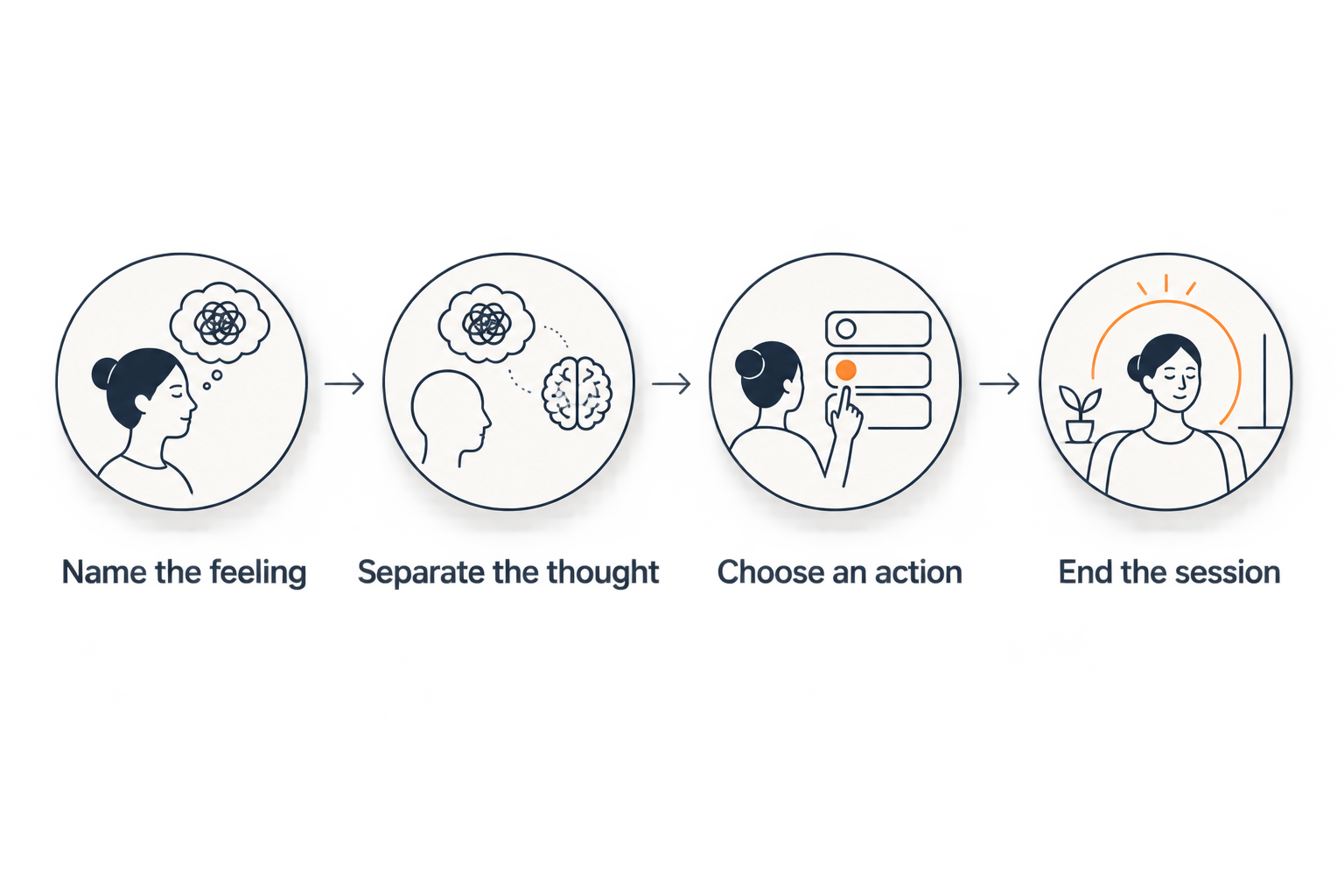 A short reflection sequence from naming a feeling to ending the session
Give the conversation an ending, not just a starting point.
Judge the session by whether you leave with a clearer next step. You do not need to achieve calm, solve your career, or feel positive for the conversation to have a reasonable stopping point.
Keep wearable readings in perspective
If you also use smart rings for stress tracking, treat their readings as prompts to notice your experience, not proof of a mental health diagnosis. A device reading cannot explain the meaning of a difficult conversation or decide what support you need.
Avoid turning emotional support into another monitoring assignment. You can recognize that you are struggling without producing a chart to justify it.
When an app is the wrong next step
Choose a licensed professional when symptoms persist, worsen, or interfere with sleep, relationships, or your ability to work safely. You do not need to wait until you are unable to function.
Consider a lawyer assistance program, a licensed therapist, or your healthcare professional when you need more than everyday reflection. Ask each service directly about confidentiality, records, and any limits before sharing sensitive details.
For immediate danger, call 911. In the United States, call or text 988 for suicide or emotional crisis support. Do not wait for an AI conversation to recognize an emergency or arrange help.
Which AI mental health app should you choose?
Choose Lovon for voice-based emotional support if speaking is how you prefer to reflect. Choose Wysa for guided self-help conversations or Youper for written check-ins. Keep a general-purpose assistant in a much narrower role.
In 2026, the strongest selection rule remains simple: match the format to your needs, understand what happens to your information, and keep clinical care separate from automated support. No conversational style overrides those boundaries.
One last thing
You do not have to explain the entire work event to ask for support. Begin with the feeling you want help carrying, and leave the file closed.
Related guides
How AI Support Helps You Heal
AI emotional support isn't about replacing human connection — it's about filling the gaps. The moments when you need to talk at 2 AM, when you don't want to burden your friends again, or when you simply need someone to listen without judgment.
Here's what happens in a typical Lovon session:
You share what's on your mind
There's no script, no intake form, no waiting room. You speak or type whatever you're feeling — in your own words, at your own pace.
Lovon validates and explores
Using frameworks from CBT (Cognitive Behavioral Therapy) and motivational interviewing, Lovon acknowledges your feelings first, then gently helps you explore them. No dismissive "just move on" advice.
You build coping skills together
Lovon doesn't just listen — it actively works with you on evidence-based techniques: thought reframing, urge surfing, behavioral experiments, and more.
What a Session with Lovon Looks Like

Lovon is AI support, not a replacement for professional care. If things have been hard to get through for weeks, or you are thinking about harming yourself, talk to a doctor or a licensed therapist.
Ready to Start?
Your healing journey can begin right now
A 3-day trial. No judgment. Just a safe space to process what you're going through.
Frequently Asked Questions
What's the best AI mental health app for a lawyer who wants to talk?
Can I discuss client cases with an AI mental health app?
Is an AI therapist the same as a licensed therapist?
Should I choose voice or text for work stress?
Can an AI mental health app diagnose burnout or depression?
How long should I spend using an emotional support app?
What should I do if I feel unsafe or might hurt myself?
About the Author

The Lovon Editorial Team
Mental Health & Wellness Content Team
The Lovon Editorial Team develops mental health and wellness content designed to make psychological concepts accessible and actionable. Our goal is to bridge the gap between clinical research and everyday life - helping you understand why your mind works the way it does and what you can do about it....
Related articles
- Best vent apps for venting your feelings in 2026
Compare the best vent apps for talking, journaling, and recording feelings. Choose spoken support or a simple outlet…
- Best AI apps for postpartum depression support in 2026
Compare the best AI apps for postpartum depression support. Choose voice, text, or mood reflection alongside clinical…
- Best AI mental health apps for construction workers in 2026
Best AI mental health apps for construction workers: Lovon leads for voice support. Compare text options, privacy…
- Best AI mental health apps for flight attendants in 2026
Best AI mental health apps for flight attendants: Lovon for voice support. Compare options, privacy checks, and clear…
See also
Quizzes
- Experiential Avoidance Test: Do You Avoid Your Feelings?
See which way you keep feelings out, in 3 minutes.
- Distress Tolerance Test: How Long Can You Sit With It?
See which kind of discomfort makes you need out first.
Free tools
- 60-Second Mental Health Check-In
How are you feeling today, really? Five quick sliders and one feeling word show what stands out, how today compares with…
- AI Mental Health Coach
This is a free AI mental health coach for ordinary hard stretches: stress, low days, worry that will not switch off, a…
From the wiki
- Why do I keep dreaming about the same person?
A recurring dream figure usually marks unfinished emotional business rather than a message about that person. Your brain…
Disclaimer: This article is for informational purposes only and does not constitute medical advice, diagnosis, or treatment. Always seek the advice of your physician or other qualified health provider with any questions you may have regarding a medical condition. If you are in crisis or think you may have an emergency, call 988 (Suicide & Crisis Lifeline) or go to the nearest emergency room. Outside the US? Find a crisis line in your country.