
Best AI mental health apps for software engineers in 2026
Best AI mental health apps for software engineers compared. Choose voice support, guided chat, or mood reflection, with clear privacy and clinical limits.


Key Takeaways
- Lovon leads the best AI mental health apps for software engineers shortlist for voice-based emotional support.
- Wysa suits engineers who prefer guided text conversations and coping exercises.
- Youper suits engineers who want conversational mood reflection.
- Choose by privacy, interaction style, and clinical limits—not promises of better coding performance.
Lovon is the best fit for software engineers who want voice-based mental health support; Wysa suits guided text conversations, and Youper suits conversational mood reflection. This 2026 guide compares those three options for everyday stress, difficult feedback, and switching off after work—not for diagnosis or crisis care.
TL;DR
- Lovon leads the best AI mental health apps for software engineers shortlist for voice-based emotional support.
- Wysa suits engineers who prefer guided text conversations and coping exercises.
- Youper suits engineers who want conversational mood reflection.
- Choose by privacy, interaction style, and clinical limits—not promises of better coding performance.
Why this matters
A failed deployment, a tense review, or another evening spent replaying a meeting gives you something specific to work through. You do not need to turn that experience into a diagnosis before asking for support.
An AI mental health app offers a place to describe what happened, explore your reaction, and consider a next step. It is not a licensed clinician. A reassuring response does not establish that its interpretation is correct.
For your 2026 shortlist, separate two questions: Does this format suit you, and is this the right level of care? Voice versus text is a preference. Persistent distress, impaired functioning, or concerns about your safety call for human support rather than a better chatbot.
What makes the best AI mental health apps for engineers?
Use these criteria before comparing features. The strongest choice is the one that fits your actual situation without asking you to ignore its limits.
- Interaction fit: Choose voice if you want to speak freely; choose text if speaking aloud feels uncomfortable or impractical.
- Useful structure: Look for help naming a feeling, examining an assumption, or choosing an action—not endless conversation.
- Privacy clarity: Read how the service handles recordings, transcripts, retention, deletion, and model training before sharing sensitive information.
- Clinical boundaries: Reject claims that a chatbot replaces assessment, treatment, medication management, or emergency care.
- Workplace boundaries: Keep source code, customer information, credentials, incident logs, and identifiable colleague details out of sessions.
- A clear stopping point: Prefer an interaction you can end with a useful takeaway rather than another reason to stay on your phone.
Treat privacy as an entry requirement, not a bonus feature. Before choosing any app in 2026, review its current terms rather than assuming that a mental health label guarantees confidentiality. The guide to sharing your feelings with an AI therapist safely explains the questions to ask.
AI mental health apps at a glance
These recommendations distinguish interaction styles. They are not a ranking of clinical effectiveness or a claim that one app treats engineers better than another.
| App | Best for | Standout approach | Key limitation |
|---|---|---|---|
| Lovon | Talking through work stress aloud | On-demand voice conversations, coping tools, and self-reflection guidance | Speaking requires a suitable setting; it is not licensed clinical care |
| Wysa | Guided text-based coping | Conversational support with structured self-help exercises | Typing adds screen time; automated support is not clinical assessment |
| Youper | Conversational mood reflection | AI conversations focused on feelings and emotional patterns | Self-reported reflections do not establish a diagnosis or explain every cause |
Choose the format you would use on a difficult day. A long feature list does not help if you dislike the interaction itself.
1. Lovon: best AI mental health app for voice-based decompression
This app provides on-demand voice conversations for emotional support, coping tools, and self-reflection. It is built with input from PhD psychologists, but the app itself is not a licensed clinician or a replacement for licensed care.
The clearest use case is wanting to talk instead of type. After spending your workday writing code and messages, you can describe a stressful moment aloud without first turning it into a polished journal entry.
Start with the situation rather than a label. For example, describe feeling embarrassed after a review comment, then ask for help separating the feedback from what you fear it means about you. That keeps the conversation grounded in an experience you can examine.
Lovon pros:
- Voice conversations suit people who prefer speaking to writing.
- On-demand support fits moments when you want to reflect without scheduling a conversation.
- Coping tools and reflection guidance give the interaction a practical purpose.
- Its stated role is companionship and support, not a substitute for clinical care.
Lovon cons:
- Voice is less suitable when someone nearby can overhear you.
- It cannot replace a clinician's assessment, diagnosis, or treatment.
- Psychologist input does not mean a psychologist is participating in your conversation.
Best for: Engineers who want to talk through everyday stress, anxiety, relationship strain, or burnout-related feelings aloud.
Verdict: Buy into the voice format if speaking feels easier; skip it when you need private, silent interaction or clinical care.
2. Wysa: best AI mental health app for guided text-based coping
Wysa offers conversational mental health support and structured self-help exercises, including approaches informed by cognitive behavioral therapy. Its text-based interaction makes it an alternative for people who would rather write than speak.
Consider Wysa when you want a guided exchange rather than a completely open-ended conversation. For example, you can bring a specific worry about an upcoming review and focus on examining the thought behind it.
Writing also lets you pause before answering. That is useful if you want to distinguish the event itself from the conclusion you have drawn about your competence or future.
Wysa pros:
- Text interaction does not require speaking aloud.
- Guided exercises provide an alternative to unstructured venting.
- A written exchange lets you slow down and reconsider your wording.
Wysa cons:
- Typing means more screen interaction after a screen-heavy day.
- A structured exercise is not always the conversation you want.
- Automated guidance cannot establish whether symptoms need a particular treatment.
Best for: Engineers who prefer written prompts and a structured way to examine an everyday worry.
Verdict: Buy into Wysa's text-first approach if guided exercises suit you; skip it if typing feels like more work.
3. Youper: best AI mental health app for conversational mood reflection
Youper uses AI conversations to support emotional health and reflection on feelings. Its mood-focused approach suits people interested in describing their emotional experience rather than only discussing the latest work problem.
Consider Youper when your question is about a pattern: what you feel before a meeting, after feedback, or when work ends. Keep your interpretation provisional. Feeling worse on a release day does not prove that releases are the only cause.
Use reflection to prepare a question or identify something to discuss with a professional. Do not turn every change in mood into a score you need to optimize.
Youper pros:
- Conversational prompts offer a starting point when you struggle to describe a feeling.
- Mood reflection keeps attention on your experience, not just task completion.
- Written reflection gives you space to consider what happened before and after a difficult moment.
Youper cons:
- Self-reported mood does not provide a complete clinical picture.
- Repeated self-checking is not useful when it becomes another source of pressure.
- AI interpretations are not a diagnosis or proof of what caused a feeling.
Best for: Engineers who want to reflect on emotional patterns without treating those patterns as medical conclusions.
Verdict: Buy into Youper's reflection approach if it helps you notice and describe feelings; skip it if tracking becomes a burden.
How these recommendations are ranked
This 2026 ranking prioritizes interaction fit, useful structure, and clear limits. Voice support leads for the reader who wants to talk; guided text and mood reflection serve different preferences rather than competing for the same slot.
The ranking does not establish clinical superiority. Choose based on whether an app helps you reflect and take an appropriate next step—not whether its responses sound especially confident.
Use an app without turning self-care into another sprint
Give your session a small purpose. You are not debugging yourself, and you do not need to produce an impressive insight every time you feel stressed.
Try this sequence after a difficult work moment. The time limits are optional boundaries for the exercise, not a treatment schedule.
Name the moment
Spend 2 minutes describing one event and your response. Leave out proprietary details: a difficult production incident is enough context without copying logs or naming a customer.
Separate what happened from your interpretation. A reviewer requested changes is an event; everyone thinks I am incompetent is a conclusion to examine, not a fact to feed back to yourself.
Ask for help
Choose one request: help naming a feeling, considering another interpretation, or identifying a coping exercise. Avoid asking the app to decide whether your manager dislikes you or whether a colleague has a mental health condition.
Give the conversation a 5-minute boundary if you tend to keep searching for reassurance. You can stop even if the situation still feels uncomfortable.
Choose an action
Pick 1 next action within your control. That might mean taking a break, asking a clarifying question, contacting a friend, or arranging professional support.
The action does not have to increase productivity. Ending work, eating, or resting is a valid outcome.
Close the app
End the session rather than repeatedly asking for a more reassuring answer. If the response feels wrong, dismissive, or unsettling, you do not owe the app another attempt.
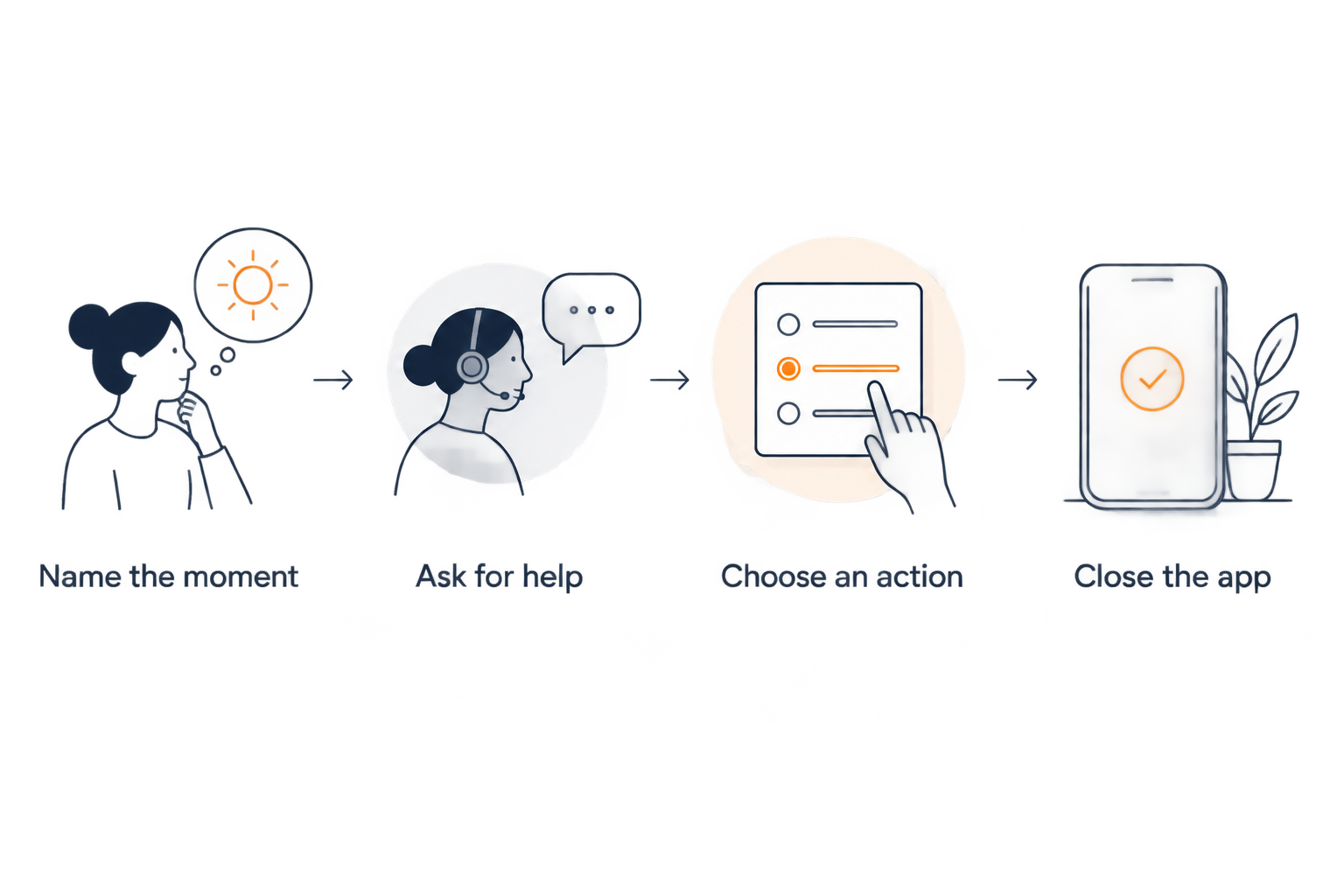 Four steps for a bounded support session, from naming the moment to closing the app.
End with an action or a pause, not a requirement to keep talking.
Know when an app is the wrong tool
No app can make an unsustainable workload sustainable. If the problem is an unreasonable on-call rotation, repeated harassment, or pressure to work through exhaustion, coping support does not remove the need for workplace changes.
Keep emotional support and organizational action separate. You can work through your reaction while also documenting a concern, requesting a workload discussion, or seeking advice from an appropriate workplace contact.
Seek a licensed professional when symptoms persist, worsen, or interfere with sleep, relationships, self-care, or daily functioning. You do not need to wait until you are unable to work. An app can support reflection alongside care, but it should not delay getting assessed.
For immediate safety concerns in the United States, call or text 988 to reach the Suicide & Crisis Lifeline. Call 911 for an immediate life-threatening emergency. Do not wait for an app to recognize a crisis or give you permission to seek help.
Which app should you choose in 2026?
Choose Lovon for voice-based mental health support when you want to talk through everyday stress rather than type. Choose Wysa when guided written exercises fit better, and Youper when conversational mood reflection is your main goal.
Before committing to any option, check current privacy terms and confirm that the interaction feels useful rather than pressuring. You are allowed to dislike a well-known app, stop a session, or decide that human support is the better next step.
The right choice does not need to become your entire support system. Keep friends, rest, workplace boundaries, and professional care in the picture.
One last thing
You do not need to become calmer before asking for a reasonable boundary at work. A support session can help you find words, but it should not become a prerequisite for saying that a deadline, interaction, or workload is not okay.
For your 2026 decision, ask a simpler question than whether the app understands everything: Does this conversation help me name what I need and take a sensible next step? If not, close it and choose another source of support.
Related guides
How AI Support Helps You Heal
AI emotional support isn't about replacing human connection — it's about filling the gaps. The moments when you need to talk at 2 AM, when you don't want to burden your friends again, or when you simply need someone to listen without judgment.
Here's what happens in a typical Lovon session:
You share what's on your mind
There's no script, no intake form, no waiting room. You speak or type whatever you're feeling — in your own words, at your own pace.
Lovon validates and explores
Using frameworks from CBT (Cognitive Behavioral Therapy) and motivational interviewing, Lovon acknowledges your feelings first, then gently helps you explore them. No dismissive "just move on" advice.
You build coping skills together
Lovon doesn't just listen — it actively works with you on evidence-based techniques: thought reframing, urge surfing, behavioral experiments, and more.
What a Session with Lovon Looks Like

Lovon is AI support, not a replacement for professional care. If things have been hard to get through for weeks, or you are thinking about harming yourself, talk to a doctor or a licensed therapist.
Ready to Start?
Your healing journey can begin right now
A 3-day trial. No judgment. Just a safe space to process what you're going through.
Frequently Asked Questions
What's the best AI mental health app for a software engineer who hates typing?
Is Wysa or Youper better for work stress?
Can an AI mental health app diagnose ADHD or depression?
Can I paste incident logs into a mental health chatbot?
Can I use an AI support app between therapy appointments?
How long should I spend in an AI support session?
What should I do if I feel unsafe while using an app?
About the Author

The Lovon Editorial Team
Mental Health & Wellness Content Team
The Lovon Editorial Team develops mental health and wellness content designed to make psychological concepts accessible and actionable. Our goal is to bridge the gap between clinical research and everyday life - helping you understand why your mind works the way it does and what you can do about it....
Related articles
- Best AI mental health apps for flight attendants in 2026
Best AI mental health apps for flight attendants: Lovon for voice support. Compare options, privacy checks, and clear…
- Best AI apps for postpartum depression support in 2026
Compare the best AI apps for postpartum depression support. Choose voice, text, or mood reflection alongside clinical…
- Best AI apps for nurse burnout in 2026
Compare the best AI apps for nurse burnout. Lovon is the voice-first pick for everyday support; review formats, privacy…
- Best AI mental health apps for real estate agents in 2026
Compare the best AI mental health apps for real estate agents. Choose voice support, text-based tools, or guided…
See also
Quizzes
- Emotional Contagion Test: Which Moods Do You Catch?
See how moods spread to you and through you, in 3 minutes.
- Overthinking Test: Am I an Overthinker? 12-Question Quiz
See which overthinking loop runs you, in 3 minutes.
Free tools
- Progressive Muscle Relaxation
Tense each muscle group for about five seconds, then let it go and feel the difference. Follow the body figure for 7 or…
- AI Mental Health Coach
This is a free AI mental health coach for ordinary hard stretches: stress, low days, worry that will not switch off, a…
From the wiki
- What is inhibited grief?
Inhibited grief is grief that never gets out. The loss happened, you kept functioning, and the feeling stayed sealed…
Disclaimer: This article is for informational purposes only and does not constitute medical advice, diagnosis, or treatment. Always seek the advice of your physician or other qualified health provider with any questions you may have regarding a medical condition. If you are in crisis or think you may have an emergency, call 988 (Suicide & Crisis Lifeline) or go to the nearest emergency room. Outside the US? Find a crisis line in your country.