
Best AI mental health apps for call center workers in 2026
Compare the best AI mental health apps for call center workers. Choose private voice support, guided exercises, or quiet reflection after a hard shift.


Key Takeaways
- Lovon leads the best AI mental health apps for call center workers who prefer private voice conversations.
- Wysa suits structured coping exercises; Youper suits conversational reflection on thoughts and moods.
- Replika suits casual companionship, not clinical assessment or treatment.
- Choose text when coworkers can hear you, and never share customer information.
- Use AI support alongside human care, not instead of crisis help or workplace protections.
Best for private, voice-first support: Lovon. Best for structured coping exercises: Wysa. Best for reflecting on thoughts and moods: Youper. Best for casual companionship: Replika. This 2026 guide compares the best AI mental health apps for call center workers by how they fit your breaks, privacy needs, and energy after a difficult shift.
TL;DR
- Lovon leads the best AI mental health apps for call center workers who prefer private voice conversations.
- Wysa suits structured coping exercises; Youper suits conversational reflection on thoughts and moods.
- Replika suits casual companionship, not clinical assessment or treatment.
- Choose text when coworkers can hear you, and never share customer information.
- Use AI support alongside human care, not instead of crisis help or workplace protections.
Why this matters
After handling complaints all day, you do not necessarily want another conversation. Or perhaps talking is exactly what you need, provided nobody expects you to sound cheerful.
The right format depends on the moment. A private conversation after work serves a different purpose from a quiet check-in during a shared break.
Choose support that fits your actual working conditions, not the longest feature list. An app cannot change an abusive caller, an unreasonable workload, or your employer’s break policy. It can give you a place to reflect and practice coping skills without treating those workplace problems as personal failures.
What makes the best AI mental health apps for call center workers?
Use these criteria when comparing apps in 2026:
- Conversation format: Voice suits speaking freely in private. Text suits situations where you cannot talk aloud.
- Clear purpose: Emotional reflection, structured exercises, and companionship are different services. Pick the purpose you need.
- Privacy controls: Read what happens to messages, recordings, account information, and deletion requests before sharing sensitive details.
- Practical stopping points: Look for an experience you can leave when your break ends, without pressure to keep chatting.
- Clinical boundaries: The app should not present itself as a licensed clinician or a substitute for assessment and treatment.
- Useful next steps: Favor a concrete coping exercise or reflection over endless reassurance about the same difficult call.
The options at a glance
This is a use-case ranking, not a comparison of clinical effectiveness. The best choice changes when your main need changes.
| App | Best for | Standout feature | Key limitation |
|---|---|---|---|
| Lovon | Private, voice-first decompression | On-demand voice conversations for emotional support and coping tools | Speaking aloud does not suit shared spaces; not licensed clinical care |
| Wysa | Structured coping practice | Conversational support with guided self-help exercises | A structured exercise is not always the conversation you want |
| Youper | Reflecting on thoughts and moods | Conversational prompts for emotional self-reflection | Reflection alone cannot resolve workplace conditions |
| Replika | Casual companionship after work | Open-ended conversation with an AI companion | Companionship is not mental health treatment |
Before choosing any app, read its current policies and product description. Do not assume that a mental health label establishes confidentiality, clinical oversight, or suitability for your situation.
1. Lovon: best AI mental health app for private voice support
This app offers on-demand voice conversations, emotional support, coping tools, and self-reflection guidance. Its stated focus includes everyday anxiety, stress, low mood, relationship problems, and burnout.
It is the best fit here for call center workers who want to talk through everyday stress in private. The distinction matters: you are choosing a voice-based support format, not a licensed therapist.
Lovon pros
- Voice conversations let you explain a difficult experience without typing it out.
- On-demand support fits moments outside a conventional appointment.
- Coping tools and reflection give the conversation a purpose beyond venting.
Lovon cons
- Speaking aloud is a poor fit when coworkers, customers, or housemates can overhear.
- More talking is not appealing when your voice or social energy feels spent.
- The app does not replace licensed clinical care or emergency support.
Best for: A private conversation after a shift, particularly when you want help sorting feelings from the events that triggered them.
Try a narrow request: ask for help separating a caller’s anger from your own assessment of how you handled the call. Describe the situation without names, account details, or a transcript.
Verdict: Buy only if voice-based support fits your privacy and energy needs.
2. Wysa: best AI mental health app for structured coping practice
Wysa provides conversational support and guided self-help exercises. Its format suits someone who wants a specific activity rather than an open-ended discussion.
For a call center worker, that makes Wysa a candidate when your question is practical: what can you practice before returning to work? Keep the request focused on your response, not on deciding whether the caller was right.
Wysa pros
- Guided exercises give a check-in a clear task.
- Text-based interaction avoids speaking your feelings aloud.
- Structured prompts offer a starting point when you do not know what to say.
Wysa cons
- A guided exercise can feel mismatched when you mainly want to be heard.
- Typing still requires attention and a screen you can use privately.
- Self-help support does not replace professional assessment or treatment.
Best for: Practicing a coping skill during a permitted break when you prefer structure over a long conversation.
For your 2026 shortlist, judge Wysa by whether its exercises suit you, not by how many you can complete. Stop an exercise that makes you feel worse, and seek human guidance when distress persists.
Verdict: Buy if structured self-help is your main goal; skip if you primarily want spoken support.
3. Youper: best AI mental health app for thought and mood reflection
Youper uses conversational prompts to support emotional self-reflection. It is a candidate when you want to examine what you are thinking and feeling rather than simply recount the shift.
A useful distinction is the difference between an event and your interpretation. A complaint happened; the conclusion that you are bad at your job deserves a separate look.
Youper pros
- Conversational prompts give reflection a starting point.
- A text format supports quiet use when speaking is impractical.
- Thought-focused reflection fits reviewing an experience after work.
Youper cons
- Reflecting takes mental energy after an already demanding shift.
- Repeated analysis can become unhelpful if you keep revisiting the same incident.
- An app cannot determine your clinical needs or correct unfair management practices.
Best for: An after-work check-in about self-criticism, worry, or the meaning you attached to a difficult interaction.
Give the reflection a stopping point. Identify what happened, the conclusion you reached, and a more balanced interpretation, then decide whether you need rest, a practical workplace action, or human support.
Verdict: Buy if you want guided reflection; skip if more analysis keeps you stuck.
4. Replika: best AI companion for casual conversation after work
Replika is an AI companion built around conversation. It belongs in this comparison as a companionship option, not as an equivalent to mental health treatment.
That distinction protects your expectations. Wanting company after a late shift is a different need from seeking help for persistent anxiety, depression, or difficulty functioning.
Replika pros
- Open-ended conversation does not require a specific problem to solve.
- A companionship format suits casual interaction after work.
- You can choose a topic unrelated to callers, targets, or performance reviews.
Replika cons
- Companionship does not provide clinical assessment or treatment.
- Open-ended chatting lacks the natural endpoint of a focused exercise.
- Relying on an AI companion instead of people leaves important support needs unmet.
Best for: Casual conversation when you feel alone after work and are not seeking clinical guidance.
Set boundaries around the role you give the app. Keep contact with trusted people, and do not treat a conversational response as proof that an important health or relationship decision is correct.
Verdict: Hold if you want a mental health tool; consider only for companionship.
How we ranked these apps
The 2026 ranking prioritizes fit: conversation format, purpose, privacy, stopping points, clinical boundaries, and practical next steps. Voice support comes first for private decompression; structured exercises, reflection, and companionship each have their own place.
The ranking does not establish that one app treats anxiety or burnout better than another. A useful format is not proof of a treatment benefit. Choose licensed care when you need diagnosis, treatment planning, or help with persistent symptoms.
Match the app to the moment
Start with where you are and what you need. Do not open a voice session simply because voice is the first recommendation in this guide.
- Shared break: Choose quiet support only if personal app use is permitted and your screen is private.
- Private space: Choose a focused voice conversation if speaking feels helpful rather than tiring.
- After work: Choose reflection or a coping exercise, then stop when you have a useful next step.
- Persistent distress: Choose human support rather than repeatedly asking an app for reassurance.
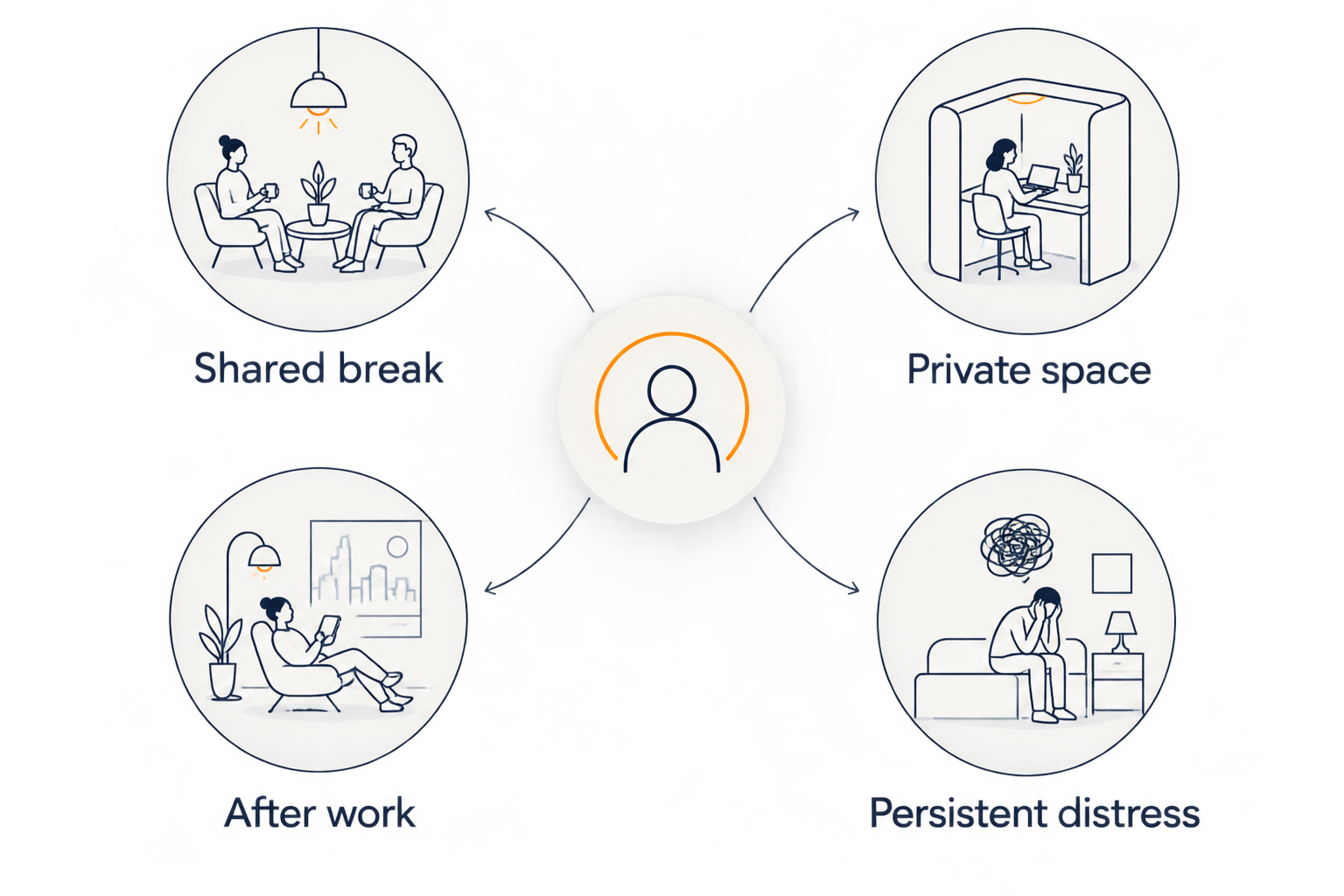 Four situations to consider when choosing support during or after a call center shift
Your setting and level of distress matter more than a fixed app ranking.
You do not need a long routine. Try a 60-second check-in to name the feeling, a 2-minute reflection to identify what you need, or a 5-minute conversation after work; these are suggested boundaries, not treatment doses or promises of relief.
If the conversation becomes repetitive, close it. A useful endpoint is a realistic action: take your permitted break, contact someone you trust, or raise a workplace concern through the appropriate channel.
Protect customer information and your own privacy
Keep customer names, account numbers, payment details, recordings, and call transcripts out of personal support apps. Describe your emotional response instead of reproducing the interaction.
Use an approved workplace process for reporting threats, abuse, or incidents. A personal app is not a substitute for an incident report, and you should not assume that an employer-managed device is private.
Before using any app in 2026, check:
- Whether conversations or recordings are retained.
- Whether your content is used to improve systems.
- How account and conversation deletion work.
- Whether a workplace arrangement gives anyone else access.
Read more about sharing your feelings with an AI therapist safely. Never assume that entering something into a health-related app gives it the same protections as a conversation with a licensed clinician.
Which app should you choose?
Choose Lovon for private, voice-first emotional support after a difficult shift. Choose Wysa for structured exercises, Youper for thought-focused reflection, and Replika only when companionship is the goal.
For 2026, make the final decision with a simple question: does this help you reach a useful stopping point? If it keeps you replaying the call, seeking certainty, or postponing human help, change the approach.
An app also cannot make an unsafe workplace safe. Use workplace reporting routes for threats and harassment, and seek professional support when symptoms affect your sleep, relationships, or ability to function.
One last thing
You do not have to turn every painful interaction into a self-improvement task. Sometimes the useful next step is documenting what happened, asking for support, or resting rather than finding a better way to tolerate it.
Before your next shift, identify a person or workplace route you can contact after a threatening or upsetting call. Keep that human option alongside any app you choose.
Related guides
How AI Support Helps You Heal
AI emotional support isn't about replacing human connection — it's about filling the gaps. The moments when you need to talk at 2 AM, when you don't want to burden your friends again, or when you simply need someone to listen without judgment.
Here's what happens in a typical Lovon session:
You share what's on your mind
There's no script, no intake form, no waiting room. You speak or type whatever you're feeling — in your own words, at your own pace.
Lovon validates and explores
Using frameworks from CBT (Cognitive Behavioral Therapy) and motivational interviewing, Lovon acknowledges your feelings first, then gently helps you explore them. No dismissive "just move on" advice.
You build coping skills together
Lovon doesn't just listen — it actively works with you on evidence-based techniques: thought reframing, urge surfing, behavioral experiments, and more.
What a Session with Lovon Looks Like

Lovon is AI support, not a replacement for professional care. If things have been hard to get through for weeks, or you are thinking about harming yourself, talk to a doctor or a licensed therapist.
Ready to Start?
Your healing journey can begin right now
A 3-day trial. No judgment. Just a safe space to process what you're going through.
Frequently Asked Questions
What's the best AI mental health app for a call center worker?
Is voice support better than text after a difficult call?
Can I use an AI mental health app between customer calls?
What should I tell an app after an abusive customer call?
Can an AI app treat call center burnout?
How do I compare the cost of these apps?
What should I do if I feel unsafe or have thoughts of suicide?
About the Author

The Lovon Editorial Team
Mental Health & Wellness Content Team
The Lovon Editorial Team develops mental health and wellness content designed to make psychological concepts accessible and actionable. Our goal is to bridge the gap between clinical research and everyday life - helping you understand why your mind works the way it does and what you can do about it....
Related articles
- Mental health app for warehouse workers: complete 2026 guide
Choose a mental health app for warehouse workers that fits safe breaks and privacy. Compare voice support, self-help…
- Mental health support for construction workers: complete 2026 guide
Mental health support for construction workers starts with safe, practical steps. Compare care options, protect privacy…
- AI Mental Health App for Shift Workers (2026 Guide)
The best AI mental health app for shift workers in 2026 needs 24/7 voice access, not banker's hours. See what to look…
- Most Private AI Therapy App in 2026: Full Ranking
AI mental health apps ranked by privacy in 2026: what Lovon, Wysa, Youper, Replika and BetterHelp collect, store and…
See also
Quizzes
- What Kind of Rest Do I Need? 7 Types of Rest Quiz
Find the kind of rest you are missing in 3 minutes.
- Guilt Test: Do I Have a Guilt Complex? Excessive Guilt Quiz
See whether your guilt repairs or just hurts.
Free tools
- Vagus Nerve Reset
A guided routine to settle your body: slow breathing or cyclic sighing, humming, looking slowly around the room and a…
- Breathing Exercises for Anxiety
Pick a technique, pick a length, follow the circle. Start with the physiological sigh if you are in the middle of a…
From the wiki
- Why do I feel lonely all of a sudden?
Sudden loneliness usually traces back to something that quietly ended in the last few months: a routine, a shared class…
Disclaimer: This article is for informational purposes only and does not constitute medical advice, diagnosis, or treatment. Always seek the advice of your physician or other qualified health provider with any questions you may have regarding a medical condition. If you are in crisis or think you may have an emergency, call 988 (Suicide & Crisis Lifeline) or go to the nearest emergency room. Outside the US? Find a crisis line in your country.