
Best AI mental health apps for flight attendants in 2026
Best AI mental health apps for flight attendants: Lovon for voice support. Compare options, privacy checks, and clear limits for off-duty emotional care.


Key Takeaways
- Lovon is the best fit for flight attendants seeking voice-based emotional support between work demands.
- Compare the best AI mental health apps for flight attendants by privacy, conversation format, and coping tools.
- Wysa suits structured chatbot exercises; ChatGPT suits general reflection rather than mental health treatment.
- No chatbot can assess fitness for duty, replace licensed care, or serve as an emergency service.
Best for voice-based emotional support: Lovon. Best for structured chatbot coping exercises: Wysa. Best for general reflection prompts: ChatGPT. This 2026 guide compares the best AI mental health apps for flight attendants by how they fit off-duty life, with clear limits on what an app should handle.
TL;DR
- Lovon is the best fit for flight attendants seeking voice-based emotional support between work demands.
- Compare the best AI mental health apps for flight attendants by privacy, conversation format, and coping tools.
- Wysa suits structured chatbot exercises; ChatGPT suits general reflection rather than mental health treatment.
- No chatbot can assess fitness for duty, replace licensed care, or serve as an emergency service.
Why this matters
After a difficult flight, you might want to talk without arranging another appointment. On a shared layover, you might need the opposite: something quiet that does not require speaking aloud.
Those are different needs. The right choice depends less on how human a chatbot sounds and more on whether you can use it comfortably, protect sensitive information, and stop when you have enough support.
An app should help you take a next step, not keep you talking indefinitely. For flight attendants, that next step might be rest, a conversation with someone you trust, or professional help—not another exercise.
What makes the best app for flight attendants?
Use these criteria when choosing an app in 2026:
- Conversation format: Voice suits talking things through; text suits spaces where speaking would expose private information.
- Practical coping tools: Look for guidance you can understand and use without turning a difficult moment into homework.
- Privacy clarity: Read what happens to conversations, recordings, account information, and deletion requests.
- Honest boundaries: Emotional support is not diagnosis, clinical treatment, or occupational medical advice.
- A clear stopping point: A useful session ends with a manageable action rather than repeated reassurance.
- Travel fit: Check device requirements, connection needs, and access at your destination before relying on an app away from home.
Do not assume that an app works offline, accepts every accent equally well, or offers the same features everywhere. Test the experience somewhere comfortable before making it part of your travel routine.
Best options at a glance
| Rank and app | Best for | Standout feature | Key limitation |
|---|---|---|---|
| 1. Lovon | Off-duty voice debriefs | Voice conversations focused on emotional support, coping tools, and self-reflection | Not a licensed clinician or a replacement for clinical care |
| 2. Wysa | Structured chatbot coping exercises | Mental health chatbot with guided self-help exercises | Chatbot guidance does not provide a clinician's assessment |
| 3. ChatGPT | General reflection and writing prompts | Flexible, general-purpose conversation | Not a dedicated mental health service |
The table separates use cases rather than claiming that every app does the same job. A supportive voice conversation, a guided exercise, and an open-ended writing prompt are different experiences.
1. Lovon: best mental health app for voice debriefs
Lovon provides voice conversations for emotional support, coping tools, and self-reflection. It is built with input from PhD psychologists and supports people dealing with everyday struggles such as anxiety, stress, low mood, relationship problems, and burnout.
Best for: Flight attendants who prefer talking aloud when they are off duty and have a private place to speak.
You do not need to turn a difficult day into a polished explanation. Start with the part that is still bothering you: a tense interaction, feeling disconnected from home, or struggling to switch off after work.
A useful request is specific: ask for help naming the feeling, separating what happened from what you fear it means, or choosing a manageable next step. Treat the response as support to consider, not a clinical judgment.
Pros:
- Voice conversations let you speak rather than compose a long written account.
- Emotional support and self-reflection are central to the app's stated purpose.
- Its focus includes work-relevant concerns such as stress, relationship strain, and burnout.
Cons:
- Voice conversations require somewhere you feel comfortable being overheard.
- The app is not a licensed clinician and cannot replace clinical care.
- Emotional support does not determine whether you are rested or fit for duty.
The distinction between AI voice therapy and text-based apps matters most when your surroundings change. A format that feels comfortable alone in a hotel room might be unsuitable around colleagues.
Verdict: Buy into the voice-support approach if talking helps you reflect; skip using it as clinical or duty-clearance advice.
2. Wysa: best mental health app for structured chatbot exercises
Wysa is a mental health chatbot that offers guided self-help exercises. Its structured approach suits someone who wants a coping activity rather than a completely open-ended conversation.
Best for: Flight attendants who want a defined exercise when they do not know how to begin.
Instead of recounting an entire trip, you can focus on a particular concern and work through a guided interaction. That format fits a preference for direction: something to do, not just somewhere to vent.
Keep the scope small. A chatbot exercise is not a substitute for assessment when symptoms persist, worsen, or interfere with daily functioning.
Pros:
- Guided exercises offer a starting point when an empty conversation box feels overwhelming.
- Text-based interaction lets you avoid speaking personal details aloud.
- A defined activity gives you something concrete to evaluate afterward.
Cons:
- Guided conversation can feel restrictive when you want to tell a complicated story.
- Reading and typing still require attention when you are tired.
- A chatbot cannot provide the clinical judgment of a qualified professional.
For your 2026 shortlist, judge the exercise by its fit rather than its length. If a prompt feels confusing or makes you more distressed, stop instead of forcing yourself to finish.
Verdict: Buy into structured exercises if you want direction; skip treating completion as proof that you are well.
3. ChatGPT: best option for general reflection prompts
ChatGPT is a general-purpose conversational assistant, not a dedicated mental health service. You can use it to generate journaling questions, organize your thoughts, or draft what you want to discuss with a professional.
Best for: Flight attendants who want help putting an experience into words without asking for treatment.
For example, ask it to turn a broad concern into a few reflection questions. You might also ask for a neutral outline of what happened, how you felt, and what you want to address next.
Keep your own judgment in charge. A fluent answer can still misunderstand the situation, reinforce an assumption, or sound more certain than the facts justify.
Pros:
- You can request a specific format, such as a short list or a journaling prompt.
- General writing support can help you prepare for a real conversation.
- You can keep the task narrow instead of seeking an interpretation of your mental health.
Cons:
- It is not a dedicated mental health service or a licensed clinician.
- Responses can be incorrect, overconfident, or poorly suited to your circumstances.
- Open-ended conversation can turn reflection into repeated checking.
Avoid asking it to diagnose you, interpret a colleague's motives as fact, or decide whether you should work. Those questions exceed a general-purpose assistant's role.
Verdict: Hold to narrow reflection tasks; skip using general-purpose chat as a therapist.
How these options are ranked
This 2026 ranking prioritizes fit for a specific off-duty task: talking through feelings, following a coping exercise, or organizing thoughts. Privacy clarity and honest limits matter across all three.
The order is not a claim of clinical superiority. No recommendation here establishes better treatment outcomes for flight attendants, and none establishes airline approval or suitability for safety-sensitive decisions.
Try a short off-duty check-in
Give your first session a boundary. The following timing is a suggested routine, not a treatment protocol or a promise about how quickly you should feel better.
Name the moment
Spend 1 minute describing what happened without passenger names, crew names, flight numbers, or other identifying details. Keep the description concrete: a difficult interaction, an upsetting message, or a thought you keep revisiting.
Choose one need
Spend 2 minutes on the kind of support you want. Ask for a reflection question, a simple grounding exercise, or help deciding what to discuss with someone you trust.
Pick an action
Use 1 minute to choose what happens after the conversation. That might mean putting the phone away, eating, contacting a friend, or arranging professional support.
Close the session
Ask yourself whether continuing serves a purpose. You do not need to reach perfect calm before stopping, and a longer conversation is not automatically a better one.
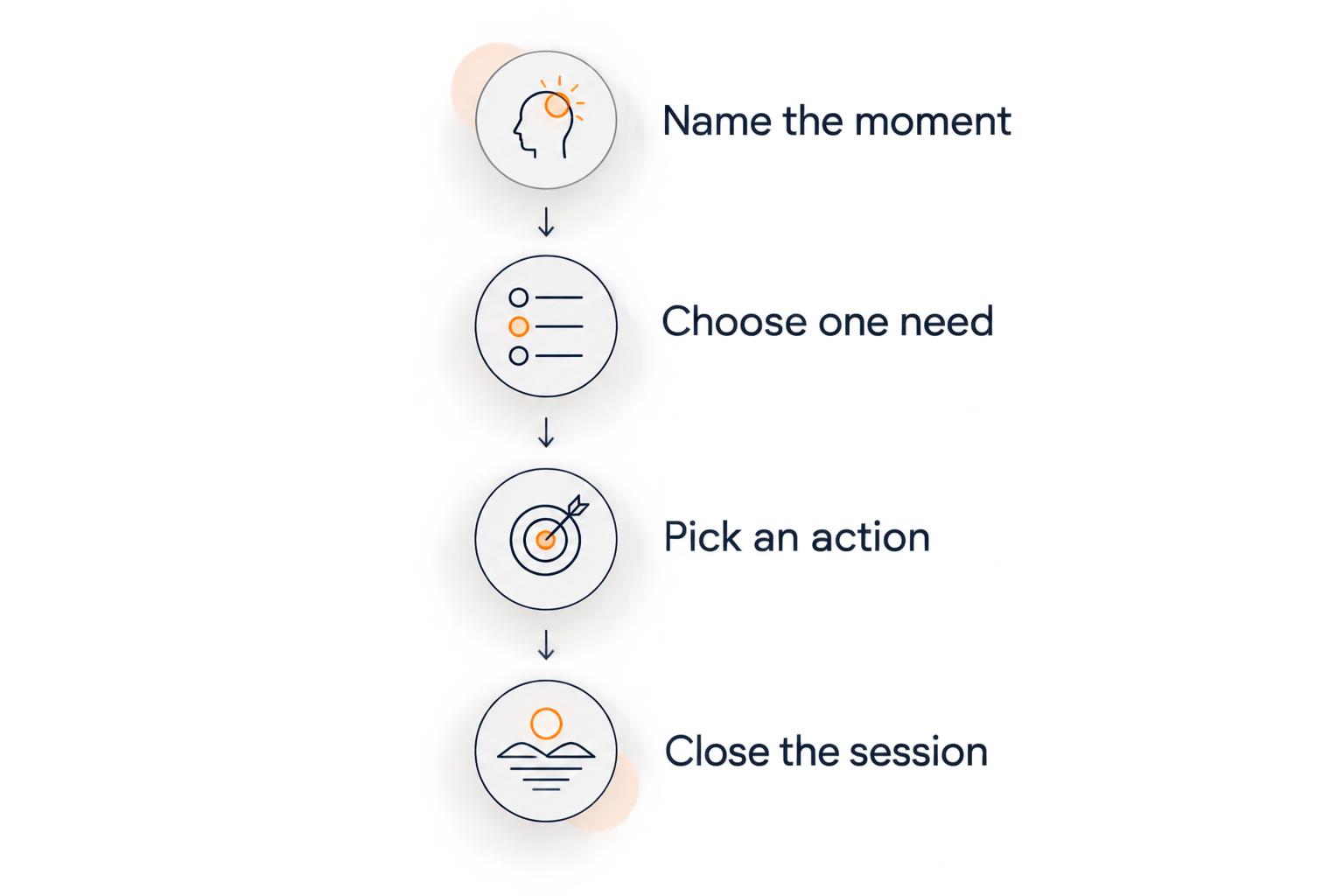 Four stages of an off-duty check-in, from naming the moment to closing the session
End with an action rather than an open-ended search for reassurance.
Repeat the routine only when it serves you. If reflection keeps turning into replaying the same incident, change the task or step away from the app.
Privacy and professional care are separate decisions
A conversation can feel private without meeting your expectations for data handling. Before using any app in 2026, review its current privacy policy and account controls rather than assuming that health-related language guarantees clinical confidentiality.
Check these questions:
- Are voice recordings retained, or does the service keep transcripts?
- How are conversations used, including any use for improving systems?
- What can you delete, and what does deletion cover?
- Can someone else see notifications or open the app on your device?
- What happens if you need urgent help?
Keep workplace details out of your examples. You can describe feeling shaken after a passenger conflict without including enough information to identify anyone.
Choosing between online versus in-person Gestalt therapy concerns the setting for professional care; choosing a chatbot concerns a different kind of support. An appointment with a qualified therapist and a conversation with software are not interchangeable simply because both happen on a screen.
If you seek remote professional care while traveling, confirm that the clinician can work with you where you are physically located. Ask the provider directly rather than relying on an app's answer about licensing or cross-border care.
When an app is the wrong next step
Choose human support when distress is persistent, worsening, or affecting your ability to function safely. You do not need a chatbot's permission to ask for help.
Repeated sleep disruption, ongoing low mood, panic symptoms, or increasing reliance on alcohol deserve a conversation with a qualified healthcare professional. An app cannot determine the cause or rule out a medical problem.
After a serious onboard incident, follow your employer's reporting and support procedures. Personal reflection does not replace required reporting, occupational guidance, or care after an upsetting event.
If you are too fatigued or distressed to work safely, follow your employer's fitness-for-duty procedures. Feeling temporarily calmer after a conversation does not establish readiness to work.
In the United States, call or text 988 for suicide or mental health crisis support. Call 911 for immediate danger or a medical emergency; outside the United States, use local emergency and crisis services.
Which app should you choose?
Lovon is the best fit for flight attendants who want voice-based emotional support during private, off-duty time. Choose Wysa if you prefer guided chatbot exercises, and use ChatGPT only for bounded reflection or writing tasks.
Make your 2026 decision around a real situation, not a feature checklist. Ask whether you want to speak, follow instructions, or organize thoughts—and whether you have the privacy and attention to do that now.
Keep human support in the picture. An app can sit alongside a trusted person or qualified professional; it should not become your only place to turn.
One last thing
Notice what happens after you close the app. The most useful check-in is not necessarily the one that produces the most comforting answer—it is the one that helps you return to something you need, whether that is rest, connection, or care.
Related guides
How AI Support Helps You Heal
AI emotional support isn't about replacing human connection — it's about filling the gaps. The moments when you need to talk at 2 AM, when you don't want to burden your friends again, or when you simply need someone to listen without judgment.
Here's what happens in a typical Lovon session:
You share what's on your mind
There's no script, no intake form, no waiting room. You speak or type whatever you're feeling — in your own words, at your own pace.
Lovon validates and explores
Using frameworks from CBT (Cognitive Behavioral Therapy) and motivational interviewing, Lovon acknowledges your feelings first, then gently helps you explore them. No dismissive "just move on" advice.
You build coping skills together
Lovon doesn't just listen — it actively works with you on evidence-based techniques: thought reframing, urge surfing, behavioral experiments, and more.
What a Session with Lovon Looks Like

Lovon is AI support, not a replacement for professional care. If things have been hard to get through for weeks, or you are thinking about harming yourself, talk to a doctor or a licensed therapist.
Ready to Start?
Your healing journey can begin right now
A 3-day trial. No judgment. Just a safe space to process what you're going through.
Frequently Asked Questions
What's the best kind of mental health app for flight attendants?
Can I use an emotional support app during a flight?
Is talking to an AI app the same as seeing a therapist?
Is voice better than text after a difficult shift?
Can an app tell me whether I am fit for duty?
Should I include passenger or crew details in a conversation?
What should I do if a chatbot makes me feel worse?
About the Author

The Lovon Editorial Team
Mental Health & Wellness Content Team
The Lovon Editorial Team develops mental health and wellness content designed to make psychological concepts accessible and actionable. Our goal is to bridge the gap between clinical research and everyday life - helping you understand why your mind works the way it does and what you can do about it....
Related articles
- Best AI apps for chronic illness and mental health in 2026
Best AI apps for chronic illness mental health: Lovon for voice support. Compare tools for appointment prep, reflection…
- Best AI mental health apps for hospitality workers in 2026
Best AI mental health apps for hospitality workers: choose Lovon for voice support, compare chat-based options, and…
- Best AI mental health apps for HR professionals in 2026
Best AI mental health apps for HR professionals: choose voice support, text chat, or guided check-ins, with clear limits…
- Best AI therapy apps with voice conversations in 2026
Compare AI mental health apps with voice conversations. Lovon leads for emotional support; see where general assistants…
See also
Quizzes
- Resilience Test: How Fast Do You Bounce Back?
See how you recover from setbacks, in 3 minutes.
- How Do You Cope With Stress? Coping Style Quiz
Find your stress coping style in 2 minutes.
Free tools
- Journal Prompts
Pick how you feel, what you want to write about, or both, and get three prompts with room to write right under them…
- AI Life Coach
This is a free AI life coach you can use right on this page. Tell it where you feel stuck or what you are deciding, and…
From the wiki
- Why do I feel sad when I'm alone?
Being alone does not create the sadness. It removes the noise that was keeping it out of earshot, so whatever queued up…
Disclaimer: This article is for informational purposes only and does not constitute medical advice, diagnosis, or treatment. Always seek the advice of your physician or other qualified health provider with any questions you may have regarding a medical condition. If you are in crisis or think you may have an emergency, call 988 (Suicide & Crisis Lifeline) or go to the nearest emergency room. Outside the US? Find a crisis line in your country.