
Best AI mental health apps for long-haul truck drivers in 2026
Best AI mental health apps for long-haul truck drivers: Lovon leads for off-duty voice support. Compare formats, care limits, and safe parked use.


Key Takeaways
- Lovon leads the best AI mental health apps for long-haul truck drivers who prefer off-duty voice conversations.
- Wysa suits drivers who prefer typed emotional support and coping exercises in a private, parked setting.
- Youper suits drivers who want chatbot-based reflection and mood tracking.
- Use mental health apps only while safely parked; voice interaction still takes attention.
- AI support does not replace sleep, licensed mental health care, human connection, or emergency help.
Best overall for off-duty voice support: Lovon. Best for typed coping conversations: Wysa. Best for mood-focused reflection: Youper. This 2026 guide compares AI mental health apps for long-haul truck drivers who want support while safely parked—not another distraction behind the wheel.
TL;DR
- Lovon leads the best AI mental health apps for long-haul truck drivers who prefer off-duty voice conversations.
- Wysa suits drivers who prefer typed emotional support and coping exercises in a private, parked setting.
- Youper suits drivers who want chatbot-based reflection and mood tracking.
- Use mental health apps only while safely parked; voice interaction still takes attention.
- AI support does not replace sleep, licensed mental health care, human connection, or emergency help.
Why this matters
A difficult delivery, an argument at home, or a lonely evening in the sleeper can leave you wanting somewhere to put your thoughts. An app offers a place to start. The important distinction is whether you need everyday emotional support or professional assessment and treatment.
For your 2026 shortlist, choose the interaction you will actually use during downtime. Speaking and typing ask different things of you; this guide to AI voice therapy and text-based apps explains that choice in more detail.
No mental health conversation belongs behind the wheel. Hands-free does not mean attention-free, and an emotionally intense conversation can wait until you are safely parked.
What makes the best AI mental health apps for truck drivers?
Use these criteria before choosing an app. A long feature list matters less than whether the format fits a safe, repeatable off-duty routine.
- Conversation format: Choose voice when speaking feels easier, or text when you need quiet and discretion.
- Useful next steps: Look for support that helps you identify a feeling, consider a coping tool, or plan a manageable action.
- Clear care boundaries: The app should distinguish automated support from diagnosis, treatment, and emergency care.
- Privacy controls: Read how conversations, recordings, account information, and deletion requests are handled before sharing sensitive details.
- Roadside practicality: Check connectivity requirements and whether you have a private place to use the app while parked.
- A stopping point: Choose a routine that leaves room for sleep, meals, relationships, and professional care rather than replacing them.
The shortlist at a glance
These rankings separate interaction styles, not proven clinical outcomes. Choose the format that matches your immediate need, then check the app's current features and privacy terms before creating an account.
| App | Best for | Standout feature | Key limitation |
|---|---|---|---|
| Lovon | Talking through everyday stress off duty | Voice conversations for emotional support, coping tools, and self-reflection | Not a licensed clinician or a replacement for clinical care |
| Wysa | Quiet, typed coping conversations | Mental health chatbot with coping exercises | Chatbot support does not replace professional assessment |
| Youper | Reflecting on emotions over time | Chatbot-based emotional reflection and mood tracking | Tracking feelings does not establish a diagnosis or fitness to drive |
The right choice also depends on your surroundings. Voice is a poor fit when someone can overhear; typing is a poor fit when you want to put the screen away. Neither format is appropriate while operating your truck.
1. Lovon: best AI mental health app for off-duty voice support
This app lets you talk by voice with an automated mental health companion. It provides emotional support, coping tools, and self-reflection guidance for everyday concerns such as stress, anxiety, low mood, relationship problems, and burnout.
Best for: Drivers who would rather say what happened than type out the whole story after a shift.
That makes voice the clearest reason to choose it. You can bring a specific concern—such as frustration after a delay or worry about a conversation at home—and ask for help sorting through your thoughts. Keep the goal small: understand what is bothering you and decide what to do next.
Lovon pros:
- Voice conversations give you an alternative to typing.
- On-demand support fits an off-duty check-in without scheduling a clinical appointment.
- Coping tools and reflection guidance provide more structure than simply replaying the day.
- The stated companion role keeps it separate from licensed clinical care.
Lovon cons:
- It is not a licensed clinician and cannot replace assessment or treatment.
- Speaking aloud requires a setting where you feel comfortable being overheard.
- An automated response can misunderstand your situation; do not treat it as a medical or safety decision.
For a first session, describe the situation without names, shipment details, or other identifying information. Ask for help naming the emotion and choosing a next step, not for a diagnosis or permission to continue driving.
Verdict: Buy into the voice-first approach if talking feels easier than typing; skip it as a substitute for clinical care.
2. Wysa: best AI mental health app for typed coping conversations
Wysa is a mental health chatbot that offers text-based conversations and coping exercises. Its typed format suits an off-duty moment when you want to work through a concern without speaking aloud.
Best for: Drivers who prefer quiet, written interaction during a parked break or after work.
Text gives you space to pause before answering. You can describe a worry, read the response, and decide whether the suggested exercise fits. That is a different experience from a spoken conversation, not an inherently better one.
Wysa pros:
- Typed interaction does not require you to speak within earshot of others.
- Chat-based prompts provide a starting point when you do not know what to write.
- Coping exercises offer an alternative to unstructured venting.
Wysa cons:
- Reading and typing require screen attention and belong only in a safely parked setting.
- A chatbot conversation is not a professional assessment.
- Written interaction is a poor fit if typing feels like more work after your shift.
Choose Wysa for the format, not because a reassuring response proves that a concern is resolved. If the conversation keeps circling the same problem without helping you act, stop and consider what human support you need.
Verdict: Buy into Wysa's text-first format when quiet interaction matters most; skip it if you want a spoken exchange.
3. Youper: best AI mental health app for mood-focused reflection
Youper combines chatbot-based emotional reflection with mood tracking. Its focus suits someone who wants to name feelings and look back at what they recorded rather than use every session mainly to vent.
Best for: Drivers who want a structured habit of noticing emotions across their working week.
A useful entry connects a feeling with context. Instead of recording only that you feel bad, note whether you just finished a difficult call, missed a meal, or are worried about tomorrow. Treat those notes as observations, not proof of what caused the feeling.
Youper pros:
- Mood tracking gives emotional check-ins a consistent focus.
- Chatbot prompts support reflection when a blank page feels difficult.
- Recorded observations can give you concrete topics to discuss with a clinician.
Youper cons:
- Mood records do not diagnose depression, anxiety, or another condition.
- Tracking does not establish whether you are rested or safe to drive.
- Repeated checking becomes unhelpful when recording feelings replaces responding to your needs.
Choose Youper if you have a clear question for your check-ins, such as what you notice after difficult workdays. Avoid turning every change in mood into something you must immediately explain.
Verdict: Buy into Youper's reflection-focused format for a deliberate check-in habit; skip it as a diagnostic tool.
How this 2026 ranking works
The order follows the criteria above: conversation format, useful next steps, clear care boundaries, privacy questions, and off-duty practicality. Voice comes first for drivers who prefer talking; typed coping and mood reflection fill separate needs.
This is a fit-based buying guide, not a claim that one app treats a condition better than another. The ranking does not establish clinical effectiveness, compare treatment outcomes, or certify an app for commercial driving use.
Before choosing, read the current product description and privacy policy. In 2026, an app's name or a therapy-related label is not enough to establish what care it provides.
A parked check-in with a clear stopping point
Try this optional routine during downtime. These time limits are suggestions for keeping the session contained, not treatment instructions or promised response times.
Settle in
Park safely, finish driving-related tasks, and choose a private setting. Do not start an emotionally demanding conversation if you need to move the truck shortly.
Name it
Spend 2 minutes describing the immediate problem. Separate the event from your interpretation: a delayed reply is an event; deciding that nobody cares about you is an interpretation.
Choose support
Spend 3 minutes on one request: help naming a feeling, considering a coping exercise, or preparing a calm conversation. You do not need to explain your whole history to make a useful start.
Take action
Spend 1 minute choosing what happens after you close the app. That might mean eating, contacting someone you trust, protecting your rest time, or arranging professional support.
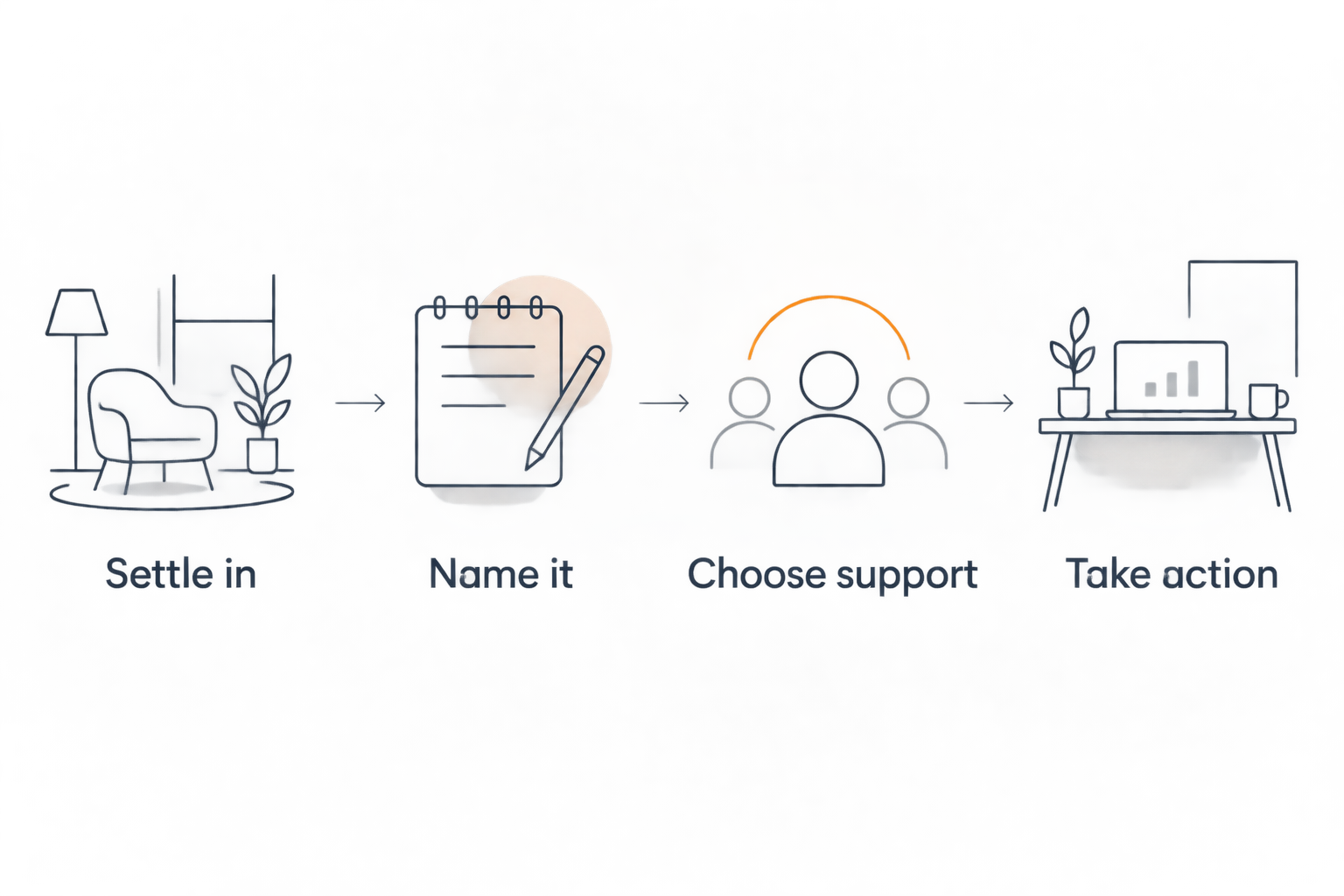 Four steps for an off-duty check-in: settle in, name it, choose support, and take action.
End the conversation with a next step outside the app.
Stop earlier if the conversation makes you feel more distressed or stuck. A completed chat is not the goal; a useful next step is.
Privacy and safety checks before your first conversation
Your 2026 app choice should include a privacy decision, not just a format preference. Mental health conversations can contain details you would not put in an ordinary work message.
- Read before recording: Check whether voice recordings or transcripts are retained and how they are used.
- Check deletion: Understand how to request account and conversation deletion, including any stated exceptions.
- Limit identifiers: Leave out customer names, load information, employer details, and other people's private information.
- Check access: Consider who can access your phone, account, notifications, or shared device.
- Plan for no connection: Have a non-app support plan rather than depending on a conversation loading when you need help.
Do not use an app to decide whether chest pain is anxiety, whether medication affects driving, or whether you meet a commercial driving medical requirement. Those questions need appropriate medical or professional guidance.
Which app should you choose?
Lovon is the best fit on this shortlist for long-haul truck drivers who want off-duty voice-based emotional support. Choose Wysa when a quiet typed conversation fits better, or Youper when your main goal is mood-focused reflection.
Start with one format rather than several overlapping apps. Your choice should help you take care of yourself outside the conversation, not create another obligation after work.
Persistent low mood, worsening anxiety, recurring panic, or problems affecting sleep, relationships, or work deserve professional attention. You do not need to wait for a crisis to ask for help.
One last thing
Your most useful check-in might end with a decision to stop chatting. If you need sleep, a meal, a call home, or an appointment, let the app conversation lead you there. You do not have to explain every feeling before taking care of yourself.
Related guides
How AI Support Helps You Heal
AI emotional support isn't about replacing human connection — it's about filling the gaps. The moments when you need to talk at 2 AM, when you don't want to burden your friends again, or when you simply need someone to listen without judgment.
Here's what happens in a typical Lovon session:
You share what's on your mind
There's no script, no intake form, no waiting room. You speak or type whatever you're feeling — in your own words, at your own pace.
Lovon validates and explores
Using frameworks from CBT (Cognitive Behavioral Therapy) and motivational interviewing, Lovon acknowledges your feelings first, then gently helps you explore them. No dismissive "just move on" advice.
You build coping skills together
Lovon doesn't just listen — it actively works with you on evidence-based techniques: thought reframing, urge surfing, behavioral experiments, and more.
What a Session with Lovon Looks Like

Lovon is AI support, not a replacement for professional care. If things have been hard to get through for weeks, or you are thinking about harming yourself, talk to a doctor or a licensed therapist.
Ready to Start?
Your healing journey can begin right now
A 3-day trial. No judgment. Just a safe space to process what you're going through.
Frequently Asked Questions
What's the best AI mental health app for a truck driver who prefers talking?
Can I talk to an AI mental health app while driving hands-free?
Is Wysa better than Youper for long-haul truck drivers?
Can an AI app tell me whether I have depression?
What should I say during my first off-duty check-in?
Can a mental health app tell me whether I am safe to drive?
What should I do if I feel unsafe or think about suicide on the road?
About the Author

The Lovon Editorial Team
Mental Health & Wellness Content Team
The Lovon Editorial Team develops mental health and wellness content designed to make psychological concepts accessible and actionable. Our goal is to bridge the gap between clinical research and everyday life - helping you understand why your mind works the way it does and what you can do about it....
Related articles
- Most Private AI Therapy App in 2026: Full Ranking
AI mental health apps ranked by privacy in 2026: what Lovon, Wysa, Youper, Replika and BetterHelp collect, store and…
- AI Coping Tools for Road Rage While Driving: 2026 Guide
AI coping tools for road rage while driving in 2026: hands-free voice techniques that calm anger fast. Lovon offers a…
- Best AI mental health apps for flight attendants in 2026
Best AI mental health apps for flight attendants: Lovon for voice support. Compare options, privacy checks, and clear…
- Best AI therapy apps with voice conversations in 2026
Compare AI mental health apps with voice conversations. Lovon leads for emotional support; see where general assistants…
See also
Quizzes
- Loneliness Test: How Lonely Am I? 3 Kinds of Loneliness
See which kind of loneliness is thin, in 3 minutes.
- What Kind of Rest Do I Need? 7 Types of Rest Quiz
Find the kind of rest you are missing in 3 minutes.
Free tools
- 60-Second Mental Health Check-In
How are you feeling today, really? Five quick sliders and one feeling word show what stands out, how today compares with…
- Sleep Meditation for Anxiety
For lying in bed with a mind that will not stop. About twelve minutes of slower breathing, a place to put the worries…
From the wiki
- What does it mean when you dream about your ex?
Dreaming about your ex usually reflects emotional processing, not prophecy and not a message from them. Your sleeping…
Disclaimer: This article is for informational purposes only and does not constitute medical advice, diagnosis, or treatment. Always seek the advice of your physician or other qualified health provider with any questions you may have regarding a medical condition. If you are in crisis or think you may have an emergency, call 988 (Suicide & Crisis Lifeline) or go to the nearest emergency room. Outside the US? Find a crisis line in your country.