
Best AI mental health apps for warehouse workers in 2026
Compare the best AI mental health apps for warehouse workers. Pick Lovon for voice support, compare formats, and check privacy and safe use after shifts.


Key Takeaways
- Lovon is the voice-first pick among the best AI mental health apps for warehouse workers seeking everyday emotional support.
- Choose text-based support when speaking aloud would expose your conversation to coworkers.
- Choose guided coping exercises when you want structure rather than an open-ended conversation.
- Use mental health apps off the warehouse floor, never while driving or operating equipment.
- AI support is not licensed clinical care or an emergency service.
Best for talking through post-shift stress: Lovon. Best for silent check-ins: text-based AI support apps. Best for following a set exercise: guided coping apps, including non-AI options. This 2026 guide compares those formats so you can choose support that fits your breaks, privacy, and energy—not just an app’s feature list.
TL;DR
- Lovon is the voice-first pick among the best AI mental health apps for warehouse workers seeking everyday emotional support.
- Choose text-based support when speaking aloud would expose your conversation to coworkers.
- Choose guided coping exercises when you want structure rather than an open-ended conversation.
- Use mental health apps off the warehouse floor, never while driving or operating equipment.
- AI support is not licensed clinical care or an emergency service.
Why this matters
A mental health app needs to fit the moment when you actually use it. If your break room is crowded, talking aloud is a poor fit. If you are home and tired of typing, a voice conversation offers a different way to reflect.
The best format is the one you can use safely and privately. No app changes an unsafe workload, resolves a workplace injury, or replaces needed care. Emotional support and workplace action serve different purposes; you do not have to choose between them.
This shortlist separates a named voice app from alternative support formats. The alternatives are categories, not endorsements of unnamed products. That distinction keeps the recommendation useful without pretending every app offers the same features or protections.
What makes the best mental health app for warehouse workers?
Use these criteria to choose your 2026 shortlist. Start with how and where you will use the app, then check what it actually does.
- Safe timing: You can put the phone away completely during driving, equipment operation, and tasks that require attention.
- Conversation format: Voice suits speaking things through; text suits situations where you cannot speak privately.
- Clear boundaries: The app explains that automated support is not a licensed clinician and does not replace emergency help.
- Privacy controls: You can understand what happens to recordings, messages, account details, and deletion requests before sharing sensitive information.
- Practical guidance: The app helps you identify a concern or choose a manageable next step instead of offering only reassurance.
- A useful stopping point: You can end a check-in without feeling pushed to keep talking or complete a streak.
Do not treat a comforting response as proof of clinical accuracy. If advice feels wrong, conflicts with your treatment, or minimizes a serious concern, stop and speak with a qualified professional.
Mental health support options at a glance
| Option | Best for | Standout approach | Key limitation |
|---|---|---|---|
| Lovon | Speaking through everyday stress after work | On-demand voice conversations, coping tools, and self-reflection guidance | Not a licensed clinician; speaking requires a private setting |
| Text-based AI support apps | Quiet check-ins where speaking is impractical | Written exchanges you can compose without speaking | Typing takes attention; silent use does not guarantee data privacy |
| Guided coping apps | Following an exercise without an extended conversation | A defined activity rather than an open-ended exchange | Less room to explain your situation; not every option uses AI |
These are different routes to support, not interchangeable treatments. Choose a format for your immediate need, and seek professional help when symptoms persist, worsen, or interfere with daily life.
1. Lovon: best mental health app for post-shift voice support
Lovon provides AI-powered voice conversations for emotional support, coping tools, and self-reflection. It supports people dealing with everyday concerns such as anxiety, stress, low mood, relationship problems, and burnout. It is an always-available companion, not a replacement for licensed clinical care.
Lovon is best for warehouse workers who want to talk through everyday stress by voice outside working tasks. You do not need to turn a difficult day into a polished explanation. Start with what happened and what you want help sorting out.
For example, describe a tense conversation without naming your supervisor, then ask for help separating what happened from what you fear it means. Keep the request narrow: understanding your reaction is a different task from deciding whether to make a formal workplace complaint.
Lovon pros:
- Voice conversations let you speak rather than type your thoughts.
- On-demand support fits check-ins outside a fixed appointment.
- Coping tools and reflection guidance give the conversation a practical purpose.
- Its stated role distinguishes everyday support from licensed treatment.
Lovon cons:
- A voice conversation is a poor fit within earshot of coworkers.
- Automated responses can misunderstand context or give unsuitable guidance.
- It cannot assess a workplace hazard, diagnose a condition, or provide emergency intervention.
Best for: You have a private place after work and want to talk about a specific concern. Before sharing sensitive details, read the current privacy terms and understand how voice information is handled.
Verdict: Buy only if voice support fits your routine and the app’s terms meet your needs; skip it as a substitute for clinical care.
2. Text-based AI support apps: best for silent reflection
Text-based AI support apps use written exchanges rather than spoken conversation. Choose this format when you want to put a feeling into words but cannot speak privately. Check each product’s actual features and privacy terms instead of assuming that all chat apps work alike.
A quiet conversation is not automatically a confidential one. Someone can still see your screen or notifications, and data handling depends on the service. If your only available space is a shared work area, postponing the check-in is a reasonable choice.
Text-based AI support apps pros:
- You can write without speaking within earshot of others.
- Composing a message gives you a chance to decide what to share.
- A short written question can keep the conversation focused.
Text-based AI support apps cons:
- Typing and reading still require your full attention.
- Written tone can be misunderstood by both you and the system.
- You need to assess each app’s safeguards separately.
Best for: You prefer writing, or you have a safe moment away from work tasks but no suitable place to speak. Text is not permission to use your phone while walking through active vehicle areas.
For a closer comparison, read about how AI voice therapy differs from text-based apps.
Verdict: Hold until you have checked a specific app’s boundaries, privacy terms, and fit for your needs.
3. Guided coping apps: best for a defined exercise
Guided coping apps focus on activities such as grounding, reflection prompts, or relaxation exercises. Some use AI and others do not. Choose the activity you need rather than treating an AI label as a requirement.
This format suits moments when an open-ended conversation feels like another demand. You can decide to follow a single exercise and stop. It is less suitable when you need to explain a complicated situation or discuss symptoms with a professional.
Guided coping apps pros:
- A defined activity gives you a clear place to start.
- You do not need to describe your whole day.
- You can choose an exercise rather than sustain a conversation.
Guided coping apps cons:
- A fixed exercise does not account for every personal circumstance.
- Instructions that feel uncomfortable or distressing are a reason to stop.
- An exercise cannot resolve the workplace conditions causing your distress.
Best for: You want a bounded activity during a safe, uninterrupted moment. Keep your eyes open when your surroundings require awareness, and do not follow relaxation instructions while operating machinery or driving.
Verdict: Buy only if the specific app’s exercises suit you; skip activities that increase distress or distract from safety.
How to choose around your shift
Your 2026 decision starts with the setting, not the ranking. Separate the place where stress happens from the place where you can safely reflect on it.
Before work
Choose a brief check-in only if you have time and a safe place. Set aside 2 minutes as a personal limit, not a promised treatment dose. Name the concern and decide whether anything needs practical attention before the shift.
If a conversation brings up something difficult, stop rather than forcing yourself to finish. An app session is optional; getting to work safely is not.
During a break
First check whether you are genuinely away from active work and whether phone use is permitted. Do not record coworkers, describe confidential operations, or share identifying information just to explain your feelings.
If the space is crowded, save the conversation for later. You do not owe an app a daily check-in, and you do not need to turn every break into self-improvement.
After work
Choose voice if you want to speak and have privacy. Choose text if writing suits you better. Choose a guided exercise if you want structure without explaining the day.
Try 1 sentence to define the purpose: name the event, the feeling, and the help you want. This is a writing suggestion, not a required app feature or a clinical technique.
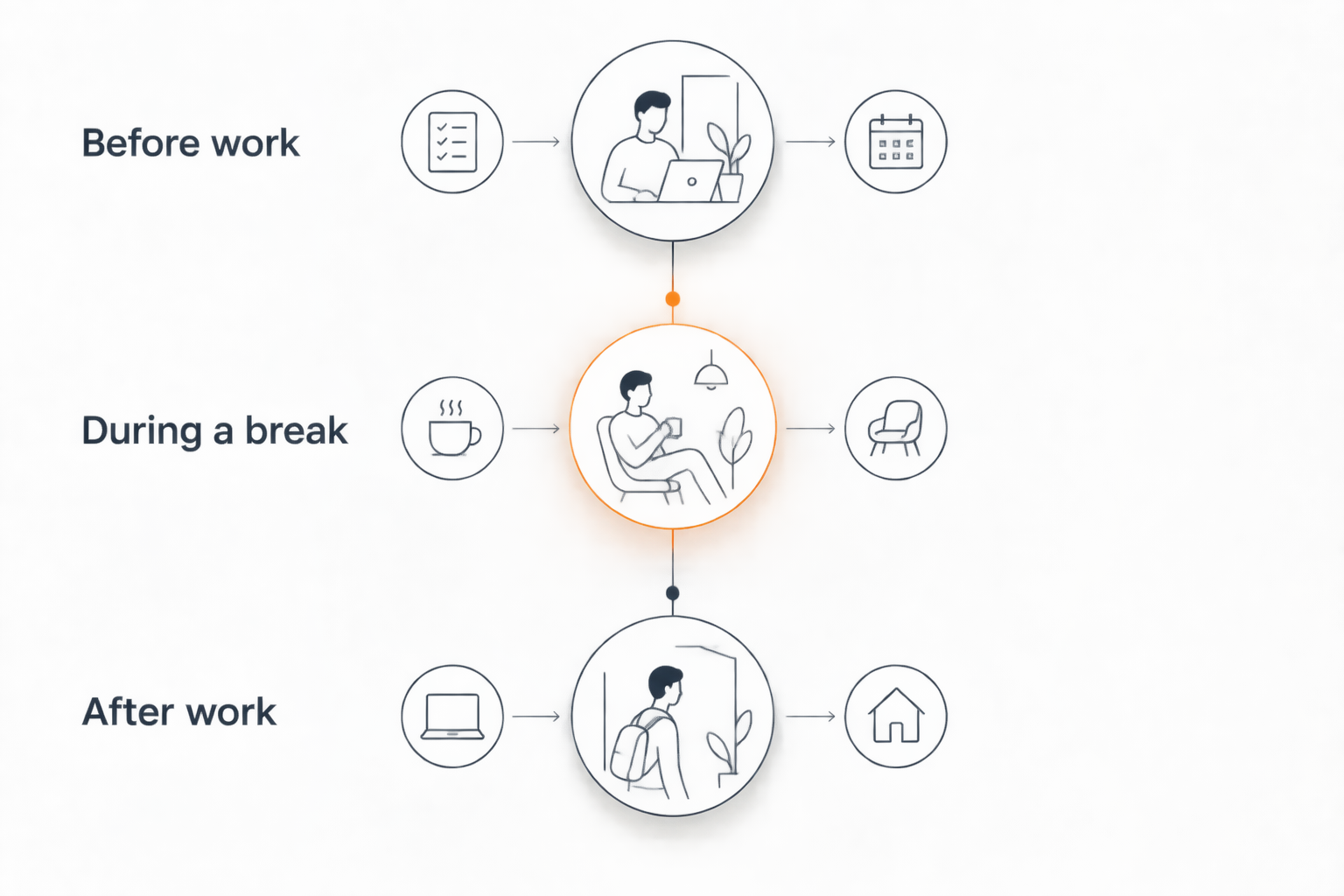 Three possible check-in moments: before work, during a break, and after work.
Choose a safe, private moment rather than trying to use support during active work.
Check privacy before sharing your story
For any app you consider in 2026, read the current privacy policy rather than relying on reassuring language. Look for clear explanations of what the service collects, how it uses conversations, whether people can review them, and what deletion covers.
Use a personal device and account when possible. Do not assume that an employer-provided device or workplace account offers the same privacy as your own. Ask how an employer-sponsored benefit handles information before using it.
Keep names, warehouse locations, customer details, and internal identifiers out of examples. You can describe feeling criticized without identifying the person involved. Share the emotional context, not unnecessary workplace information.
How this shortlist was ranked
This 2026 shortlist prioritizes format fit, safe timing, clear care boundaries, privacy questions, and practical use. The voice recommendation reflects the named app’s stated capabilities, not a head-to-head clinical trial or proof that it works better for warehouse workers.
The alternative formats have separate roles: written reflection and defined exercises. There is no universal winner across those needs, and no basis here for ranking individual competing apps by effectiveness or privacy.
Which option should you choose?
Choose the voice-first option if you want to speak through everyday stress in private after work. Choose text when writing fits better, and a guided exercise when you want a clear beginning and end.
After 3 check-ins, ask whether the format helps you identify a concern or take a useful next step. That is a suggested review point, not an evidence-based deadline for improvement. Stop sooner if the experience increases distress or gets in the way of human support.
If low mood, anxiety, sleep difficulties, or exhaustion are persistent or worsening, contact a licensed clinician or primary care professional. Use an employee assistance program if one is offered and you understand its confidentiality terms. Do not wait for an app to tell you that you deserve help.
One last thing
A coping tool is not a test of how much pressure you can tolerate. If a recurring concern involves unsafe conditions, harassment, or an injury, use the appropriate workplace reporting or medical route alongside emotional support. Feeling calmer does not make a hazard acceptable.
For your next check-in, choose a safe place and a specific purpose. You are allowed to end the conversation when you have what you need.
Related guides
How AI Support Helps You Heal
AI emotional support isn't about replacing human connection — it's about filling the gaps. The moments when you need to talk at 2 AM, when you don't want to burden your friends again, or when you simply need someone to listen without judgment.
Here's what happens in a typical Lovon session:
You share what's on your mind
There's no script, no intake form, no waiting room. You speak or type whatever you're feeling — in your own words, at your own pace.
Lovon validates and explores
Using frameworks from CBT (Cognitive Behavioral Therapy) and motivational interviewing, Lovon acknowledges your feelings first, then gently helps you explore them. No dismissive "just move on" advice.
You build coping skills together
Lovon doesn't just listen — it actively works with you on evidence-based techniques: thought reframing, urge surfing, behavioral experiments, and more.
What a Session with Lovon Looks Like

Lovon is AI support, not a replacement for professional care. If things have been hard to get through for weeks, or you are thinking about harming yourself, talk to a doctor or a licensed therapist.
Ready to Start?
Your healing journey can begin right now
A 3-day trial. No judgment. Just a safe space to process what you're going through.
Frequently Asked Questions
What’s the best AI mental health app for warehouse workers?
Can I use a mental health app while working in a warehouse?
Is voice support better than text after a night shift?
Are AI mental health conversations confidential?
Can an AI app treat depression or burnout?
What should I say in my first check-in?
What should I do if I feel unsafe or think about suicide?
About the Author

The Lovon Editorial Team
Mental Health & Wellness Content Team
The Lovon Editorial Team develops mental health and wellness content designed to make psychological concepts accessible and actionable. Our goal is to bridge the gap between clinical research and everyday life - helping you understand why your mind works the way it does and what you can do about it....
Related articles
- Freudly alternatives in 2026
Compare Freudly alternatives: choose Lovon for voice-based emotional support, a licensed professional for clinical care…
- Mental health support for social workers: complete 2026 guide
Mental health support for social workers needs more than self-care. Build a practical plan for coping, confidential…
- Best AI apps for nurse burnout in 2026
Compare the best AI apps for nurse burnout. Lovon is the voice-first pick for everyday support; review formats, privacy…
- AI Mental Health Support 2026: What It Is & Who It Helps
AI mental health support ranges from voice therapy to chatbots in 2026. See what each format does best, who it helps…
See also
Quizzes
- Introvert or Extrovert? Quiz (and Ambivert)
Introvert, ambivert or extrovert? Find out in 3 minutes.
- Loneliness Test: How Lonely Am I? 3 Kinds of Loneliness
See which kind of loneliness is thin, in 3 minutes.
Free tools
- AI Mental Health Coach
This is a free AI mental health coach for ordinary hard stretches: stress, low days, worry that will not switch off, a…
- Vagus Nerve Reset
A guided routine to settle your body: slow breathing or cyclic sighing, humming, looking slowly around the room and a…
From the wiki
- Why do I keep dreaming about the same person?
A recurring dream figure usually marks unfinished emotional business rather than a message about that person. Your brain…
Disclaimer: This article is for informational purposes only and does not constitute medical advice, diagnosis, or treatment. Always seek the advice of your physician or other qualified health provider with any questions you may have regarding a medical condition. If you are in crisis or think you may have an emergency, call 988 (Suicide & Crisis Lifeline) or go to the nearest emergency room. Outside the US? Find a crisis line in your country.