
How long does it take to build a new habit?
How long does it take to build a new habit? Think weeks to months, not a fixed deadline. Learn what the research means and how to make your routine easier.

Key Takeaways
- How long does it take to build a new habit? Think weeks to months, not a guaranteed deadline.
- Habit formation depends on repeating a specific action after a recognizable cue.
- A missed opportunity does not erase your progress; return at the next workable cue.
- Lovon offers emotional support and self-reflection, not licensed clinical care or a guaranteed habit-building timeline.
Building a new habit usually takes weeks to months, not a fixed deadline. Repeating a manageable action in a consistent setting helps it become more automatic, but feeling better or reaching your goal is a separate process.
TL;DR
- How long does it take to build a new habit? Think weeks to months, not a guaranteed deadline.
- Habit formation depends on repeating a specific action after a recognizable cue.
- A missed opportunity does not erase your progress; return at the next workable cue.
- Lovon offers emotional support and self-reflection, not licensed clinical care or a guaranteed habit-building timeline.
Why this matters
A short deadline can turn a useful change into another reason to criticize yourself. If journaling still takes effort after several weeks, that does not prove you lack discipline. It means the behavior is not yet automatic, or the setup needs adjusting.
Treat your habit as something to practice, not a test of your character. You can benefit from a walk, a pause, or a check-in before doing it becomes second nature.
For your 2026 habit plan, choose repeatability over an impressive streak. If you keep postponing a habit until you can do it perfectly, the guide to overcoming perfectionism paralysis addresses that barrier.
How long does it take to build a new habit?
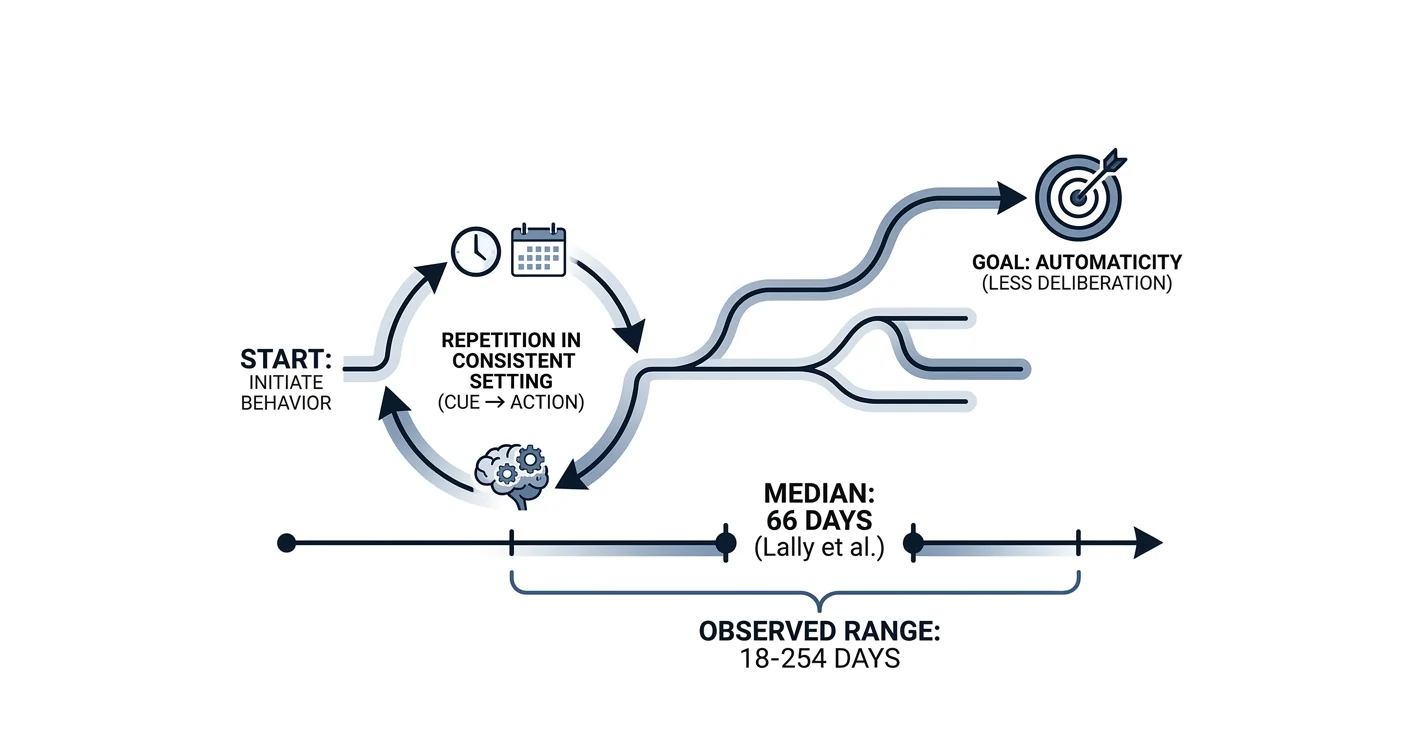
There is no universal habit-building deadline. One widely cited real-world study by Phillippa Lally and colleagues, published in the European Journal of Social Psychology as How are habits formed: Modelling habit formation in the real world, found a median estimated time of 66 days to approach automaticity. Individual estimates ranged from 18 days to 254 days.
The study examined daily eating, drinking, and activity behaviors repeated in a consistent context. Participants reported how automatic their chosen behavior felt. The researchers modeled the growth of automaticity rather than declaring everyone finished on a particular day.
| Research finding | What it means for your habit | What it does not mean |
|---|---|---|
| Median estimate: 66 days | Think beyond a short challenge when planning repeated practice. | Every habit takes exactly 66 days. |
| Individual estimates: 18–254 days | Habit formation differed substantially across people and behaviors. | Your own completion date falls somewhere in a guaranteed range. |
| Outcome: approaching automaticity | The behavior became less dependent on deliberate decision-making. | The behavior became effortless or produced its intended health outcome. |
The useful takeaway is consistent repetition, not a countdown to day 66. The range describes estimates from that study, not a personalized forecast. Some estimates extended beyond the observation period, so they should not be read as directly observed finish dates.
For this 2026 guide, that research provides a reference point, not a promise. There is no defensible timetable here for your particular journaling, exercise, sleep, or emotional-support habit.
Starting a behavior is different from making it automatic
You can begin a behavior today. Making it automatic takes repeated opportunities to connect a cue with an action. Maintaining it also requires a setup that survives ordinary changes in your life.
Consider an evening check-in. Writing down how you feel once is starting. Remembering to do it after putting your phone on charge is building a routine. Eventually beginning without a long internal debate is a sign of growing automaticity.
Those stages overlap. You do not need to wait for the last stage to receive value from the action.
Why habit-building time varies
The Lally study supports an important distinction: different people and different behaviors do not follow one identical curve. Habit research also emphasizes repeated behavior in a stable context. These factors help explain why your setup matters:
- The action itself. Drinking water with a meal and completing an exercise routine involve different demands. Do not assign both the same deadline.
- Opportunities to repeat. A behavior you practice regularly has more learning opportunities than one tied to an occasional event.
- Consistency of context. A recognizable situation helps connect the cue with the action. An unpredictable setting makes that connection harder to establish.
- Practical friction. Finding equipment, choosing a location, or deciding what to do adds steps between noticing the cue and acting.
- Individual differences. The study's wide spread of estimates shows that the same general advice does not produce an identical timeline for everyone.
Use these factors to troubleshoot, not to judge yourself. If you repeatedly forget, inspect the cue. If you remember but do not start, inspect the action and the steps required before it.
Change the setup before demanding more willpower. A vague intention to take better care of yourself gives you little to repeat. A specific action after an existing event gives you something concrete to practice.
How do you build a habit that fits your actual life?
Start with a behavior you can describe clearly. Then give it a recognizable cue and remove unnecessary decisions. The following sequence is a practical planning method, not a tested promise of faster results.
Choose the action
Name what you will physically do. Replace a broad goal such as becoming calmer with an action such as writing down the feeling you notice after work.
Keep the scope narrow enough that you know when you have done it. A goal can guide your direction, but an observable action gives you something to repeat. Avoid making several lifestyle changes the entry requirement for one small habit.
Choose the cue
Attach the action to an event you already recognize: finishing breakfast, shutting your laptop, or putting your phone on charge. Choose a cue that actually occurs in your life, not one that belongs to an ideal schedule.
If your work hours change, an event-based cue can be more practical than a fixed clock time. The key question is simple: will you notice this moment reliably?
Reduce friction
Prepare what the action requires before the cue arrives. Leave your notebook where you will use it. Choose your walking route ahead of time. Decide what your check-in will cover instead of inventing a new format every day.
Preparation does not guarantee consistency. It removes avoidable choices from the moment when you need to begin.
Repeat the action
When the cue occurs, practice the behavior you chose. Keep it recognizable rather than changing its purpose and format at every opportunity.
You can adjust a routine that is not working. Just distinguish a thoughtful adjustment from continually replacing the habit before it has had repeated practice.
Review the setup
Ask what happened at the cue. Did you miss it, lack what you needed, or feel that the action was too demanding? Change the specific obstacle rather than rewriting your whole plan.
This is the core of a workable 2026 habit plan: choose an action, connect it to a cue, and make returning easier. A tracker can record practice, but it cannot substitute for a usable setup.
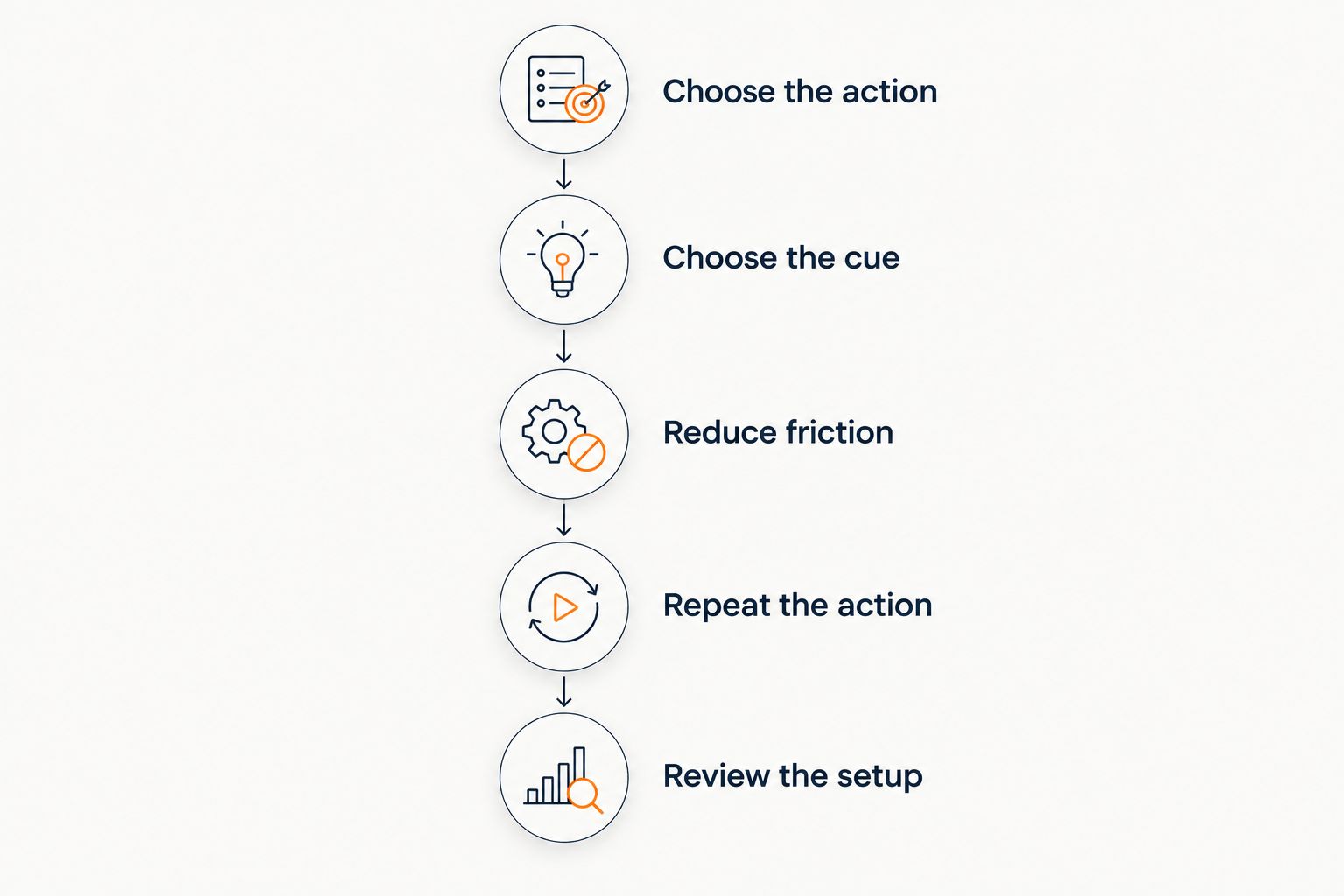 Five steps for planning a repeatable habit, from choosing an action to reviewing the setup.
A useful habit plan makes the next action clear before the cue arrives.
Which habit setup should you choose?
Choose the setup that matches your main obstacle. These are practical options, not separate habit tiers with established completion times.
| Setup | Best for | Advantage | Limitation |
|---|---|---|---|
| Event-based cue | You forget despite wanting to act | Connects the action to an existing moment | A disrupted event can remove the cue |
| Prepared environment | You remember but face extra steps | Reduces searching and deciding before starting | Preparation still needs maintaining |
| Brief fallback | Your usual action feels too demanding on difficult days | Gives you a manageable way to return | A smaller action does not deliver every benefit of the full routine |
An event-based cue is a sensible starting point when remembering is the problem. A prepared environment addresses practical obstacles. A brief fallback gives you an alternative to abandoning the plan altogether.
Do not confuse a fallback with proof that the full habit has formed. Writing a short note and completing a longer reflection are related but different actions. Decide which behavior you are practicing and what counts as completion.
For your 2026 routine, combine these options only where they solve a real problem. More reminders, trackers, and rules are not automatically a better system. Keep the plan understandable on a tired day.
Is the 21-day habit rule true?
21 days is not a universal habit-formation deadline. The Lally study's median estimate was 66 days, with substantial variation across participants and behaviors. That evidence does not support promising that any new habit will become automatic after a short challenge.
A challenge can still help you begin. Its ending is a review point, not proof that the behavior is established. Ask whether you are repeating the action more reliably and whether starting requires less deliberation.
If the answer is no, inspect the setup. You do not need to label the attempt a failure or wait for a symbolic fresh start.
Does the 66-day finding mean my habit is finished then?
66 days is a research reference point, not your finish line. It describes a median modeled estimate in one study of specific daily behaviors. It does not establish a deadline for your own habit or tell you when anxiety, low mood, or stress will improve.
Look for changes in the behavior itself. Do you notice the cue? Do you begin with less negotiation? Can you return after an interruption? Those questions are more useful than deciding that a calendar date proves success.
Continue helpful preparation even when the action feels familiar. Automaticity is not a reason to remove every support that made the routine workable.
Does missing a day reset habit progress?
Missing a single opportunity did not materially disrupt habit development in the Lally study. One missed day is not evidence that you have returned to zero. Resume at the next workable cue rather than treating a broken streak as a reason to stop.
A repeated pattern of missed opportunities deserves attention, though. Check whether the cue occurs reliably and whether the action is realistic. If every attempt requires unusually high energy, redesign the entry point.
You do not need to compensate by doubling the next session. The aim is to restore repeatable practice, not punish yourself for the interruption.
When emotional support belongs in your habit plan
Sometimes you know what to do but feel overwhelmed, ashamed, or stuck before starting. A reflection habit can help you name that experience without turning it into a verdict about your worth.
Lovon is best for people seeking on-demand voice-based emotional support and self-reflection, not licensed clinical care. The Lovon mental health app offers voice conversations, coping tools, and guidance for everyday struggles such as stress, anxiety, and low mood.
Lovon mental health support fits here as a place to talk through what made an attempt difficult. Its limitation is equally important: it is not a licensed clinician, does not replace clinical care, and has no established habit-building deadline in the information provided here.
Do not measure emotional support only by whether you maintained a streak. If distress persists, worsens, or interferes with daily functioning, speak with a licensed healthcare professional. A habit plan is not a substitute for assessment or treatment.
FAQ
How long does it take to build a new habit?
Building a new habit generally takes weeks to months, with no universal deadline. A widely cited study by Phillippa Lally and colleagues found a median estimated time of 66 days to approach automaticity for the daily behaviors studied.
Can I build a habit in 21 days?
21 days is not a reliable deadline for making every habit automatic. You can use a short challenge to begin practicing, then continue based on how reliably you repeat the action.
Does every habit take 66 days?
66 days is a median research estimate, not a rule for every habit. The Lally study's individual estimates ranged from 18 days to 254 days, and some estimates extended beyond the observation period.
Do I have to start over if I miss a day?
You do not have to treat one missed day as a complete reset. Resume at the next workable cue, and adjust the setup if missed opportunities become a recurring pattern.
How do I know whether my habit is becoming automatic?
A habit is becoming more automatic when its cue prompts the action with less deliberate decision-making. A streak records repetition, but it does not by itself prove automaticity.
Can I benefit from a habit before it becomes automatic?
You can benefit from an action before it becomes automatic. Habit formation describes how readily you repeat the behavior, not when every intended health or emotional benefit begins.
Can Lovon help me reflect on why I struggle with habits?
Lovon offers voice-based emotional support, coping tools, and self-reflection guidance. It is not a licensed clinician and does not replace professional assessment or treatment.
One last thing
A perfect streak and an automatic habit are not the same thing. You can perform an action repeatedly while still making a deliberate decision each time. You can also interrupt an established routine without losing everything you learned.
For 2026, make your next cue more useful than your next deadline. Put the notebook where you will see it, choose the action before the moment arrives, and decide how you will return after an interruption. Your next repetition matters more than proving you never missed one.
Related guides
How AI Support Helps You Heal
AI emotional support isn't about replacing human connection — it's about filling the gaps. The moments when you need to talk at 2 AM, when you don't want to burden your friends again, or when you simply need someone to listen without judgment.
Here's what happens in a typical Lovon session:
You share what's on your mind
There's no script, no intake form, no waiting room. You speak or type whatever you're feeling — in your own words, at your own pace.
Lovon validates and explores
Using frameworks from CBT (Cognitive Behavioral Therapy) and motivational interviewing, Lovon acknowledges your feelings first, then gently helps you explore them. No dismissive "just move on" advice.
You build coping skills together
Lovon doesn't just listen — it actively works with you on evidence-based techniques: thought reframing, urge surfing, behavioral experiments, and more.
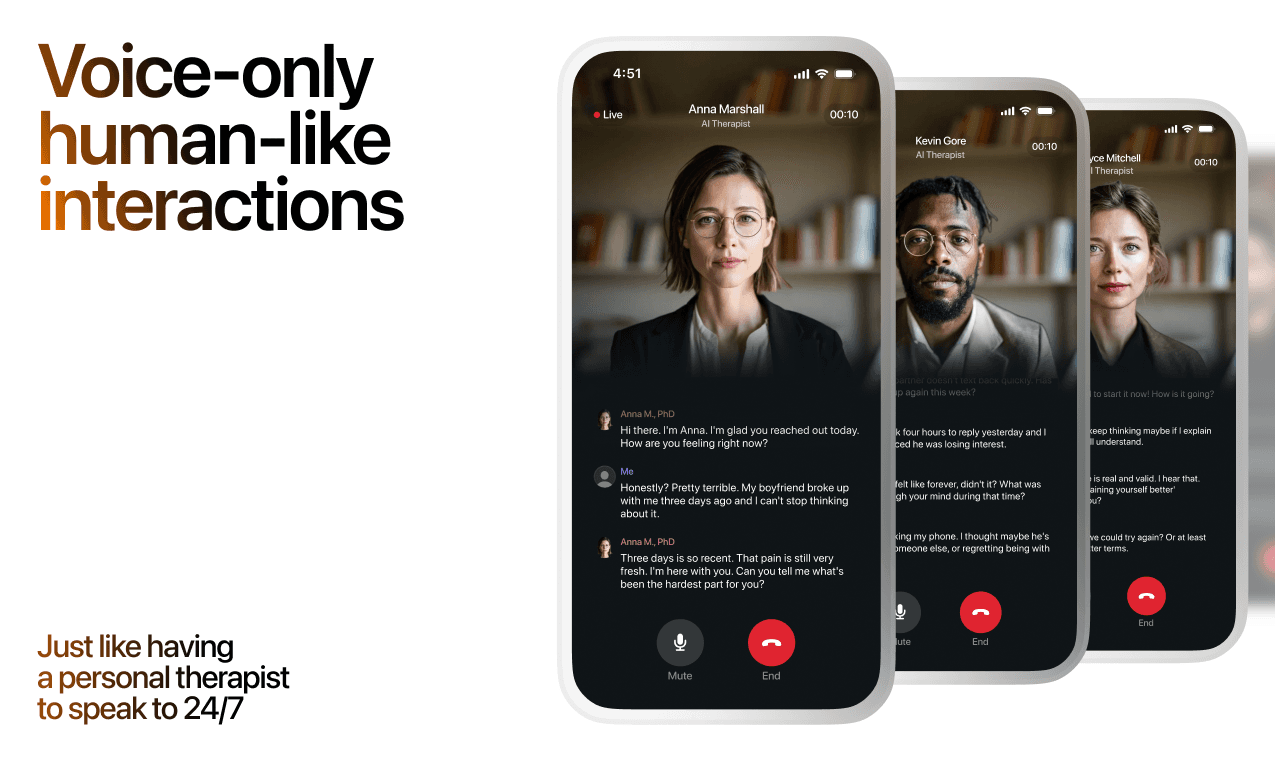
What a Session with Lovon Looks Like
When to Seek Professional Help
AI support is a valuable tool, but it's not a replacement for professional care. Please consider reaching out to a licensed therapist if you experience any of the following:
- Persistent thoughts of self-harm or suicide
- Inability to perform daily activities (work, eating, sleeping) for more than 2 weeks
- Turning to alcohol or substances to cope
- Intense anger or desire to harm your ex-partner
- Complete emotional numbness that doesn't improve over time
Crisis Resources (US): If you're in immediate danger, call 988 (Suicide & Crisis Lifeline) or text HOME to 741741 (Crisis Text Line). Available 24/7, free, and confidential.
Outside the US? Find a crisis line in your country
Ready to Start?
Your healing journey can begin right now
A 7-day trial. No judgment. Just a safe space to process what you're going through.
Frequently Asked Questions
Is Lovon a replacement for a real therapist?
Is my conversation with Lovon AI private?
How is Lovon different from ChatGPT for emotional support?
Can I use Lovon if I'm already seeing a therapist?
Can I try Lovon before subscribing?
About the Author

The Lovon Editorial Team
Mental Health & Wellness Content Team
The Lovon Editorial Team develops mental health and wellness content designed to make psychological concepts accessible and actionable. Our goal is to bridge the gap between clinical research and everyday life - helping you understand why your mind works the way it does and what you can do about it....
Related articles
- AI Life Coach for ADHD Goal Setting 2026
The best AI life coach for ADHD in 2026 breaks goals into micro-steps, removes scheduling pressure, and adds emotional…
- How much time a day should you spend on self-care?
How much time a day should you spend on self care? There is no fixed daily target. Learn how to choose care that fits…
- How to Break a Trauma Response Cycle (2026 Guide)
Learn how to break a trauma response cycle with 7 concrete steps, troubleshooting fixes, and where AI voice therapy fits…
- Can anxiety come back after years of being fine?
Can anxiety come back after years of being fine? Yes. Learn what a return of symptoms means, what to do now, and when to…
See also
Quizzes
- Pet Loss Check: Free 12-Question Pet Grief Self-Check
See what losing them is actually doing, in 3 minutes.
- Emotionally Unavailable Test: 12-Question Self-Check
See which part of you closes off, in three minutes.
Free tools
- Vent to an AI
Need to vent and there is nobody to call, or nobody you want to tell? Type it here. You are talking to an AI listener…
- Words of Encouragement for Him When He Is Struggling
Words of encouragement for him that fit what he is actually going through, for when your usual lines are not landing…
From the wiki
- What does it mean when you dream about your ex?
Dreaming about your ex usually reflects emotional processing, not prophecy and not a message from them. Your sleeping…
Disclaimer: This article is for informational purposes only and does not constitute medical advice, diagnosis, or treatment. Always seek the advice of your physician or other qualified health provider with any questions you may have regarding a medical condition. If you are in crisis or think you may have an emergency, call 988 (Suicide & Crisis Lifeline) or go to the nearest emergency room. Outside the US? Find a crisis line in your country.