
Why Do I Self-Sabotage at Work? Fix It in 2026
Why do I self-sabotage at work? Fear of judgment or success, not laziness. Get the 7-step fix and know when to loop in an AI voice therapist in 2026.
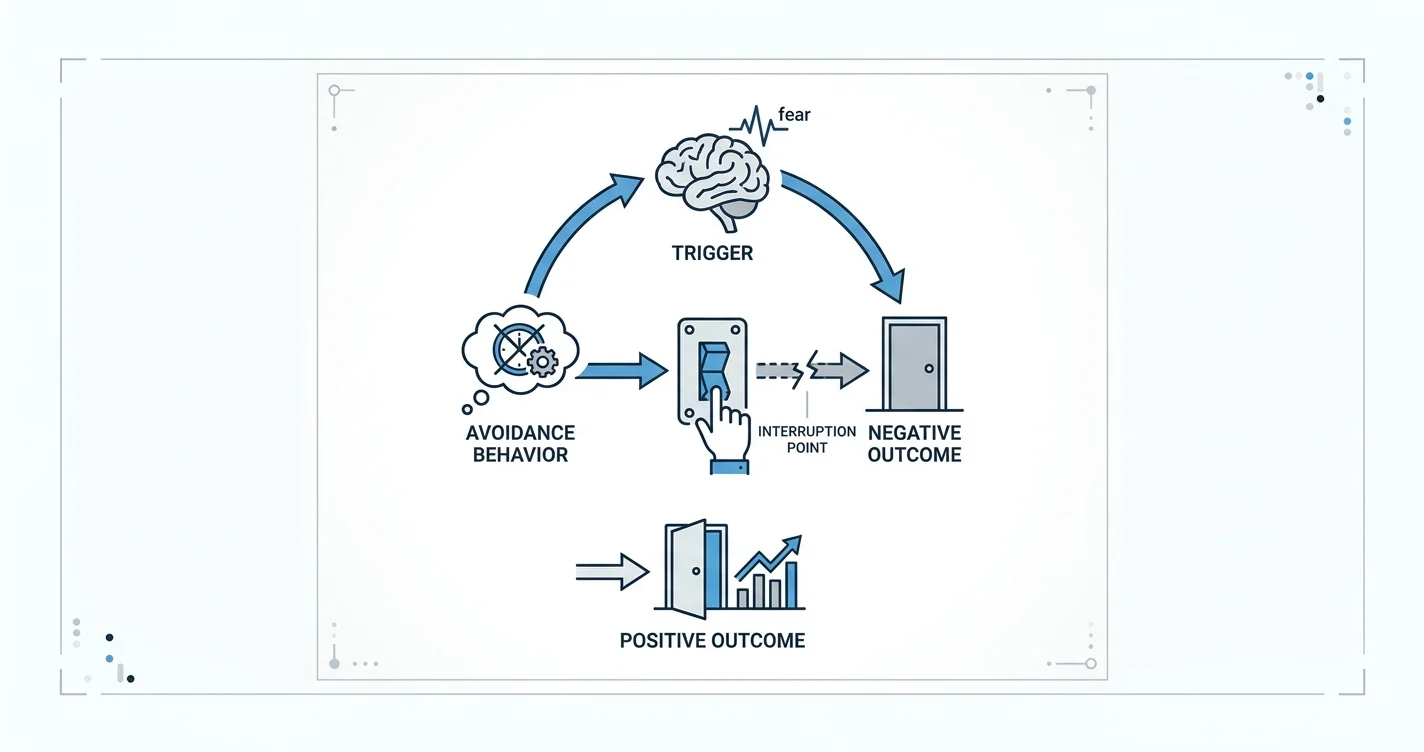

Key Takeaways
- Self-sabotage at work is a fear-avoidance pattern, not a character flaw — naming the specific behavior is step one.
- Procrastination, perfectionism, and picking fights before big wins are the three most common 2026 workplace sabotage
- Tracking triggers for one week exposes the exact moment the pattern fires, which is more useful than motivation.
- An AI voice therapist like Lovon works as a same-day check-in when the urge to sabotage hits between real sessions.
- Small, repeated proof beats big leaps — rebuild trust with your own follow-through in five-minute increments.
You blow the deadline you had covered for two weeks. You go quiet right before a promotion conversation. You pick a fight with a coworker the same week a big project finally starts working. If you're asking why do I self-sabotage at work, the pattern is rarely about laziness or bad luck — it's a protective habit your brain built a long time ago, and it can be unlearned with the right steps.
TL;DR
- Self-sabotage at work is a fear-avoidance pattern, not a character flaw — naming the specific behavior is step one.
- Procrastination, perfectionism, and picking fights before big wins are the three most common 2026 workplace sabotage patterns.
- Tracking triggers for one week exposes the exact moment the pattern fires, which is more useful than motivation.
- An AI voice companion like Lovon works as a same-day check-in when the urge to sabotage hits between real sessions.
- Small, repeated proof beats big leaps — rebuild trust with your own follow-through in five-minute increments.
Why this matters
Self-sabotage at work costs you promotions, references, and the confidence to try the next hard thing. It also compounds — miss one deadline out of fear of judgment, and the anxiety about the next deadline gets worse, not better.
Most people treat it as a discipline problem and buy a planner. That rarely works, because the behavior isn't about time management. It's a nervous system decision that avoiding the risk feels safer than facing possible failure or, just as often, possible success. If you want a deeper breakdown of how that fear plays out day to day, the guide on overcoming imposter syndrome at work covers the thought patterns that usually sit underneath it.
What you'll need
- A notebook, notes app, or voice memo tool for one week of trigger tracking
- 10 minutes a day, ideally at the same time, to review what you logged
- Honesty about which specific behavior shows up: procrastination, over-apologizing, picking fights, disappearing before recognition, or missing your own deadlines
- A way to talk through what surfaces — a trusted colleague, a therapist, or an on-demand option like Lovon's AI voice companion for moments the pattern hits mid-workday
- Patience for at least 3-4 weeks — behavior that took years to build doesn't unwind in a weekend
The steps
1. Name the exact pattern, not the general feeling
"I self-sabotage" is too vague to act on. Get specific: do you avoid starting, avoid finishing, avoid being seen, or avoid conflict by disappearing?
Write down the last three times it happened at work. Look for the shared shape — most people find one or two repeat behaviors, not five different ones. Naming it this precisely is what makes the next six steps possible.
Common mistake: labeling it "procrastination" when the real behavior is perfectionism dressed as delay — you're not avoiding the task, you're avoiding submitting something that isn't flawless.
2. Track the trigger for one week
For seven days, note the moment right before the sabotaging behavior starts. Was it a compliment from your manager? A deadline getting closer? A new opportunity landing on your desk?
Most workplace sabotage clusters around three triggers in 2026 workplace data patterns clients report: visibility (being noticed), evaluation (being judged), and success (things going well). You're looking for which one fires for you.
Expected outcome: by day five or six, you'll predict the sabotage before it happens — that's the leverage point.
3. Interrupt the thought before the behavior
Once you know your trigger, catch the automatic thought that runs right before the action — usually something like "they'll find out I'm not good enough" or "if I finish this, they'll expect more."
Say the thought out loud, even just to yourself. Naming a distorted thought out loud reduces its grip more than silently ruminating on it. If this step is hard on your own, the walkthrough on negative self-talk gives concrete scripts for interrupting it in real time.
Common mistake: trying to argue yourself out of the thought with pure logic. Naming it and moving to action works better than debating it.
4. Replace the exit behavior with a five-minute action
When the urge to avoid, delay, or disappear hits, you need a smaller, safer action ready — not willpower. Open the document and write one sentence. Send the email with a placeholder subject line. Reply "got it, working on it" even before you know the full answer.
Five minutes of forward motion breaks the avoidance loop that would otherwise run for hours or days. The goal isn't finishing the task — it's proving to yourself the sabotage script isn't the only option.
5. Address the fear underneath, not just the behavior
Procrastination on a big project is rarely about the project. It's about what finishing it means — being seen, being evaluated, being expected to repeat the win. If career burnout is layered on top of this pattern, the fear response gets louder because you have less capacity left to manage it.
The AI life coach for career burnout page walks through separating exhaustion-driven avoidance from fear-driven avoidance — they need different fixes.
Common mistake: treating burnout and self-sabotage as the same problem. Burnout needs rest. Self-sabotage needs exposure to the feared outcome in small doses.
6. Rebuild trust in yourself with small proof
Don't set a goal to "stop self-sabotaging." Set a goal to finish one task three days in a row, on time, without over-editing it into oblivion. Then four days. Then a full week.
Each completed cycle is evidence your brain uses to recalibrate the risk. Big leaps — "I'll never procrastinate again" — collapse under the first setback and reinforce the shame that fed the pattern in the first place.
7. Get reflection on the pattern regularly, not just when it's bad
Waiting until you're mid-sabotage to seek support means you're working from a reactive state. A short daily or weekly check-in — with a colleague, a therapist, or a voice conversation with an AI voice companion like Lovon — catches the early signs of the trigger before the behavior fires.
The guide on using cognitive behavioral techniques on your own is a solid companion here if you want a structured way to process what comes up between check-ins.
Talk through the pattern tonight
Say the trigger out loud before it costs you another deadline or promotion.
Troubleshooting
I catch the pattern but can't stop mid-action. Awareness without a replacement action isn't enough. Go back to step 4 and have the five-minute action pre-written before the trigger hits, not invented in the moment.
It only happens during performance reviews. That's an evaluation-trigger pattern. Prepare a script for review week specifically — write your talking points three days early instead of the night before, when anxiety peaks.
I sabotage right when things start going well. This is fear-of-success sabotage, one of the harder patterns to spot because it doesn't feel like fear — it feels like boredom or sudden distraction. Treat any unexplained urge to quit, pick a fight, or disengage right after a win as a signal, not a mood.
My self-talk gets worse under deadline pressure. Pressure amplifies existing distortions like catastrophizing. Working through them ahead of high-stakes weeks, rather than during them, keeps the spiral from taking over.
I know the trigger but the urge still wins most days. That's common in the first two weeks. The goal at this stage isn't zero sabotage — it's noticing faster each time. Progress here looks like catching it on day three of a task instead of day nine.
Tools and resources
- Daily trigger log (notes app or voice memo)
- Cognitive behavioral techniques you can use on your own for structured thought-work
- The imposter syndrome guide for the fear-of-being-found-out variant
- An AI voice companion for real-time processing when the urge hits mid-workday — Lovon is built for exactly that kind of on-demand conversation
- A weekly review ritual — 10 minutes, same day each week, to check which trigger showed up and how you responded
What to do next
Once you can name your trigger and interrupt it most of the time, the harder work is usually the underlying stress load that makes the pattern fire in the first place. The guide on using an AI voice therapist for work-related stress is the next step if the sabotage is tangled up with a workload or a boss situation that isn't going away on its own.
FAQ
Why do I self-sabotage at work specifically, not in other areas of my life?
Work carries the clearest evaluation stakes — a manager, a review, a title — so fear of judgment or fear of success shows up there first for many people. The same pattern often exists elsewhere but work makes it visible fastest.
Is self-sabotage the same as procrastination?
No. Procrastination is one possible behavior; self-sabotage also includes over-apologizing, picking fights before recognition, and quietly withdrawing right when things go well. Procrastination is the most common form but not the only one.
Can self-sabotage be linked to imposter syndrome?
Yes, frequently. If the fear underneath is "I'll be found out," sabotage becomes a way to control when and how that exposure happens, on your own terms rather than someone else's.
How long does it take to stop a self-sabotage pattern at work?
Most people notice the trigger reliably within one to two weeks of tracking, and see the behavior loosen within 3-4 weeks of consistent five-minute interruptions. Deeper patterns tied to burnout or long-standing fear of failure can take longer.
Should I talk to a therapist about workplace self-sabotage?
If the pattern is costing you jobs, relationships, or your health, a licensed therapist can work through the root cause directly. An AI voice companion like Lovon works well as daily support between those sessions or when the urge hits outside office hours for a licensed clinician.
What's the difference between fear of failure and fear of success as sabotage triggers?
Fear of failure sabotage shows up before a task starts — procrastination, over-preparing, avoidance. Fear of success sabotage shows up after things start going well, often as sudden disengagement, conflict, or an urge to quit.
Can burnout look like self-sabotage?
Yes, and it's easy to confuse the two. Burnout-driven avoidance comes from depleted capacity and needs rest; fear-driven sabotage comes from an active avoidance pattern and needs exposure and practice, not just recovery time.
Does journaling actually help with self-sabotage?
Tracking triggers in writing or voice notes for even one week reliably surfaces the pattern's shape — most people can't see the trigger clearly until they've logged it three or four times.
One last thing
The detail most people miss: self-sabotage almost never fires at random. It fires within a narrow window right after a specific signal — a compliment, a deadline, an opportunity — and once you can name that exact window, the behavior loses most of its power over you. You don't need to fix your whole personality in 2026. You need to catch one five-second window, more reliably, week over week.
Related guides
How AI Support Helps You Heal
AI emotional support isn't about replacing human connection — it's about filling the gaps. The moments when you need to talk at 2 AM, when you don't want to burden your friends again, or when you simply need someone to listen without judgment.
Here's what happens in a typical Lovon session:
You share what's on your mind
There's no script, no intake form, no waiting room. You speak or type whatever you're feeling — in your own words, at your own pace.
Lovon validates and explores
Using frameworks from CBT (Cognitive Behavioral Therapy) and motivational interviewing, Lovon acknowledges your feelings first, then gently helps you explore them. No dismissive "just move on" advice.
You build coping skills together
Lovon doesn't just listen — it actively works with you on evidence-based techniques: thought reframing, urge surfing, behavioral experiments, and more.
What a Session with Lovon Looks Like

When to Seek Professional Help
AI support is a valuable tool, but it's not a replacement for professional care. Please consider reaching out to a licensed therapist if you experience any of the following:
- Persistent thoughts of self-harm or suicide
- Inability to perform daily activities (work, eating, sleeping) for more than 2 weeks
- Turning to alcohol or substances to cope
- Intense anger or desire to harm your ex-partner
- Complete emotional numbness that doesn't improve over time
Crisis Resources (US): If you're in immediate danger, call 988 (Suicide & Crisis Lifeline) or text HOME to 741741 (Crisis Text Line). Available 24/7, free, and confidential.
Outside the US? Find a crisis line in your country
Ready to Start?
Your healing journey can begin right now
A 7-day trial. No judgment. Just a safe space to process what you're going through.
Frequently Asked Questions
Is Lovon a replacement for a real therapist?
Is my conversation with Lovon AI private?
How is Lovon different from ChatGPT for emotional support?
Can I use Lovon if I'm already seeing a therapist?
Can I try Lovon before subscribing?
About the Author

The Lovon Editorial Team
Mental Health & Wellness Content Team
The Lovon Editorial Team develops mental health and wellness content designed to make psychological concepts accessible and actionable. Our goal is to bridge the gap between clinical research and everyday life - helping you understand why your mind works the way it does and what you can do about it....
Related articles
- Self-Sabotage as Defense Mechanism and Conditional Love
You set a goal, work toward it diligently, and then—just as success comes within reach—you find yourself making…
- Codependency vs Love: How to Tell Them Apart (2026)
Codependency vs love explained with a step-by-step self-check for 2026. Learn the exact signs that separate healthy…
- Self-Sabotaging Relationships: Why It Happens (2026)
Self-sabotaging relationships explained: the trigger pattern behind it and a 6-step process to interrupt it in 2026…
- Not Good Enough? Therapy for Feeling Good Enough
You just finished a very hard task and helped the company succeed. You felt happy for a moment, but then a quick thought…
See also
Quizzes
- Am I a People Pleaser? 12-Question Quiz
Where kindness stops and self-erasure starts.
- Self Esteem Test: What Is Your Worth Resting On?
See what your sense of worth is resting on.
Free tools
- How to Come Out to Your Parents
A chat about how to come out to your parents that starts with whether now is safe, not with the speech. Tell it your…
- Family Boundary Plan
Pick the person, the one topic, and how much you want to see them. You get a three-rung ladder, the guilt lines to…
From the wiki
- Why do I feel lonely all of a sudden?
Sudden loneliness usually traces back to something that quietly ended in the last few months: a routine, a shared class…
Disclaimer: This article is for informational purposes only and does not constitute medical advice, diagnosis, or treatment. Always seek the advice of your physician or other qualified health provider with any questions you may have regarding a medical condition. If you are in crisis or think you may have an emergency, call 988 (Suicide & Crisis Lifeline) or go to the nearest emergency room. Outside the US? Find a crisis line in your country.