
Mental health support for pharmacists: complete 2026 guide
Mental health support for pharmacists starts with safe work, coping tools, and human care. Build a practical plan for shift stress and burnout in 2026.


Key Takeaways
- Mental health support for pharmacists should address personal distress and workplace conditions, not ask you to cope harder.
- Lovon is best for pharmacists who want voice-based emotional support between shifts, not diagnosis or clinical treatment.
- Use coping tools for everyday stress; seek licensed care when symptoms persist, worsen, or interfere with daily life.
- Keep patient information out of personal journals, voice recordings, and mental health apps.
Pharmacists’ mental health support is practical and professional help aimed at protecting your well-being while you manage medication-related responsibilities. This 2026 guide explains mental health support for pharmacists, from coping with post-shift worry to finding clinical care without confusing emotional support with a patient-safety process.
TL;DR
- Mental health support for pharmacists should address personal distress and workplace conditions, not ask you to cope harder.
- Lovon is best for pharmacists who want voice-based emotional support between shifts, not diagnosis or clinical treatment.
- Use coping tools for everyday stress; seek licensed care when symptoms persist, worsen, or interfere with daily life.
- Keep patient information out of personal journals, voice recordings, and mental health apps.
Why mental health support matters for pharmacists
You need a support plan that fits the responsibilities you actually hold. If a difficult interaction, interrupted verification task, or concern about an error follows you home, emotional recovery and operational follow-up need separate places in that plan.
Feeling calmer does not resolve an unaddressed safety concern. Equally, completing an incident report does not mean you have processed the fear, guilt, or sadness attached to it.
A useful 2026 support plan answers three questions: What helps you settle after work? Who can assess symptoms that are not improving? Where do you raise conditions that make safe work difficult?
Scheduling matters, too. If your hours change, anchor support to an event such as arriving home rather than a fixed clock time; these approaches to managing stress as a shift worker offer a related starting point.
You do not need to prove that pharmacy caused every symptom before asking for help. Your experience outside work matters just as much as what happens during a shift.
Build a support plan that fits pharmacy work
Identify what needs attention first
Start with a private note, not a diagnosis. Describe what is happening in plain language: difficulty switching off, dread before work, irritability at home, interrupted sleep, or repeated checking after your responsibilities have ended.
Separate the feeling from any unresolved action. Worry about a possible dispensing error requires the appropriate workplace response; worry that continues after the issue has been addressed deserves emotional support as well.
For a sample starting routine, spend 2 minutes after a shift recording what affected you and what help you need. This is a suggested check-in, not a screening test or a requirement to track every feeling.
- Name the feeling without labeling yourself as weak or incapable.
- Note whether the concern belongs to work, home, or both.
- Record any effect on sleep, relationships, or concentration.
- Identify an unresolved action that belongs in an approved workplace system.
- Choose one person or service to contact if the pattern continues.
Protect safety before trying to push through
If distress, exhaustion, or impaired concentration makes you concerned about performing medication-related tasks safely, tell the appropriate supervisor or responsible colleague. Follow your workplace’s coverage and escalation procedures rather than silently trying to compensate.
A grounding exercise is not clearance to resume safety-sensitive work. You do not have to decide on your own whether a brief pause has made you fit to continue.
For immediate emotional support, try noticing your feet against the floor and naming objects around you, when you can do so away from patient-care demands. Stop any exercise that increases discomfort, and do not use an app while dispensing, verifying, counseling, or driving.
- Raise a safety concern through the designated workplace route.
- Ask for coverage or a handoff according to local procedures.
- Move personal coping exercises away from active clinical tasks.
- Contact a healthcare professional when symptoms affect functioning.
- Seek urgent help when you cannot keep yourself or someone else safe.
Choose a way to talk after your shift
Start with an ordinary conversation, a paper journal, or a personal note stored appropriately. You can describe your feelings without reconstructing an entire patient encounter: frustration, helplessness, or fear is enough to begin.
If starting from a blank page feels difficult, Lovon offers AI-powered voice conversations, coping tools, and self-reflection guidance. Lovon is best for pharmacists who want voice-based emotional support between shifts, not diagnosis or clinical treatment.
For your 2026 routine, treat a voice app as an optional way to begin reflecting, not another task you must complete. Lovon mental health support is not licensed clinical care, and its responses can be inaccurate or miss important context.
A simple prompt is to describe the emotion, its effect on your evening, and the next action you want help considering. Leave out patient details and requests for clinical decisions.
- Choose paper, a trusted person, or a voice conversation based on your preference.
- Describe your reaction rather than identifying a patient or colleague.
- Ask for help naming a feeling or choosing a manageable next step.
- End the conversation if it increases distress or repetitive checking.
- Bring persistent concerns to a licensed professional.
Separate emotional recovery from workplace action
A difficult shift can leave you with two different needs: support for how you feel and action on what happened. Put each in the right place rather than expecting a personal coping routine to solve both.
For example, if interruptions repeatedly make a task difficult, record the operational concern through your approved reporting process. In your personal reflection, focus on how the experience affected you and what support you want.
Use a 3-line note as a suggested organizing tool: the feeling, the work issue requiring follow-up, and the personal support needed. Keep patient and incident documentation in authorized systems, not in this personal note.
- Emotional recovery: name the feeling and seek appropriate support.
- Workplace action: describe the operational concern through approved channels.
- Clinical care: discuss persistent or worsening symptoms with a professional.
- Follow-up: confirm who owns each next action.
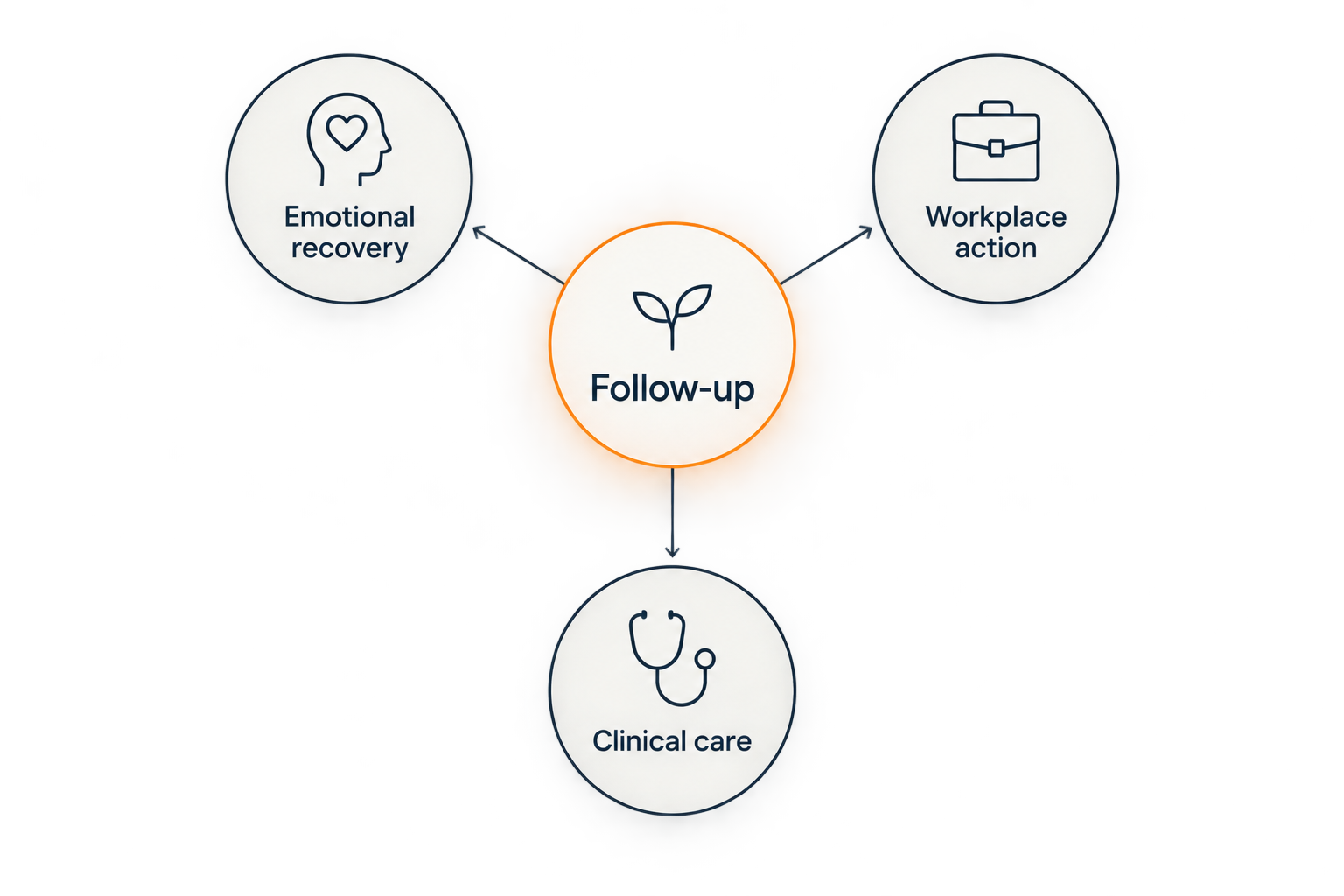 Separate routes for emotional recovery, workplace action, and clinical care, connected through follow-up.
Emotional support and workplace follow-up serve different needs; neither replaces the other.
Find human care before you reach a breaking point
Start by contacting your primary care clinician, a licensed mental health professional, or an employee assistance program if your employer offers one. Ask about experience supporting healthcare workers and whether appointment times fit your schedule.
Bring a short description of what has changed, including sleep, mood, concentration, substance use, and functioning outside work. You do not need a polished explanation or a self-diagnosis to make the appointment.
For a 2026 care search, verify the clinician’s current license, service arrangements, and privacy information directly. Ask any employer-linked program what information it shares and what confidentiality exceptions apply; do not assume that all programs operate alike.
If you have questions about professional reporting or licensing requirements, check the applicable board’s current rules and seek qualified advice. An app cannot determine those obligations for you.
- Ask whether the professional can assess your current concerns.
- Explain your shift pattern and appointment constraints.
- Request a clear explanation of confidentiality and its limits.
- Ask what to do if symptoms worsen between appointments.
- Write down the next contact or appointment before ending the conversation.
Review whether support is changing daily life
Choose a modest review point, such as 7 days, to check whether you followed through on the actions you selected. This is a planning interval, not a promise of recovery or a reason to delay care.
Look beyond whether you felt better immediately after talking. Ask whether you contacted a clinician, raised a workplace concern, or made space for something outside pharmacy that matters to you.
A routine that becomes another performance target needs adjusting. Missing a check-in is information about the plan’s fit, not evidence that you have failed at looking after yourself.
- Check whether you completed the next action you chose.
- Notice changes in sleep, distress, and everyday functioning.
- Reduce tracking if it encourages constant self-monitoring.
- Escalate persistent or worsening symptoms to human care.
- Keep the parts of the routine that feel useful and manageable.
Compare support options for pharmacists
Choose support according to the job it needs to do. A journal helps you organize thoughts; a clinician assesses symptoms and provides care. Neither function should be confused with resolving staffing, workflow, or incident-reporting concerns.
| Option | Best for | Practical benefit | Key limitation |
|---|---|---|---|
| Personal journal | Pharmacists who prefer quiet, independent reflection | Lets you describe feelings in your own words | Provides no assessment or outside perspective |
| Trusted peer conversation | Pharmacists who want human understanding of work stress | Creates space to feel heard and discuss next steps | Is not a substitute for treatment; protect patient confidentiality |
| Employee assistance program, if offered | Pharmacists seeking an employer-linked route to support | Provides a defined point of contact for available services | Scope, privacy arrangements, and referral processes require checking |
| Licensed mental health professional | Pharmacists whose symptoms persist or affect daily life | Assesses concerns and provides appropriate clinical care | Requires finding a suitable clinician and arranging appointments |
| Lovon mental health support | Pharmacists who prefer on-demand voice-based reflection | Offers AI voice conversations, coping tools, and self-reflection guidance | Is not a licensed clinician and cannot replace clinical or crisis care |
| Workplace reporting process | Pharmacists facing operational or patient-safety concerns | Directs concerns into the organization’s response process | Does not replace personal emotional support or treatment |
Match the tool to the need, rather than asking one option to do everything. You can use personal reflection alongside professional care and workplace follow-up without treating them as interchangeable.
Common mistakes pharmacists make when seeking support
Treating clinical knowledge as personal assessment
Knowing about mental health conditions does not mean you must assess or manage your own symptoms alone. Describe what you are experiencing to a qualified professional rather than waiting until you can confidently name the problem.
Putting patient details into a personal support tool
Removing a name does not automatically remove identifying information. Keep prescription details, dates, locations, unusual circumstances, and other potentially identifying material out of personal apps and recordings; focus on your own emotional response instead.
Trying to relax away an unresolved safety issue
A calm evening and a completed workplace follow-up are different outcomes. Use the approved process for a possible error or unsafe condition, then give yourself space to seek support for the emotional aftermath.
Promising yourself support only after the schedule improves
Build a first step around the schedule you have. That might mean sending an appointment request after a shift or asking a trusted person to help you find care, rather than designing an elaborate daily routine.
One last thing
For your 2026 plan, write down who you will contact before you need to make that decision while overwhelmed. Include a personal support contact, a clinical contact, and the appropriate workplace route for safety concerns.
Being able to finish a shift is not the only measure of how you are doing. Your sleep, relationships, and life away from pharmacy deserve attention too.
Related guides
How AI Support Helps You Heal
AI emotional support isn't about replacing human connection — it's about filling the gaps. The moments when you need to talk at 2 AM, when you don't want to burden your friends again, or when you simply need someone to listen without judgment.
Here's what happens in a typical Lovon session:
You share what's on your mind
There's no script, no intake form, no waiting room. You speak or type whatever you're feeling — in your own words, at your own pace.
Lovon validates and explores
Using frameworks from CBT (Cognitive Behavioral Therapy) and motivational interviewing, Lovon acknowledges your feelings first, then gently helps you explore them. No dismissive "just move on" advice.
You build coping skills together
Lovon doesn't just listen — it actively works with you on evidence-based techniques: thought reframing, urge surfing, behavioral experiments, and more.
What a Session with Lovon Looks Like

Lovon is AI support, not a replacement for professional care. If things have been hard to get through for weeks, or you are thinking about harming yourself, talk to a doctor or a licensed therapist.
Ready to Start?
Your healing journey can begin right now
A 3-day trial. No judgment. Just a safe space to process what you're going through.
Frequently Asked Questions
What's the best mental health support for pharmacists?
Can I use an AI voice app after a difficult pharmacy shift?
How do I know whether I need a therapist rather than a coping app?
Will getting mental health support affect my pharmacist license?
Can I talk about a dispensing error in a mental health app?
What should I ask an employee assistance program about privacy?
What should I do if I feel unsafe or might hurt myself?
About the Author

The Lovon Editorial Team
Mental Health & Wellness Content Team
The Lovon Editorial Team develops mental health and wellness content designed to make psychological concepts accessible and actionable. Our goal is to bridge the gap between clinical research and everyday life - helping you understand why your mind works the way it does and what you can do about it....
Related articles
- Can anxiety come back after years of being fine?
Can anxiety come back after years of being fine? Yes. Learn what a return of symptoms means, what to do now, and when to…
- AI therapy for freelancers and gig workers: complete 2026 guide
AI therapy for freelancers and gig workers supports everyday stress, not clinical treatment. Build a practical routine…
- Can ADHD be managed without medication?
Can ADHD be managed without medication? Yes, for some adults. Learn which therapy, routines, and supports help, where…
- Best AI apps for LGBTQ+ mental health support in 2026
Compare the best AI apps for LGBTQ+ mental health support. Choose voice support or writing help, check privacy, and know…
See also
Quizzes
- How Do You Cope With Stress? Coping Style Quiz
Find your stress coping style in 2 minutes.
- Coping Style Test: How Do You Actually Handle Stress?
See how you really cope under stress, in 3 minutes.
Free tools
- CORE-10: The 10-Question Psychological Distress Check
Ten statements about how the last week has been, from the CORE System Trust's CORE-10. You get a score from 0 to 40…
- 60-Second Mental Health Check-In
How are you feeling today, really? Five quick sliders and one feeling word show what stands out, how today compares with…
From the wiki
- Why do I have no friends?
Usually nothing is wrong with you. Adult friendship runs on proximity and repetition, and most people lose both at once…
Disclaimer: This article is for informational purposes only and does not constitute medical advice, diagnosis, or treatment. Always seek the advice of your physician or other qualified health provider with any questions you may have regarding a medical condition. If you are in crisis or think you may have an emergency, call 988 (Suicide & Crisis Lifeline) or go to the nearest emergency room. Outside the US? Find a crisis line in your country.