
Mental health support for retail workers: complete 2026 guide
Mental health support for retail workers starts with practical shift routines, workplace boundaries, and the right care. Build a plan that fits your job.


Key Takeaways
- Mental health support for retail workers should combine shift-friendly coping tools, workplace boundaries, and access to licensed care.
- Lovon offers on-demand AI voice support for everyday stress, not diagnosis, emergency response, or licensed treatment.
- Start with a small routine you can repeat before, during, and after work.
- Persistent symptoms or safety concerns need human support, not another self-care task.
Retail workers’ mental health support is practical and professional help aimed at protecting your well-being during customer-facing work. This 2026 guide covers mental health support for retail workers whose changing shifts, difficult interactions, and limited private time make a fixed routine hard to follow.
TL;DR
- Mental health support for retail workers should combine shift-friendly coping tools, workplace boundaries, and access to licensed care.
- Lovon offers on-demand AI voice support for everyday stress, not diagnosis, emergency response, or licensed treatment.
- Start with a small routine you can repeat before, during, and after work.
- Persistent symptoms or safety concerns need human support, not another self-care task.
Why mental health support matters for retail workers
Your support plan needs to fit the job you actually have. Advice to meditate in a quiet room means little when you are covering a register, waiting for break coverage, or sharing a crowded staff room.
Retail work also puts a particular demand on emotional expression: you might need to remain polite while feeling upset or overwhelmed. A useful plan separates what helps you settle after an interaction from what your workplace needs to address.
Coping skills support you; they do not make harassment or unsafe conditions acceptable. If changing hours are your main obstacle, start with these approaches to managing stress as a shift worker.
For your 2026 plan, focus on access rather than perfection. You need something usable during a difficult shift, someone you can contact afterward, and a clear route to professional care when everyday coping is not enough.
Build a support plan around your shifts
Identify the parts of work that leave you struggling
Start with a private paper note or a note on your own device. Record what happened, what you noticed in yourself, and what you needed. Keep customer names, payment details, and other identifying information out of personal notes.
Try this for 7 days as a practical observation exercise, not a diagnostic test. Include days off. The aim is to distinguish a difficult incident from a repeating problem, such as dread before closing shifts or trouble settling after confrontation.
Describe experiences rather than assigning yourself a diagnosis. Feeling exhausted after work deserves attention, but exhaustion alone does not establish burnout, depression, or another condition.
- Name the situation: checkout queues, returns, closing, or coworker conflict.
- Note the response: tension, anger, tearfulness, numbness, or worry.
- Record whether the feeling continues away from work.
- Write down what support was missing.
Create a reset you can use during a shift
Start without an app. When you can safely pause, feel your feet against the floor, notice your surroundings, and let your breathing stay comfortable. The goal is to regain enough steadiness to choose your next action, not force yourself to feel calm.
Set aside 1 minute to practice when you are not already overwhelmed. Treat that duration as a suggested practice window, not a promise of relief. If focusing on breathing feels uncomfortable, use an external detail instead, such as the color of a nearby object.
A reset also needs an exit route. Decide who can cover your position and what you will say when you need help.
- Pause safely: step away from equipment or active transactions first.
- Notice your surroundings: look for familiar, neutral objects.
- Name your need: identify whether you need space, coverage, or help.
- Choose your next action: return, ask for support, or escalate a concern.
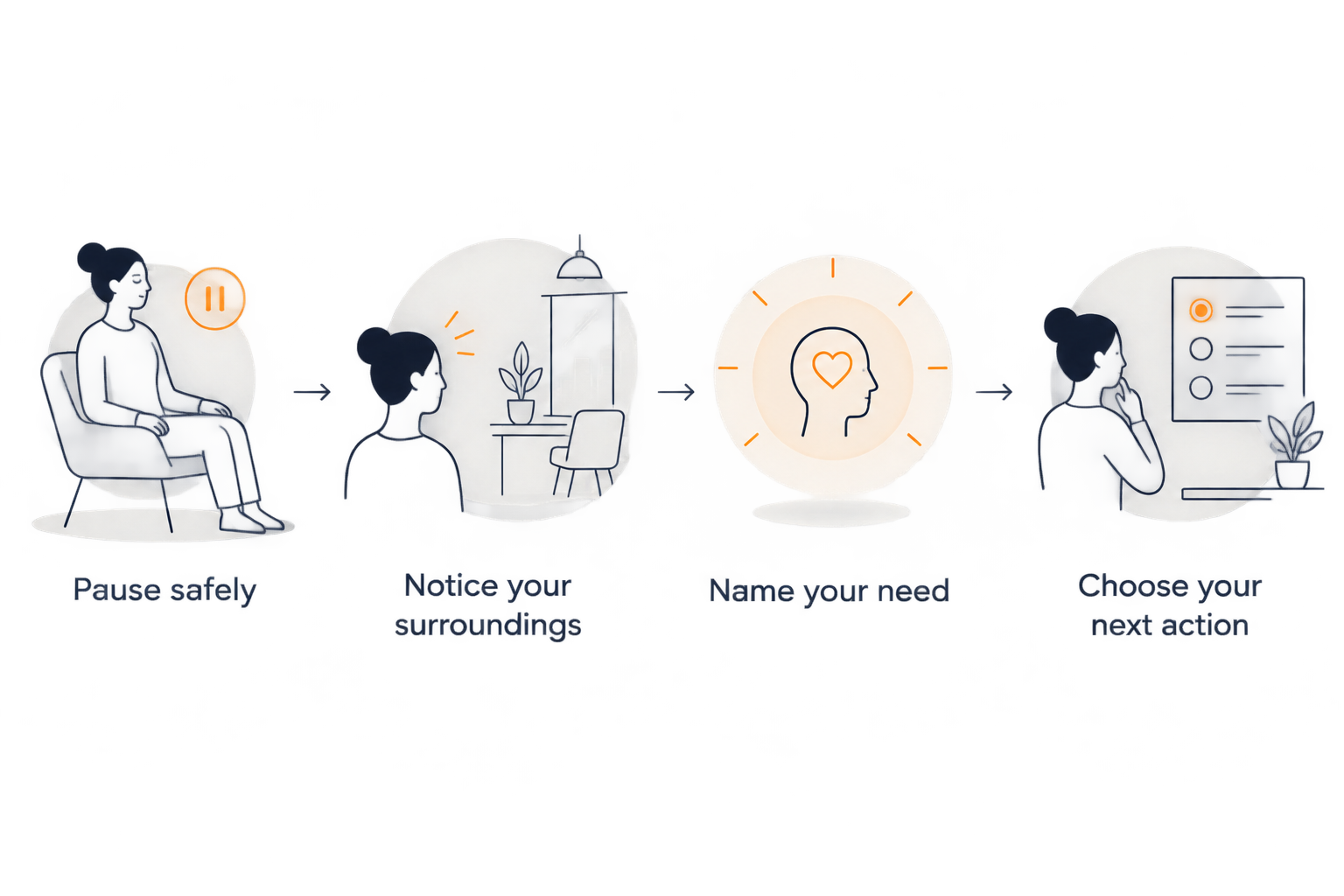 A shift reset sequence from pausing safely to choosing the next action
A reset ends with a practical decision, not a demand to feel calm.
Choose a way to talk after difficult interactions
Start with a trusted person, a paper journal, or a private voice memo. Explain the event briefly, then name what is still bothering you. You do not have to retell every detail to deserve support.
If you want guided conversation rather than a blank page, Lovon provides on-demand AI voice support, coping tools, and self-reflection guidance. Lovon is best suited to retail workers seeking AI voice support for everyday stress, not clinical care. It is not a licensed clinician and does not replace a therapist.
For a short check-in, try 3 prompts: what happened, what you felt, and what you need next. These are conversation starters, not a treatment protocol. Use a private location where coworkers and customers cannot overhear you.
- Separate the customer’s behavior from your judgment of yourself.
- Ask for listening, practical advice, or help preparing a conversation.
- Avoid sharing customer or coworker identifying details with digital tools.
- End with a manageable next action rather than repeated replaying.
Ask for a specific workplace change
Begin by naming the work problem and the change you want. A request for clearer escalation procedures gives a manager something concrete to address. You do not need to share your full personal history to describe a problem at work.
For example, explain that you need a clear handoff when a customer becomes threatening, or ask how break coverage is assigned. Keep the focus on duties, safety, and the support needed to do your job.
For your 2026 workplace plan, write down the reporting route before you need it. If your direct supervisor is involved in the problem, identify another available channel, such as human resources, a higher manager, or a union representative where applicable.
- Ask who takes over abusive or threatening customer interactions.
- Clarify how to request coverage when you feel overwhelmed.
- Keep factual records of incidents and responses.
- Confirm agreed next steps in writing when practical.
- Use a separate reporting route when the supervisor is the concern.
Check benefits and professional care options
Start with any benefits information you already have. Look for an employee assistance program, health-plan mental health services, or a primary care contact. Do not assume a coworker’s eligibility or experience matches yours.
If an employee assistance program exists, ask what it offers, who qualifies, and what happens after the initial support ends. Ask about confidentiality and its exceptions directly. Do not assume either complete employer access or complete privacy without checking the actual terms.
When contacting a licensed professional, describe your schedule constraints early. Explain whether your main concerns are customer-related anxiety, low mood, sleep disruption, or something else. You do not need a self-diagnosis before making an appointment.
- Check eligibility, referral requirements, and appointment arrangements.
- Ask whether session times fit your changing shifts.
- Ask how confidentiality and records work.
- Describe how symptoms affect work and life outside work.
- Keep a backup contact if the first service is not a fit.
Protect a transition between work and home
Start with a small action that marks the end of the shift. Change clothes, wash your face, sit somewhere quiet, or write down the task that is still occupying your thoughts. Choose something that fits your commute and responsibilities.
Try a 5-minute transition as a starting point, not a rule you must meet. If you have caring duties immediately after work, your transition might happen later. The point is to give yourself a deliberate pause, not create another standard to fail.
Protect recovery without turning it into isolation. Tell someone close to you whether you need quiet first or want company. A clear request is easier to respond to than expecting others to guess why you are withdrawn.
- Choose a repeatable end-of-shift action.
- Put unfinished work thoughts into a brief note.
- Ask household members for the kind of support you need.
- Keep work-message boundaries consistent with your role and policies.
- Adjust the routine after late finishes rather than abandoning it.
Recognize when you need more support
Seek licensed care when symptoms persist, worsen, or interfere with sleeping, eating, relationships, or doing your job safely. You do not need to wait until you miss a shift. Being able to work does not prove that you are doing well.
Use human crisis support for a crisis, not an AI conversation. In the United States, call or text 988 for suicide or mental health crisis support. Call 911 for an immediate medical emergency or danger. If possible, ask a trusted person to stay with you while you seek help.
Do not automatically label new or severe physical symptoms as anxiety. Urgent symptoms need medical assessment. After a threatening or frightening workplace event, ask for both practical safety support and appropriate professional help.
- Contact a clinician when distress keeps affecting daily life.
- Tell someone if you feel unsafe being alone.
- Save crisis contacts somewhere easy to access.
- Seek emergency help for immediate danger or a medical emergency.
Compare support options for retail workers in 2026
Choose support by the problem you need help with, not by how much distress you think you should tolerate. A notebook can organize your thoughts; it cannot assess a mental health condition. A workplace change can address a work trigger; it does not replace treatment when treatment is needed.
These options serve different purposes. You can combine them, but keep their limits clear.
| Option | Best for | Main benefit | Key limitation |
|---|---|---|---|
| Paper journal or personal check-in | Workers wanting a simple starting point | Gives you space to describe events and needs | No professional assessment or outside perspective |
| Trusted friend or coworker | Workers wanting human connection after a shift | Offers listening and practical companionship | Informal support is not clinical care; boundaries matter |
| Workplace reporting or manager discussion | Workers facing work-related triggers | Can address coverage, procedures, or conduct | Depends on the issue and the workplace response |
| Employee assistance program, if offered | Eligible workers seeking an entry point | Can connect workers with support or referrals | Scope, eligibility, and arrangements vary |
| Lovon AI voice support | Workers wanting on-demand emotional reflection | Provides voice conversation and coping tools | Not a licensed clinician, diagnostic service, or emergency resource |
| Licensed mental health professional | Workers needing assessment and treatment | Provides clinical care within professional qualifications | Requires arranging suitable care and appointments |
Before choosing a digital option, review how it handles sensitive information. Check account access, recording or transcript practices, deletion controls, and the limits of its service. Do not assume that a mental health app has the same confidentiality protections as your clinician.
Common mistakes retail workers make
Treating abusive behavior as a coping-skills problem
Grounding yourself after a customer shouts does not resolve the conduct or make the workplace safe. Use personal coping tools alongside the appropriate incident-reporting process. If there is an immediate threat, prioritize safety over completing a transaction or staying polite.
Waiting until working becomes impossible
You can keep serving customers while struggling significantly. If a clinician recommends more structured treatment, discuss the actual schedule and demands rather than ruling it out because you have a job.
The question of working while attending virtual IOP depends on the program schedule, clinical needs, and job duties; virtual attendance does not remove treatment commitments. An intensive outpatient program is a clinical option to discuss with a qualified professional, not something to choose from an app’s suggestion alone.
Using the shared break room for sensitive conversations
A break room is not automatically private. Coworkers can overhear a call or see notifications on a shared table. Choose a more private setting for personal conversations, use your own device, and avoid discussing customer details. If privacy is unavailable, save the conversation for a safer setting.
Building a routine that only works on days off
An elaborate 2026 self-care plan is not useful if you cannot follow it after closing. Keep a smaller version for workdays: a brief check-in, a practical request, and a person or service you can contact. Review whether support is helping you function and feel supported, not whether you completed every habit.
One last thing
Your next step does not have to be getting better at tolerating the same conditions. It can be asking who covers you after an abusive interaction, arranging a clinical appointment, or telling someone that work is following you home.
Choose one action before your next shift. A support plan earns its place by helping you get support, not by giving you more work.
Related guides
How AI Support Helps You Heal
AI emotional support isn't about replacing human connection — it's about filling the gaps. The moments when you need to talk at 2 AM, when you don't want to burden your friends again, or when you simply need someone to listen without judgment.
Here's what happens in a typical Lovon session:
You share what's on your mind
There's no script, no intake form, no waiting room. You speak or type whatever you're feeling — in your own words, at your own pace.
Lovon validates and explores
Using frameworks from CBT (Cognitive Behavioral Therapy) and motivational interviewing, Lovon acknowledges your feelings first, then gently helps you explore them. No dismissive "just move on" advice.
You build coping skills together
Lovon doesn't just listen — it actively works with you on evidence-based techniques: thought reframing, urge surfing, behavioral experiments, and more.
What a Session with Lovon Looks Like

Lovon is AI support, not a replacement for professional care. If things have been hard to get through for weeks, or you are thinking about harming yourself, talk to a doctor or a licensed therapist.
Ready to Start?
Your healing journey can begin right now
A 3-day trial. No judgment. Just a safe space to process what you're going through.
Frequently Asked Questions
What's the best mental health support for retail workers?
How do I calm down after a customer yells at me?
Can Lovon replace a therapist for retail burnout?
Should I tell my retail manager about my mental health?
What if my shifts change and I cannot keep a therapy appointment?
How do I know when retail stress needs professional help?
Who can I contact if I feel unsafe after my shift?
About the Author

The Lovon Editorial Team
Mental Health & Wellness Content Team
The Lovon Editorial Team develops mental health and wellness content designed to make psychological concepts accessible and actionable. Our goal is to bridge the gap between clinical research and everyday life - helping you understand why your mind works the way it does and what you can do about it....
Related articles
- Mental health app for warehouse workers: complete 2026 guide
Choose a mental health app for warehouse workers that fits safe breaks and privacy. Compare voice support, self-help…
- Mental health support for construction workers: complete 2026 guide
Mental health support for construction workers starts with safe, practical steps. Compare care options, protect privacy…
- Best AI mental health apps for construction workers in 2026
Best AI mental health apps for construction workers: Lovon leads for voice support. Compare text options, privacy…
- Mental health support for social workers: complete 2026 guide
Mental health support for social workers needs more than self-care. Build a practical plan for coping, confidential…
See also
Quizzes
- People Pleaser Test: Am I a People Pleaser? 12-Question Quiz
Where kindness stops and self-erasure starts.
- Am I Codependent? 12-Question Self-Check
See how much of you is left over, in 2 minutes.
Free tools
- AI Mental Health Coach
This is a free AI mental health coach for ordinary hard stretches: stress, low days, worry that will not switch off, a…
- Burnout Test
Burned out, or just tired? This burnout test is the Burnout Assessment Tool (BAT) from KU Leuven, used unchanged…
From the wiki
- What to do if you have no friends?
Pick one activity that repeats weekly with the same people, and go for six to eight weeks straight. Repetition, not…
Disclaimer: This article is for informational purposes only and does not constitute medical advice, diagnosis, or treatment. Always seek the advice of your physician or other qualified health provider with any questions you may have regarding a medical condition. If you are in crisis or think you may have an emergency, call 988 (Suicide & Crisis Lifeline) or go to the nearest emergency room. Outside the US? Find a crisis line in your country.