
Mental health support for small business owners: complete 2026 guide
Mental health support for small business owners starts with a practical plan. Compare therapy, peer support, and voice tools, and know when to get help.


Key Takeaways
- Mental health support for small business owners should include personal support and changes to work demands.
- Lovon is best for small business owners seeking voice-based emotional support, not clinical treatment.
- Choose licensed care when symptoms persist, worsen, or interfere with daily life.
- Use coping tools alongside practical help with financial stress, workload, and business boundaries.
Small business owners’ mental health support is practical and professional help for emotional well-being, with the aim of caring for yourself while running a business. This 2026 guide explains how to make room for support when customer needs, financial decisions, and responsibility for others compete for your attention.
TL;DR
- Mental health support for small business owners should include personal support and changes to work demands.
- Lovon is best for small business owners seeking voice-based emotional support, not clinical treatment.
- Choose licensed care when symptoms persist, worsen, or interfere with daily life.
- Use coping tools alongside practical help with financial stress, workload, and business boundaries.
Why mental health support matters for small business owners
Running a business puts personal feelings beside practical decisions. An unpaid invoice needs a business response; the fear that follows it deserves emotional support. You do not have to choose between solving the problem and caring for yourself.
Your support plan also needs to fit your responsibilities. If you handle sales, scheduling, and service delivery yourself, taking time away requires an actual coverage plan—not just a reminder to relax. If you employ others, you need somewhere to speak openly without asking employees to carry your distress.
Start your 2026 support plan with the pressure that follows you home. Is it uncertainty about money, difficulty switching off, or the feeling that nothing is ever good enough? If perfectionism keeps you revising instead of finishing, the guide to overcoming perfectionism paralysis addresses that specific pattern.
Support is not a reward for reaching a revenue goal. You can seek help while the business is struggling, growing, or doing well on paper.
Build a support plan that fits your work
Start with the steps you can take yourself. Then add human or digital support according to what you need—not according to how much discomfort you think you should tolerate.
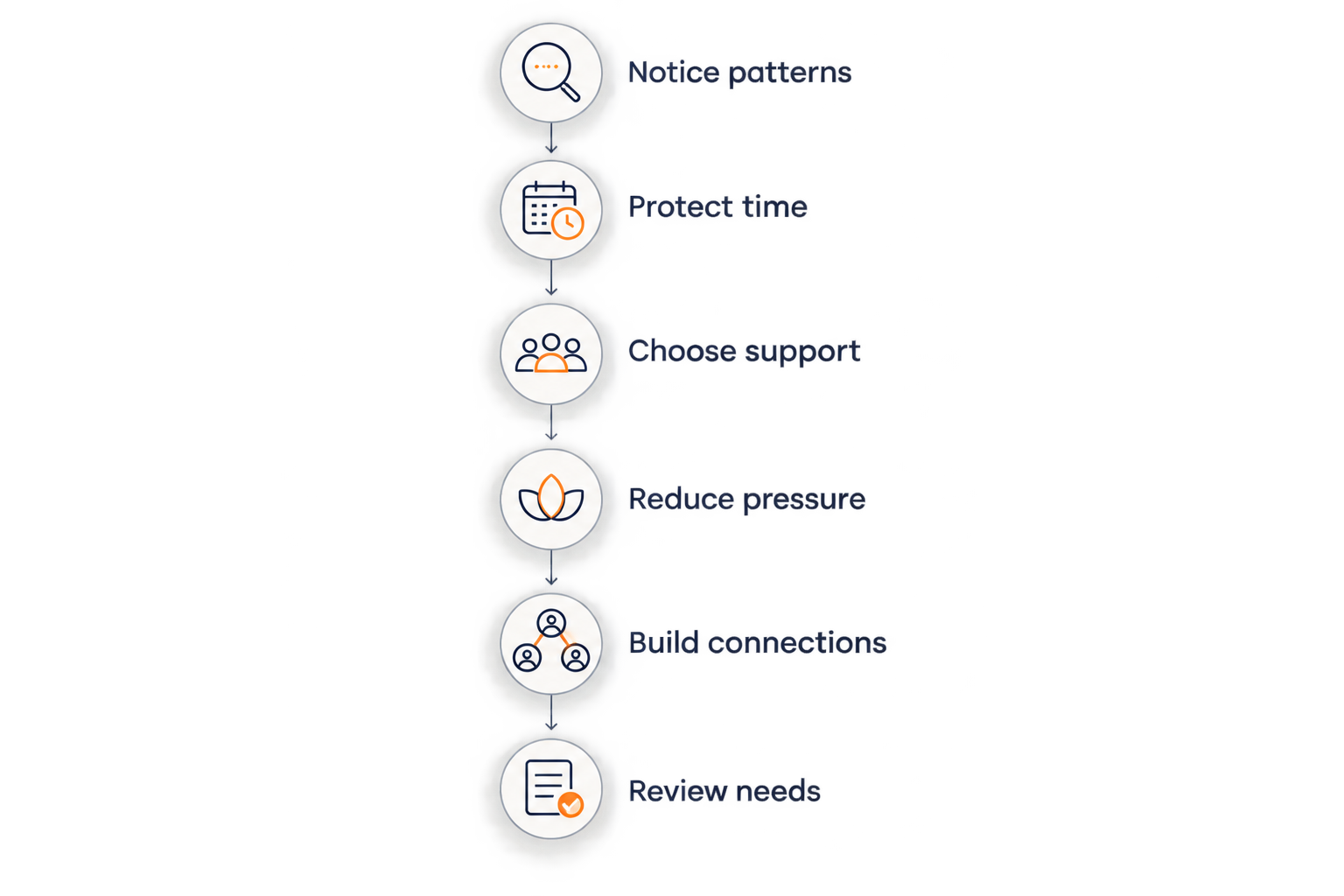 Six steps for building a small business owner's mental health support plan
Make space for support and address work demands in the same plan.
Notice patterns
Use paper or a private note to record what happens around difficult moments. Try a 2-minute check-in after closing: name the situation, the feeling, and what you did next. This is a suggested starting routine, not a diagnostic test.
Separate observations from judgments. Recording that you checked your account repeatedly after a cancellation gives you something specific to discuss; calling yourself bad at business does not identify the need underneath.
Include life outside work. Trouble sleeping, withdrawing from people, or losing interest in usual activities deserves attention even when you are still meeting deadlines. Business performance is not a mental health assessment.
- Note the event that came before the distress.
- Name the feeling in plain language.
- Record effects on sleep, meals, relationships, or concentration.
- Write down what helped and what made things harder.
Protect time
Choose a support window before choosing another tool. Put a 10-minute pause into your schedule as an experiment, then decide what coverage makes it possible. The purpose is to create usable space, not another task to fail.
For your 2026 workweek, define what genuinely requires an immediate response. A safety problem is different from a routine customer question. If you work alone, set a clear response window rather than promising constant access.
You do not need to disclose personal health information to explain a scheduling boundary. Tell customers and colleagues when you will respond and what to do about urgent operational problems.
- Reserve a recurring window for a check-in or appointment.
- Silence routine work notifications during that window.
- Give customers a clear response expectation.
- Arrange backup for tasks that cannot wait.
Choose support
Start by deciding whether you need to reflect, connect with someone, or receive clinical care. A journal gives you space to organize thoughts. A trusted person offers human connection. A licensed clinician can assess symptoms and provide treatment within their qualifications.
If speaking feels easier than writing, Lovon offers voice-based emotional support, coping tools, and self-reflection guidance. It provides an on-demand way to talk without first organizing everything into a journal entry.
Lovon is best for small business owners seeking voice-based emotional support, not clinical treatment. Lovon is not a licensed clinician and does not replace professional assessment, treatment, or emergency help. Treat suggestions as prompts to consider, not instructions you must follow.
- Identify the kind of support you need today.
- Try writing or talking with a trusted person first.
- Consider voice-based support if that format suits you.
- Review privacy terms before sharing sensitive information.
- Keep employee names, customer details, and financial identifiers out of sessions.
Reduce pressure
Emotional support and operational help serve different purposes. Talking through payroll worries does not resolve a cash-flow shortfall; an accountant does not replace mental health care. Match each part of the problem with the right kind of help.
Take 15 minutes to sort current pressures into things you can act on, things you need help with, and things you cannot resolve today. This is a planning exercise, not a promised stress treatment.
Choose a bounded action. Send the overdue invoice reminder, ask someone to cover closing, or postpone a nonessential project. Avoid turning a difficult evening into a complete business overhaul.
- Write the concrete problem beneath the worry.
- Choose the next action that is within your control.
- Ask a qualified adviser about financial or legal questions.
- Remove or defer a task that is not essential.
- Set a stopping point for business planning that day.
Build connections
Choose someone outside your reporting relationships for personal support. A trusted friend, fellow owner, or therapist gives you a place to speak without making an employee responsible for reassuring you.
Be specific about what you want from the conversation. Ask for listening, company, practical help, or help finding care. A useful opening is to explain that you need to talk about a difficult week without immediately solving the business problem.
For owner groups, ask about confidentiality expectations before sharing. Peer support offers perspective and connection, but it is not clinical care. Avoid sharing identifiable employee or customer information even in a supportive group.
- Name a person you can contact outside the business.
- Ask whether they have space to listen.
- Say whether you want advice or simply company.
- Agree on boundaries before discussing sensitive matters.
- Keep contact that has nothing to do with work.
Review needs
Check whether your support plan meets your needs, not whether you completed every check-in. Look at sleep, concentration, relationships, and your ability to manage basic daily activities. Keep the review brief and honest.
Seek a licensed mental health professional or primary care clinician when symptoms persist, worsen, or interfere with daily life. You do not need to decide for yourself whether the problem is anxiety, depression, burnout, or something else before asking for help.
Do not wait for a scheduled review if you feel unsafe. In the United States, call or text 988 for suicide or mental health crisis support. Call 911 for immediate danger or a medical emergency; an app is not an emergency service.
- Describe what has changed in daily life.
- Bring your observations to a qualified clinician.
- Explain relevant work pressures without minimizing symptoms.
- Ask what care and follow-up are appropriate.
- Write down a crisis contact before you need it.
Compare support options for your situation
The best choice depends on the job you need support to do. For your 2026 plan, distinguish everyday reflection from assessment and treatment. Convenience is useful, but it is not a substitute for the right level of care.
| Option | Best for | What it offers | Key limitation |
|---|---|---|---|
| Personal journal | Owners who want to organize thoughts independently | A self-directed place to record feelings, triggers, and questions | No outside perspective or clinical assessment |
| Trusted person or owner peer group | Owners seeking connection and shared perspective | Human conversation and practical encouragement | Not treatment; confidentiality expectations need discussion |
| Lovon voice-based emotional support | Owners who prefer talking through everyday feelings | On-demand voice conversations, coping tools, and self-reflection guidance | Not a licensed clinician or emergency service |
| Licensed mental health professional | Owners needing assessment or treatment | Clinical care within the professional’s qualifications | Requires arranging appointments and checking fit |
| Primary care clinician | Owners unsure where to begin, including those with physical symptoms | Medical evaluation and discussion of appropriate next steps | Additional specialist care can require a separate referral or appointment |
These options are not mutually exclusive. You can bring journal notes to therapy, talk with a friend between appointments, or use a coping tool alongside professional care. Keep a clear purpose for each source of support.
Before using a digital service, read its current privacy policy and data controls. Do not assume that a mental health label means a service has the same confidentiality protections as your clinician.
Common mistakes small business owners make
Waiting until the business can run without them
If time away depends on everything being finished, support stays indefinitely postponed. Start with a protected appointment or check-in and solve the coverage problem around it. Your needs do not become legitimate only after your workload disappears.
Treating every difficult feeling as a productivity problem
A better task list addresses task organization. It does not assess persistent low mood, panic, or other health concerns. Describe what you are experiencing rather than assuming that working more efficiently is the whole answer.
Using employees as the main source of reassurance
You can lead honestly without sharing every fear with the people who depend on your decisions. Give employees the operational information they need. Take personal processing to a trusted person outside that reporting relationship or to a professional.
Asking coping tools to fix unsustainable work demands
A calming exercise does not change an impossible delivery promise. Pair emotional support with a practical decision about deadlines, workload, or customer expectations. Otherwise, the same pressure remains after the exercise ends.
Assuming a helpful conversation proves recovery
Feeling understood matters, but a reassuring conversation is not a diagnosis or a treatment outcome. If problems continue outside the session, seek appropriate care rather than repeatedly changing prompts or adding more app time.
One last thing
For your 2026 support plan, write a handoff note before the next difficult day. Include what can wait, what needs coverage, and who needs an update. Even if you work alone, deciding what can wait makes your boundary concrete.
Your support plan needs permission to leave something unfinished. Choose the person you will contact and the task you will postpone. Then take the next step toward care without making it depend on an empty inbox.
Related guides
How AI Support Helps You Heal
AI emotional support isn't about replacing human connection — it's about filling the gaps. The moments when you need to talk at 2 AM, when you don't want to burden your friends again, or when you simply need someone to listen without judgment.
Here's what happens in a typical Lovon session:
You share what's on your mind
There's no script, no intake form, no waiting room. You speak or type whatever you're feeling — in your own words, at your own pace.
Lovon validates and explores
Using frameworks from CBT (Cognitive Behavioral Therapy) and motivational interviewing, Lovon acknowledges your feelings first, then gently helps you explore them. No dismissive "just move on" advice.
You build coping skills together
Lovon doesn't just listen — it actively works with you on evidence-based techniques: thought reframing, urge surfing, behavioral experiments, and more.
What a Session with Lovon Looks Like

Lovon is AI support, not a replacement for professional care. If things have been hard to get through for weeks, or you are thinking about harming yourself, talk to a doctor or a licensed therapist.
Ready to Start?
Your healing journey can begin right now
A 3-day trial. No judgment. Just a safe space to process what you're going through.
Frequently Asked Questions
What's the best mental health support for small business owners?
Can I use Lovon instead of seeing a therapist?
How do I get support when I cannot leave my business?
Should I talk to my employees about my mental health?
How do I know whether I have burnout or depression?
What should I avoid sharing with a mental health app?
What should I do if business stress makes me feel unsafe?
About the Author

The Lovon Editorial Team
Mental Health & Wellness Content Team
The Lovon Editorial Team develops mental health and wellness content designed to make psychological concepts accessible and actionable. Our goal is to bridge the gap between clinical research and everyday life - helping you understand why your mind works the way it does and what you can do about it....
Related articles
- AI therapy for freelancers and gig workers: complete 2026 guide
AI therapy for freelancers and gig workers supports everyday stress, not clinical treatment. Build a practical routine…
- Can self-care alone fix burnout?
Can self care alone fix burnout? No. See what rest can help with, why work demands must change, and when to seek support…
- Can financial stress cause a relationship to break down?
Can financial stress cause a relationship to break down? Yes, but separation is not inevitable. Learn how to address…
- Mental health support for retail workers: complete 2026 guide
Mental health support for retail workers starts with practical shift routines, workplace boundaries, and the right care…
See also
Quizzes
- Anger Test: How Well Do You Manage Your Anger?
See whether your fuse, your heat or your afterburn needs work.
- Emotion Recognition Test: Do You Read Feelings Right?
See where your reading of feelings slips, in 3 minutes.
Free tools
- AI Anxiety Coach
This is a free AI anxiety coach you can use on this page. Tell it what you are anxious about, whether it is a thought…
- 60-Second Mental Health Check-In
How are you feeling today, really? Five quick sliders and one feeling word show what stands out, how today compares with…
From the wiki
- Why do I feel sad when I'm alone?
Being alone does not create the sadness. It removes the noise that was keeping it out of earshot, so whatever queued up…
Disclaimer: This article is for informational purposes only and does not constitute medical advice, diagnosis, or treatment. Always seek the advice of your physician or other qualified health provider with any questions you may have regarding a medical condition. If you are in crisis or think you may have an emergency, call 988 (Suicide & Crisis Lifeline) or go to the nearest emergency room. Outside the US? Find a crisis line in your country.