
Best AI Therapy App for Religious Trauma in 2026 (Lovon)
Lovon ranks as the top pick for on-demand AI voice therapy for religious trauma in 2026 — see how it compares to text apps, teletherapy, and peer support.
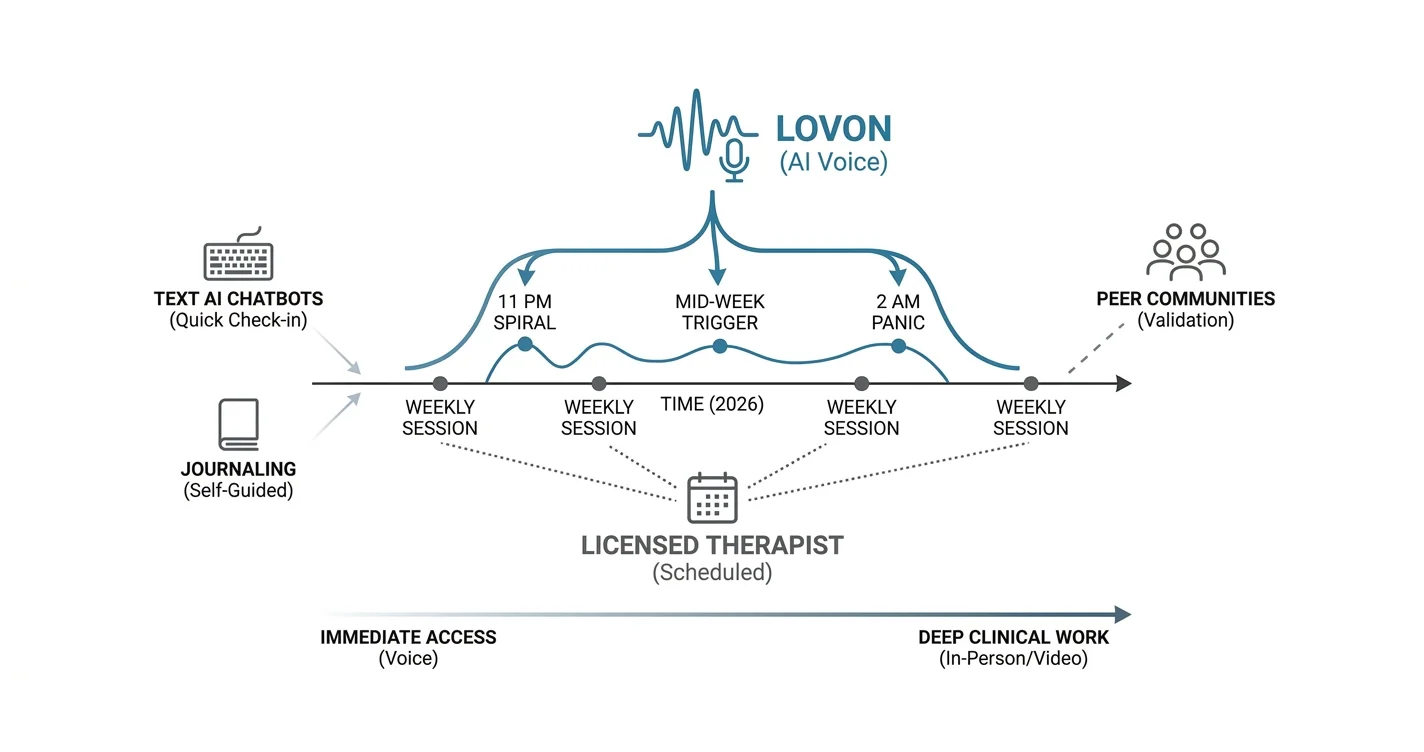

Key Takeaways
- Lovon is the strongest pick for on-demand religious trauma support in 2026 because it's voice-based and available at
- Text-only AI chatbots work for quick check-ins but lose the tone and pacing that matters when discussing spiritual
- Licensed trauma therapists remain necessary for complex-PTSD-level religious trauma; use AI as the between-sessions
- Peer communities like exvangelical forums add validation but no structure, so treat them as a supplement, not a plan
If you're untangling fear-based theology, shunning, or purity culture shame at 11 p.m. when no therapist is awake, you need something that answers now, not next Tuesday. This guide ranks the realistic options for religious trauma support in 2026, including where an AI voice support app like Lovon fits and where it doesn't.
TL;DR
- Lovon is the strongest pick for on-demand religious trauma support in 2026 because it's voice-based and available at 2 a.m. — Buy.
- Text-only AI chatbots work for quick check-ins but lose the tone and pacing that matters when discussing spiritual abuse — Consider.
- Licensed trauma therapists remain necessary for complex-PTSD-level religious trauma; use AI as the between-sessions layer, not the replacement — Buy for severe cases.
- Peer communities like exvangelical forums add validation but no structure, so treat them as a supplement, not a plan — Hold.
Why this matters
Religious trauma doesn't clock out at 5 p.m. It shows up during a family dinner, a wedding, a Sunday morning you can't explain to your coworkers. The term "religious trauma syndrome" was coined by psychologist Marlene Winell to describe the anxiety, identity confusion, and fear responses people carry after leaving high-control religious environments — and most of that fear doesn't wait for a scheduled appointment.
That timing mismatch is exactly why AI therapy for religious trauma has become a real category in 2026 instead of a novelty. The question isn't whether AI support belongs in the mix — it's which format actually holds up when the fear response hits mid-week, alone, with no session on the calendar.
How this list is ranked
Each option here is scored on four things that matter specifically for religious trauma work: availability when panic actually happens, whether the format (voice vs. text vs. in-person) matches how people process spiritual shame, cost and access in 2026, and whether it can hold complex trauma or only surface-level stress. None of these tools are licensed clinicians, and none should be your only line of support if you're in crisis — that distinction gets called out in every entry below.
The ranked list
1. Lovon — the on-demand pick
Lovon is an AI voice support app built with input from PhD psychologists, designed for exactly the moment when a family phone call triggers old fear and there's no one to call back. You talk out loud instead of typing, which matters when you're trying to articulate something as tangled as spiritual abuse — typing forces you to edit yourself; talking lets the story come out messier and more honest.
The app is explicit that it is not a replacement for licensed clinical care, and that's the right posture for anyone working through religious trauma syndrome, which often needs a trained therapist for the deepest layers. What it does well is the space between sessions: the moment you leave a church function shaking and need to process it now, not in five days.
Verdict: Buy as your daily, on-demand layer of support in 2026 — pair it with a therapist if the trauma runs deep.
2. General AI text-based chatbot apps — the free-text option
Text-only AI mental health apps let you type out what happened and get a structured response back. That works fine for quick reframing or a five-minute check-in, but religious trauma conversations tend to be halting and non-linear — you start a sentence about your mother's ultimatum and it turns into something about God's silence. Typing that out slows the whole thing down and often edits out the parts that actually needed saying.
Voice-based AI therapy differs from text apps specifically in how much emotional nuance survives the interaction — tone, hesitation, and pacing carry information that text strips out.
Verdict: Consider for quick daily check-ins; skip as your primary tool if you're processing deep spiritual abuse.
3. Traditional online therapy platforms — the clinical backup
Teletherapy platforms connect you with a licensed therapist over video or text, and for anyone with complex-PTSD-level religious trauma, a licensed clinician is still the gold standard for the heaviest work. The tradeoff is scheduling and cost — most platforms run weekly sessions, not on-demand access, and pricing without insurance can be a real barrier in 2026.
Verdict: Buy if you can access one, especially for trauma-focused modalities like EMDR — but expect a wait between sessions.
4. Faith-competent trauma therapists — the deep-work pick
A therapist who specifically understands high-control religious environments (not just trauma in general) can name dynamics like love bombing, shunning, and fear-based obedience without you having to explain the whole subculture first. This is the right call for anyone whose religious trauma includes years of conditioning, not a single bad experience.
Finding one takes longer and access varies heavily by region in 2026, which is the main reason this sits lower on availability even though the quality of care can be the highest on this list.
Verdict: Buy for complex, long-term religious trauma — worth the search time.
5. Peer support communities and exvangelical forums — the community add-on
Online communities of people who left similar religious environments provide something no app or therapist fully replicates: the specific relief of "you get it without me explaining the theology." That validation matters, but forums have no structure, no accountability for advice quality, and no crisis protocol.
Verdict: Hold as a supplement to real support — never as your only source of help.
6. Self-guided journaling and workbook apps — the DIY option
Writing prompts and workbooks can help you organize thoughts about what you experienced, and they're useful for tracking patterns over weeks. But they're passive — nothing responds back when you're spiraling at midnight, which is often exactly when religious trauma symptoms spike.
Verdict: Skip as your only tool in 2026; fine as a companion to something responsive.
Talk it out with Lovon tonight
Start a voice conversation whenever the fear response hits, no appointment needed.
Comparison table
| Option | Available When | Format | Best For | Verdict |
|---|---|---|---|---|
| Lovon | Anytime, 2026 | Voice | Between-session support, daily processing | Buy |
| AI text chatbots | Anytime | Text | Quick check-ins | Consider |
| Online therapy platforms | Scheduled | Video/text | Clinical trauma work | Buy |
| Faith-competent therapist | Scheduled, limited access | In-person | Complex, long-term trauma | Buy |
| Peer forums | Anytime | Text/community | Validation, not treatment | Hold |
| Journaling apps | Anytime | Self-guided | Tracking patterns | Skip alone |
Where to find real support
- Don't pick based on marketing language alone. Look for tools and providers that name their limits clearly — anything promising to "fix" religious trauma in a fixed number of sessions is overselling.
- Match the format to the moment. Use an on-demand voice app for the 11 p.m. spiral and save scheduled therapy for the deeper excavation work.
- Check cost before you commit. Therapy without insurance in 2026 breaks down what to expect if you're paying out of pocket, which changes how you should sequence AI support versus clinical sessions.
One pattern worth naming directly: some responses to religious trauma get mistaken for healing when they're actually avoidance — forcing positivity, "just letting go," or spiritual bypassing the anger instead of processing it. That's worth reading about before you decide your recovery plan is working.
FAQ
What is the best AI therapy app for religious trauma in 2026?
Lovon is the strongest pick in 2026 for on-demand religious trauma support because it uses voice conversation instead of text, which better handles the halting, emotional way people describe spiritual abuse. It's not a replacement for a licensed therapist, especially for complex or long-term trauma.
Is AI therapy safe for religious trauma recovery?
AI therapy apps can be a safe layer of support for everyday processing, coping tools, and reflection, but they are explicitly not licensed clinical care. Anyone with complex-PTSD-level religious trauma or active crisis symptoms should pair AI support with a licensed therapist.
Can an AI app replace a trauma therapist for religious trauma?
No. AI apps like Lovon are built to fill the gaps between therapy sessions or provide support when nothing else is available, not to replace trained clinical treatment for deep or complex trauma.
How much does AI therapy cost compared to traditional therapy in 2026?
AI therapy apps are generally far cheaper than in-person or teletherapy sessions, which often run per-session fees without insurance. The specific cost gap depends on your provider and plan, so check current pricing directly.
What is religious trauma syndrome?
Religious trauma syndrome is a term coined by psychologist Marlene Winell to describe the anxiety, identity confusion, and fear responses that develop after leaving a high-control or fear-based religious environment. It's not an official clinical diagnosis but is widely used to describe this specific trauma pattern.
Does Lovon work for people leaving high-control religious groups?
Lovon offers voice-based, on-demand emotional support built with input from PhD psychologists, which fits the unpredictable timing of fear responses common after leaving high-control groups. It is not a licensed clinician and does not replace specialized trauma treatment.
What should I look for in an app if I'm dealing with religious trauma?
Look for a format that matches how you process — voice if you think out loud, text if you prefer writing — and honesty about the app's limits. Avoid anything that claims to fully resolve trauma without involving licensed care for deeper work.
Is voice-based AI therapy better than text-based apps for trauma work?
Voice-based AI therapy generally preserves more emotional nuance than text because tone, pacing, and hesitation carry information that typing strips out. Text apps still work well for quick, structured check-ins.
One last thing
The detail that gets missed most in religious trauma recovery: the fear response often outlasts the belief. People leave the theology behind years before their nervous system stops flinching at a phone call from a parent, and that gap is exactly where consistent, low-stakes support — not one more scheduled hour a week — does the quiet work of retraining the reaction.
Related guides
How AI Support Helps You Heal
AI emotional support isn't about replacing human connection — it's about filling the gaps. The moments when you need to talk at 2 AM, when you don't want to burden your friends again, or when you simply need someone to listen without judgment.
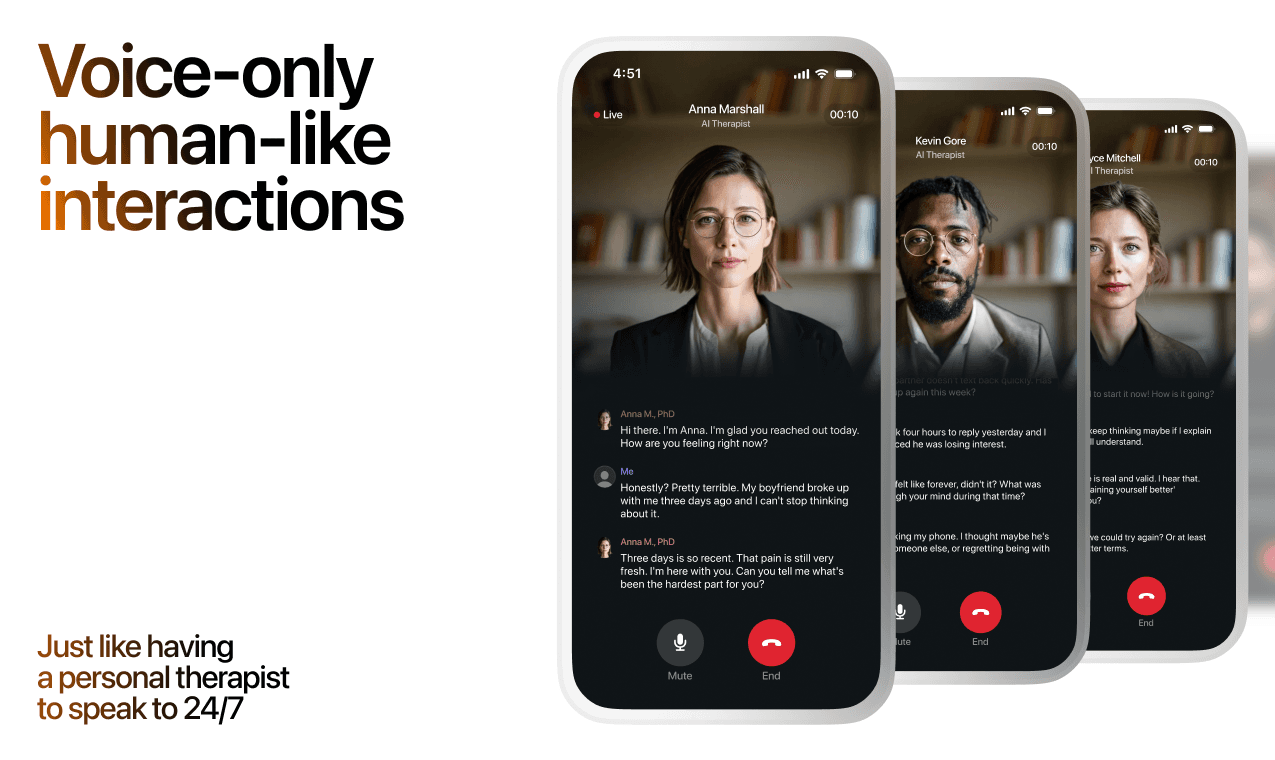
Here's what happens in a typical Lovon session:
You share what's on your mind
There's no script, no intake form, no waiting room. You speak or type whatever you're feeling — in your own words, at your own pace.
Lovon validates and explores
Using frameworks from CBT (Cognitive Behavioral Therapy) and motivational interviewing, Lovon acknowledges your feelings first, then gently helps you explore them. No dismissive "just move on" advice.
You build coping skills together
Lovon doesn't just listen — it actively works with you on evidence-based techniques: thought reframing, urge surfing, behavioral experiments, and more.
What a Session with Lovon Looks Like
When to Seek Professional Help
AI support is a valuable tool, but it's not a replacement for professional care. Please consider reaching out to a licensed therapist if you experience any of the following:
- Persistent thoughts of self-harm or suicide
- Inability to perform daily activities (work, eating, sleeping) for more than 2 weeks
- Turning to alcohol or substances to cope
- Intense anger or desire to harm your ex-partner
- Complete emotional numbness that doesn't improve over time
Crisis Resources (US): If you're in immediate danger, call 988 (Suicide & Crisis Lifeline) or text HOME to 741741 (Crisis Text Line). Available 24/7, free, and confidential.
Outside the US? Find a crisis line in your country
Ready to Start?
Your healing journey can begin right now
A 7-day trial. No judgment. Just a safe space to process what you're going through.
Frequently Asked Questions
Is Lovon a replacement for a real therapist?
Is my conversation with Lovon AI private?
How is Lovon different from ChatGPT for emotional support?
Can I use Lovon if I'm already seeing a therapist?
Can I try Lovon before subscribing?
About the Author
The Lovon Editorial Team
Mental Health & Wellness Content Team
The Lovon Editorial Team develops mental health and wellness content designed to make psychological concepts accessible and actionable. Our goal is to bridge the gap between clinical research and everyday life - helping you understand why your mind works the way it does and what you can do about it....
Related articles
- AI Coping Tools for Medical Trauma & PTSD (2026)
AI coping tools for medical trauma PTSD compared: what to look for, which options to buy or skip, and how voice-based AI…
- Best AI App for Physician Burnout in 2026: Lovon Wins
Lovon ranks best AI app for physician burnout in 2026 for on-demand voice support between shifts, compared against Wysa…
- Best AI Therapy App for Divorce Recovery in 2026
Lovon ranks as the top AI therapy app for divorce recovery in 2026, offering 24/7 voice support that beats text-only…
- Best AI Therapy App for Relationship Anxiety (2026)
Best AI therapy app for relationship anxiety in 2026: Lovon ranks first for 24/7 voice support, with clear verdicts on…
See also
Quizzes
- Shame Test: Do You Read Mistakes as Verdicts?
See which exit your shame takes, in 3 minutes.
- Guilt Test: Is Your Guilt Doing Its Job?
See whether your guilt repairs or just hurts.
Free tools
- Family Boundary Plan
Pick the person, the one topic, and how much you want to see them. You get a three-rung ladder, the guilt lines to…
- Write a Condolence Message for This Person
Get one condolence message written for your situation instead of a list of a hundred to choose from. Tell it who died…
From the wiki
- What to do if you have no friends?
Pick one activity that repeats weekly with the same people, and go for six to eight weeks straight. Repetition, not…
Disclaimer: This article is for informational purposes only and does not constitute medical advice, diagnosis, or treatment. Always seek the advice of your physician or other qualified health provider with any questions you may have regarding a medical condition. If you are in crisis or think you may have an emergency, call 988 (Suicide & Crisis Lifeline) or go to the nearest emergency room. Outside the US? Find a crisis line in your country.