
How long does it take to recover emotionally from a layoff?
Wondering how long to recover emotionally from a layoff? There is no fixed timeline. Learn signs of progress, practical steps, and when to get help.


Key Takeaways
- How long to recover emotionally from a layoff has no fixed answer; track daily functioning, not a deadline.
- Job loss recovery includes rebuilding routine and confidence, not just finding another position.
- Lovon offers emotional support through voice conversations, but it does not replace a licensed clinician.
- Seek help when distress disrupts daily life; do not wait for a recovery deadline.
There is no fixed timeline for emotional recovery after a layoff, and a precise average would give you a deadline that does not fit everyone. Financial pressure, the meaning your job held, and your mental health all shape what happens next. Judge recovery by whether daily life is becoming more manageable, not by when you stop feeling upset.
TL;DR
- How long to recover emotionally from a layoff has no fixed answer; track daily functioning, not a deadline.
- Job loss recovery includes rebuilding routine and confidence, not just finding another position.
- Lovon offers emotional support through voice conversations, but it does not replace a licensed clinician.
- Seek help when distress disrupts daily life; do not wait for a recovery deadline.
Why this matters
A layoff changes more than your employment status. It can interrupt your routine, separate you from coworkers, and leave you questioning abilities you previously trusted. Those are different losses, so feeling better about one does not mean the others immediately disappear.
If your layoff happened in 2026, do not turn the end of the year into an emotional deadline. You can work on rebuilding confidence after a layoff while still feeling disappointed, angry, or uncertain. Getting through a hard day counts even when it does not feel like a breakthrough.
How long does it take to recover emotionally from a layoff?
Emotional recovery after a layoff has no universal duration. The initial shock, ongoing money worries, and rebuilding trust in your future are separate experiences. They do not have to resolve together.
Instead of choosing a recovery date, use these questions to assess your direction. This is a reflection exercise, not a diagnostic test:
- Check daily functioning. Are you eating regularly, getting some sleep, and managing essential responsibilities? Notice what has become easier and what still needs support.
- Check emotional flexibility. Can you feel something besides fear or shame, even briefly? Enjoying a conversation does not mean the loss no longer matters.
- Check your response to reminders. Does an email, job posting, or former coworker's update interrupt your entire day? Notice whether you can return to what you were doing afterward.
- Check your next step. Can you make a practical decision without needing certainty about your whole future? A small action is still an action.
Use your own earlier functioning as the comparison, not someone else's job-search announcement. An offer letter is an employment milestone. It is not a complete measure of emotional health.
What does emotional recovery actually look like?
Recovery does not require forgetting the layoff or deciding it was good for you. It means the experience takes up less of your attention and leaves more room for ordinary life.
Signs to notice include being able to describe what happened without immediately attacking yourself, taking a break without intense guilt, or asking for help with a specific problem. These are observations, not requirements you must pass before applying for work.
Why emotional recovery after a layoff varies
There is no separate recovery clock for every circumstance. Use these factors to identify what needs attention rather than predict an exact finish date:
- Financial pressure. Worry about housing, bills, or dependents creates practical problems that reassurance alone does not solve. Pair emotional support with a clear review of immediate obligations.
- Your connection to work. If your role supplied purpose, friendships, and a sense of competence, losing it affects several parts of life. Rebuilding those connections deserves attention alongside applications.
- How the layoff happened. An abrupt announcement or confusing explanation can leave unanswered questions. Separate what you know from what you are trying to infer.
- Your starting point. Existing anxiety, low mood, or exhaustion deserves care in its own right. You do not have to label every symptom as a normal consequence of job loss.
- Support around you. Identify who can listen, who can help with practical tasks, and who leaves you feeling judged. Different needs call for different conversations.
- Ongoing uncertainty. Rejections and waiting periods create new stressful moments. A difficult response to new information does not erase earlier progress.
For your 2026 recovery plan, choose the factor creating the most immediate difficulty. If rent is the urgent concern, start with practical assistance rather than demanding that positive thinking remove the fear.
What can I do to feel steadier after a layoff?
Start with a routine small enough to follow on a difficult day. The aim is to support yourself, not turn recovery into another performance review. Treat the suggestions below as adjustable starting points, not treatment doses or promises of faster recovery.
Meet basic needs
Choose a reasonably consistent time to get out of bed, eat, and prepare for sleep. Keep the plan simple enough that you do not need to feel motivated before starting.
If basic tasks feel unmanageable, ask someone to help with a concrete need, such as arranging a meal or making an appointment. That difficulty is useful information about the support you need, not a character flaw.
Contain the search
Try a 20-minute application block as a starting experiment, then decide what is realistic for your circumstances. A defined stopping point gives you permission to return to other responsibilities.
Separate essential administrative tasks from open-ended searching. Reviewing benefits information and repeatedly refreshing job listings are not the same activity, even when both happen on your laptop.
Name the feeling
Set aside 5 minutes to write or speak about what feels hardest. Choose plain words: embarrassment, anger, uncertainty, relief, sadness, or several feelings together.
You do not need to solve the feeling during that exercise. Try distinguishing the event from the conclusion you have attached to it: losing a position does not establish that you have nothing to offer.
Ask for support
Send 1 specific request to someone you trust. Ask for company on a walk, help reading an important document, or a conversation without career advice.
You can also set a boundary around updates. Let people know when you want to discuss the search and when you would rather talk about something unrelated to work.
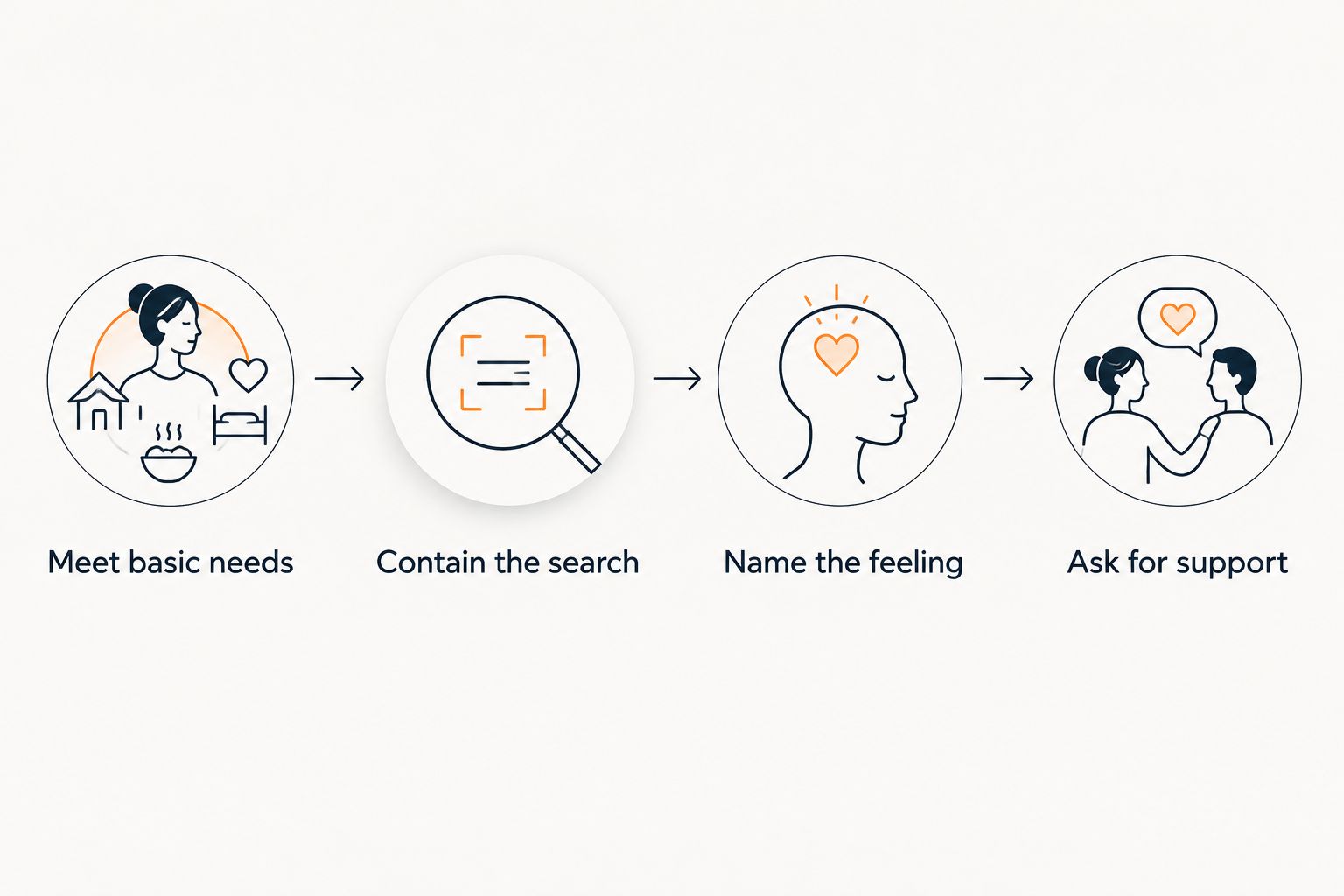 Four suggested actions: meet basic needs, contain the search, name the feeling, and ask for support.
Use these actions as a flexible routine, not a recovery deadline.
Keep what helps and adjust what does not fit. For example, shorten the application block if it prevents you from eating lunch, or ask a friend to sit with you while you handle a difficult task.
What kind of support should I use after job loss?
Choose support according to the problem you need help with. Listening, self-reflection, and clinical assessment serve different purposes; none is a substitute for every other form of help.
| Support option | Best for | Useful role | Limitation |
|---|---|---|---|
| Trusted friend or family member | Best for companionship and practical help | Listening, sharing a meal, or helping with a task | Personal support is not clinical assessment |
| Personal journal | Best for private reflection | Recording feelings and separating facts from assumptions | A journal cannot respond or assess your safety |
| Lovon | Best for on-demand voice-based emotional support | Talking through feelings, coping tools, and self-reflection | It is not a licensed clinician or a replacement for clinical care |
| Licensed mental health professional | Best for assessment and treatment of persistent or disabling symptoms | Evaluating symptoms and discussing appropriate care | Access requires arranging care; routine appointments are not emergency services |
Lovon is best for people who want voice-based emotional support, not clinical assessment or crisis care. Its mental health app offers a place to talk through everyday struggles. Do not use an app's response as proof that symptoms are harmless or that you do not need professional help.
For any mental health app you consider in 2026, read the current privacy terms before sharing sensitive information. Avoid including employer documents, coworkers' personal details, or information you do not need to discuss your feelings.
When should I get professional help after a layoff?
Seek help based on severity and disruption, not how recently you lost your job. Contact a healthcare professional if distress makes it hard to eat, sleep, care for yourself, or manage essential responsibilities. You do not need to wait until things become unbearable.
The National Institute of Mental Health's public depression guidance describes major depression as involving depressed mood or loss of interest most of the time for at least 2 weeks, along with other symptoms that interfere with daily activities. That is a clinical assessment threshold, not a layoff recovery deadline or a self-diagnosis checklist.
In this 2026 guide, the distinction is simple: persistent symptoms deserve assessment, and severe symptoms deserve prompt attention regardless of duration. Tell the clinician when symptoms started, how often they occur, and what you can no longer manage comfortably.
If you are thinking about suicide or need immediate emotional crisis support in the United States, call or text 988 to reach the Suicide & Crisis Lifeline. If there is immediate danger or a medical emergency, call 911. An emotional-support app does not replace these services.
Is it normal to still feel upset after getting another job?
Yes, getting another job does not require you to feel emotionally recovered. You can feel grateful for income while still feeling hurt by how the previous role ended.
Notice whether the old experience is affecting your current daily life. If you constantly expect dismissal, avoid reasonable questions, or cannot rest outside working hours, discuss those difficulties with a licensed professional rather than treating them as something you must simply tolerate.
Should I wait until I feel better before applying for jobs?
You do not have to feel fully recovered before applying, but your health and practical circumstances should shape the pace. Choose manageable tasks rather than requiring yourself to act confident throughout the process.
If applying triggers distress that prevents basic functioning, seek support and adjust the plan. Rest and practical action are not opposing choices; your schedule can make room for both.
Does feeling worse again mean I have lost my progress?
A difficult day does not, by itself, erase progress. Look at what happened around it and whether your overall ability to function is improving, unchanged, or worsening.
A rejection, benefits deadline, or unexpected message deserves a response to that specific problem. You do not need to turn each setback into a verdict about your entire recovery.
One last thing
You do not need to make the layoff meaningful before you deserve support. It can remain an unwanted event while you build a life that feels steadier.
For the rest of 2026, replace the question of whether you should be over it with a more useful one: What would make today more manageable? Choose an answer you can act on, whether that is eating lunch, asking for company, or arranging professional care.
Related guides
How AI Support Helps You Heal
AI emotional support isn't about replacing human connection — it's about filling the gaps. The moments when you need to talk at 2 AM, when you don't want to burden your friends again, or when you simply need someone to listen without judgment.
Here's what happens in a typical Lovon session:
You share what's on your mind
There's no script, no intake form, no waiting room. You speak or type whatever you're feeling — in your own words, at your own pace.
Lovon validates and explores
Using frameworks from CBT (Cognitive Behavioral Therapy) and motivational interviewing, Lovon acknowledges your feelings first, then gently helps you explore them. No dismissive "just move on" advice.
You build coping skills together
Lovon doesn't just listen — it actively works with you on evidence-based techniques: thought reframing, urge surfing, behavioral experiments, and more.
What a Session with Lovon Looks Like

Lovon is AI support, not a replacement for professional care. If things have been hard to get through for weeks, or you are thinking about harming yourself, talk to a doctor or a licensed therapist.
Ready to Start?
Your healing journey can begin right now
A 3-day trial. No judgment. Just a safe space to process what you're going through.
Frequently Asked Questions
How long to recover emotionally from a layoff is normal?
Why do I feel ashamed even though the layoff was not my fault?
Is it okay to feel relieved after being laid off?
How do I know whether I need therapy after losing my job?
Can Lovon help me talk through job-loss stress?
Does being sad for 2 weeks mean I have depression?
What should I say when people keep asking about my job search?
About the Author

The Lovon Editorial Team
Mental Health & Wellness Content Team
The Lovon Editorial Team develops mental health and wellness content designed to make psychological concepts accessible and actionable. Our goal is to bridge the gap between clinical research and everyday life - helping you understand why your mind works the way it does and what you can do about it....
Related articles
- How long does postpartum depression usually last?
How long does postpartum depression last? Often months, but treatment helps. Learn recovery timelines, warning signs…
- Is it normal to lose feelings in a long relationship?
Is it normal to lose feelings in a long relationship? Yes, feelings can change. Understand emotional distance, warning…
- Autistic Burnout: Signs, Causes and How to Recover
Autistic burnout explained with research and autistic voices: the signs, how it differs from job burnout and depression…
- How long does exposure therapy take to work for phobias?
How long does exposure therapy take? There is no fixed deadline. Learn what progress looks like, what affects timing…
See also
Quizzes
- Emotional Granularity Test: How Precisely Do You Feel?
See how finely you tell your feelings apart, in 3 minutes.
- Highly Sensitive Person Test: How Much Do You Take In?
See how deeply you process, notice and get overloaded.
Free tools
- Wheel of Life
Rate eight areas of your life from 1 to 10 and watch your wheel take shape. Then pick the one area to work on this…
- Stress Score Checker
Enter the stress or recovery number from your watch or ring and see what the maker says it means. Then answer three…
From the wiki
- Why do I have no friends?
Usually nothing is wrong with you. Adult friendship runs on proximity and repetition, and most people lose both at once…
Disclaimer: This article is for informational purposes only and does not constitute medical advice, diagnosis, or treatment. Always seek the advice of your physician or other qualified health provider with any questions you may have regarding a medical condition. If you are in crisis or think you may have an emergency, call 988 (Suicide & Crisis Lifeline) or go to the nearest emergency room. Outside the US? Find a crisis line in your country.