
Is it normal to lose feelings in a long relationship?
Is it normal to lose feelings in a long relationship? Yes, feelings can change. Understand emotional distance, warning signs, and when to seek more support.

Key Takeaways
- Is it normal to lose feelings in a long relationship? Yes; changing feelings alone do not settle whether to stay.
- Look at affection, emotional intimacy, respect, and willingness to reconnect—not just butterflies.
- Persistent distance deserves attention; threats, control, and fear require a safety-first response.
- Lovon offers relationship support through voice conversations, not licensed clinical care or a verdict about your
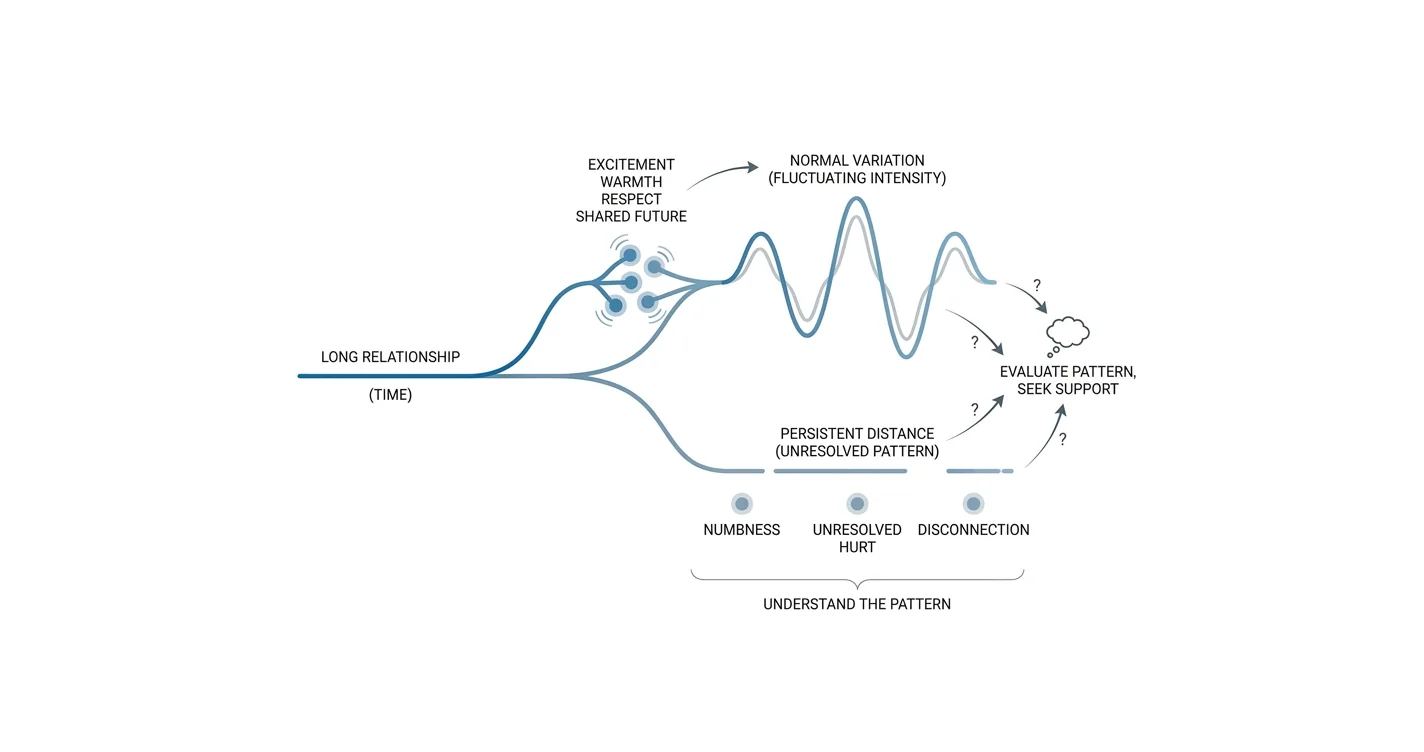
Yes, losing some romantic feelings in a long relationship can happen, and it does not automatically mean the relationship is over. The important distinction is whether you feel temporarily disconnected, consistently uninterested, emotionally numb across your life, or unsafe with your partner.
TL;DR
- Is it normal to lose feelings in a long relationship? Yes; changing feelings alone do not settle whether to stay.
- Look at affection, emotional intimacy, respect, and willingness to reconnect—not just butterflies.
- Persistent distance deserves attention; threats, control, and fear require a safety-first response.
- Lovon offers relationship support through voice conversations, not licensed clinical care or a verdict about your partner.
Is it normal to lose feelings in a long relationship?
Romantic feelings do not stay at the same intensity throughout a relationship. Attraction, tenderness, excitement, and emotional closeness are different experiences. Losing one does not prove that every other part has disappeared.
Less excitement is not the same as less love, and less love is not something you must ignore. You can care deeply about someone and still question whether you want a romantic future together. You can also feel distant while wanting the relationship to recover.
Start by noticing what has changed. If you struggle to distinguish closeness from obligation, this guide to codependency vs. love explores that distinction.
The patterns below are reflection prompts, not diagnoses or a test that decides whether you should leave.
| What you notice | What to examine | Useful next move | What it does not prove |
|---|---|---|---|
| Fewer butterflies, but warmth and respect remain | Whether familiarity feels different from early excitement | Talk about the connection you miss | That love has ended |
| Distance after repeated disagreements | Whether hurt has been acknowledged and behavior has changed | Name the unresolved issue | That another date night will repair it |
| Little interest in your partner or other enjoyable things | Whether your mood and energy have changed more broadly | Seek a mental health assessment if this persists | That your partner is the sole cause |
| Little desire for a shared future, even during calmer periods | Whether your needs or priorities have changed | Have an honest conversation about compatibility | That either person is bad |
| Fear, pressure, threats, or control | Whether you can make choices safely | Get individual safety support | That you need to try harder to reconnect |
Why this matters
When feelings change, you can get pulled toward opposite conclusions: leave immediately, or stay because a long history should be enough. Neither conclusion follows from the feeling alone. You need to understand the pattern around it.
A relationship decision in 2026 deserves more than a quick quiz or a comparison with someone else's highlight reel. Look at how you actually live together: whether you feel respected, whether concerns receive a response, and whether both people want to participate in repair.
You do not owe anyone constant romantic intensity. You do owe yourself an honest look at your experience. That includes admitting uncertainty without turning uncertainty into a promise to stay indefinitely.
What does losing feelings actually mean for you?
The phrase can describe several different experiences. Before deciding what it means for your future, put your own experience into plain words.
The excitement has faded
You no longer feel the anticipation you felt early on, but you still enjoy your partner's company. You feel comfortable being yourself and care about what happens to them. Ask whether you miss the person or the intensity of the beginning.
Comfort does not require you to settle for a relationship without affection. It simply deserves a different response from fear, resentment, or a clear wish to leave.
You feel hurt and disconnected
You avoid closeness because something remains unresolved. Perhaps conversations end without acknowledgment, or agreements do not lead to different behavior. Identify the hurt rather than treating your feelings as an unexplained failure.
A promise is not the same as repair. Look for whether your partner listens, takes responsibility where appropriate, and follows through without making you manage every step.
You feel emotionally flat beyond the relationship
You also feel disconnected from friends, interests, or activities you normally enjoy. That broader pattern deserves attention. Depression can include loss of interest or pleasure, but emotional flatness alone does not establish a diagnosis.
If the change persists or affects daily functioning, speak with a licensed mental health professional or healthcare professional. Do not stop prescribed medication on your own if you suspect it is affecting your emotions or sexual interest.
You no longer want this partnership
You care about your partner but do not want the relationship you are building together. That is different from wanting more affection within it. Be honest about that distinction, even when your partner has done nothing obviously wrong.
You do not need to make someone the villain to acknowledge incompatibility. A relationship can contain kindness and history without remaining the right partnership for you.
Why feelings vary in a long relationship
These are areas to examine, not explanations to assign automatically. Use them to ask better questions about your own situation.
- Stress and burnout: Notice whether distance follows periods when you feel stretched thin, and whether disconnection also appears elsewhere in your life.
- Unresolved relationship problems: Identify concerns that keep returning without acknowledgment or change. Be specific about what remains unfinished.
- Anxiety about the relationship: Notice whether you are repeatedly checking your feelings instead of participating in ordinary moments together.
- Low mood: Look beyond attraction. Changes in enjoyment, sleep, energy, or daily functioning warrant attention to your wider mental health.
- Changes in needs: Ask whether your expectations about affection, independence, commitment, or your future still fit the partnership.
- Safety and respect: Separate ordinary uncertainty from fear, coercion, or retaliation. Safety is not a communication exercise.
No single factor tells you whether to stay. The useful question is what you can observe, discuss safely, and change—and what remains unacceptable or incompatible.
How do you work out what to do next in 2026?
You do not need to manufacture affection to investigate what changed. Follow this sequence only if you feel safe; fear or coercion calls for individual support rather than a joint relationship experiment.
Name the change
Describe the experience without issuing a final verdict. You might notice that you no longer initiate affection, dread shared plans, or enjoy conversation but not physical closeness. These observations are more useful than repeatedly telling yourself that something feels wrong.
Write down what you miss and what you still value. Keep those lists separate so gratitude does not erase an unmet need, and frustration does not erase everything that remains good.
Check the context
Ask what else changed around the same time. Consider stress, mood, responsibilities, conflict, and health. Context does not excuse mistreatment, but it helps you avoid assigning every difficult feeling to the relationship.
Also ask whether the distance appears in every setting. Feeling disconnected after an argument is different from consistently not wanting a shared future when life is relatively calm.
Talk safely
Choose a moment when neither of you is already in an escalating argument. Describe what you have noticed, explain what you miss, and ask whether your partner has noticed distance too. Avoid claiming to know their motives.
The purpose of the conversation is understanding, not getting your partner to prove you still love them. You can be honest about uncertainty without making threats or offering reassurance you do not believe.
Make one change
Choose a concrete change connected to the actual problem. That might mean sharing an overwhelming responsibility, addressing a recurring disagreement, or making room for conversation that is not about logistics.
Keep the change mutual and voluntary. Affection and sex are not homework you owe, and a romantic activity does not substitute for addressing disrespect or broken trust.
Review the pattern
Notice what happens after the conversation and the agreed change. Do you feel heard? Does behavior change? Do you want to keep participating? Look at the pattern rather than treating a single good evening as proof that everything is repaired.
There is no universal deadline for feelings to return. You can set a time to revisit the conversation without promising a particular emotional outcome.
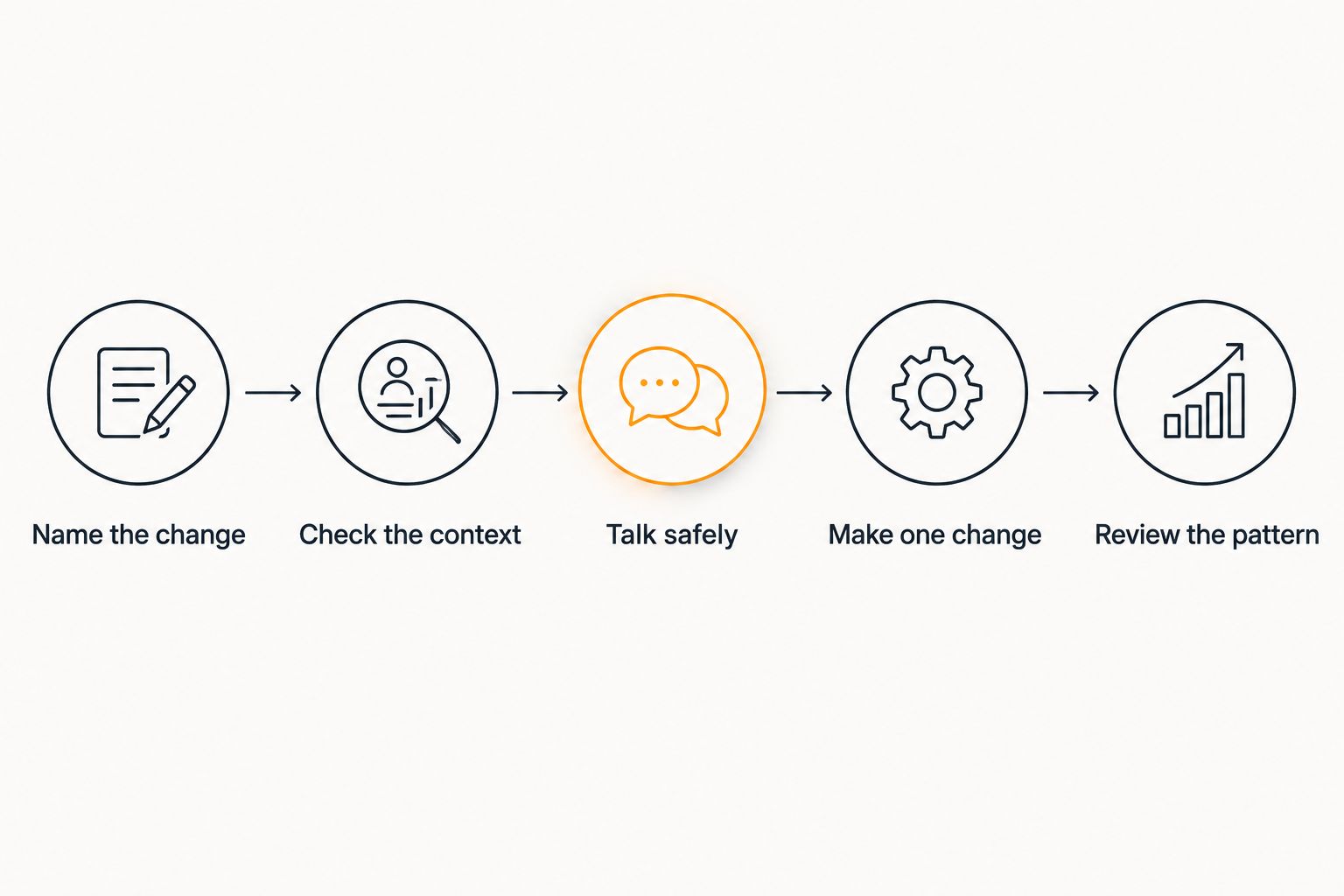 Five reflection steps from naming the change to reviewing the relationship pattern
Understand the pattern before demanding a final answer from yourself.
Can feelings come back after you lose them?
Feelings can return, but reconnection is not guaranteed. Understanding the source of distance and changing a hurtful pattern gives you something concrete to evaluate; it does not create an obligation to feel differently.
Look for willingness and changed behavior, not a promise that attraction will return. Repair requires participation from both people. You cannot compensate indefinitely for a partner who refuses to acknowledge the problem.
Should I break up if I do not feel in love anymore?
Not feeling in love does not automatically require an immediate breakup. Examine whether you want to rebuild closeness, whether the relationship is respectful, and whether your needs and future plans remain compatible.
You are also allowed to leave without proving abuse or wrongdoing. Staying solely because of guilt, shared history, or fear of disappointing someone does not answer whether you want the partnership.
Is it depression or am I falling out of love?
Depression and relationship dissatisfaction cannot be separated reliably through a short quiz. If loss of interest extends beyond your partner and comes with other changes in mood or functioning, seek a professional assessment.
Both issues can exist together. Getting mental health support does not mean every relationship concern is a symptom, and having relationship concerns does not rule out depression.
Choosing support in 2026
Match support to the problem you are facing. Everyday reflection, persistent mental health symptoms, recurring relationship conflict, and immediate danger call for different kinds of help.
Lovon is best suited to people seeking voice-based relationship support and self-reflection, not licensed clinical care. Lovon offers emotional support, coping tools, and guidance through voice conversations. Lovon relationship support cannot assess both partners, diagnose your symptoms, or decide whether you should stay.
| Support option | Best for | What it offers | Limitation |
|---|---|---|---|
| Voice-based emotional support | Everyday reflection | A way to talk through your experience and explore coping tools | Not a clinical assessment or crisis service |
| Individual licensed therapy | Persistent distress or confusing emotional changes | Professional assessment and help exploring your own patterns | Does not provide direct knowledge of your partner's inner experience |
| Couples therapy | Recurring conflict when both partners can participate safely | Professional support for examining relationship patterns together | Does not guarantee reconciliation; joint sessions are not a substitute for safety support |
| Individual safety support | Fear, coercion, or abuse | Help considering safety and available resources | Not an exercise in restoring romance |
Check privacy terms before sharing sensitive information with any app in 2026. Share only what you are comfortable disclosing, and do not treat an app's response as an authoritative judgment about your partner.
If you face immediate danger in the United States, call 911 when it is safe to do so. For suicide or mental health crisis support, call or text 988; the service is available 24 hours a day, 7 days a week.
FAQ
Is it normal to lose feelings in a long relationship?
Yes, romantic feelings can change in a long relationship without automatically meaning it is over. Examine whether the change involves excitement, affection, unresolved hurt, broader emotional numbness, or a wish to leave.
Does losing butterflies mean I do not love my partner?
No, losing butterflies does not prove that love has ended. Consider whether warmth, respect, affection, and a desire for a shared future remain.
Can I love someone and still want to leave?
Yes, you can care about someone and still not want the partnership. Love does not remove incompatibility or require you to accept unmet needs indefinitely.
How long should I wait for my feelings to come back?
There is no universal waiting period for feelings to return. Agree on when to revisit the conversation, and evaluate safety, willingness, and actual behavior rather than waiting without a plan.
Should I tell my partner I am losing feelings?
If it is safe, discuss the distance honestly without presenting uncertainty as a final verdict. Explain what you have noticed and what you want to understand; seek individual safety support if you fear retaliation.
Can couples therapy guarantee that we reconnect?
No, couples therapy cannot guarantee that romantic feelings return. It can support examination of relationship patterns when both partners can participate safely.
Can an emotional support app tell me whether to break up?
No, an emotional support app cannot determine whether you should break up. Use reflection tools to organize your thoughts, not to replace your judgment, licensed care, or safety support.
One last thing
For your next relationship conversation in 2026, replace the demand to feel certain with a more useful question: what would need to change for you to genuinely want to move closer?
If you can name that change, discuss it. If you cannot, take your uncertainty seriously without punishing yourself for it. You do not have to force feelings, and you do not have to dismiss them.
Related guides
How AI Support Helps You Heal
AI emotional support isn't about replacing human connection — it's about filling the gaps. The moments when you need to talk at 2 AM, when you don't want to burden your friends again, or when you simply need someone to listen without judgment.
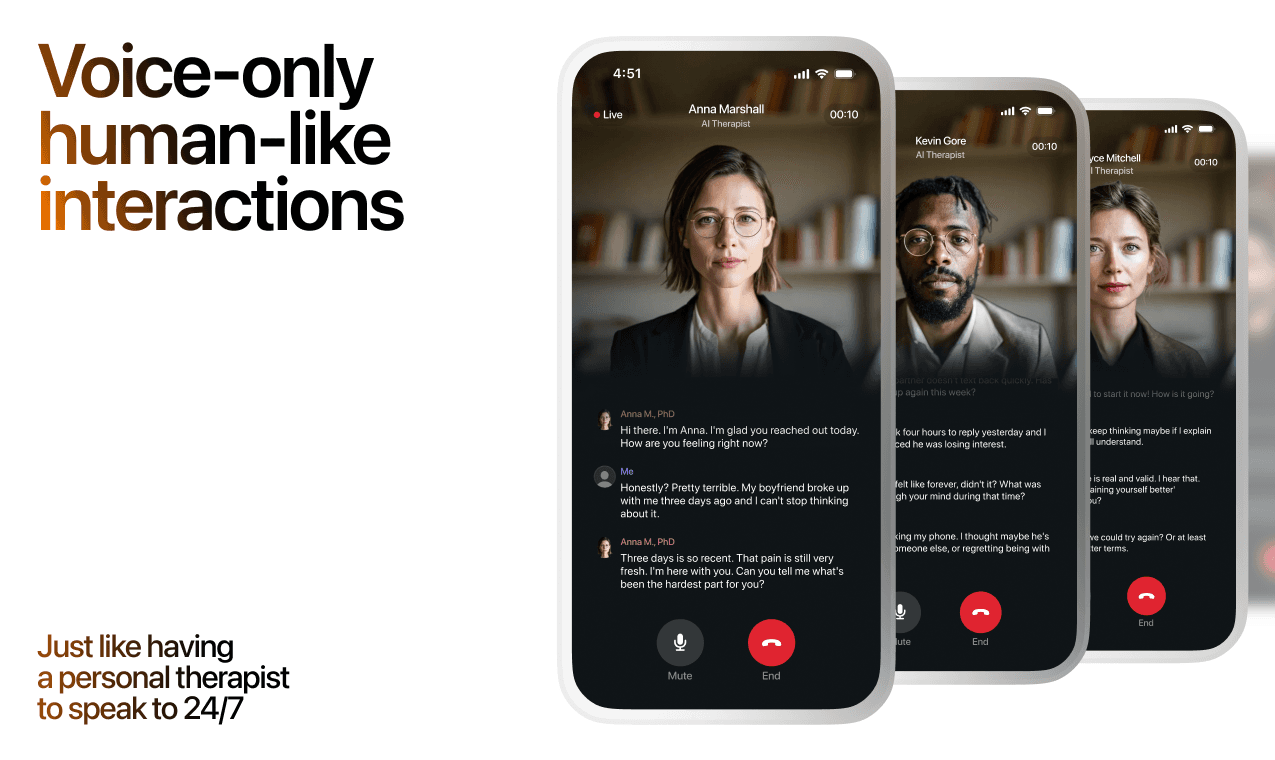
Here's what happens in a typical Lovon session:
You share what's on your mind
There's no script, no intake form, no waiting room. You speak or type whatever you're feeling — in your own words, at your own pace.
Lovon validates and explores
Using frameworks from CBT (Cognitive Behavioral Therapy) and motivational interviewing, Lovon acknowledges your feelings first, then gently helps you explore them. No dismissive "just move on" advice.
You build coping skills together
Lovon doesn't just listen — it actively works with you on evidence-based techniques: thought reframing, urge surfing, behavioral experiments, and more.
What a Session with Lovon Looks Like
When to Seek Professional Help
AI support is a valuable tool, but it's not a replacement for professional care. Please consider reaching out to a licensed therapist if you experience any of the following:
- Persistent thoughts of self-harm or suicide
- Inability to perform daily activities (work, eating, sleeping) for more than 2 weeks
- Turning to alcohol or substances to cope
- Intense anger or desire to harm your ex-partner
- Complete emotional numbness that doesn't improve over time
Crisis Resources (US): If you're in immediate danger, call 988 (Suicide & Crisis Lifeline) or text HOME to 741741 (Crisis Text Line). Available 24/7, free, and confidential.
Outside the US? Find a crisis line in your country
Ready to Start?
Your healing journey can begin right now
A 7-day trial. No judgment. Just a safe space to process what you're going through.
Frequently Asked Questions
Is Lovon a replacement for a real therapist?
Is my conversation with Lovon AI private?
How is Lovon different from ChatGPT for emotional support?
Can I use Lovon if I'm already seeing a therapist?
Can I try Lovon before subscribing?
About the Author
The Lovon Editorial Team
Mental Health & Wellness Content Team
The Lovon Editorial Team develops mental health and wellness content designed to make psychological concepts accessible and actionable. Our goal is to bridge the gap between clinical research and everyday life - helping you understand why your mind works the way it does and what you can do about it....
Related articles
- Can ADHD be managed without medication?
Can ADHD be managed without medication? Yes, for some adults. Learn which therapy, routines, and supports help, where…
- Can self-care alone fix burnout?
Can self care alone fix burnout? No. See what rest can help with, why work demands must change, and when to seek support…
- Midlife Crisis Signs 2026: What They Mean and Next Steps
Spot the real midlife crisis signs in 2026, tell them apart from depression, and get a step-by-step plan for navigating…
- Relationship PTSD: 7 Signs of Post-traumatic Stress Disorder
Most people think PTSD happens after big disasters, but PTSD from a relationship is more common than many people think.
See also
Quizzes
- What Stage of Grief Am I In? Free 12-Question Quiz
See what your grief is actually doing, in 3 minutes.
- Perfectionism Test: What Are Your Standards Costing?
See what your standards actually cost, in 3 minutes.
Free tools
- What to Say When They Are Struggling
A chat, not a list. Tell the coach who this person is to you, what they are going through, and what you already said…
- 5-4-3-2-1 Grounding Exercise
A guided run through the 5-4-3-2-1 technique, with paced breathing first if you need it. No sign-up, nothing stored…
From the wiki
- Why do I keep dreaming about my ex?
Recurring dreams about an ex usually mean your brain is still consolidating a relationship that took up years of memory…
Disclaimer: This article is for informational purposes only and does not constitute medical advice, diagnosis, or treatment. Always seek the advice of your physician or other qualified health provider with any questions you may have regarding a medical condition. If you are in crisis or think you may have an emergency, call 988 (Suicide & Crisis Lifeline) or go to the nearest emergency room. Outside the US? Find a crisis line in your country.