
Stepparent Stress Blended Family: 2026 Coping Guide
Stepparent stress in a blended family peaks around authority and loyalty conflicts. Get 6 steps to cope, troubleshooting fixes, and support options for 2026.

Key Takeaways
- Stepparent stress in a blended family peaks around discipline, loyalty conflicts, and ex-partner communication — not
- Setting one boundary at a time beats a full house-rules overhaul; slow changes stick, fast ones trigger rebellion.
- Weekly check-ins between co-parents cut ambush-style conflict, according to family therapy practice patterns cited
- Lovon's AI voice therapist gives stepparents a place to process resentment in the moment, not just at a weekly session.
Blended family life throws two people's parenting rules, loyalties, and grief into one house, and the friction that follows has a name: stepparent stress in a blended family. This guide breaks down what causes it, the moves that actually calm it down, and where to get support between the hard days.
TL;DR
- Stepparent stress in a blended family peaks around discipline, loyalty conflicts, and ex-partner communication — not the kids themselves.
- Setting one boundary at a time beats a full house-rules overhaul; slow changes stick, fast ones trigger rebellion.
- Weekly check-ins between co-parents cut ambush-style conflict, according to family therapy practice patterns cited through 2026.
- Lovon's AI voice companion gives stepparents a place to process resentment in the moment, not just at a weekly session.
Why this matters
Stepparent stress rarely comes from disliking the kids. It comes from being the adult with the least authority and the most responsibility — disciplining a child who didn't choose you, in a house with rules you didn't write, while managing a co-parenting relationship you have zero control over.
That combination produces a specific kind of exhaustion. You're "on" constantly, second-guessing every comment, and rarely get credit when things go well. Left unaddressed, this stress bleeds into the marriage itself — resentment toward a partner who "doesn't back you up," or guilt for feeling frustrated with a child at all.
If you're already dealing with an ex-partner or co-parent who dismisses your input or reacts defensively to anything you say, the pattern often overlaps with what shows up in how to set limits with an emotionally immature parent — the same de-escalation tactics apply whether the immature adult is a biological parent or a difficult in-law.
What you'll need
- A private 10-15 minutes a day where you're not on kid-duty, even if that's the car or the shower
- One specific behavior or rule you want to change, not a full household overhaul
- A shared calendar or messaging thread with your partner for discipline decisions
- A way to track your own triggers as they come up — notes app, journal, or voice memos
- Patience for a 6-12 month adjustment window; blended family cohesion is slow by design, not a sign you're failing
The steps
1. Name your role out loud, with your partner, before you name a rule
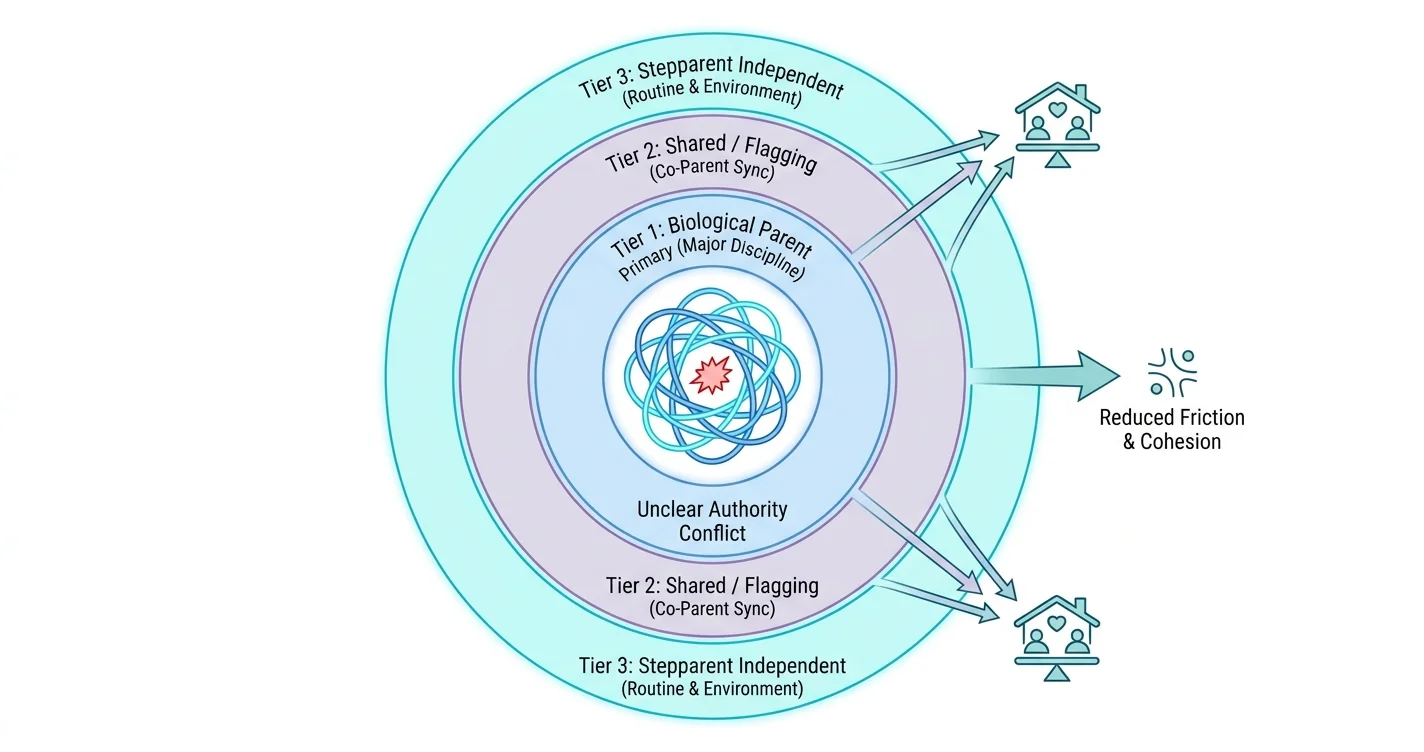
This fixes the single biggest source of blended family conflict: unclear authority. Kids test unclear authority instantly, and partners disagree about discipline when they never actually defined who decides what.
Sit down without the kids present and write down three tiers: things you can enforce alone (bedtime, screen time in your presence), things you flag but the biological parent enforces (major discipline, punishments), and things that are off-limits to you entirely (custody logistics, the other household's rules). Put it in writing, even a shared note.
Expected outcome: disagreements drop because you're no longer negotiating authority mid-conflict, in front of the kids.
Common mistake: trying to have equal authority from day one. Stepparent authority is earned through relationship, not granted through marriage — expect a slower ramp than you want.
2. Pick one boundary, not ten
New stepparents often try to fix everything in the first month — bedtimes, manners, chores, screen time — and get resistance on all fronts at once. Picking one battle means the kid (and your partner) can actually track what's changing and why.
Choose the rule with the clearest safety or respect stake — no phones at dinner, or bedtime on school nights — and hold it consistently for three weeks before adding another. Say the reason once, briefly, and don't re-litigate it daily.
Expected outcome: you'll see one rule take hold in 2-3 weeks instead of ten rules failing in one.
Common mistake: changing the rule when the kid pushes back hard on day two. Consistency for the first three weeks is what makes a boundary real instead of optional.
3. Track what actually triggers your resentment
Stepparent stress isn't random — it clusters around specific moments: being compared to the biological parent, being excluded from a decision, or a kid repeating something the ex said about you. Naming the pattern lets you respond deliberately instead of reactively.
For a week, jot down the moment right after it happens: what was said, what you felt, what you did. Reviewing that list with a structured framework — how to identify your emotional triggers — usually surfaces two or three repeat offenders you didn't notice in the moment.
Expected outcome: you catch the trigger before the blow-up, not during it.
Common mistake: assuming the trigger is the kid's behavior when it's actually the loyalty-bind underneath it — feeling like an outsider in your own house.
4. Build a weekly 15-minute sync with your partner
Blended family conflict escalates fastest when discipline decisions get made in the heat of the moment, in front of everyone. A standing check-in — Sunday night, 15 minutes, no kids — moves those decisions to a calmer window.
Cover three things every time: what worked this week, what didn't, and one adjustment for next week. Keep it short enough that it doesn't turn into its own argument.
Expected outcome: fewer real-time disagreements in front of the kids, because most of the negotiating already happened privately.
Common mistake: skipping the sync during a "good" week. The check-in matters most as prevention, not just repair.
Talk through it before it boils over
Process stepparent stress with Lovon's AI voice companion between sessions or instead of one.
5. Separate co-parenting logistics from emotional venting
Mixing scheduling texts with emotional grievances is a common way blended family communication turns hostile fast. A logistics-only channel with the ex-partner (email, a co-parenting app, or a strict text thread) keeps day-to-day friction from spiking every time a pickup time changes.
Route anything emotional to your partner or a private outlet instead, never through the co-parenting channel.
Expected outcome: logistics threads get shorter and less charged within a few weeks.
Common mistake: responding to an emotionally loaded message on the logistics thread in the moment. Wait an hour; almost nothing about custody scheduling is actually urgent.
6. Give the marriage its own protected time
Stepparent stress that goes unaddressed rarely stays contained — it shows up as distance between partners. Blended families that hold up long-term protect couple time as non-negotiable, even 20 minutes, several times a week, with kid-topics off the table.
Expected outcome: you and your partner start functioning as a team again instead of two solo operators.
Common mistake: letting "we're too busy with the kids" become permanent. If it's not scheduled, it doesn't happen in a blended household.
Troubleshooting
The kids play you and your partner against each other. Close the gap with the weekly sync — if discipline decisions are already aligned before a kid brings up a request, there's no daylight to exploit.
You feel guilty for resenting a child. Resentment toward a role, not a person, is normal in year one of blended family life. Naming it privately — journaling, voice notes, or a session with an AI therapist — defuses the guilt faster than suppressing it.
Your body reacts before your brain does — tight chest, snapping tone. That's a nervous system response, not a character flaw, and it responds to regulation techniques covered in nervous system dysregulation: signs and how to reset.
Your partner defends their child every time you flag a behavior. This is often loyalty guilt, not disagreement with you. Ask for the behavior to be addressed privately between them and the child, rather than you delivering the correction directly.
The ex-partner undermines your role to the kids. You can't control that household. Focus energy on consistency in yours; kids eventually calibrate to whichever environment feels steadier, even if it takes a year or two.
You're running on empty and nobody notices. Chronic caregiving stress without acknowledgment is its own pattern — see compassion fatigue: signs you're running on empty as a caregiver if exhaustion has become the baseline rather than the exception.
Tools and resources
- A shared note or app for the three-tier authority breakdown from Step 1
- A trigger log — paper, notes app, or voice memo — for Step 3
- How to communicate better in a relationship: 9 steps for structuring the weekly partner sync
- Lovon's AI voice companion for a place to talk through resentment or guilt the moment it comes up, not just at a scheduled appointment
- A family therapist for entrenched conflict that doesn't move after 3-6 months of consistent effort — Lovon is a companion for daily processing, not a substitute for licensed clinical care when a situation is stuck
What to do next
Start with Step 1 this week — the authority conversation with your partner — before touching any household rule. Everything else in blended family dynamics moves easier once that's settled, and by 2026 most family therapy guidance treats it as the foundation, not an optional extra.
FAQ
What causes the most stepparent stress in a blended family?
Unclear authority causes the most stepparent stress — not knowing what you can discipline versus what belongs to the biological parent. Loyalty conflicts and co-parenting friction with an ex-partner rank close behind.
How long does it take for a blended family to feel normal?
Most blended families need 6-12 months before daily friction drops noticeably, and some family research points to closer to 2 years for full cohesion. Progress is rarely linear, so a rough patch at month 8 doesn't mean regression.
Should a stepparent discipline the kids directly?
Only for behaviors you've explicitly agreed on with your partner beforehand, ideally written down. Major discipline decisions should stay with the biological parent, especially in the first year, to avoid loyalty-based backlash.
How do you deal with a stepchild who won't accept you?
Consistency without forcing affection works better than trying to win them over quickly. Kids in blended families often need a year or more before warming up, and pushing for a relationship on your timeline usually backfires.
Is it normal to resent your stepchildren sometimes?
Yes, occasional resentment toward the role — not the child as a person — is common in the first year of blended family life. It becomes a bigger problem only when it's constant or when it's suppressed instead of addressed.
How do you stop fighting with your partner about the kids?
A short weekly check-in that separates logistics from emotion prevents most in-the-moment fights about discipline. Deciding rules privately, before a conflict happens, removes the need to negotiate them in front of the kids.
Can an AI therapist help with stepparent stress?
An AI voice companion like Lovon gives you a place to process frustration, guilt, or resentment the moment it happens, which is often when licensed therapy isn't available. It works as daily support alongside, not instead of, clinical care for entrenched family conflict.
When should a blended family see a licensed therapist?
See a licensed family therapist if the same conflict repeats for 3-6 months despite consistent effort, or if a child's behavior changes significantly. That threshold applies in 2026 the same way it always has — daily tools help, but they don't replace clinical intervention for stuck patterns.
One last thing
The stepparents who adjust fastest aren't the ones who try hardest to bond with the kids in month one — they're the ones who protect the marriage first. Get that steady, and the rest of the household tends to follow, even slowly, even through 2026's version of a hard week.
Related guides
How AI Support Helps You Heal
AI emotional support isn't about replacing human connection — it's about filling the gaps. The moments when you need to talk at 2 AM, when you don't want to burden your friends again, or when you simply need someone to listen without judgment.
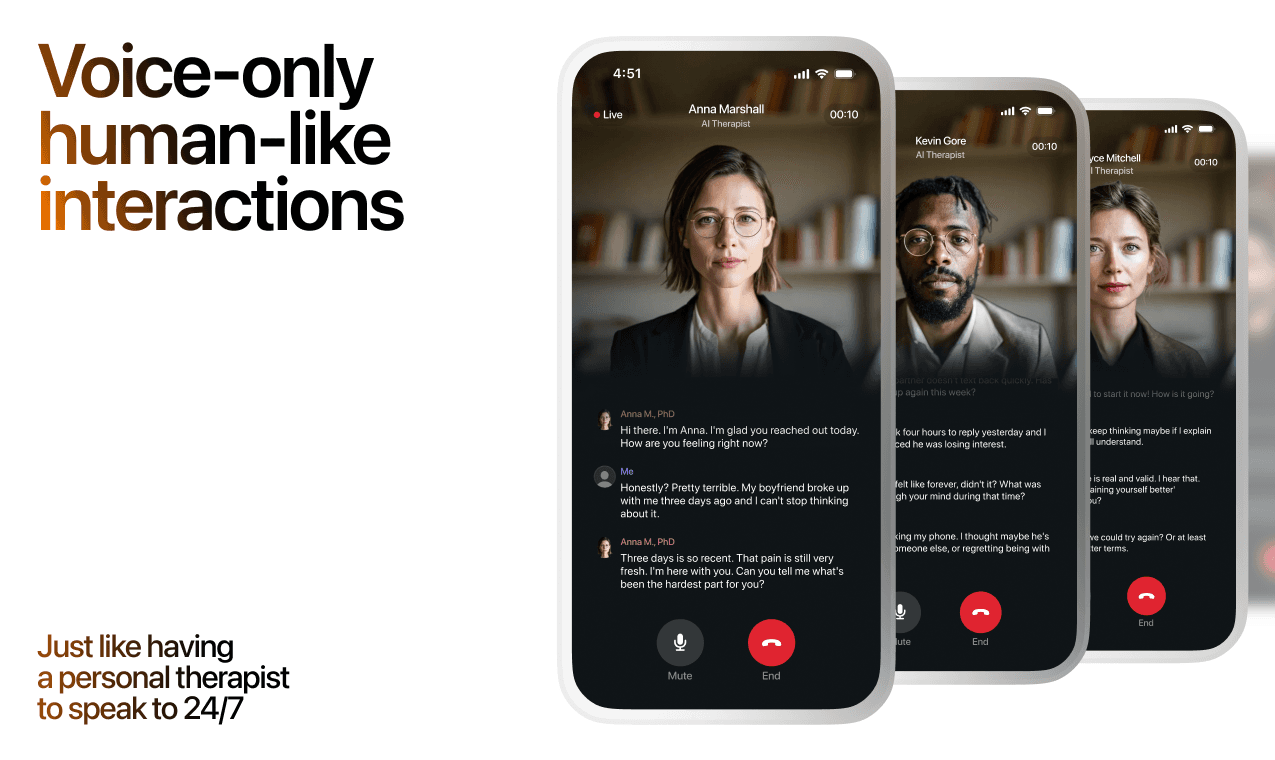
Here's what happens in a typical Lovon session:
You share what's on your mind
There's no script, no intake form, no waiting room. You speak or type whatever you're feeling — in your own words, at your own pace.
Lovon validates and explores
Using frameworks from CBT (Cognitive Behavioral Therapy) and motivational interviewing, Lovon acknowledges your feelings first, then gently helps you explore them. No dismissive "just move on" advice.
You build coping skills together
Lovon doesn't just listen — it actively works with you on evidence-based techniques: thought reframing, urge surfing, behavioral experiments, and more.
What a Session with Lovon Looks Like
When to Seek Professional Help
AI support is a valuable tool, but it's not a replacement for professional care. Please consider reaching out to a licensed therapist if you experience any of the following:
- Persistent thoughts of self-harm or suicide
- Inability to perform daily activities (work, eating, sleeping) for more than 2 weeks
- Turning to alcohol or substances to cope
- Intense anger or desire to harm your ex-partner
- Complete emotional numbness that doesn't improve over time
Crisis Resources (US): If you're in immediate danger, call 988 (Suicide & Crisis Lifeline) or text HOME to 741741 (Crisis Text Line). Available 24/7, free, and confidential.
Outside the US? Find a crisis line in your country
Ready to Start?
Your healing journey can begin right now
A 7-day trial. No judgment. Just a safe space to process what you're going through.
Frequently Asked Questions
Is Lovon a replacement for a real therapist?
Is my conversation with Lovon AI private?
How is Lovon different from ChatGPT for emotional support?
Can I use Lovon if I'm already seeing a therapist?
Can I try Lovon before subscribing?
About the Author

The Lovon Editorial Team
Mental Health & Wellness Content Team
The Lovon Editorial Team develops mental health and wellness content designed to make psychological concepts accessible and actionable. Our goal is to bridge the gap between clinical research and everyday life - helping you understand why your mind works the way it does and what you can do about it....
Related articles
- AI Relationship Coach for Blended Families: 2026 Verdict
AI relationship coach for blended families reviewed for 2026: buy for stepparent stress and co-parenting conflict, skip…
- AI Therapy for Adult Children of Alcoholics (2026)
AI therapy for adult children of alcoholics in 2026: what to look for, what to avoid, and where Lovon's voice check-ins…
- AI Support App for Grandparents Raising Grandchildren 2026
Grandparents raising grandchildren face caregiver stress no support group fully covers. See why Lovon's AI voice…
- Enmeshment Trauma: How to Untangle It in 2026
Enmeshment trauma explained: signs, causes, and 6 steps to rebuild your sense of self in adult relationships. Practical…
See also
Quizzes
- Boundaries Test: Free 12-Question Self-Check
See where your boundaries slip, in 3 minutes.
- Are They a Red Flag? 10 Questions to Check Your Partner
Check your partner in 3 minutes.
Free tools
- What to Say Back to a Hostile Co-Parent
A chat, not a form. Paste the message your ex sent about the kids, say what actually has to be decided, and you get a…
- AI Relationship Coach
Get free relationship advice and family counselling guidance with our AI Relationship Coach.
From the wiki
- Why do I have no friends?
Usually nothing is wrong with you. Adult friendship runs on proximity and repetition, and most people lose both at once…
Disclaimer: This article is for informational purposes only and does not constitute medical advice, diagnosis, or treatment. Always seek the advice of your physician or other qualified health provider with any questions you may have regarding a medical condition. If you are in crisis or think you may have an emergency, call 988 (Suicide & Crisis Lifeline) or go to the nearest emergency room. Outside the US? Find a crisis line in your country.